Project 1 Mechanical design of battery pack
Battery pack capacity: 18 kWh
Cell: ANR26650M1-B
Prepare a detailed battery pack drawing along with its enclosure. State your assumptions.
ABSTRACT:- In this project, we are going to calculate the all parameters which are required for the build EV battery pack. We are going to use the Cell: ANR26650M1-B for our battery pack. In parameters, we will consider all electrical aspects like temperature, Depth of discharge, Operation current, Energy density, Work cycles, Battery capacity, State of Charge (SOC), State of Health (SOH), Ampere-hour (Ah) Capacity. We also calculate all geometrical considerations like size, weight, volume, area, etc. In the end, we consider some enclosures model for our battery pack.
Lithium Werks’ 26650 cells are best for Power.Safety.Life.TM applications. They deliver very high power due to their use of patented Nanophosphate® battery technology. Based on lithium iron phosphate chemistry (LiFePO4), the cells are inherently safe over a wide range of temperatures and conditions. Whether the application requires outstanding cycle life or stable float reliability, the Lithium Werks’ 26650 cells are suitable for a wide variety of power, pulse, or stand-by applications.
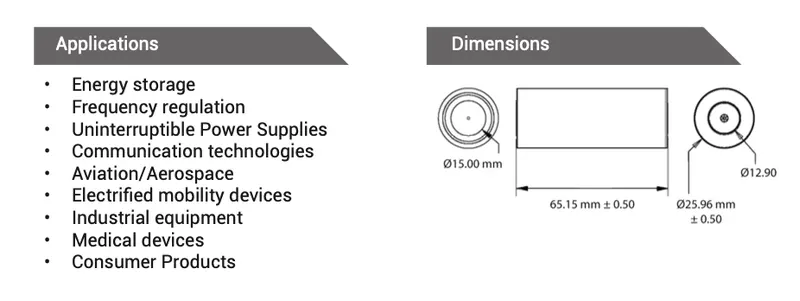

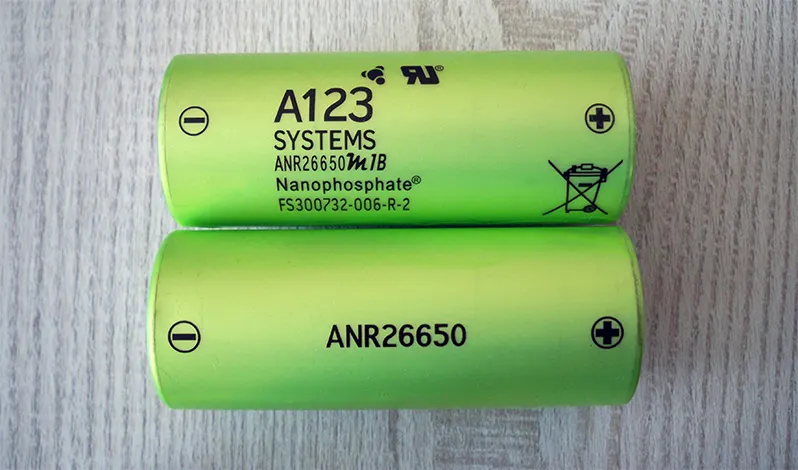

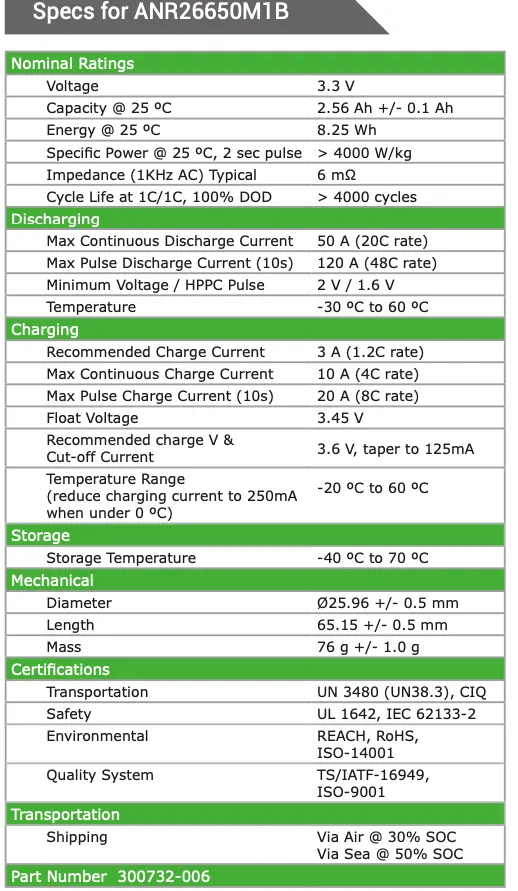
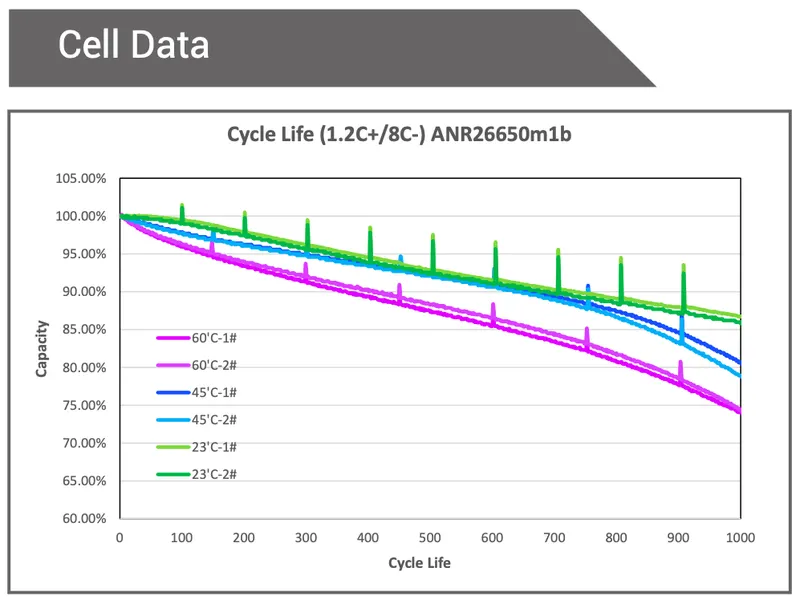
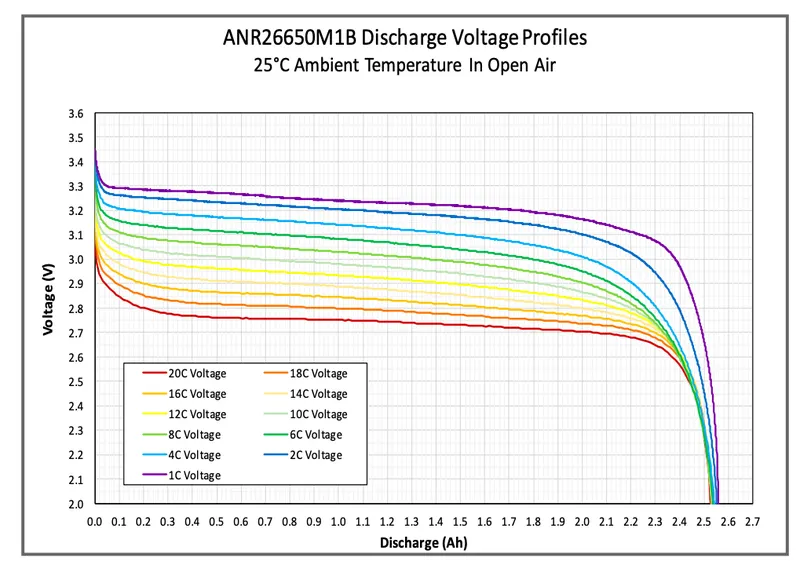
The above data is the cell manufacture data.now we start the mechanical design part.
operating temparatures are given by the above data while charging and discharging.
Discharging Temprature :- -30 oC to 60 oC
Charging Temprature :- -20 oC to 60 oC
Storage Temperature:- -40 oC to 70 oC
Battery pack calculation
Based on the cell parameters provided by the manufacturers, we can calculate the energy content, volume, gravimetric density and volumetric density for each cell.
| Manufacturer | A123-Systems |
| Type | cylindrical |
| Model | ANR26650m1-B |
| Source | [5] |
| Length [m] | 0.065 |
| Diameter [m] | 0.026 |
| Height [m] | 0 |
| Width [m] | 0 |
| Thickness [m] | 0 |
| Mass [kg] | 0.076 |
| Capacity [Ah] | 2.5 |
| Voltage [V] | 3.3 |
| C-rate (cont.) | 10 |
| C-rate (peak) | 24 |
1. Volume of each cell, Vc [m3]
Vc =π⋅(Dc)24⋅Lc">Vc =π⋅(Dc)24⋅LcVc =π⋅(Dc)24⋅Lc
Lc - battery cell length [m]
Dc - battery cell diameter [m]
Vc = (π * 0.0262 /4)* 0.065 = 0.034510 m3
2. Battery cell energy, Ebc [Wh]
Ec=Cc⋅Uc">Ec=Cc⋅UcEc=Cc⋅Uc
Cc - battery cell capacity [Ah]
Uc - battery cell voltage [v]
Ec = 2.5*3.3 = 8.25 Wh
3. Battery cell energy density
Volumetric energy density, uV [Wh/m3]
uV=EcVc">uV=EcVcuV=EcVc
uV = 8.25/0.034510 = 108.55 Wh/m3
Gravimetric energy density, uG [Wh/kg]
uG=Ecmc">uG=EcmcuG=Ecmc
mc - battery cell mass [kg]
uG = 8.25/0.076 = 239.06 Wh/kg
- With the above cell parameters and the core requirements for the battery (nominal voltage, average energy consumption and vehicle range), we calculate the main parameters of the high voltage battery.
High voltage battery
1. The Battery pack total energy Eb [Wh]
- The required battery pack total energy Eb [Wh] is calculated as the product between the average energy consumption Eavg [Wh/km] and vehicle range Dv [km].
- Here we’ll design the high voltage battery pack of 18Kwh for a vehicle range of 250 km.
Therefore, Eb = 18Kwh Dv = 200km
Eavg = Eb / Dv = 18000/200 = 90Wh/km
2. The Battery pack Voltage, Ub [V]
- The battery pack voltage is considered to be 300V high voltage.
Ub = 300V
we are going to consider that the battery pack is made up only from several strings connected in parallel.
3. The number of battery cells connected in series Ns
- Ns in a string is calculated by dividing the nominal battery pack voltage Ub [V] to the voltage of each battery cell Uc [V]. The number of strings must be an integer.
Ns=UbUc">Ns=UbUcNs=UbUc
Ns = 300/3.3 = 90.90 = 91 S
4. The energy content of a string Es [Wh]
- Eb is equal with the product between the number of battery cells connected in series Ns [-] and the energy of a battery cell Ec [Wh].
Es=Ns⋅Ec">Es=Ns⋅EcEs=Ns⋅Ec
Es = 91 * 8.25 = 750.75 Wh
5. The number of battery cells connected in Parallel, Np
- The total number of strings of the battery pack Np [-] is calculated by dividing the battery pack total energy Eb [Wh] to the energy content of a string Es [Wh]. The number of strings must be an integer. Therefore, the result of the calculation is rounded to the higher integer.
Np=EbEs">Np=EbEsNp=EbEs
NP = 18000/750.75 = 23.9 = 24 P
We can now recalculate the battery pack total energy Eb [Wh] as the product between number of strings Np [-] and the energy content of each string Es [Wh].
Eb = 24*750.75 = 18.02 KWh
6. The battery pack capacity Cb [Ah]
-
Cb is calculated as the product between the number of strings Np [-] and the capacity of the battery cell Cc [Ah].
Cb=Ns⋅Cc">Cb=Ns⋅CcCb=Ns⋅Cc
Cb = 24*2.5 = 60Ah
7. The total number of cells of the battery pack Nb
- The total number of cells of the battery pack is calculated as the product between the number of strings Np [-] and the number of cells in a string Ns [-].
Nb=Np⋅Ns">Nb=Np⋅NsNb=Np⋅Ns
Nb = 91*24 = 2184 no of cells
The size and mass of the high voltage battery are very important parameter to consider when designing a battery electric vehicle (BEV). In this example we are going to calculate the volume of the battery pack considering only the battery cells. In reality there are other factors to consider, like: electronic circuits, cooling circuit, battery casing, wiring, etc.
8. The battery pack mass (cells only) mb [kg]
- The battery pack mass (cells only) is the product between the total number of cells Nb [-] and the mass of each battery cell mc [kg].
mb=Nb⋅mc">mb=Nb⋅mcmb=Nb⋅mc
mb = 2184 * 0.076 = 165.98 kg
9. The volume of the battery pack (cells only) Vb [m3]
- The volume of the battery pack (cells only) is the product between the total number of cells Nb [-] and the mass of each battery cell Vc [m3].
- This volume is only used to estimate the final volume of the battery pack, since it does not take into account the auxiliary components/systems of the battery.
Vb=Nb⋅Vc">Vb=Nb⋅VcVb=Nb⋅Vc
Vb = 2184 * 0.034510 = 75.37 m3
- The volume can be also calculated function of number of strings and number of cells in a string. This calculation method is more appropriate for cylindrical cell, since the volume occupied by a cylindrical cell must take into account the air gap between cells.
10. The string peak current Ispc [A]
- The string peak current is the product between the peak C-rate of the battery cell C-ratecp [h-1] and the battery cell capacity Cb [Ah].
Isp=Cratecp⋅Cb">Isp=Cratecp⋅CbIsp=Cratecp⋅Cb
Isp = 24*2.5 = 60A
11. The battery pack peak current Ibp [A]
- The battery pack peak current is the product between the string peak current Ispc [A] and the number of strings of the battery pack Np [-].
Ibp=Isp⋅Np">Ibp=Isp⋅NpIbp=Isp⋅Np
Ibp = 60 * 24 = 1440 A
12. The battery pack peak power Pbp [W]
- The battery pack peak power Pbp [W] is the product between battery pack peak current Ibp [A] and the battery pack voltage Ub [V]
Pbp=Ibp⋅Ub">Pbp=Ibp⋅UbPbp=Ibp⋅Ub
Pbp = 1400 * 300 = 432 KW
13. The string continuous current Isc [A]
- The string continuous current is the product between the continuous C-rate of the battery cell C-ratebc [h-1] and the battery cell capacity Cb [Ah].
Isc=Cratebc⋅Cb">Isc=Cratebc⋅CbIsc=Cratebc⋅Cb
Isc = 10 * 2.5 = 25 A
14. The battery pack continuous current Ibc [A]
- The battery pack continuous current is the product between the string continuous current Isc [A] and the number of strings of the battery pack Np.
Ibp=Isc⋅Np">Ibp=Isc⋅NpIbp=Isc⋅Np
Ibc = 25 * 24 = 600A
15. The battery pack continuous power Pbc [W]
- The battery pack continuous power is the product between battery pack continuous current Ibc [A] and the battery pack voltage Ub [V].
Pbc=Ibc⋅Ub">Pbc=Ibc⋅UbPbc=Ibc⋅Ub
Pbc = 600 * 300 = 180KW

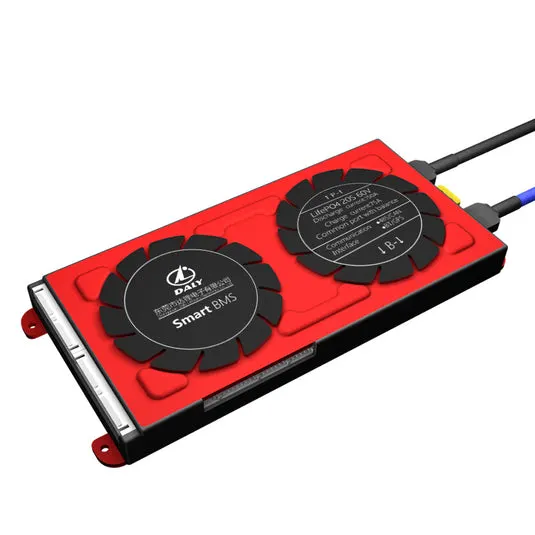
BMS (Battery Management System)
- A Battery Management System (BMS) is said to be the brain of a battery pack. The BMS is a set of electronics that monitors and manages all of the battery’s performance. Most importantly, it keeps the battery from operating outside of its safety margins
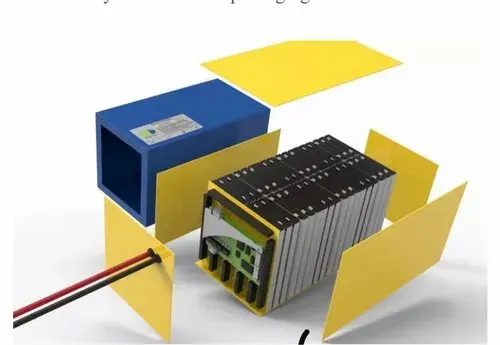
Battery pack Enclosure
- Lithium-ion Battery pack which is comprised of assembly of battery modules is the main source of power transmission for electric vehicles. During the actual operation of electric vehicle, the battery packs and its enclosure is subjected to harsh environmental conditions such as the external vibrations and shocks due to varying road slopes. This will result in stresses and deformations of different degrees.
- The vehicle safety heavily depends on the safety of battery pack which in turn is dependent on its mechanical features, such as the ability to resist deformation and vibration shocks. In addition, lighter weight vehicle is preferred because it can increase the range of vehicle and the life cycle of a battery pack.
- Enclosure must be design in a manner with lot of structural analysis and lot of optimisation processes.
- A wall thickness of 3 mm, which requires a gap of 1.5 mm, is recommended as the battery compartment is flush with the wall surface. Adjust the required gap or screw length for larger wall thickness.
BTMS (Battery Thermal Management System)
- For battery thermal modelling, a reliable thermal model of the battery is required. Starting from the heat generated from the battery, the thermal management system can be modelled by applying the correct boundary conditions. Battery thermal models are realized by considering the electrical/electrochemical characteristics and the thermal behaviour of the battery. Heat generation inside the batteries is governed by complex electrochemical reactions depending on temperature and state of the battery. Coupled, uncoupled or partially coupled models of the battery can be realized.
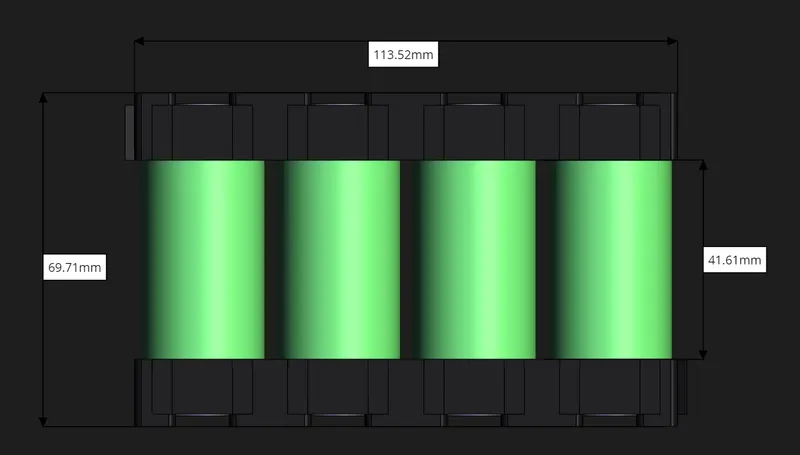
- There enough gap between the cells in our design to implement thermal strips or fins.
the battery pack is used for genarelly cars and trucks .
in thsoe are prefering for high voltage when we connected batteryes in series the voltage is increased. when we connected cells in parallel the capacity is incressed(AH ).
300 v * 60 Ah = 18.2 kwh