Project 1 Mechanical design of battery pack
Battery pack capacity: 18 kWh
Cell: ANR26650M1-B
Prepare a detailed battery pack drawing along with its enclosure. State your assumptions.
Solution:-
Cell used:-
ANR26650M1-B
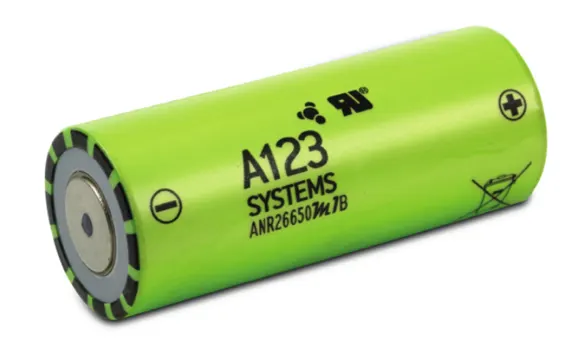
Battery Specifications:-
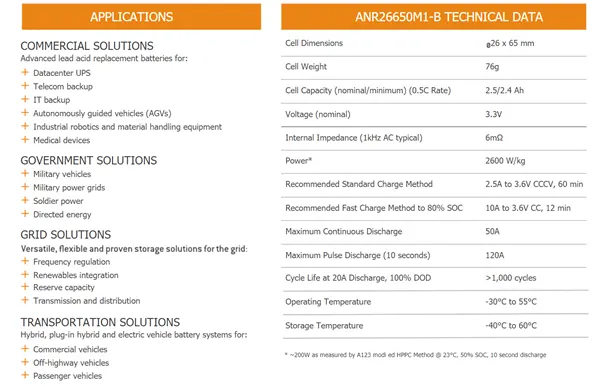
Assumption:- Assuming the Voltage required by the vehicle to be 330 V
Calculations:-
Pack Capacity in Ah = Capacity in Wh / Pack Voltage
Capacity in kWh = 18
Capacity in Wh = 18000
Pack Voltage (V) = 330
Pack Capacity in Ah = 54.54 ~ 55
Number of Cells in Series = Pack Voltage / Cell Voltage
Pack Voltage = 330 V
Cell Voltage = 3.3 V
Number of Cells in Series = 100
Number of Cells in Parallel = Pack Capacity / Cell Capacity
Pack capacity = 55 Ah
Cell Capacity = 2.5 Ah
Number of Cells in Parallel = 22
Total Number of Cells Required = 2200
Calculating Size of Battery Pack:-
Battery Dimensions
Diameter = 26 mm
Height = 65 mm
Cell Holder:-
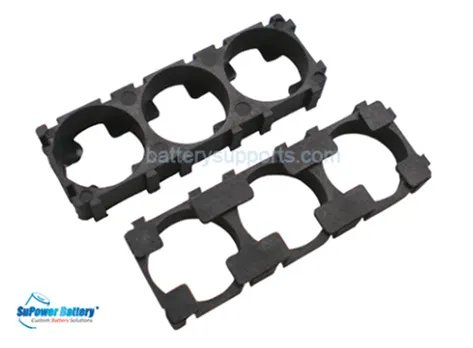
Assuming the gap between the cells due to cell holder be 3 mm
Case 1
Considering 100 S 22 P
Length of the Pack = (No. of Cells in Series x Cell diameter) + (Gap between cells x { No. of Cells in Series + 1})
[Note:- In the above example, for 3 cell holder the space occupied by the 3mm gap between them is 3*4 = 12mm
So for 3 cells we have to multiply the gap by (no. of cells + 1)]
Length of the Pack = (100*26) + (3*101) = 2903 mm
Similarly,
Breadth of the Pack = (No. of Cells in parallel x Cell diameter) + (Gap between cells x { No. of Cells in Parallel + 1})
Breadth of the Pack = (22*26) + (3*23) = 641 mm
Therefore,
Pack Dimension = 2903 x 641 mm
Case 2
Considering 100 S 22 P
But this time in the length of the Pack there will be 50 cells in series which will again be connected to 50 cells in series making the breadth of the pack Double than the previous Case
Length of the Pack = (No. of Cells in Series x Cell diameter) + (Gap between cells x { No. of Cells in Series + 1})
Length of the Pack = (50*26) + (3*51) = 1453 mm
Similarly,
Breadth of the Pack = (No. of Cells in parallel x Cell diameter) + (Gap between cells x { No. of Cells in Parallel + 1})
Breadth of the Pack = (44*26) + (3*45) = 1279 mm
Therefore,
Pack Dimension = 1453 x 1279 mm
Comparing Both the cases we conclude that Case 2 gives a more compact design than Case 1
Enclosure
Here the material used for enclosure will be Aluminium
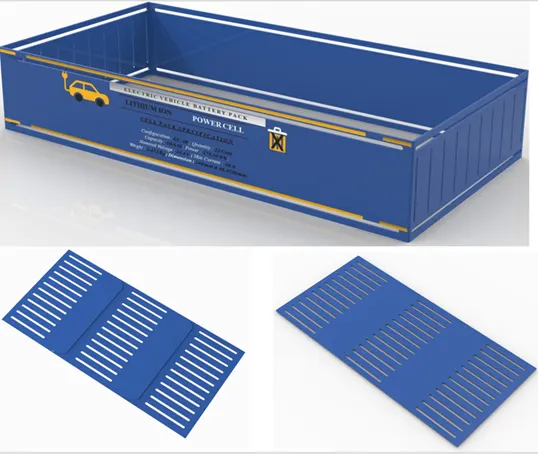
Thickness of Side Frame = 1 mm
Thickness of Upper Tray = 0.8 mm
Thickness of Bottom Tray = 1 mm
Height of Side Frame = Height of battery + 2 mm for Ventilation = 67 mm
Overall Dimension of the Pack = 1455 x 1281 x 67 mm
Battery Connector
We will be using Nickel Strips for connection between cells
Nickel strip is generally used in battery building. Its due to its efficiency of usage in spot welding and soldering as well its high corrosion resistance over time. It has good properties and excellent resistance to many corrosive environments. The pure nickel will never get rust after it applied to battery packs. It won’t affect the current transfer between batteries.

Process For Connecting Nickel Strips to the Terminals of the Battery
Welding makes an electrical connection in a small fraction of a second, without dissipating much heat in the battery terminal at all. The end terminals of the cell stay relatively cool, and the seals of the cell (which are some kind of rubber or plastic) remain in good condition.
Soldering requires heating up the whole area to be soldered to about 250–300 degrees C, which takes a few seconds even using a soldering gun of 140 W output. This heats up the whole end of the cell by conduction. On one end of the cell, (whichever end the sealing gasket is located), the gasket gets hotter than it has been designed for, and this can damage the seal. Leakage is likely in the future.
Using Spot Welding to connect the Nickel Strips to the terminals of the Battery