Project 1 Mechanical design of battery pack
AIM:
ANR26650M1B Lithium Iron Phosphate High Current Type Cylindrical Battery (Recommended maximum discharge current 70A) using patented Nanophosphate technology The ANR26650M1-B is the next generation of A123 Systems' pioneering 26650 cylindrical cell, now with greater power and energy density and lower impedance.
The cathode material is one of the most important and defining components of lithium ion batteries. It is also a major determinant of the final performance and cost of a rechargeable battery.
ANR26650M1-B Cell (Data Sheet)
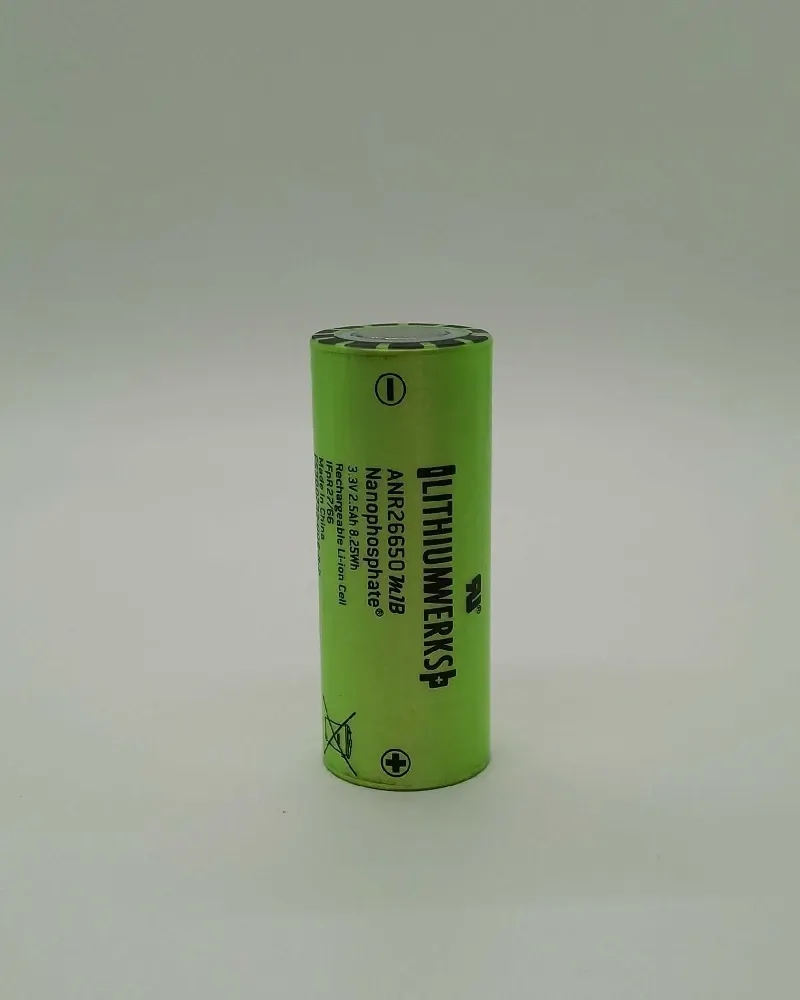
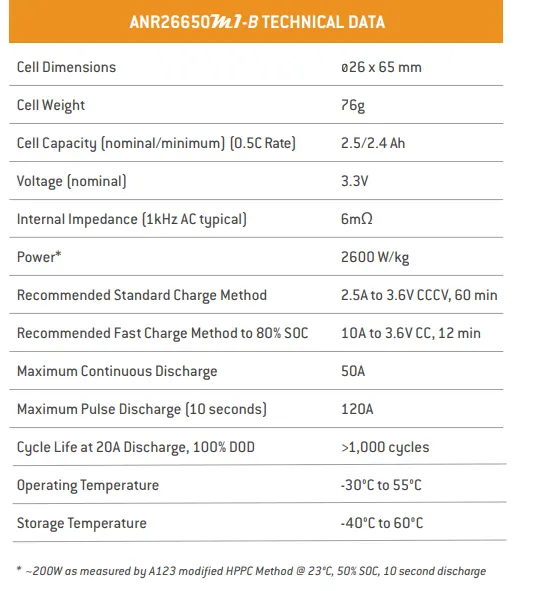
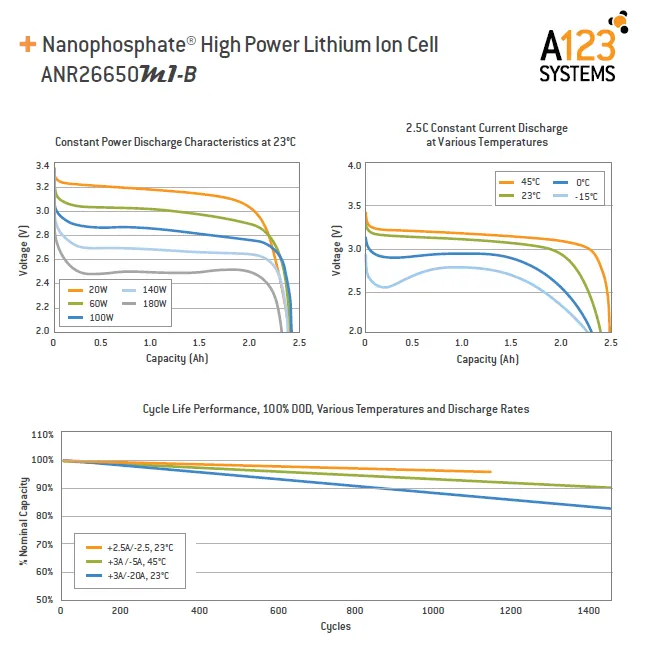
- High-performance Nanophosphate lithium iron phosphate (LiFePO4) battery technology delivers high power and energy density combined with excellent safety performance and extensive life cycling in a lighter weight, more compact package.
- Cells have low-capacity loss and impedance growth over time as well as high usable energy over a wide state of charge (SOC) range, allowing systems to meet end-of-life power and energy requirements with minimal pack oversizing.
- Lithium-ion batteries power the lives of millions of people each day. From laptops and cell phones to hybrids and electric cars, this technology is growing in popularity due to its light weight, high energy density, and ability to recharge.
CHARGE/DISCHARGE
- While the battery is discharging and providing an electric current, the anode releases lithium ions to the cathode, generating a flow of electrons from one side to the other. When plugging in the device, the opposite happens: Lithium ions are released by the cathode and received by the anode.
Key Features
- Long cycle life: more than 2000 times (charging and discharging at 1C and 100% DOD, remaining capacity more than 80%)
- Safety: The cell has a relatively stable charging and discharging platform due to the use of LiFePO4 as its cathode material, the structure of the cell barely change during charging and discharging, it won’t burn or explode even under special conditions such as short circuit, overcharging, squeezing.
- Excellent high temperature performance: the operating temperature could reach up to 75℃, the performance at high temperature is much better than other type of lithium cell.
- Eco-friendly: The LiFePO4 cell doesn't contain any heavy metals or rare metals, it is non-toxic and pollution free.
Applications
- Solar Energy Storage System , UPS backup power supply, Telecom base station, Solar street light, Emergency light, Electric vehicle, Electric motorcycle, Yacht, RV, Golf cart, E-bike, Power tool, Medical equipment and other Electronic Products.
Fatigue design of battery packs
- Battery packs incorporate a large number of mechanical, electrical and electrochemical component systems. They comprise thousands of discrete cells that are connected in series and parallel to electrical busbars in order to supply the required energy capacity. Cells are often welded together to complete the electrical path.
- These welds are highly susceptible to vibration and suffer from vibration-induced fatigue damage. Furthermore, a combination of lightweight support structures with relatively heavy electrochemical components can result in mechanical resonance in the battery structure with a high risk of fatigue cracking.
ANR26650M1-B Specifications
Nominal Ratings
Voltage: 3.3 Volts
Capacity: 2.5 Ah
Energy: 8.25 Wh
Specific Power: 2600 W/kg
Impedance (1KHz AC Typical) 6 mΩ
Cycle Life at 1C/1C, 100% DOD: > 4000 cycles
Cell Type: 26650 Lithium Ion Power Cylindrical Cell
Discharging
Max Continuous Discharage: 50 A
Max Pulse Discharge Current >50% SOC (10s): 120 A
Minimum Voltage: 2 Volts
Temperature: -30ºC to 55ºC
Charging
Recommended Standard Charge: 2.5 Amps
Max Charge Rate: 10 Amps
Max Pulse Charge Current <50% SOC (10s): 25 A
Float Voltage: 3.45 Volts
Recommended charge V & Cut-off Current: 3.6 Volts, taper to 125mA
Temperature
(reduce charging current to 250mA when under 0ºC): 0ºC to 55ºC
Mechanical
Diameter: Ø25.96 +/- 0.5 mm (1.0")
Length: 65.15 +/- 0.5 mm (2.6")
Mass: 76 g
Certifications
Transportation: UN 3480 (UN38.3), CIQ
Safety: UL 1642, IEC 62133
The LithiumWerks ANR26650M1-B is the next generation of A123 Systems’ pioneering 26650 cylindrical cell, now with greater power and energy density and lower impedance. This versatile lithium ion cell is suitable for a wide variety of applications and system designs. Proven performance in the toughest conditions, combining durability, reliability, and safety, the ANR26650 cell offers an excellent combination of price-performance.
Battery pack calculation
Based on the cell parameters provided by the manufacturers, we can calculate the energy content, volume, gravimetric density and volumetric density for each cell.
| Manufacturer | A123-Systems |
| Type | cylindrical |
| Model | ANR26650m1-B |
| Source | [5] |
| Length [m] | 0.065 |
| Diameter [m] | 0.026 |
| Height [m] | 0 |
| Width [m] | 0 |
| Thickness [m] | 0 |
| Mass [kg] | 0.076 |
| Capacity [Ah] | 2.5 |
| Voltage [V] | 3.3 |
| C-rate (cont.) | 10 |
| C-rate (peak) | 24 |
1. Volume of each cell, Vc [m3]
Vc =π⋅(Dc)24⋅Lc">Vc =π⋅(Dc)24⋅LcVc =π⋅(Dc)24⋅Lc
Lc - battery cell length [m]
Dc - battery cell diameter [m]
Vc = (π * 0.0262 /4)* 0.065 = 0.034510 m3
2. Battery cell energy, Ebc [Wh]
Ec=Cc⋅Uc">Ec=Cc⋅UcEc=Cc⋅Uc
Cc - battery cell capacity [Ah]
Uc - battery cell voltage [v]
Ec = 2.5*3.3 = 8.25 Wh
3. Battery cell energy density
Volumetric energy density, uV [Wh/m3]
uV=EcVc">uV=EcVcuV=EcVc
uV = 8.25/0.034510 = 108.55 Wh/m3
Gravimetric energy density, uG [Wh/kg]
uG=Ecmc">uG=EcmcuG=Ecmc
mc - battery cell mass [kg]
uG = 8.25/0.076 = 239.06 Wh/kg
- With the above cell parameters and the core requirements for the battery (nominal voltage, average energy consumption and vehicle range), we calculate the main parameters of the high voltage battery.
High voltage battery
1. The Battery pack total energy Eb [Wh]
- The required battery pack total energy Eb [Wh] is calculated as the product between the average energy consumption Eavg [Wh/km] and vehicle range Dv [km].
- Here we’ll design the high voltage battery pack of 18Kwh for a vehicle range of 250 km.
Therefore, Eb = 18Kwh Dv = 200km
Eavg = Eb / Dv = 18000/200 = 90Wh/km
2. The Battery pack Voltage, Ub [V]
- The battery pack voltage is considered to be 300V high voltage.
Ub = 300V
we are going to consider that the battery pack is made up only from several strings connected in parallel.
3. The number of battery cells connected in series Ns
- Ns in a string is calculated by dividing the nominal battery pack voltage Ub [V] to the voltage of each battery cell Uc [V]. The number of strings must be an integer.
Ns=UbUc">Ns=UbUcNs=UbUc
Ns = 300/3.3 = 90.90 = 91 S
4. The energy content of a string Es [Wh]
- Eb is equal with the product between the number of battery cells connected in series Ns [-] and the energy of a battery cell Ec [Wh].
Es=Ns⋅Ec">Es=Ns⋅EcEs=Ns⋅Ec
Es = 91 * 8.25 = 750.75 Wh
5. The number of battery cells connected in Parallel, Np
- The total number of strings of the battery pack Np [-] is calculated by dividing the battery pack total energy Eb [Wh] to the energy content of a string Es [Wh]. The number of strings must be an integer. Therefore, the result of the calculation is rounded to the higher integer.
Np=EbEs">Np=EbEsNp=EbEs
NP = 18000/750.75 = 23.9 = 24 P
We can now recalculate the battery pack total energy Eb [Wh] as the product between number of strings Np [-] and the energy content of each string Es [Wh].
Eb = 24*750.75 = 18.02 KWh
6. The battery pack capacity Cb [Ah]
-
Cb is calculated as the product between the number of strings Np [-] and the capacity of the battery cell Cc [Ah].
Cb=Ns⋅Cc">Cb=Ns⋅CcCb=Ns⋅Cc
Cb = 24*2.5 = 60Ah
7. The total number of cells of the battery pack Nb
- The total number of cells of the battery pack is calculated as the product between the number of strings Np [-] and the number of cells in a string Ns [-].
Nb=Np⋅Ns">Nb=Np⋅NsNb=Np⋅Ns
Nb = 91*24 = 2184 no of cells
The size and mass of the high voltage battery are very important parameter to consider when designing a battery electric vehicle (BEV). In this example we are going to calculate the volume of the battery pack considering only the battery cells. In reality there are other factors to consider, like: electronic circuits, cooling circuit, battery casing, wiring, etc.
8. The battery pack mass (cells only) mb [kg]
- The battery pack mass (cells only) is the product between the total number of cells Nb [-] and the mass of each battery cell mc [kg].
mb=Nb⋅mc">mb=Nb⋅mcmb=Nb⋅mc
mb = 2184 * 0.076 = 165.98 kg
9. The volume of the battery pack (cells only) Vb [m3]
- The volume of the battery pack (cells only) is the product between the total number of cells Nb [-] and the mass of each battery cell Vc [m3].
- This volume is only used to estimate the final volume of the battery pack, since it does not take into account the auxiliary components/systems of the battery.
Vb=Nb⋅Vc">Vb=Nb⋅VcVb=Nb⋅Vc
Vb = 2184 * 0.034510 = 75.37 m3
- The volume can be also calculated function of number of strings and number of cells in a string. This calculation method is more appropriate for cylindrical cell, since the volume occupied by a cylindrical cell must take into account the air gap between cells.
10. The string peak current Ispc [A]
- The string peak current is the product between the peak C-rate of the battery cell C-ratecp [h-1] and the battery cell capacity Cb [Ah].
Isp=Cratecp⋅Cb">Isp=Cratecp⋅CbIsp=Cratecp⋅Cb
Isp = 24*2.5 = 60A
11. The battery pack peak current Ibp [A]
- The battery pack peak current is the product between the string peak current Ispc [A] and the number of strings of the battery pack Np [-].
Ibp=Isp⋅Np">Ibp=Isp⋅NpIbp=Isp⋅Np
Ibp = 60 * 24 = 1440 A
12. The battery pack peak power Pbp [W]
- The battery pack peak power Pbp [W] is the product between battery pack peak current Ibp [A] and the battery pack voltage Ub [V]
Pbp=Ibp⋅Ub">Pbp=Ibp⋅UbPbp=Ibp⋅Ub
Pbp = 1400 * 300 = 432 KW
13. The string continuous current Isc [A]
- The string continuous current is the product between the continuous C-rate of the battery cell C-ratebc [h-1] and the battery cell capacity Cb [Ah].
Isc=Cratebc⋅Cb">Isc=Cratebc⋅CbIsc=Cratebc⋅Cb
Isc = 10 * 2.5 = 25 A
14. The battery pack continuous current Ibc [A]
- The battery pack continuous current is the product between the string continuous current Isc [A] and the number of strings of the battery pack Np.
Ibp=Isc⋅Np">Ibp=Isc⋅NpIbp=Isc⋅Np
Ibc = 25 * 24 = 600A
15. The battery pack continuous power Pbc [W]
- The battery pack continuous power is the product between battery pack continuous current Ibc [A] and the battery pack voltage Ub [V].
Pbc=Ibc⋅Ub">Pbc=Ibc⋅UbPbc=Ibc⋅Ub
Pbc = 600 * 300 = 180KW
The mass and volume are calculated only at cell level, taking into account the cell dimensions and mass. The battery pack which will be in the vehicle will have additional components (wires, electronic components, soldering, case, etc.), which will increase both the final volume and mass.
The results
| Manufacturer | A123-Systems |
| No of cells in string [-] | 91 |
| String energy [Wh] | 750.75 |
| No of strings [-] | 24 |
| BP energy [kWh] | 180.2 |
| BP capacity [Ah] | 60 |
| No total cells [-] | 2184 |
| BP mass [kg]* | 165.98 |
| BP volume [l]* | 75.37 |
| BP peak current [A] | 1440 |
| BP peak power [kW] | 432 |
| BP continuous current [A] | 900 |
| BP continuous power [kW] | 180 |
BATTERY MODULE
- The Battery Requirements is 18.02KWh battery pack, the required configuration of the pack is 91S24P, 91 series, and 2184 cells connected in parallel.
- To build such a large grid, we need to slip the battery packs into the battery module, which reduce the complexity of monitoring and optimizing battery management and minimizing battery damage.
So, we are Splitting the 91S24P 2184cells into no of 7S4P Cell Modules
No of Cells in Battery Pack, 91 * 24 = 2184 cells
No of Cells in a Battery Module, 7 * 4 = 28 cells
No of Modules = 2184/28 = 78 no of Modules
Modules Configuration = 13 x 6 = 78
Cell Configuration in a module = 7S4P
no of Modules in the Battery Pack = 78
Module Configuration in the Battery pack = 13 x 6
Mechanical Design of battery pack:
The high voltage battery it is one of the most important component of a battery electric vehicle (BEV). The battery parameters have a significant influence on other components and attributes of the vehicle, like:
- maximum traction motor torque
- maximum regeneration brake torque
- vehicle range
- vehicle total weight
- vehicle price
Pretty much all major aspects of a pure electric vehicle (EV) depend on the parameters of the high voltage battery.
For our electric vehicle battery design we are going to start from 4 core input parameters:
- chemistry
- voltage
- average energy consumption of the vehicle on a driving cycle
- vehicle range
A battery consists of one or more electrochemical cells (battery cells) which are converting chemical energy into electrical energy (during discharging) and electrical energy into chemical energy (during charging). The type of elements contained within a battery and the chemical reactions during discharging-charging events define the chemistry of a battery.
A battery cell consists of five major components: electrodes – anode and cathode, separators, terminals, electrolyte and a case or enclosure. For automotive applications there are different types of cells used:
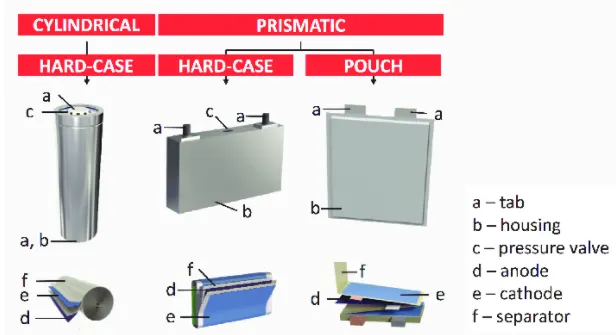
Individual battery cells are grouped together into a single mechanical and electrical unit called a battery module. The modules are electrically connected to form a battery pack.
EV design - Battery calculation:
Assumptions:
Battery energy = 18 kwh
Voltage (to run the vehicle) = 400V
(i) Energy = 18 kWh
(ii) Number of cells (N) = energy / (nominal voltage*capacity)
N = 18000 / (3.3*2.5)
N = 2182
We need a minimum of 2182 cells to get 18 kWh energy, now based on that, we need to decide configuration – series and parallel.
In series configuration capacity remains the same and voltage will be the sum of individual cell voltage.
In a parallel configuration, the voltage remains the same and capacity accumulates.
And we assumed 400 Volts are need to run the vehicle.
The nominal voltage of one cell is 3.3 V
Number of series cells required to produce 400 V (Ns) = voltage required / nominal voltage of one cell
Ns = 400 / 3.3
Ns = 121.21 = 122
122 cells are connected in series will generate 400 voltage and the capacity of the whole module will be 2.5 Ah
Now we need to find the number of cells which will be connected in a parallel configuration
Np (cell in parallel) = total cell / Ns
Np = 2182 / 122
Np = 17.8 = 18
Hence we take 18 cells for each parallel row, although it is exceeding the required capacity, that is negligible.
Cell architecture = 122 Series and 18 Parallel = 122S18P
(iii) Battery capacity:
We know parallel configured cell multiplies individual cell capacity so,
Capacity = parallel cell row*individual cell capacity
Capacity = 18 * 2.5
Capacity = 45 Ah
(iv) Current supplied by the battery
We have already calculated battery capacity which is 45 Ah means it is going to supply 45 A current per hour. which can be considered as C-rate.
(v) Range:
Let’s powertrain energy consumption = 100 Wh/km at 70% powertrain efficiency
Range = Capacity / energy consumed per kilometre
Range = 18000 / 100
Range = 180 km
So,our vehicle will be able to cover around 180 km with current parameters.
(vi) Internal Resistance of Battery:
The entire resistance encountered by a current as if it flows through a battery from the negative terminal to the positive terminal is known as internal resistance of battery.
(vii) Battery Dimensions:
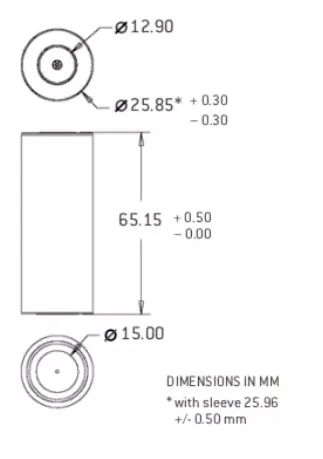
ANR26650 cell has 26mm diameter and 65mm height. On the basis of that we need to decide battery size of battery casing.
Length of casing (L) = number of cells at series*(cell diameter (26) + margin at both side of cell (4)) + clearance at side (diameter of edged cell + margin)
L = 122*30 + 60
L = 3720 mm
Breadth of casing (B) = number of cells at parallel*(cell diameter (26) + margin at both side of cell (4) + clearance at side (diameter of edged cell + margin)
B = 18*30 + 60
B = 600 mm
Height of casing (H) = 65+35 (Height of cell + margin for wiring ,Cell holders and metal strips)
H = 100 mm
(viii) Weight of battery pack
Cell weight = 76g
Number of the cells = 2182
Battery pack weight (W) = cell weight*number of cells + weight of accessories
W = 76*2182 + 4.5 = 165.8 + 4.5 = 170.3 kg
Assembly of the battery pack
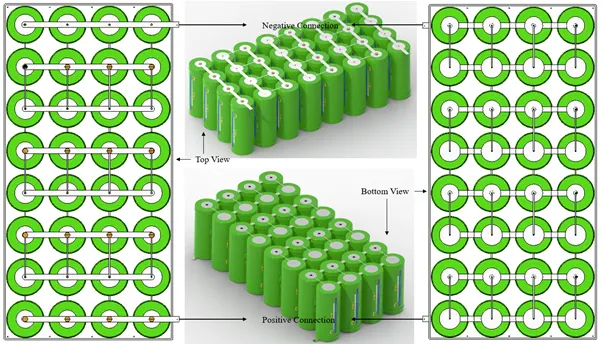
1)Battery holding and providing the spacing between the battries.
2)Connecting the battries with the strips (Series or Parallel)
3)making and manifacturing the battery enclosure housing with the thermal managment system and BMS
1)
- Each of the cells are now need to be connected so that it could form a big battery module.
- So this holdes are very importatnt to provide the gapping between the battery and holding the battries in the correct manner.
- The cells has a vent at the end cap of the cell.and should not be covered by any mechinical means.Blocking the cell vent and then sufficiently abusing the cell so as to built the pressure in cell.There must be minimum of 1mm spacing between each cells to allow the vent to open under the fault condition.
- Holders will make it easy to palcethe contact plate between the cells.
2)Nickel strip:
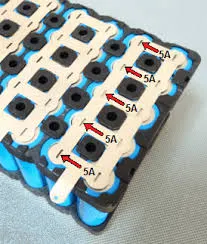
Nickel strip is generally used in battery building. Its due to its efficiency of usage in spot welding and soldering as well its high corrosion resistance over time. It has good properties and excellent resistance to many corrosive environments. The pure nickel will never get rust after it applied to battery packs.

3)
- The battery encolsure is the final protection of the battery.
- So the battery enclose must be very strong and light in weight.
- In the case of any accident the batteries has the tendentcy of catch fire if it get leaked during the car crash,so the battery modle is enclose in a very strong encolsure due to the safety.
- The weight should be less so we can get the best pssible range.
- In this metal housing there is a temperature managment system provided to cool and heat the battries when there is a need to get the best performace of the battries.
- There a several numbers of models connected in series and parallel to build a entire battry pack.
Design Benefits:
• Up to 50 percent lighter than an equivalent steel design
• Best-in-class mass energy density at more than 160 watt-hours per kilogram, an extremely efficient design
for OEMs and Tier 1 battery pack manufacturers.
• Accommodates all battery cell types and is designed particularly for battery electric vehicles with larger power packs such as pick-up trucks, sport utility vehicles and crossovers.
• Most cost-effective aluminum solution for mass production electric vehicles when compared to aluminum extrusion and casting-intense designs.
• Low price premium on $/kg saved compared to equivalent steel designs at substantially lower weight.
Conclusion:
Lithium Ion and Lithium Ion Polymer batteries are a great power source for some applications but they require preventive protection during discharging and charging.This we have studied how to model a battery pack for 18kw battery.
reference:
Lithium-ion battery - Wikipedia