Project 1 Mechanical design of battery pack
Battery pack capacity: 18 kWh
Cell: ANR26650M1-B
Prepare a detailed battery pack drawing along with its enclosure. State your assumptions.
AIM:
To Prepare a detailed battery pack drawing along with its enclosure with ANR26650M1-B by a capacity of 18 kWh.
ANR26650M1-B is a Nano phosphate high-power lithium-ion cell that is made of lithium iron phosphate (LiFePo4). This is more powerful and has high energy than other cells and lower impedance it has high efficiency with more safety precautions and also has a long life. It has a wide range of SOC with fewer losses which leads to less discharge for long range with lighter weight. These cells have low-capacity loss and impedance growth over time as well as high usable energy over a wide state of charge range.
It is widely used in all areas which have the necessity of high power and energy, transmission and distribution, grids, power plants, EV and HEV vehicles, military machines, and vehicles. And it uses also in system back-ups, industrial robotics, medical devices, etc.
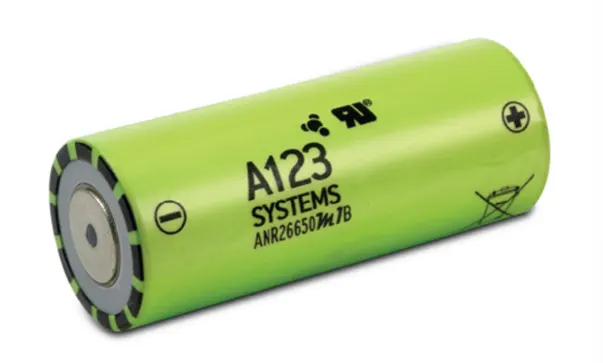
The view of the ANR26650M1-B is as shown below, by the manufacturer of the A123 system.
The parameters of the ANR26650M1-B are as shown,
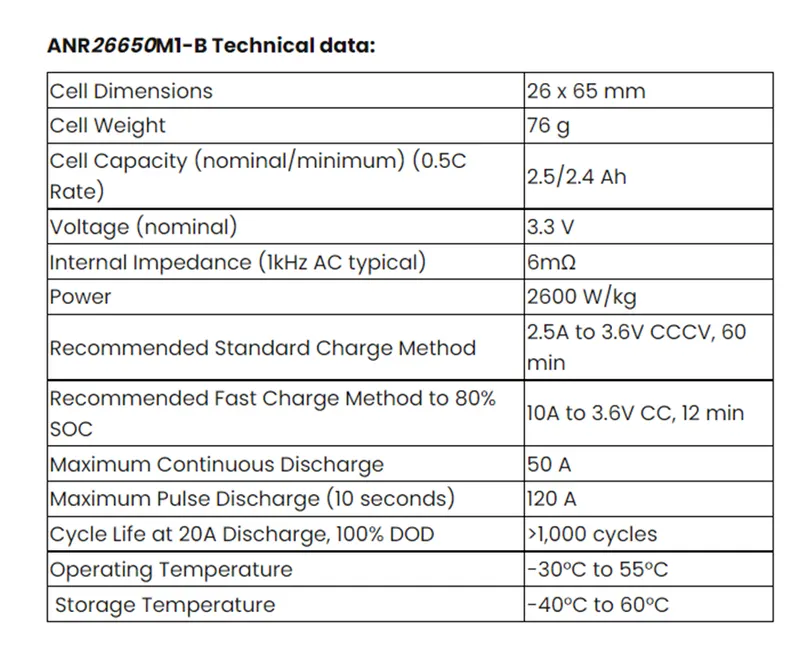
From this, we can say that the nominal voltage is 3.3V, cell capacity 2.5Ah
If we observe the characteristics of the ANR26650M1-B by different conditions like constant power discharge characteristics, constant current discharge at various temperatures, and some others as shown below,
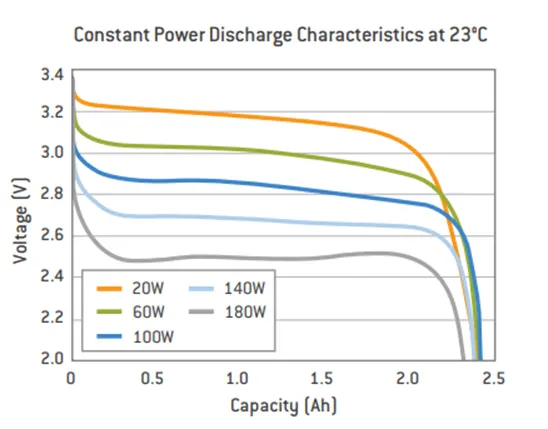
If we observe here that changing the power that is by increasing the power at a constant temperature decreases the voltage respectively.
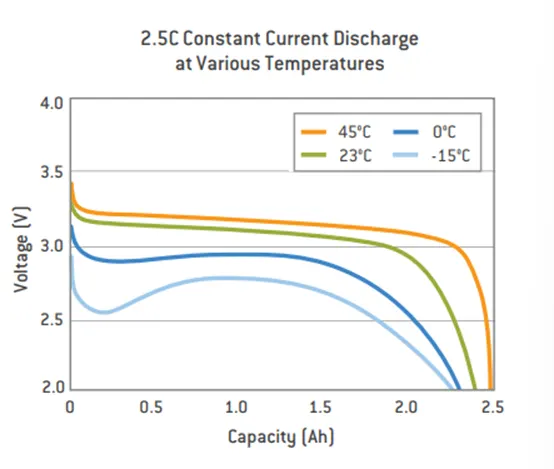
If we observe here by changing the temperature from 45 degrees to – 15 degrees it reduces respectively as shown above.
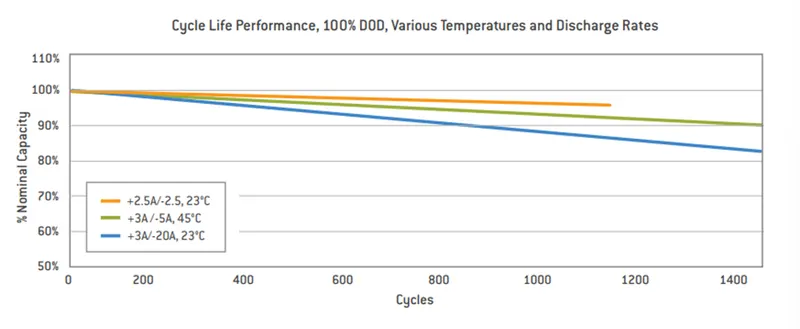
In this, as we can see that by changing the charging and discharging cases as shown its performance characteristics changed her (+) represents charging and (-) represents discharging. By changing the temperatures its performance change.
Design of the ANR26650M1-B cell with dimensions as shown below,
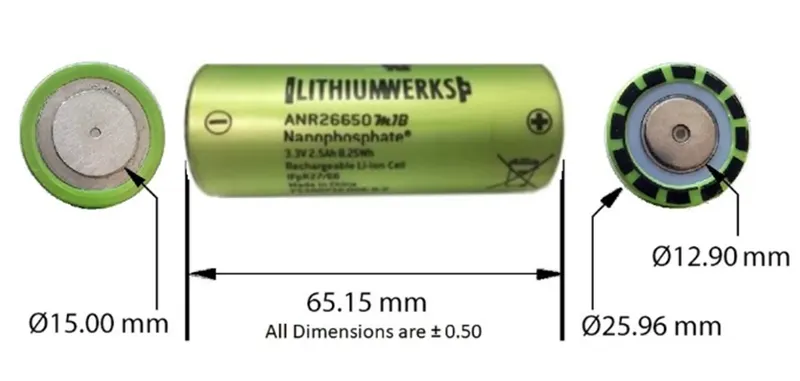
As we know that safety, designing, sizing and some other things are more important to any of the objects they play a key role in the transport, manufacturing, etc. if we see these aspects in the lithium-ion cell batteries it is difficult to transport the battery because of the vibrations, exposure of high impact of the forces and thermal run away. To avoid all these too small robust mechanical designs are necessary. Here the mechanical designs play a major role before using in vehicles or some other machines because if any problem occurs during the designing time it leads to damage to the battery or creates a major problem in the circuit. Designing battery packing provides a greater degree of protection against so many of these.
The basic design of the cells.
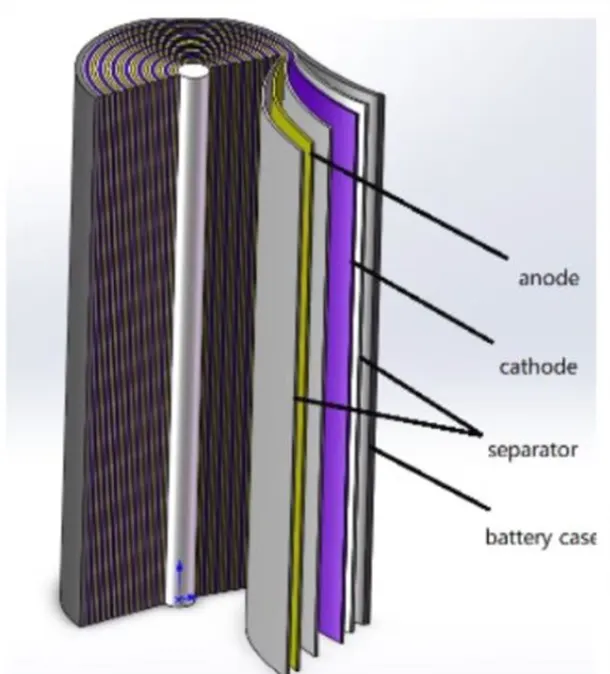
The major parts of the battery cell are five those are, anode, cathode, separators, electrolyte, and terminals. A battery consists of one or more electrochemical cells (battery cells) which are converting chemical energy into electrical energy at the time of discharging and electrical energy to the chemical at the time of charging. The chemical reaction that occurs at the time of charging and discharging is called the chemistry of the battery. There are so many types of cells in use like a cylindrical, flat, pouch, etc.
A battery has a set of modules that is in a certain design with a set of cells connected. The modules and batteries are connected or configured in a series, parallel or in both based on the requirement by this, the outlook of the battery pack is decided. Changing the same cells with different designs changes the voltage and capacity values but the power remains the same in the circuit. The battery pack consists of both hardware and software components which are cell and BMS respectively.
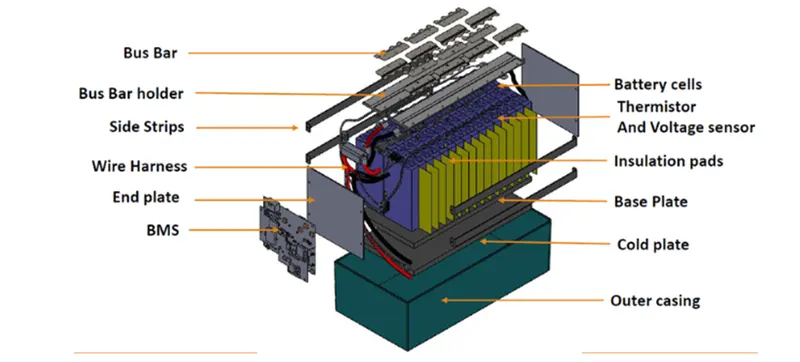
The inner parts of the battery pack are shown above by collecting all these software and hardware parts a complete battery pack is formed. By changing the cell connections, the outlook is changed but the parts and their functions are the same. The design of the battery is decided before the construction based on the palace available in the vehicle to fit.
The performance characteristics and another view of the ANR26650M1-B are,
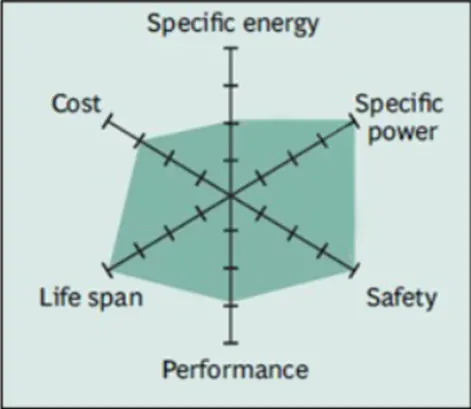
By this, we can identify or observe the overall view and its specifications are known.
In this graph, we see that the points in the line indicate the percentage of 25% each. In the specific energy line, it shows 2 points which are 50% of energy be given on our requirement. In the specific power, it shows full that is it gives the 100% of power as an output from the battery. From the safety point of view also it gives 100% to protect. But in performance issues, it gives only 50% of its life. It has a 100% life span which is given by the manufacturer and its cost also less and easy to buy for the consumers.
Building steps of the battery pack:
Parts of the battery
The main parts of the battery system are, cells, modules, BMS, wires, strips, case, separators, insulators, sensors, etc.
The complete manufacturing processes of the battery pack look as shown.
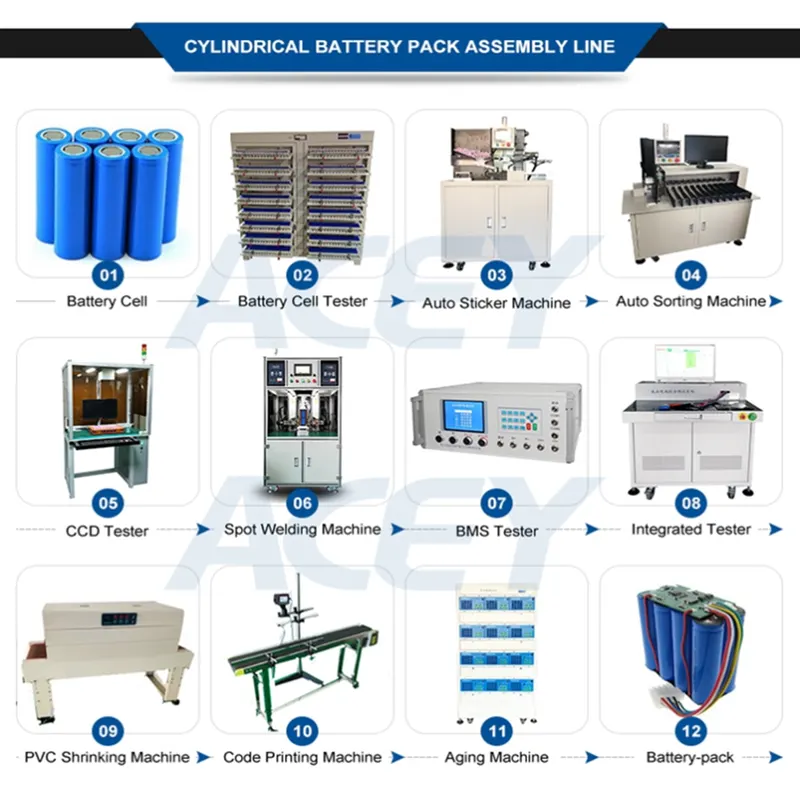
These are the equipment that is used to complete the total battery pack through the machines.
The machines that we used for the battery packing are,
- Auto sticker machine, auto sorting machine, spot welding machine, shrinking machine, code printing machine, and aging machine.
- Auto sticker machine is used to stickering the names that are labeled to the cells based on the given values its condition and some other parameters basses.
- The sorting machine can execute the sorting test based on the voltage and internal resistance tests before assembly. the battery sorter machine has 8 channels for OK battery cells and 1 for NG battery cells, which greatly promote the sorting efficiency and ensure the normalization of cell sorting.
- To build the battery pack the cell parameters working and mechanical design are very important. The battery calculations are used to build the pack with a specific idea based on our requirements. By this, we can find the exact size, location, necessary of the cooling system, etc can be found.
Battery calculations.
Given data,
Battery energy = 18 kWh
From the ANR26650M1-B datasheet
Nominal voltage = 3.3 V
Cell capacity = 2.5 Ah
Internal impedance = 6 mΩ
Cell weight = 76 g
Cell Dimensions = 26*65 mm
Operating temperature = -30°C to 55°C
Number of cells (N) = energy / (nominal voltage*capacity)
N = 18000 / (3.3*2.5)
N = 2182 cells nearly
We need a minimum of 2182 cells to get 18 kWh energy, now based on that, we need to decide on configuration – series and parallel but not exact cells.
In series configuration capacity remains the same and voltage will be the sum of individual cell voltage.
In a parallel configuration, the voltage remains the same and capacity accumulates.
And we assumed 300 Volts are needed to run the vehicle.
The capacity of the total battery for 18kWh is,
Capacity = 18000/300
Battery capacity = 60 Ah
The nominal voltage of one cell is 3.3V.
Number of series cells required to produce 300 V (Ns) = voltage required / nominal voltage of one cell
Ns = 300/3.3
Ns = 90.9
Ns = 91 cells in series
So, to produce 300 V of voltage we require 91 cells of ANR26650M1-B in series which have 3.3V. the excess voltage is considered in losses.
The capacity of the whole module will be 2.5
To find the number of cells which will be connected in a parallel configuration
Np = 60 / 2.5
Np = 24
Np = 24 cells in parallel
Here we use 24 cells in parallel to run the battery with a 60 Ah capacity.
The total cell model is having the pack of 91S24P configuration
- The spot-welding machine has an intelligent welding function that can improve the efficiency of the battery pack during the welding process. It’s equipped with built-in temperature sensors and an intelligent cooling system that can automatically work according to the machine’s internal temperature. It is used to weld the strips which are used to connect the cells for series a of parallel.
Battery module:
The total battery power = (91*3.3 V) * (24*2.5 Ah)
= 18018 Wh
= 18.018 kWh
The battery requirement is an 18.018 kWh battery pack, the required configuration of that pack is 91S24P, i.e., 91 series, and 24 cells connected in parallel
To build such a large grid, we need to slip the battery packs into the battery module, which reduces the complexity of monitoring and optimizing battery management and minimizing battery damage.
For that, we use the modules which take care of cell protection, monitoring, and connections of a set of cells.
In this, we are dividing the set of cells from battery pack 91S24P into 7S4P
So, the no of cells in each module is = 7*4
= 28 cells
Total no of cells = 2184 cells
Therefore, no of modules = 2184 / 28
= 78 modules
We have already calculated battery capacity which is 60 Ah means it is going to supply 60 A current per hour. which can be considered as the C-rate of the battery.
Let us assume the energy consumption for 1 km is 100 Wh. So, the total range of the battery for 18kWh is 180 Km.
There fore the no of kilometers that a vehicle run with a full charge of 18kWh is 180Km.
Battery enclosure pack size:
ANR26650 cell has 26mm diameter and 65mm height. Based on that we need to decide the battery size of the battery casing which is the total battery pack.
Length of the casing (L) = number of cells at series*(cell diameter (26) + margin at both sides of the cell which to free up space called holders and gaps for the sheet protector,s, etc (4) + clearance at the side (diameter of the edged cell + margin) (All should be in value with mm)
L = 91*30+80
L = 2810 mm
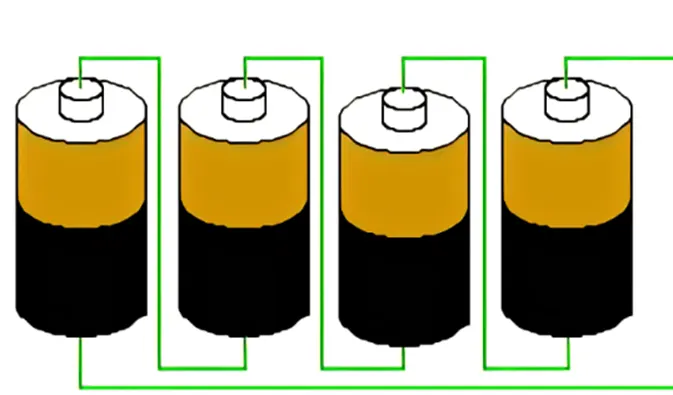
Cells in series
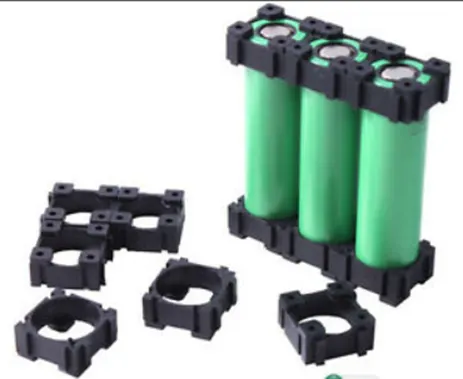
Cell holders,
Breadth of casing (B) = number of cells at parallel*(cell diameter (26) + margin at both side of the cell (4) + clearance at side (diameter of edged cell + margin) for protection
B = 24*30 + 80
B = 800 mm
Cells in parallel,
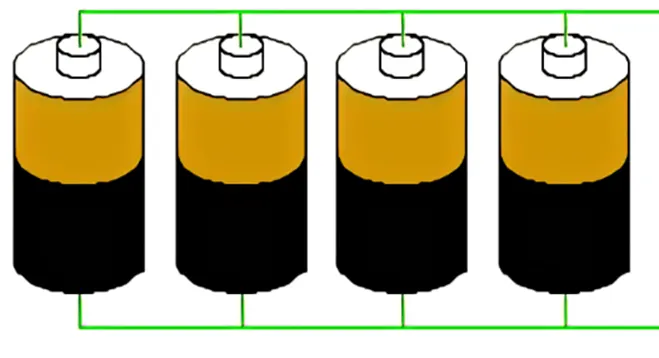
Side clearances,
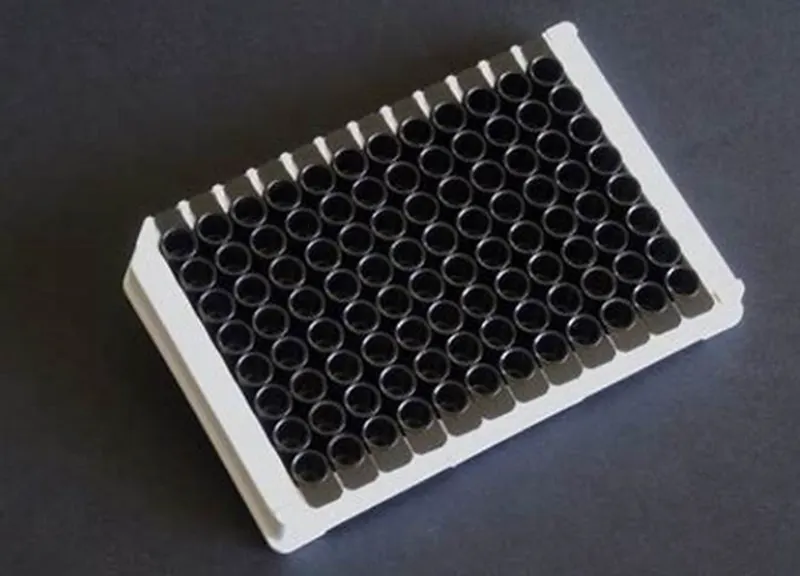
There fore the total area of the battery is = 2810 * 800
= 224800 mm
= 2.248 m
Height of the battery (H) = 65 (height of the cell) + 35 (wires, holders, strips, etc)
= 100 mm
Therefore, the volume of the battery is = L*B*H
= 2810*800*100
= 0.224 m
Weight of battery pack
Cell weight = 76g from the datasheet
Number of cells = 2184
Battery pack weight (W) = cell weight*number of cells + weight of accessories
W = 76*2184 + 4.5 = 165.984 + 4.5 = 170.48kg
Here we got the battery sizes weight, no of cells and modules, pack size with its accessories like wires, etc.
The Battery Management System (BMS) is connected to the cells modules and battery which is used to identify critical situations like the voltage, temperature, and battery capacity values at the running of the battery time. It is mainly used for the monitoring purpose and balancing of the cells in the battery pack. By this, we can operate without damage which leads to exploding in critical situations. The outlook of the BMS with the cells looks as shown.
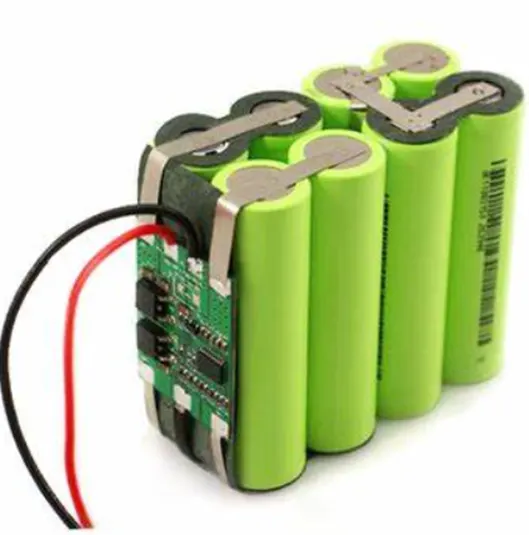
shrinking machine is used to shrink the battery pack at a certain heated temperature in the form of air in the closed loop. The code printing and the aging machine are used to print the code value of the battery cell like ANR26650M1-B and the lifetime of the battery is calculated respectively.
The testers are used to confirm the cell total parameters like voltage, capacity, temperature, pressure, BMS, chemicals, etc.