Project 1 Mechanical design of battery pack
AIM:
To develop the mechanical design of a battery pack based on the required energy capacity.
OBJECTIVES:
- To design a battery pack whose energy capacity is equal to 18 kWh.
- The battery pack should be developed from lithium-ion cells whose specification is ANR26650MI-B.
- While designing the battery pack relevant assumptions can be made and the same be stated in the report.
THEORY:
Stages of battery pack design
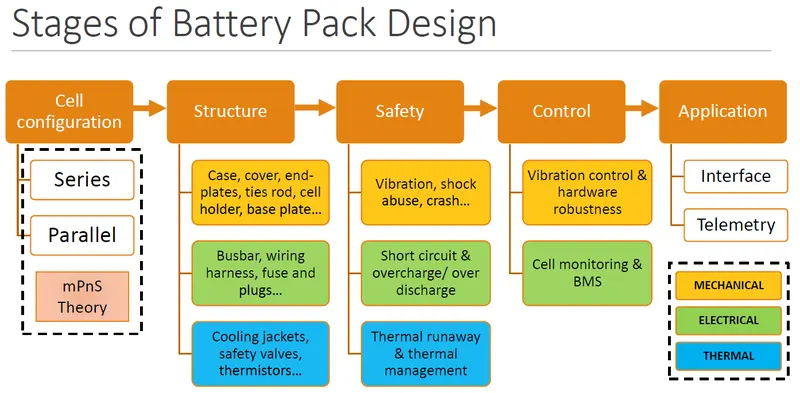
The various design elements to be considered while developing a battery pack are as follows:
1. Electrical Design
• Determination of capacity, voltage and current.
- High voltage isolation.
• Short circuit prevention.
• Efficient power delivery.
2. Thermal Design
- Improve pack efficiency.
- Mitigate thermal accidents.
- Increase pack life.
3. Mechanical Design
• Safe structure for extreme conditions.
• Cost, productivity and reliability.
• Ease of assembly and service.
• Aesthetics, compactness and light weight.
4. Battery Management System (BMS) Design
• Maintain cell/pack operating limits.
• Prevent events compromising safety.
• Control thermal systems.
• Communication and logistics.
BATTERY PACK CAPACITY:
Cell: ANR26650M1-B
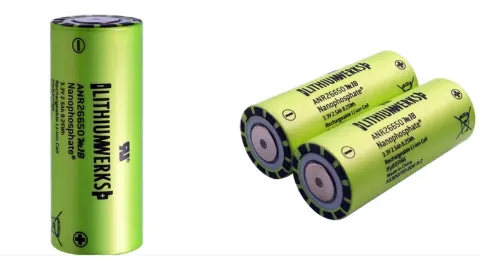
Specifications:
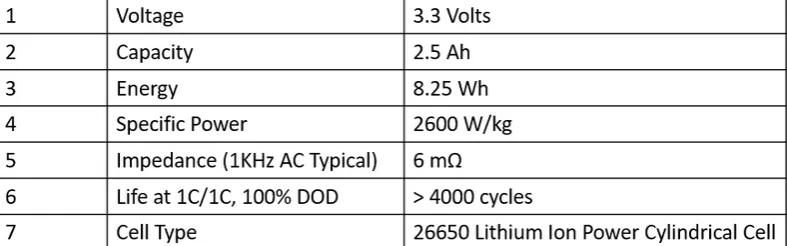
1)Nominal ratings
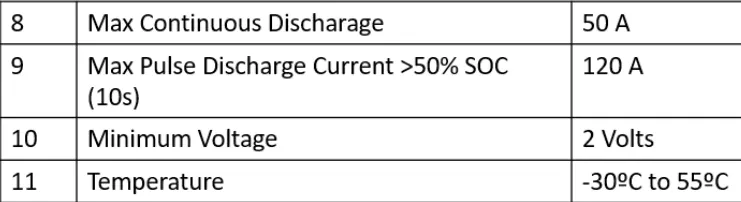
2)Discharging
3)Charging
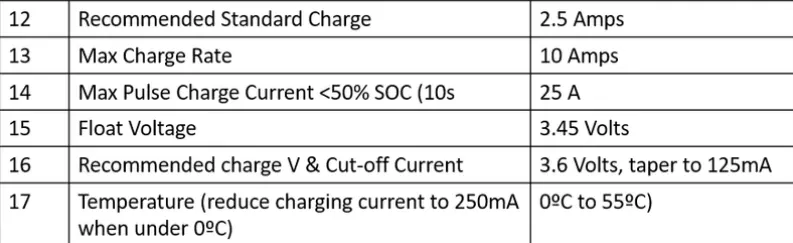
4)Mechanical
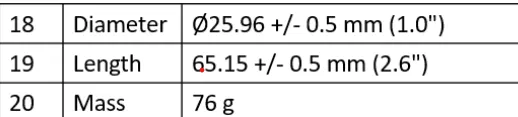
• The LithiumWerks ANR26650MI-B is the next generation of A123 Systems' pioneering 26650 cylindrical cell, now with greater power and energy density and lower impedance. This versatile lithium ion cell is suitable for a wide variety of applications and system designs. Proven performance in the toughest conditions, combining durability, reliability, and safety, the ANR26650 cell offers an excellent combination of price-performance.
• Lithium Werks' 26650 cells are capable of delivering very high power due to its use of patented Nanophosphate battery technology. Based on lithium iron phosphate chemistry (LiFePO4), the cells are inherently safe over a wide range of temperatures and conditions. Whether the application requires outstanding cycle life or stable float reliability, the Lithium Werks' 26650 cells are suitable for a wide variety of power, pulse, or stand-by applications.
•Nanophosphate battery technology offers stable chemistry, faster charging, consistent output, excellent cycle life and superior cost performance. It provides the foundation for safe systems while meeting the most demanding customer requirements. Multiple layers of protection are employed at the chemistry, cell and system level to achieve an energy storage solution with superior safety and abuse tolerance compared to metal oxide lithium-ion chemistries.
Cylindrical Cell Primary Applications:
• Portable high power devices.
Stationary battery backup systems.
• Grid stabilization energy storage systems.
• Commercial truck and bus hybrid electric vehicles (HEVs).
Lithium Ion Cell Benefits:
• Power:- Over 2,600 W/kg and 5,800 W/L.
•Safety:- Excellent abuse tolerance and environmentally friendly.
•Life:- Excellent calendar life, ICX cycle life vs. conventional lithium ion.
DATA SHEET:
EXAMPLE
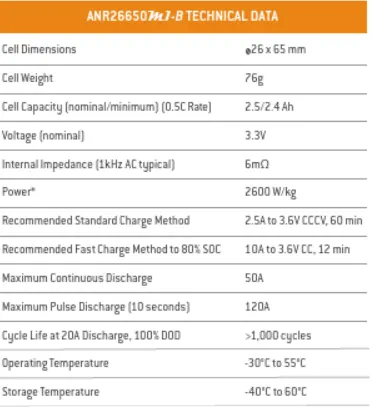
From the datasheet, we can take the parameters to do the calculation for an batterypack.
Nominal voltage=3.3V
cell capacity:25 Ah
Internal impedence=6m ohms
cell weight=76g
cell dimension=26*65mm
operating temp=-30 t 55 deg celcius
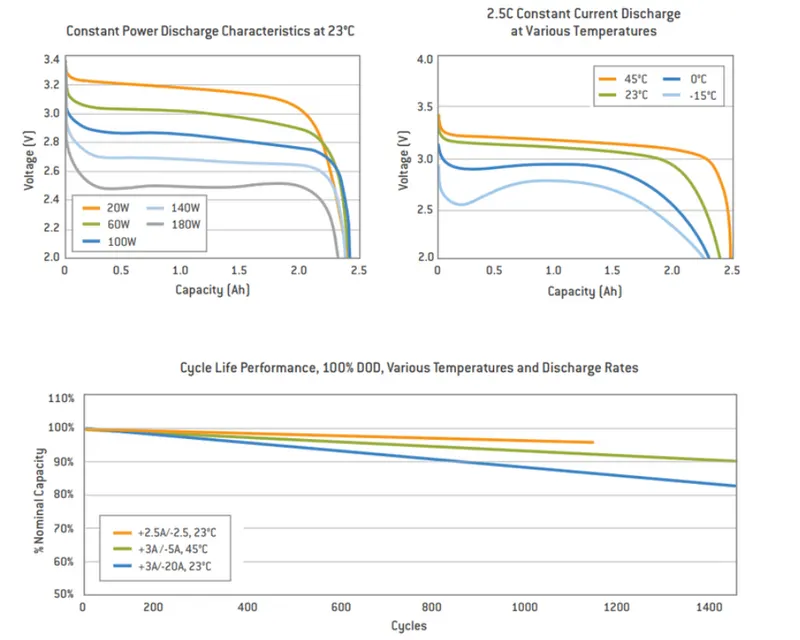
Depth of discharge characteristic of a cell from the datasheet.
1. To find the total no. of cells for 18kwh battery-pack capacity.
given:
Energy=18kwh *1000=18000
cell Nominal voltage=3.3v
cell capacity = 2.5 Ah
Total number of cell-energy/(cell nominal voltage * cell capacity)
=18000/(3.3 2.5)
Total no of cells =2182 cells
We need a minimum of 2182 cells to get 18kwh of energy, now based on that we need to configure the cells as series and parallel connections.
2. To find the series connection:
• In the series connection, the voltage will be high.
• We can assume 500 voltage is required to run the vehicle.
No of series cells required to produce (500v) =Required voltage/nominal voltage.
=500/3.3
=151.5
Let us consider the no of cells in series =152
3. To find the parallel connection:
total connection-series connection parallel connection
parallel connection=total connection/series connection
For parallel connection capacity can increases.
=2182/152
parallel connection= 14.35
let us consider the parallel connection as 15
Now the cell architecture is 152s15p means 152 series and 15 parallel connections
4. Total Battery pack capacity
we know the parallel configured cell multiplies individual cell capacity so,
single battery pack capacity-parallel cell row nominal cell capacity
= 15*2.5
=37.5Ah
Total battery pack capacity (152*3.3)* (15*2.2)
Total battery pack capacity=18.81 kwh.
5. Current supplied by the battery:
We have already calculated the battery capacity which is 37.5Ah means it is going to supply 37.5A current per hour which can be considered as C-rate.
6. Range
Lets powertrain energy consumption = 100 WH/km
Range-capacity/energy consumed per km
=18000/100
Range 180 km
7. To find the area required for the battery pack:
Length = No of series * diameter
L-152*26m=3952mm
L-3952/100-39.52 M
width=No of parallel * diameter
w-15*26-390
w=390/100-3.9
Area required for the battery pack is 152s15p=2*(length + width)* height
=2*(3.95+0.39)*65m
Area required for the battery pack is 152s15p=0.564m^2
8. Total weight of the battery pack:
Total weight of the battery pack= Total cell each cell weight
Total weight of the battery pack=2182*76
Total weight of the battery pack=165.83 kgs
This battery is given in a cylindrical shape so we can use the holder to make 152s15p architecture and spot welding for connection in the battery pack.
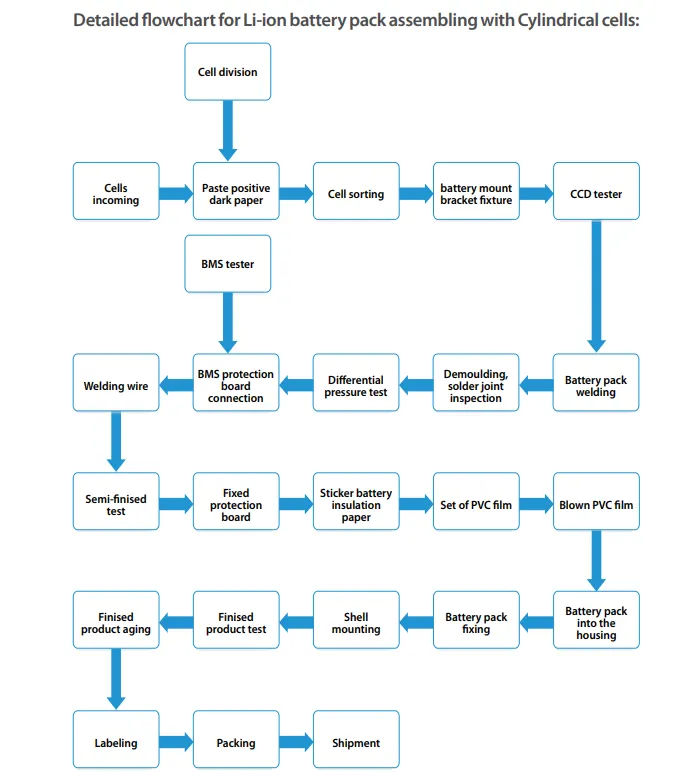
Cylindrical: Cylindrical lithium cells are used for high specific energy density and good mechanical stability. This shape offers good safety and a high cycle life at a low cost. The disadvantage is that it has low packaging density.
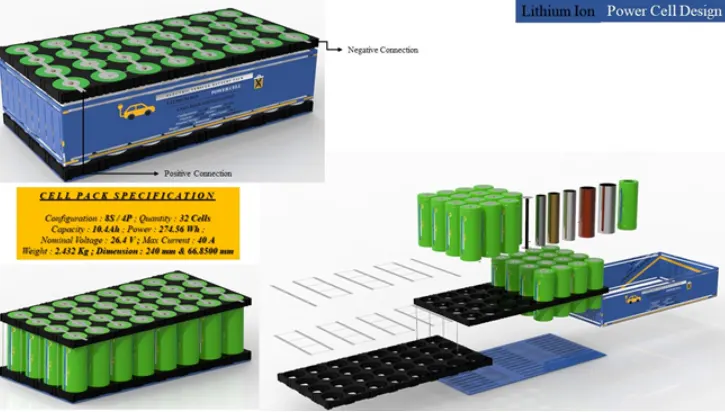
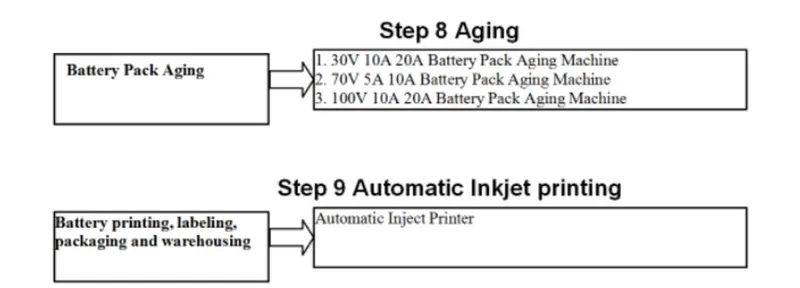
Cylindrical battery pack assembly management for EV:
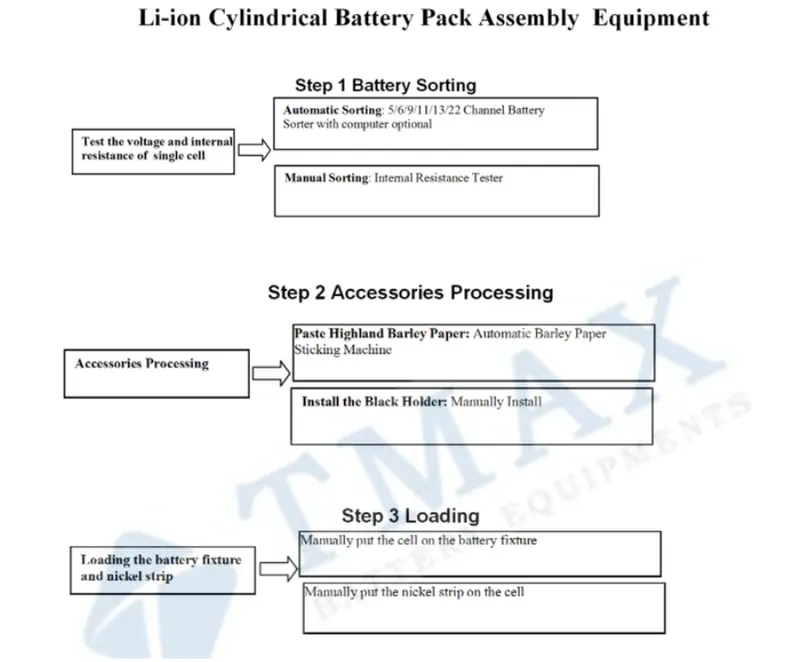
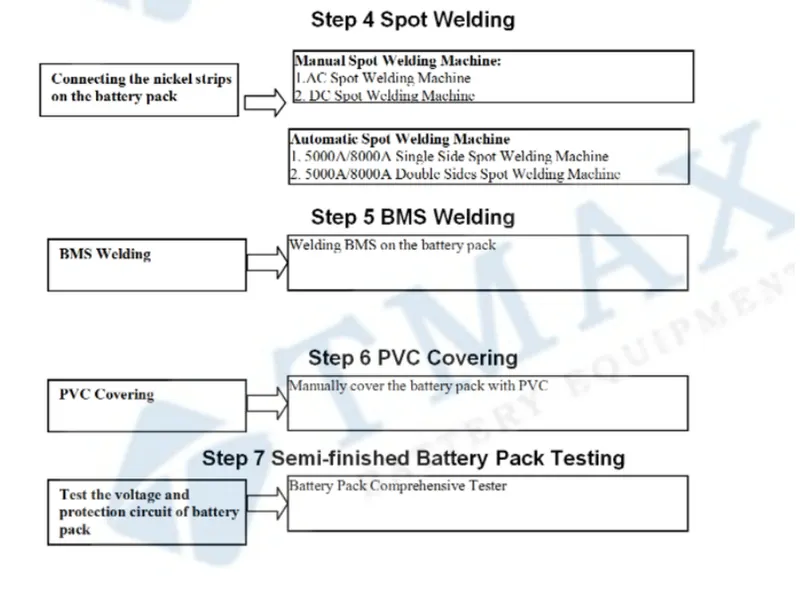
Welded battery sample:
Variant types of machines and devices are used stepwise to make a battery pack.
Even below the factors have to be considered while designing the battery pack:
- Lightweight
- Compactly packaged
- Ergonomic
- Structurally rigid
- Swappable
- Configurable
- Thermally stable
- Impact-resistance
- Fire-proof
- Easy to manufacture
- Easy to service
- Low-cost