Project 1 Mechanical design of battery pack
- ANR26650M1-B is the battery model used here
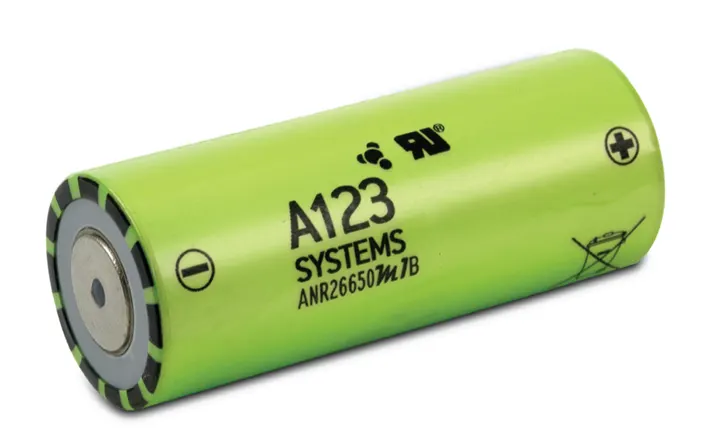
- high power and energy density combined with excellsent safety performance and extensive life cycling in a lighter weight
- cellss have low-capacity loss and impedance growth over time as well as high usable energy over a wide state of charge (SOC) range
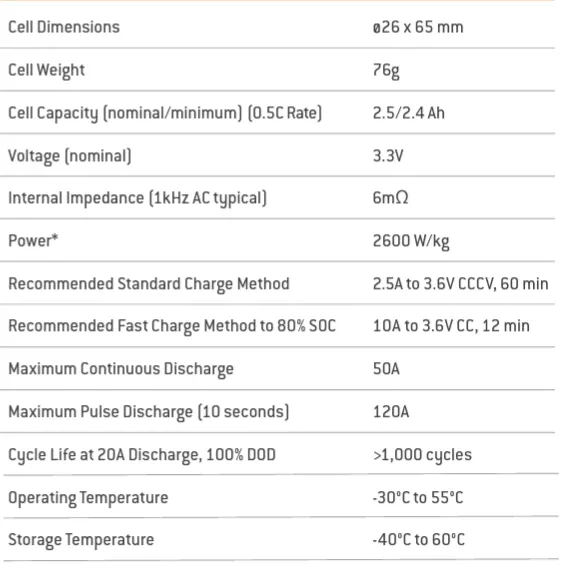
- ANR26650M1-B Specifications Nominal Ratings Voltage:
- 3 Volts Capacity
- 5 Ah Energy
- 25 Wh Specific Power
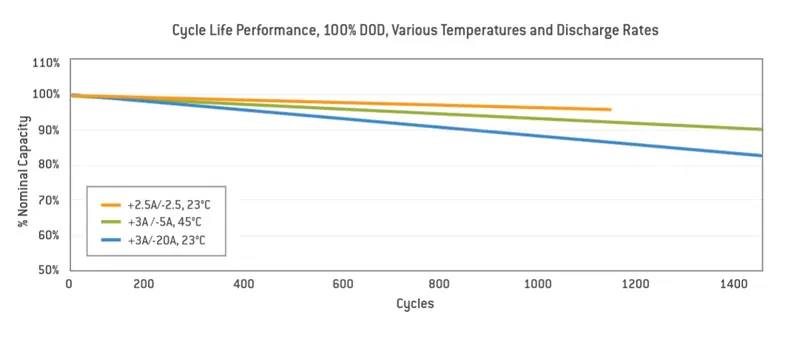
- 2600 W/kg Impedance (1KHz AC Typical) 6 mΩ Cycle Life at 1C/1C, 100% DOD: > 4000 cycle
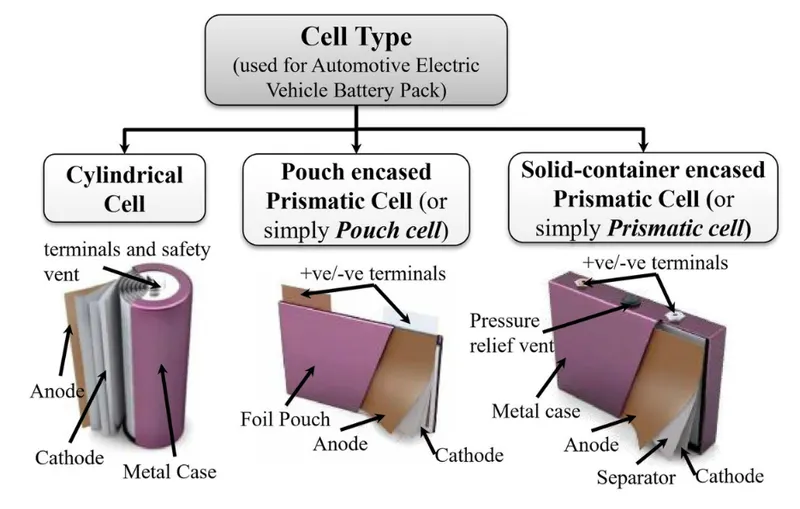
- Cells Type: 26650 Lithium Ion Power Cylindrical Cells
- Discharging Max Continuous Discharge: 50 A
- Max Pulse Discharge Current >50% SOC (10s): 120 A
- Minimum Voltage: 2 Volts Temperature: -30ºC to 55ºC
- Charging Recommended Standard Charge: 2.5 Amps
- Max Charge Rate: 10 Amps
- Max Pulse Charge Current <50% SOC (10s): 25 A
- Float Voltage: 3.45 Volts
- Recommended charge V & Cut-off Current: 3.6 Volts, taper to 125mA
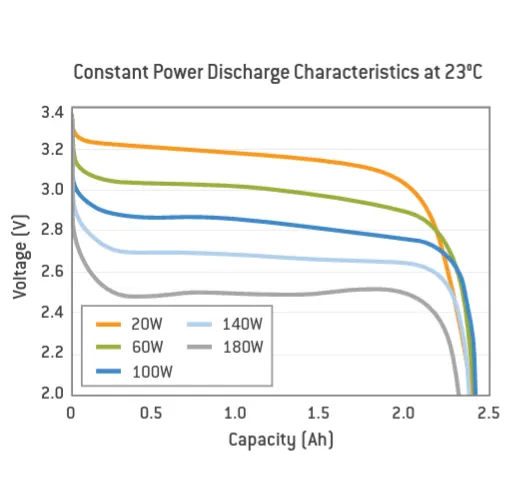
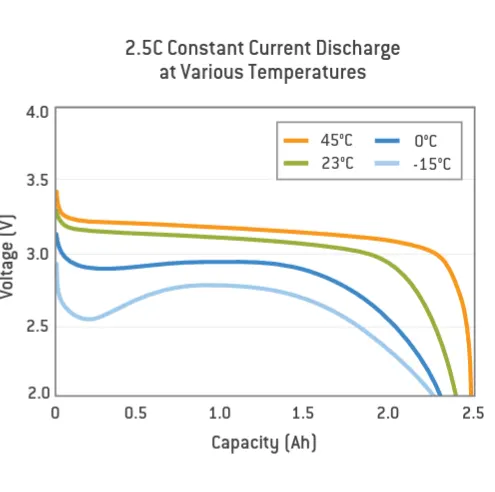
- Temperature (reduce charging current to 250mA when under 0ºC): 0ºC to 55ºC
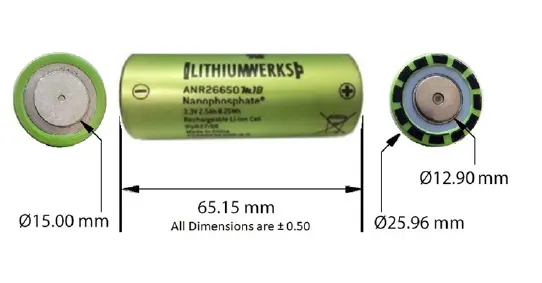
- Mechanical Diameter: Ø25.96 +/- 0.5 mm (1.0") Length: 65.15 +/- 0.5 mm (2.6")
- Mass: 76 g Certifications Transportation: UN 3480 (UN38.3), CIQ Safety: UL 1642, IEC 62133
- The Lithium ion ANR26650M1-B is the next generation of A123 Systems’ pioneering 26650 cylindrical cellss, now with greater power and energy density and lower impedance.
- This versatile lithium ion cells is suitable for a wide variety of applications and system designs. Proven performance in the toughest conditions, combining durability, reliability, and safety, the ANR26650 cells offers an excellsent combination of price-performance.
- Cylindrical Cells Primary Applications:
- Portable high-power devices
- Stationary battery backup systems
- Grid stabilization energy storage systems
- Commercial truck and bus hybrid electric vehicles (HEVs)
- Lithium Ion Cells Benefits:
- Power: Over 2,600 W/kg and 5,800 W/L
- Safety: Excellsent abuse tolerance and environmentally friendly
- Life: Excellsent calendar life, 10X cycle life vs. conventional lithium ion
- calculation as per assumptions: 18 KWh battery pack.
- calculation for designing an 18 KWh battery pack basically 18 KWh is energy require to achieve the vehicle it proper range and its depend on the voltage(V) and amp-hr capacity (Ah)
- single cells energy (Wh) [the value of a single cells energy is used to calculate the total energy of the battery pack]:
- single cells energy (Wh)= cells capacity(Ah)* cells voltage(V)
- = 2.5Ah *3.3V
- = 8.25 Wh
- single cells volume calculation:
- single cells volume = pi(r^2) *h
- = 3.14(0.013^2) *0.065
- = 0.03451 m^3
- single cells energy density:
- volumetric energy (Wh/m^3) = single cells energy / volume of each cells
- = 8.25Wh / 0.03451 m^3
- = 239.0611 Wh/m^3
- gravimetric energy (Wh/kg) = single cells energy / single cells mass
- = 8.25Wh / 0.076 kg
- =108.5526 Wh/Kg
- calculation of high voltage battery packfor design and calculation of battery pack here, i assume a vehicle to achieve 200km in 18 KWh battery pack also i assume 145.2nominal voltage for series connection.
- so, we assume that,vehicle range = 200 Km
- battery pack capacity = 18.1210KWh now,
- we will calculate per Km average energy requirement = 18120.96 (Wh)/200 (Km)
- = 90.60 Wh/Km
- therefore, battery pack total energy = average energy * km
- = 90.60Wh * 200km
- = 18120.96 Wh
- let's assume nominal voltage for series connection= 145.2 V basically this depends upon the motor power, we can decide the value according to the motor.
- number of cells connected in series = nominal voltage of series connection/nominal voltage of a single cells = 145.2V/ 3.3V
- = 44 cells
- 44 cells will be connected in a series connection to provide a proper voltage.
- energy for battery pack (Wh) = number of cellss connected in series * single cells energy
- = 44* 8.25Wh
- = 363 Wh
- number of cells connected in parallel = battery pack total energy (Wh)/energy for battery pack (Wh)
- = 18120.96 Wh/363 Wh
- = 50 cells
- 50 cells will be connected in a parallel to provide a proper capacity power.
- battery pack total energy (Wh) = no. of cells connected in parallel * energy for battery pack
- = 50* 363 Wh
- = 18.150 KWh
- battery pack capacity (Ah) = no. of cells connected in parallel * single cells capacity (Ah)
- = 50*2.5 Ah
- = 125 Ah
- the value of battery pack capacity is used for the total power required by the vehicle.
- total number of cells for battery pack = no. of cells connected in parallel * number of cells connected in series
- = 50*44
- =2200 cellss
- 2200 cells will be used to make a complete battery pack.
- mass of battery pack = total number of cells for battery pack * mass of single cells
- = 2200 * 0.076 kg
- = 167.2 kg
- 2 kg is the total weight of cells connected in parallel and series
- total volume of the battery pack = total number of cells for battery pack * volume of single cells
- = 2200 * 0.0345 m^3
- = 75.9 m^3
- 9 m^3 is the volume occupied by total cells used in battey pack.
- cells peak current(A) = C rate (max pulse charge current) * single cells capacity
- = 20* 2.5
- = 50A
- battery pack peak current(A) = cells peak current(A) * no. of cells connected in parallel
- =50*50
- = 2500A
- battery pack peak power(W) = battery pack peak current(A) * voltage of series connection
- = 2500 A * 145.2
- = 363 KW
- cells continuous current(A) = C rate (max continuous charge current) * single cells capacity
- = 10* 2.5
- = 25A
- battery pack continuous current(A) = cells continuous current(A) * no. of cells connected in parallel
- = 25*50
- = 1250 A
- battery pack continuous power(W) = battery pack continuous current(A) * voltage of series connection
- = 1250 A * 145.2
- = 181.5 KW
- The process outlined in this article will begin with taking the battery cells out of packaging.
- This article will discuss the fabrication process using the battery cells as the “raw material” in the battery pack fabrication process.
- These small individual cells are typically manufactured at other, specialized facilities and arrive at the automobile fabrication plant as completed products.
- This workflow is the vision for the vaulted Tesla Gigafactory in Nevada which will produce all the battery cells required for the Tesla’s automotive assembly facilities.
- The individual battery cells are simply metallic cartridges that contain an anode, cathode, and separator immersed in an electrolyte fluid.
- Before the cells can be assembled into modules, each cells undergoes checks within a specialized fixture.
- This process is essentially a “leak check” process to ensure that the electrolyte isn’t leaking from the cells and to ensure that no moisture intrusion occurs over the entire operational life of the battery
- While most people know what components comprise a traditional gasoline-powered automobile engine, they likely know little about the components or parts of an Electric Vehicle (EV) battery pack.
- This is understandable because EVs are still relatively new in the automotive marketplace, and the conception of how exactly a battery works is more difficult to understand when compared with the myriad of moving components that comprise internal combustion engines.
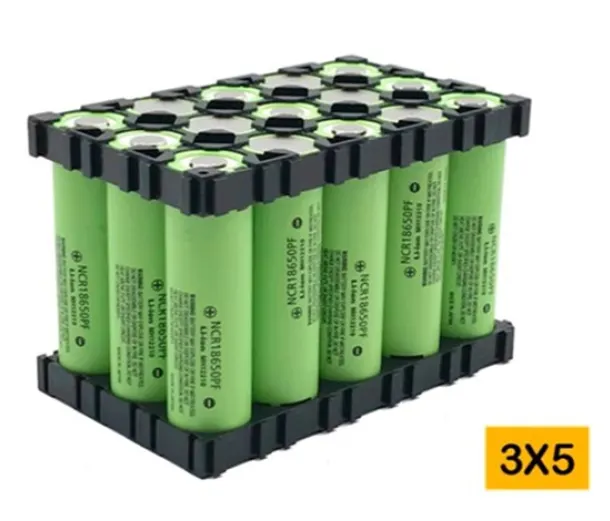
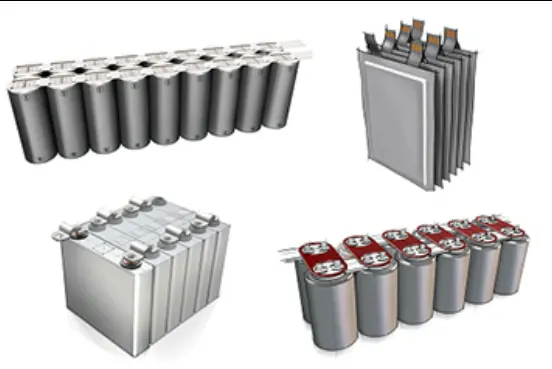
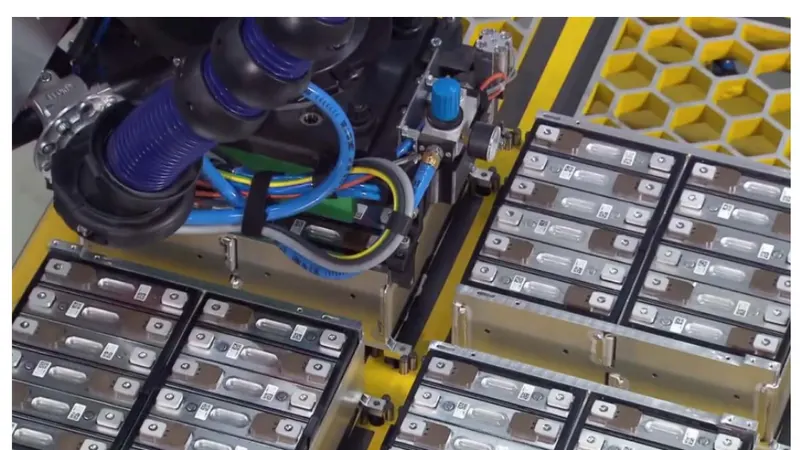
- These battery cells are assembled together in frames to form Battery Modules.
- These modules are then linked together via a myriad of electrical connections and enclosed in the Battery Pack which is assembled directly to the automobile frame.
- Initially it is required to know the energy requirement.
- Then with that information, number of cells required to be calculated.
- Then configure the cells in series and parallel according to desired voltage and capacity.
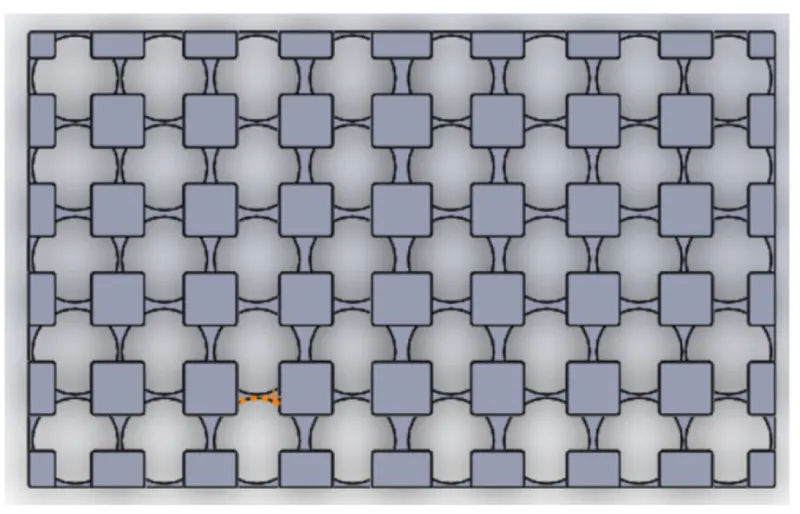
- Calculate the pack dimensions and weight for preparing the casing pr cells holder to the pack.
- Then Battery pack assembly by placing them in cells holder according to the configuration.
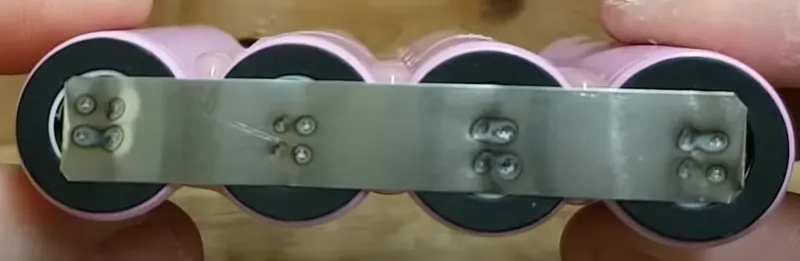
- And then connecting the cells in series and parallel with the help of nickel strips by spot welding.
- Connect the BMS to the pack.
- Set a suitable thermal management technique to the battery pack.
- Placing in a enclosure for protection
Conclusion:
The necessary details are explained