Project 1 Mechanical design of battery pack
Question:
Battery pack capacity: 18 kWh
Cell: ANR26650M1-B
Prepare a detailed battery pack drawing along with its enclosure. State your assumptions.
Answers:
The to be modeled battery pack for this project is made up of ANR26650M1B cells. They are high-performance Nanophosphate lithium iron phosphate (LiFePO4) battery. Thier technology delivers high power and energy density combined with excellent safety performance and extensive life cycling in a lighter weight, more compact package. This cells have low capacity loss and impedance growth over time as well as high usable energy over a wide state of charge (SOC) range, allowing our systems to meet end-of-life power and energy requirements with minimal pack oversizing.
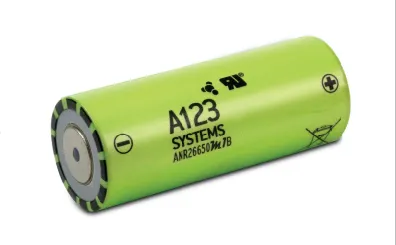
The A123 ANR26650M1-B has the following characteristics.
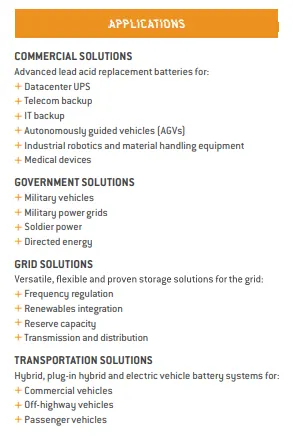
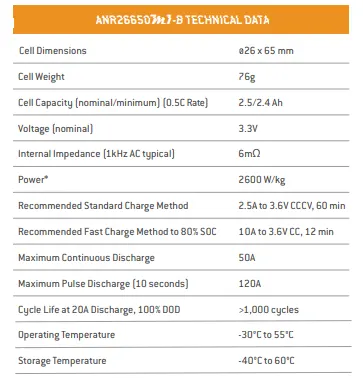
Data Calculations:
from the above informations from the Datasheet we notice this cells have
-Nominal voltage of 3.3V
-Nominal current capacity of 2.5Ahr
*Hence giving them an energy capacitiy of 3.3V * 2.5Ahr = 8.25Whr
*But we need a Battery with the energy capacity of 18KWhr
*This means we will need to buid a battery pack (With both series and parallel conections) from the sigle cell.
Each celle has the following energy content.
Volumetric energy (Wh/m^3) = Single Energy / Volume of each cell
8.25 Whr/ 0.0345m^3 = 248.62 Wh/m^3
Gravimetric energy (Wh/Kg) = Single Cell Energy / Single Cell mass
8.25 Whr/ 0.076 = 112.89 Wh/kg
Assumptions:
*For this calculations we assume our battery pack has to power a 300V motor.
*Cooling and heating will be ignored.
*The battery will be modeled with 10% more energy capacity to compesate energy loss as heat.
*10% of 18K is 1800 there for we want a battery with total capacity of 19.8K or better still 20KWhr
Calculation of battery series and Parallel connections:
-Total battery pack capacity = 20KWhr
-Total battery pack voltage = 250V
-Total current = 20K/250 = 80A
*Total number of cell to be connected in series
250V/3.3V = 75cells
*Total number of cells to be connected in parallel
80/2.5A = 32cells
Battery Pack Modul
since the amout of battery cells need are so monay hance making cooling difficult, we could reduce them into smaller modules and later connect them together.
*We could make a module of 5S&4P this means each battery module will have the following capacity.
-5* 3.3V = 16.5V
-4*2.5A = 10Ahr
making the battery having an energy capacity of 16.5*10 = 165Whr
*Hence we will be needing to connect 10 modules in parallel and 15 modules in series. hence making a final connection of 15s(modules)&8Parallel(modules)
NB:
Before we start connecting the battery together we want to make sure the following points are checked.
-All battery cells have good physical and chemical conditions so as not to bring a bad cell in the pack bacause this will affect the pack as a whole negatively.
-All the cells have to pass the various test (Vibration test, drop test etc).
-All battery cells have to be checked for a correct or the same amout of voltage, this is because for different cell voltages the SOH of the battery pack will be compromised because the cells will discharge and charge differently.
Making of each battery pack Module:
first some saftey measure will be taking into consideration .
-The pack should we matterial hard enough to protect against shock during vibration
-It should be made with insulating material to help regulate tempirature.
-It should be closed from dirts.
Now the pack will look like this.
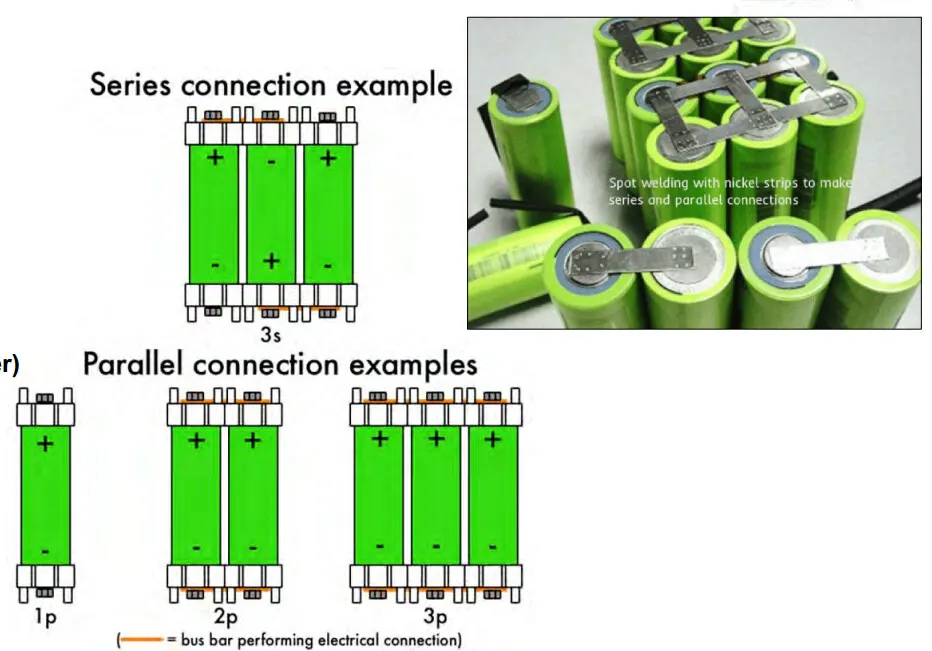
*Nickel strips are used to connect the ANR26650m1-B cells together. There are serveral alternative to this but despite its high cost.
-It has very low resistance hence less heat produced during charging and uncharging.
-It is flexible and dose not stand a chance of braking.
HOw will the battery be weld together:
Both are very good technics of joining metals together very firmly but very larg amount of heat is involved. Since in this case firmly binding the battery together is of low importance but rather creating a link for energy transfer and strong enough to withstand vehicle vibration. We also dont want to apply much heat on the battery during welding because it will affects battery SOH. So i will be choosing the Spot welding which can bind the battery together without much heat bean applyed on the battery.
HOw each Battery module will look like at the end.
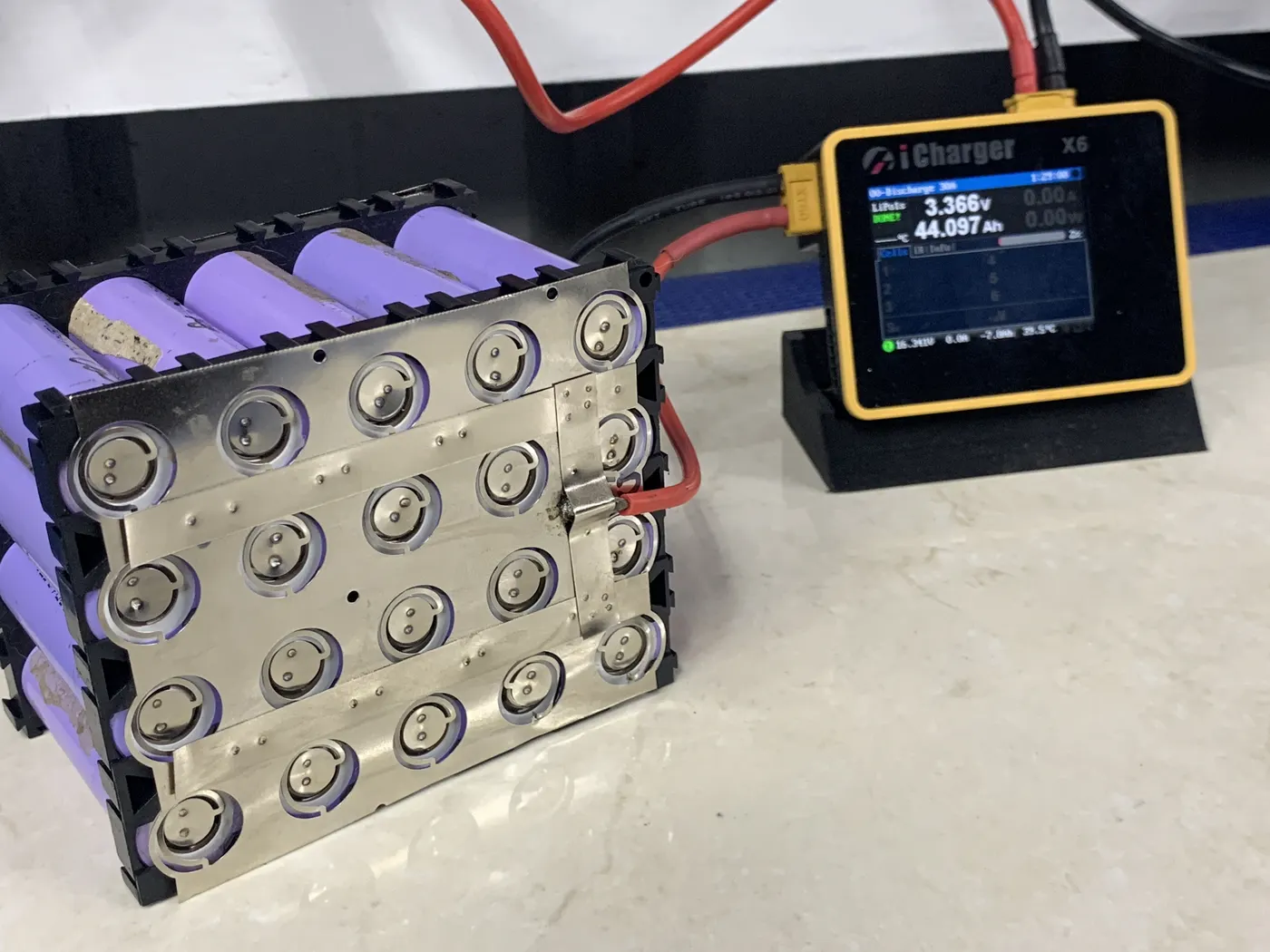
-At the end we have a battery pack module of 5S&4P locking as the above image.
-The battery pack model has to be measured to make sure it has a voltage of 16.5V and a current of 10A making and energy capacity of 165Whr.
-The metal sheat below will help to desipate the heat produced by the battery pack.
-A positive and a negative terminal will be extended outward for farther connection.
-A BMS will be connected to the battery pack module to control the charging, discharging and heat managment.
How will the Battery pack modules be connected to give the 18KWhr (20KWhr with losses as heat included):
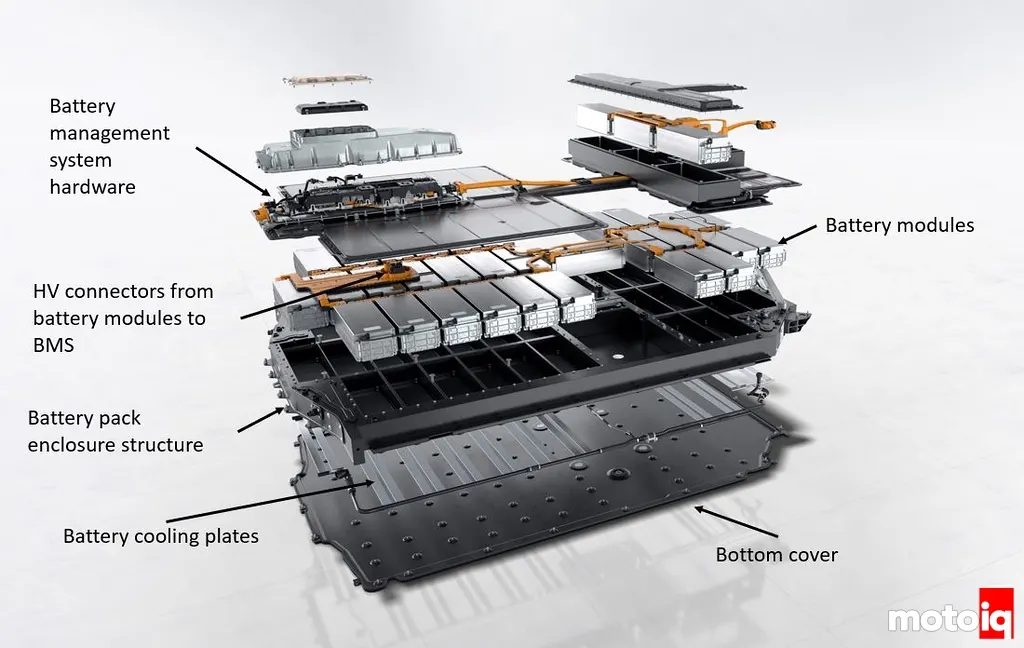
The complet battery pack will be build as shown above 15S&8P.
-The total pack voltage has to be measured to maked sure we have a total voltage of 250V.
-The total pack current capacity will be measured to make sure it is 80A
-Hece total energy capacity of the pack will be 250V*80A making it 20KWhr.
-The Pack will be put in the case to protect from external dirt, temperature and water.
-Cooling paltes will be provided for pack cooling.
-The pack BMS will be connected to make sure charge and discharge is controlled.