Project 1 Mechanical design of battery pack
Battery pack capacity: 18 kWh
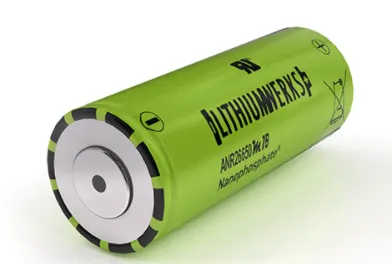
Cell: ANR26650M1-B
Prepare a detailed battery pack drawing along with its enclosure. State your assumptions.
ans.
Objective
To create a battery pack drawing of 18KWh using series and parallel connections of battery module is made up of individual lithium-ion cells.
Lithium ion cell used here is of model ANR26650M1-B from the manufacturer of byelithium werks.
To discuss about the enclosure used for battery pack.
Lithium ion cell(ANR26650M1-B)
This Lithium ion cell is manufactured by lithiumwerks. They deliver very high power due to their use of patented Nano phosphate battery Technology.
Based on Lithium iron phosphate chemistry(LiFePO4) the cells are inherently safe over a wide range of temperature and conditions.
For outstanding cycle life table float reliability this cells uh ah inherently safe over a wide range of temperature and conditions.
For outstanding cycle life table float reliability these cells are suitable for a wide variety of power pulse and standby application.
Nano phosphate battery technology of a thermostable chemistry 1st charging consistent output low capacity loss over time.
It provides extremely safe conditions for while meeting most demanding customers requirements multiple layers of protections are employed on chemistry cell and system.
Level to achieve an energy storage solution with superior safety.
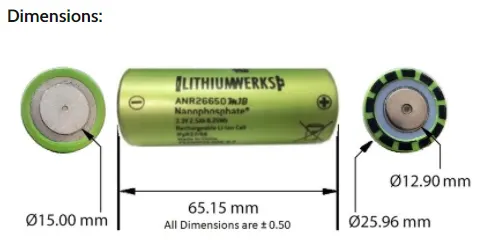
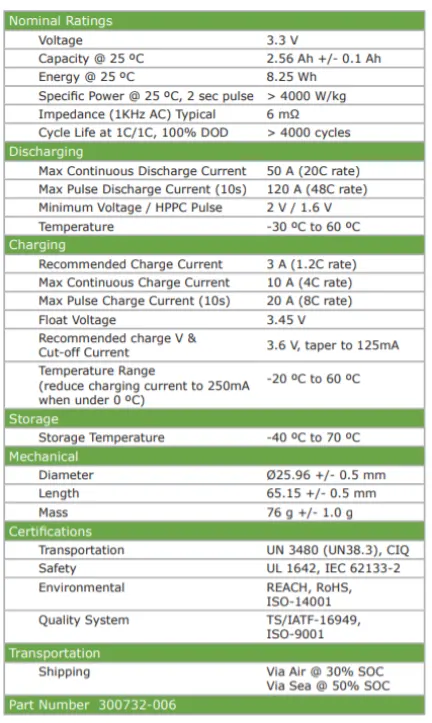
Cell specifications
Discharge voltage profile and cycle life with respect to different operating temperature from data sheet
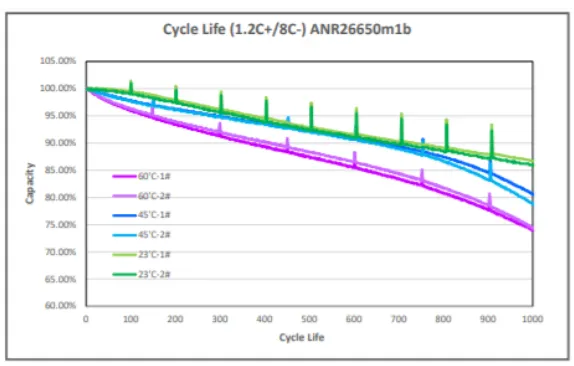
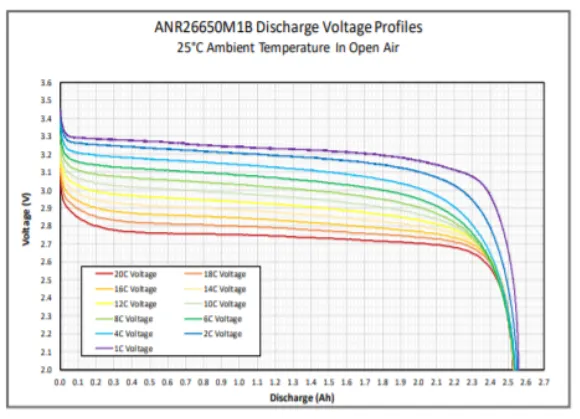
Assumptions:
We are assuming the overall voltage required to operate the motor and other accessories of electric vehicle is is 400V.
So we have constructed the battery pack of 18KWh
for a 400V input voltage motor.
Construction of battery pack:
To construct a battery pack initially we have to estimate the voltage requirement of the overall load of the vehicle.
We have assumed as 400V as mentioned above.
Then the battery model should be created in such a way that overall voltage is match with the load requirement voltage.
The module can be created in series or parallel connection of individual cells. Then every model should be connected in series or parallel to construct final battery pack.
In series connection voltage is added current remains same
In parallel connection voltage remains same, current gets added
Here in our case single cell voltage is 3.3V and a capacity of 2.56Ah , energy provided from single cell is given as 8.25Wh.
So for 18KWh or battery pack we need approximately 180000/8.25 = 2182 cells.
We have to create a single module to produce 400V for our load requirement.
So to obtain 400V output, cells are connected in series where voltage become added and current remains same .
To obtain 400V number of cells required is approximately 400/3.3 = 122 cells.
Thus single module gives as 400V from 122 cells but energy of one module is not enough to run the vehicle as motor power rating is higher. The energy generated from single module is 122*8.25Wh = 1006.5 Wh.
So to construct a battery pack with 18KWh with not exceeding 400V the models are connected in parallel. In this parallel connection the current Sar are getting added. The voltage remains same as 400V , as current increases the power of the battery pack increases to run the motor load of high power rating.
Now we have to find how many similar model should be connected in parallel to achieve 18KWh battery pack.
This can be calculated as 18KWh/1006.5Wh = 17.88, which gives as nearly 18 similar models should be connected to achieve 18KWh battery pack.
Does the battery module is said to be 122S18P configuration (122 series and 18 parallel connections) which gives us (122*18 = 2196 cells). From this we have created overall capacity of the battery pack as (2196*8.25Wh = 18117Wh) which is slightly higher than 18KWh and and.
The overall capacity(Ah) of battery pack is given as (2.5Ah*18=45Ah).
Which means it copy provided 45A of current continuously for one hour to full discharge.
Does a 3 model should be arranged in a way as battery pack to fit in an EV chasis.
Enclosure construction:
To find overall enclosure volume we have to find the volume of single module volume consists of 122 cells in series connection and multiplied with 18 parallel connected model volume.
Single module,
Let us assume 122 cells (single module) are divided into two models of 61+61 cells. The length of the module = number of cell in row*(cell diameter + margin of both side of cells) + clearance at side(2(cell dia + margin)).
= 61*(26+4)+60 = 1890mm
The breadth of the module = (cell diameter + margin of both side of cells + clearance)
= 26+4+60 = 90mm
Hight of module = height of the cell + connecting strip thickness(wire say 35mm)
= 65+35 = 100mm
Does the volume required for single module is 1.8*0.09*0.1 = 0.0162m^3
Total number of modules assumed are = 18*2=36 modules , sin single module is divided into two modules
Therefore total volume required for battery pack of 122S18P configuration construction is 0.0162*36=0.583 m^3
Thus from the above result it is assumed approximately 1m^3 of volume should be used for EV battery pack with additional ventilation spaces for pack.
Ee we can assume that two modulus are combined into one cabinet, so 18 cabinet should be connected to form final battery pack.
Materials and process in Battery Pack Construction:
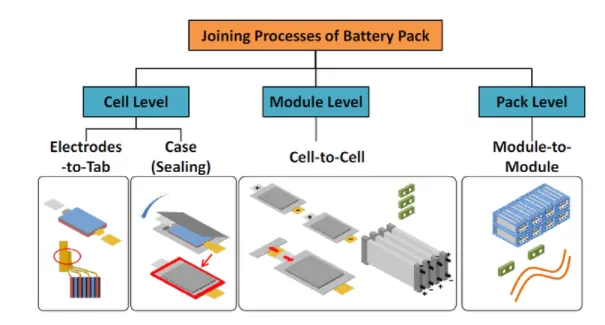
Battery Pack Construction consists of three major levels of processing namely cell level module level pack level Constructions.
The electrodes are combined with electrolyte to various cell models as cylindrical Prismatic pouch type cells.
After ke sealing cells are combined to form module level construction. Finally these models are combined to form pack level construction.
Joining Technologies of cells:
The interconnections between cells/ modules are practice by various welding techniques, some of them are:
Ultrasonic metal welding
Resistance welding
Laser beam welding
Wire bonding
Mechanical joining
Ultrasonic metal welding:
Ultrasonic metal welding or UMW or is a solid state welding technique which forms a bond by applying moderate static pressure and ultrasonic oscillation of about 20KHz between two parts of metal. The solid state welding is the high frequency motion what's causing continuous steering and plastic deformation while also removing any oxide layers or contaminants. Most metals can be ultrasonically welded and method is excellent for welding together thin files as well as thicker sheets with spot or seam welds and also wires.
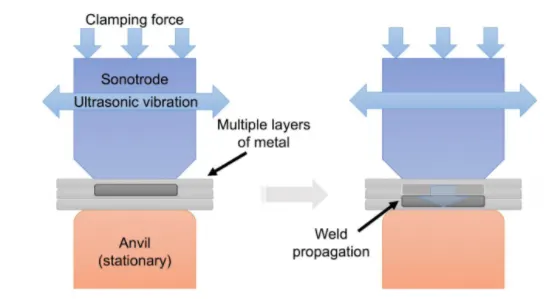
The four types of materials welded in this process can be seen as
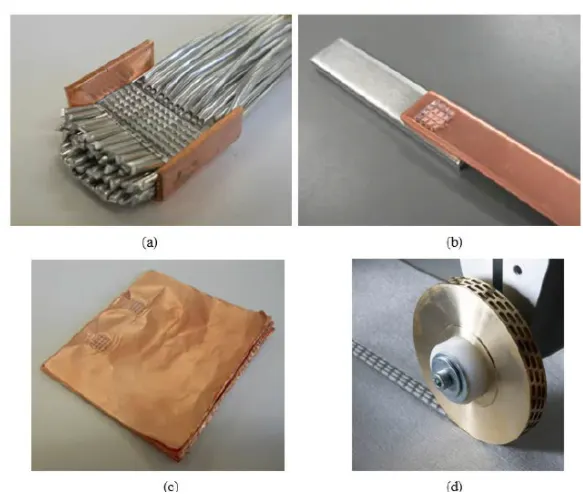
a) aluminium wire welding on copper
b) copper and Aluminium welding
c) multi layered copper foil welding
d) ultrasonic seam welding
Resistance spot welding:
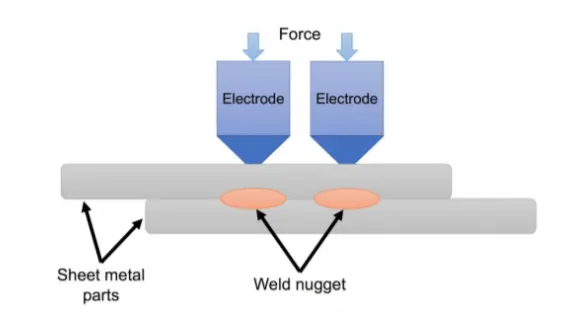
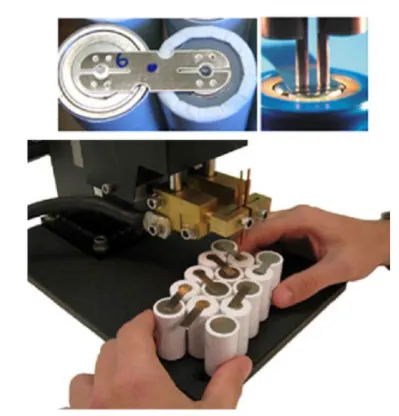
One of the oldest welding method is Resistance spot welding (RSW).RSW is a technique where two or more metal sheets are welded together through the application of an electric current and pressure between two electrodes. The electrical resistance of the material at the interface results in a generation of heat and melt the material together without the use of filler material or gases. The temperature increases in the affected area the interface and eventually reaches the materials melting point. A weld nugget forms in the affected area after cooling. This is a small volume of material which has melted and then fuse together.
Laser beam welding
Laser beam welding or LBW is a welding technique in which a laser beam provides a concentrated heat source that fuses the materials together.LBW is commonly performed using keyhole mode welding method in which the extreme power density of the laser beam causes the metal to melt and evaporate. As the metal atoms evaporate from the surface forces in the opposite direction of the evaporation causes a local vapour pressure. The vapour pressure creates a hole which is known as the keyhole by depressing the molten metal.
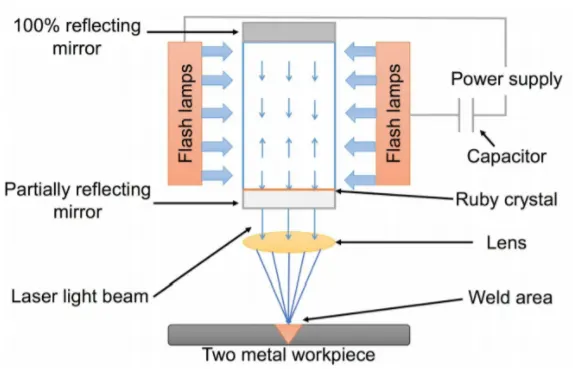
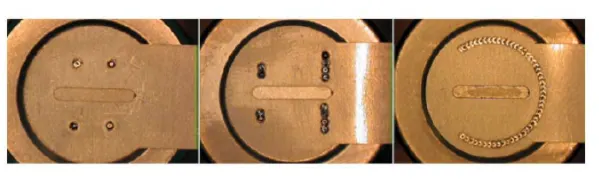
Here below shown the welding of bus was two cylindrical battery cans.
Enclosures:
Cells in series connection:
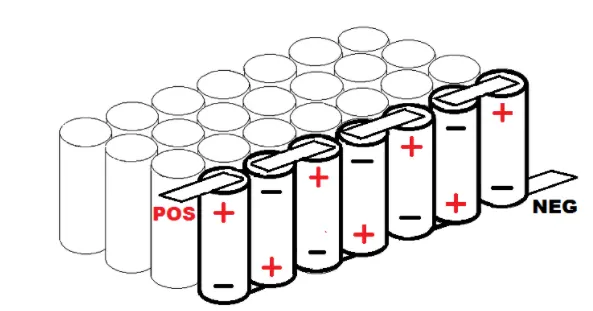
When you connect cells together in series it doesn't change the a or the capacity it only raises the voltage of the pack. Hooking them up in series means that you connect the positive end of one cell (or P- group) to the negative and of the other cell as shown below.
Cells in parallel connections:
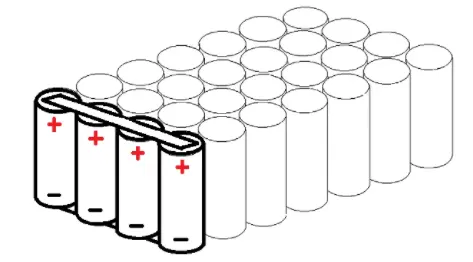
If you take several cells and connect there are same type electrodes in parallel, they all will act as though they are one large cell. Also, so when you first connect them to each other, they must be at the same level of charge.
Cell holders:
These holders are used for holding the individual cell in better posture without mis assemble. The connections can be made accordingly to make series connections and parallel connections to form the required module dimensions.
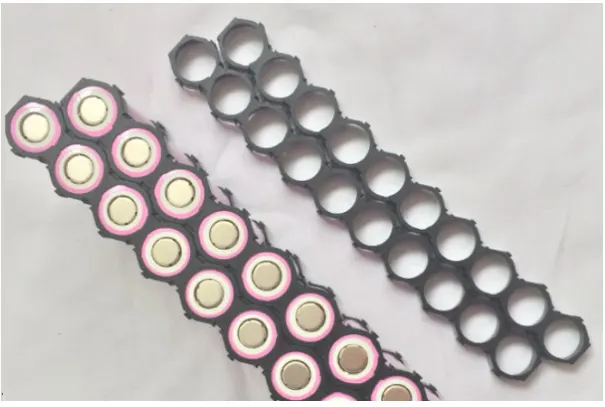
After installing the cells in an individual module the entire maximum positive terminal and maximum negative terminal are made under single pair of terminals at shown below.
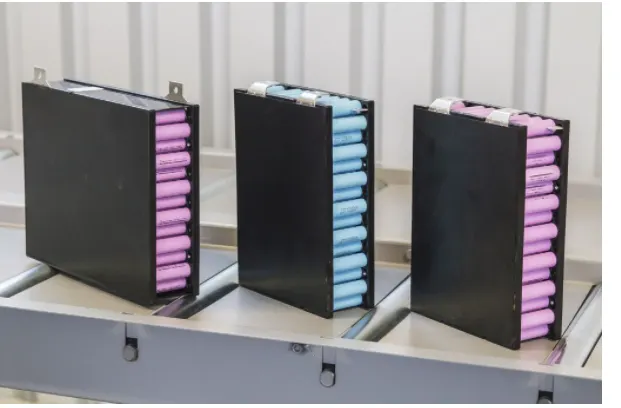
Here are shown the cells are arranged and welded without using cell holders as
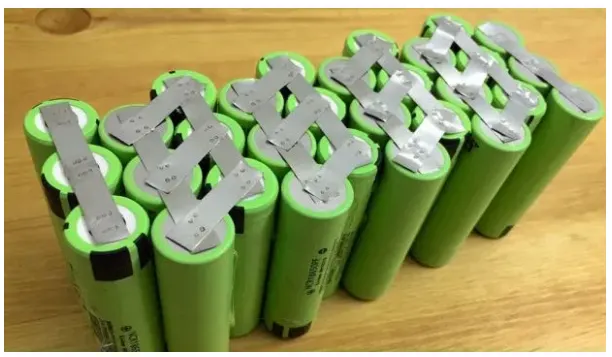
They are just covered by polymer sheet after the interconnections are made. Mostly connections with cell holder should be recommended for better safety concerns.
Battery cabinet arrangements:
Each models are interconnected in series or parallel according to the requirement and pack as a single large cabinet pack as shown below.
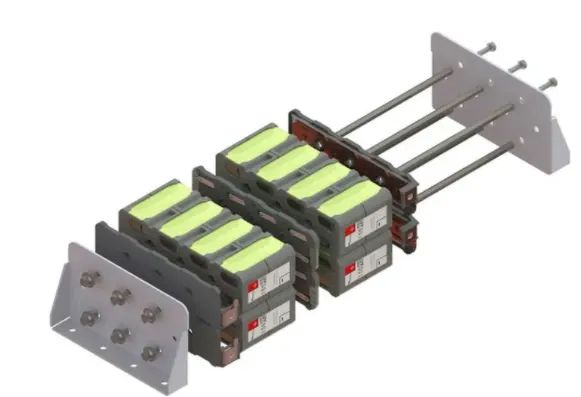
Battery pack arrangement:
Finally the overall battery pack after the arrangement of all cabinet connections with enclosures look like this as shown below
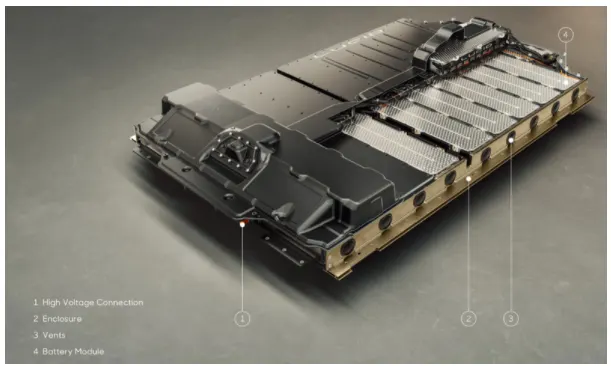
Vent holes are present with enclosure for cooling or heating the battery pack temperature according to its environment conditions.
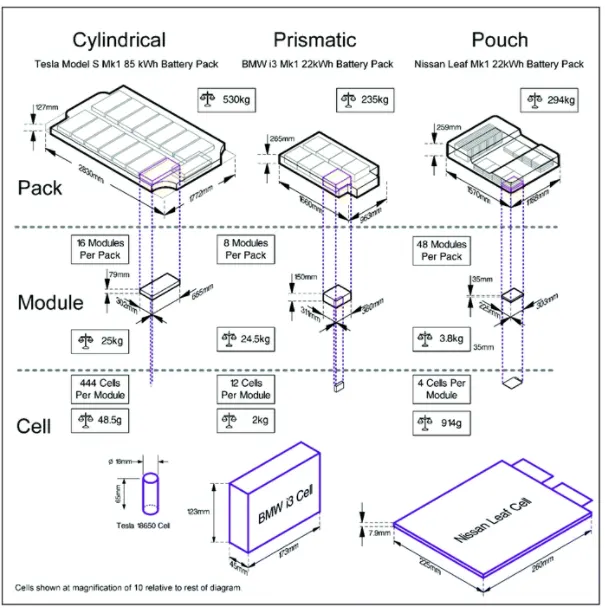
Different cell types are used by different manufacturers of such as cylindrical Prismatic pouch types:
The Pack Constructions are different for every manufacturers.
Below shown the battery pack construction process of Tesla BMW and Nissan Leaf.