Project 1 Hood
Hood Assembly
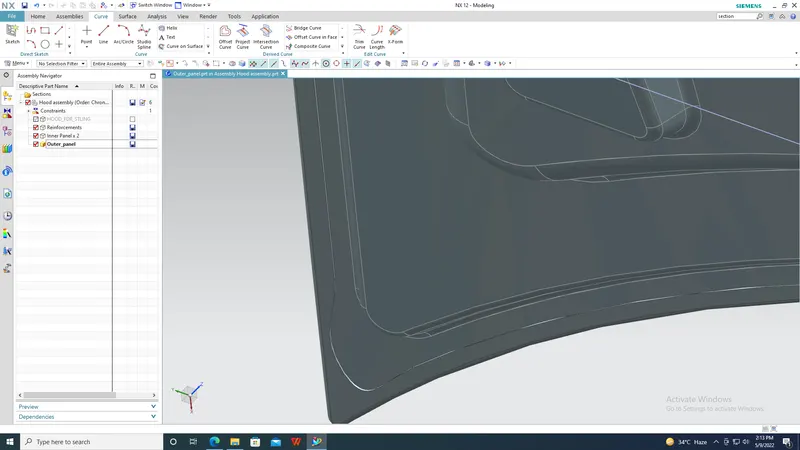
Objective: To create hood assembly with different parts in it.
Introduction: Hood is a part of car beneath which the engine and the other main parts of a car like transmission system, radiator are present.
Theory: Bonnets or hood assembly is a designed in such a way that, when there is a collision the passengers are safe and even the pedestrians are safe. Another important function of hood is to reduce the air resistance and provide an aerodynamic structure to the car. It also forms as an enclosure to the main parts of the car such as the engine, the radiator, transmission system etc.
The different components of the hood assembly are:
- Hood Outer panel.
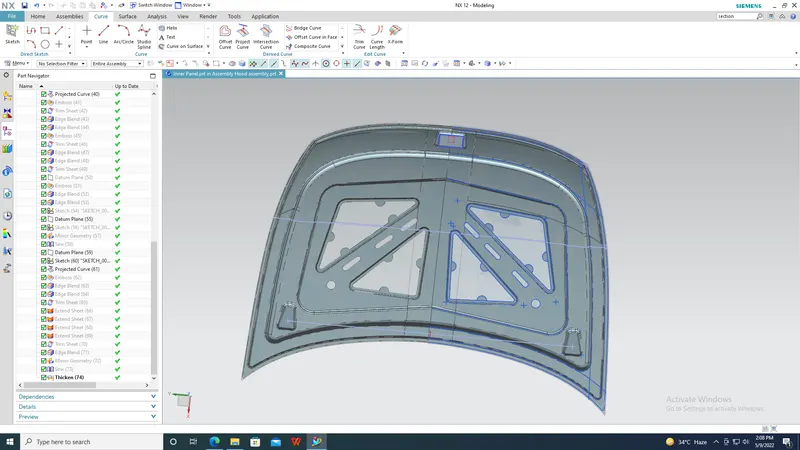
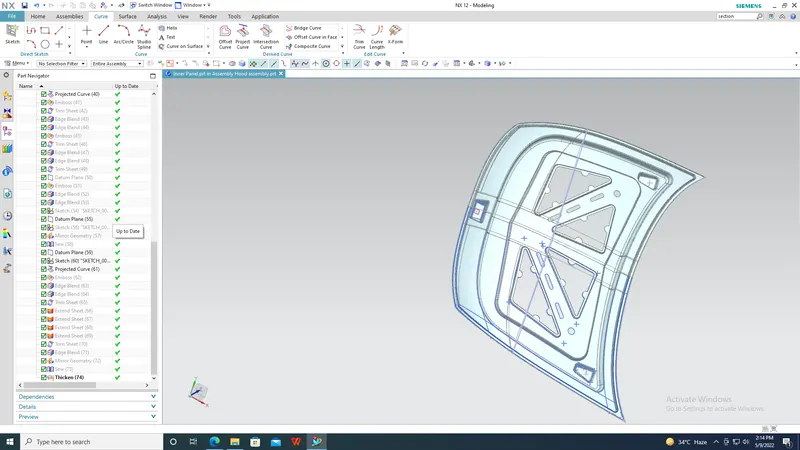
- Hood Inner panel.
- Hinge assembly.
Safety Requirements:
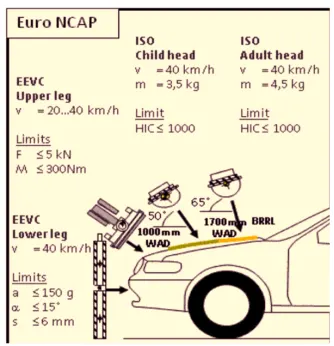
- The hood has to be designed in such a way that, upon collision, the pedestrian and the passengers inside the cars are safe. For this the inner panel of the hood has embosses. Upon collision the force gets dissipated towards the body of the car and not straight towards the passengers. This will make the impact less.
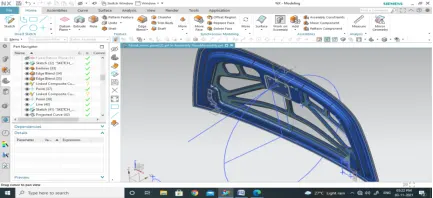
- The second major function of hood is the opening and closing of hood. The latch and striker should be positioned in such a way that the striker fits in properly. For this to happen, the striker positioning is very important. Draw the trajectory of the hood by taking the center of the hinge axis as the center of the circle. Draw a tangent line to the circle near the hook of the striker. Draw a line from the center of the hook and constrain the points of the line with the tangent using collinear constraint. The striker moves to the correct position.
Design methodology:
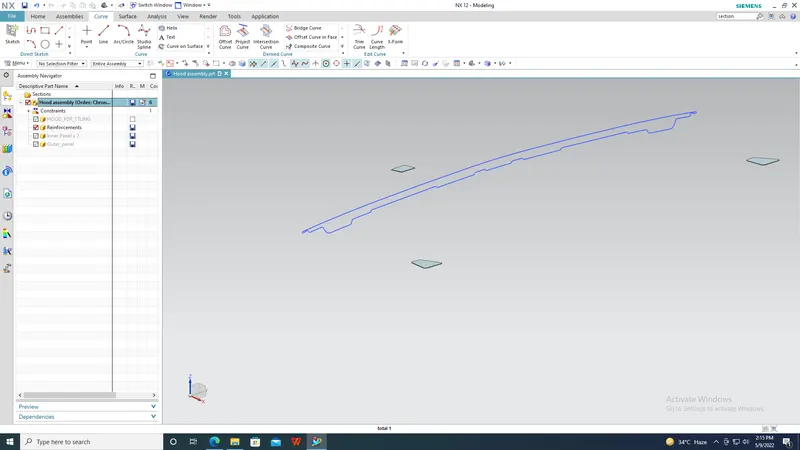
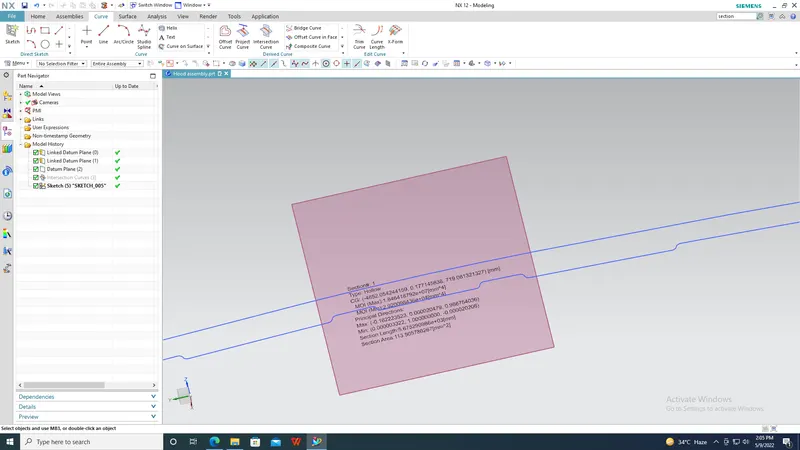
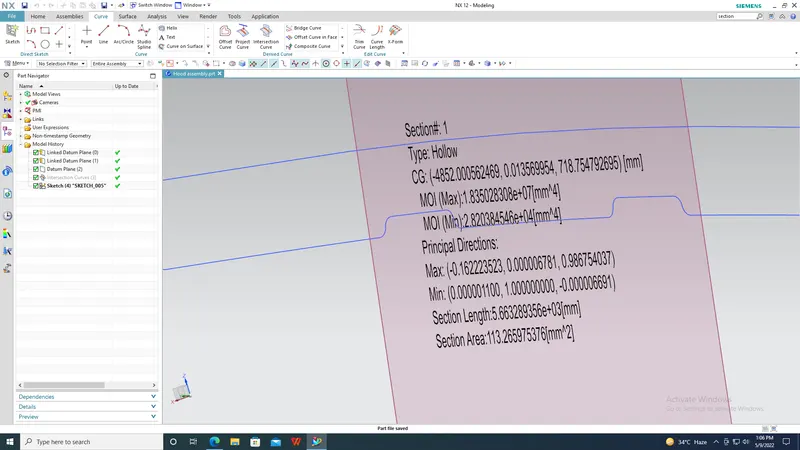
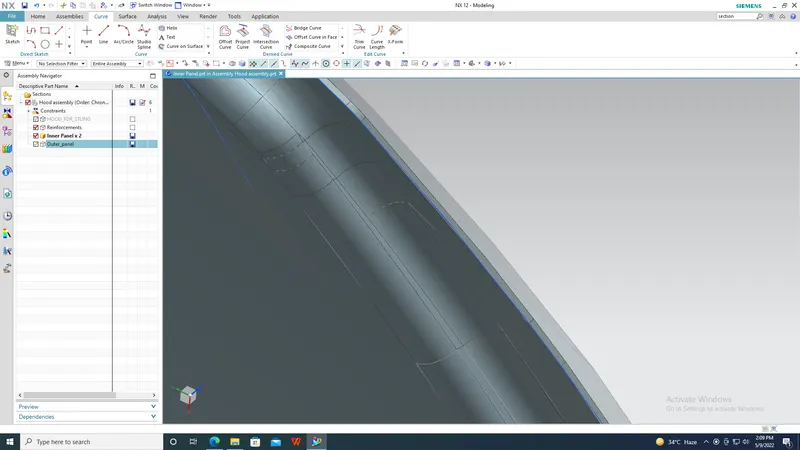
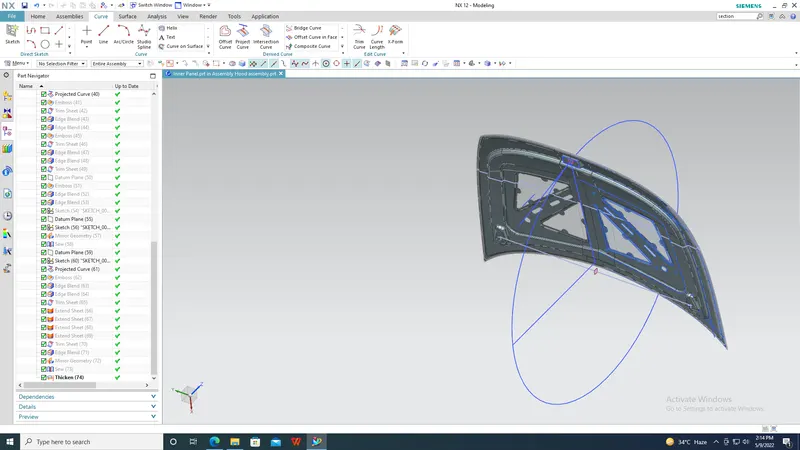
Based on the master section given to us we design the body of the inner panel. After the design of the main body embosses are made for the hinges and striker. Different shapes of embosses are made on the inner panel so that the force on collision is dissipated to the body upwards but not to the passengers. There should be 4-5mm gap between the embosses and outer panel.
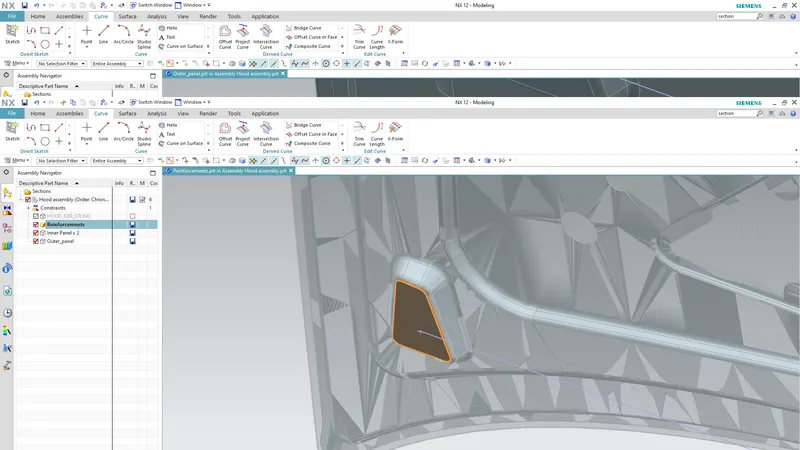
Hinge and striker reinforcements are necessary because when we fix a hinge or a striker we are adding weight to the hood. This makes the hood weak. To add strength at those points we make reinforcements.
While manufacturing a positive draft angle is given so that the punch after deep drawing leaves the sheet easily.
Mastics sealant points:
The mastic sealant is applied at these points, between inner panel and outer panel. Instead of using bolts and welds to join the inner and outer panel, it can be done by applying mastic sealants and hemming. Thus solving the aesthetic purpose. Initially it is in the form of paste but after a hot bath in a furnace it gets hardened. These also increase the strength of the panel. The influence of mastic sealant is around 80mm.
Hemming and relief:
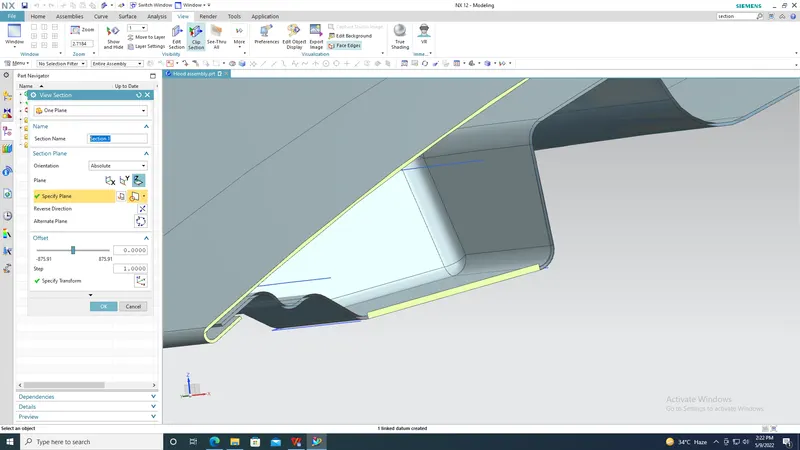
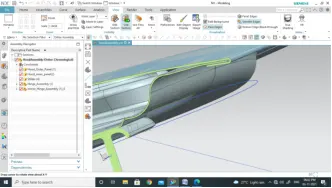
Hemming is a process by which the outer panel and inner panels are joined. The outer panel wraps around the inner panel. There is a gap given while hemming. This gap is filled with sealants. The gap is also given because wear and tear occurs when they are in contact.
Hemming is done with the help of rollers.
Conclusion:
- The necessary reinforcements are made- hinge reinforcements and striker reinforcement.
- The inner and outer panels are joined by using hemming process and by applying mastic points.
- All the parts are joined in the assembly.