Project 1 - Geometric Design Parameter- Prerequisites
Que-1List all the highway elements required for Road Geometric Design as prerequisites & necessary checklist during design. eg. Design Speed, Design Vehicle, etc.
Ans-The importance of these elements required for Road Geometric-
- Topography
- Design Speed
- Traffic Factors
- Design Hourly Volume and Capacity
- Environmental And Other Factors
- Topography-
- The topography or terrain conditions influence the design speed, which in turn governs the design of highway elements.
- The classification of topography is based on the cross slope of the country as Plain, Rolling, Mountainous and Steep.
- For Example in plain terrain On the state highway permissible design speed is 100 km/h, whereas the same speed on rolling terrain is permitted to 80 km/h & on the mountain, the terrain is 50 km/h.
-
A second important factor that affects the geometric design is topography. For plain terrain, it is very easy to construct the highway as per the standards. As the terrain and the gradient increase, the construction cost will increase for a specific design speed. So, to keep the construction cost and time under control, the geometric standards vary with different terrain or topography. This is hence classified as steeper gradients and sharper curves.
2-Design Speed-
- Design Speed of the vehicle depend upon the type of Topography or Terrain Classification and the road over which it moves. Examples- National Highway, State highway, Major District Road, Other district Road, Village Road.
- Design is the speed of the vehicle that helps in deciding the: cross-section element, width, clearance, side distance, the radius of the curve, superelevation, transition, gradient, length of the submit curve, etc.
- Speed is a parameter that has huge variations will the person driving, the vehicle type, the topography, etc. This is the reason why the design speed is taken as a primary factor in the geometric design of highways. The highest continuous speed, given that the weather conditions are conducive, to facilitate safety traveling of the vehicles is called the design speed. Legal speed is different from design speed. The legal speed is the speed at which drivers tend to travel beyond a safe speed. The desired speed is the maximum speed at which the driver can travel
when they are constrained using a local geometry or traffic. As mentioned before, speed is a factor that brings variations of different types. This requires having different vehicle design speeds to satisfy the requirement of all vehicle drivers. So, by the standard: the 85th percentile design speed is the normally adopted design speed. 85th percentile design speed can be defined as the speed which is higher than the speed taken by 85% of the drivers on that road. For some countries, this value will be in the range of 95 to 98 percentile speed.
3-Traffic Factors-
- Traffic factors include vehicle characteristics and human characteristics.
- To design highway elements standard size of the vehicle is considered (car) in case of mixed traffic operation.
- Human characteristics include the physical, mental, and psychological characteristics of drivers and Pedestrians.
-
It is of crucial importance in highway design, as is the traffic data both current and future estimates. Traffic volume indicates the level of services (LOS) for which the highway is being planned and directly affects the geometric features such as width, alignment, grades, etc., without traffic data it is very difficult to design any highway.
4-Design Hourly Volume and Capacity-
- The traffic volume fluctuates over time, hence the designing must be done for peak hours, but it will be highly uneconomical to do so.
- Hence designing is being done for a reasonable value of traffic volume termed as “Design Hourly Volume”.
-
The general unit for measuring traffic on the highway is the Annual Average Daily Traffic volume, abbreviated as AADT. The traffic flow (or) volume keeps fluctuating with time, from a low value during off-peak hours to the highest value during the peak hour. It will be uneconomical to design the roadway facilities for the peak traffic flow.
Environmental and other factors
Environmental factors like air pollution, noise pollution, landscaping, aesthetics, and other global conditions should be given due consideration in the geometric design of roads.
5-Environmental And Other Factors-
- environmental factor such as aesthetics air pollution, noise pollution, and landscaping also governs the design of the Highway element.
- The geometric design of a highway is performed by considering the following elements:
Weights and Dimensions of Road Vehicles - Terrain Classification and the design of speed
- Design of Cross-section of road
- Super-elevation
- Curves-Horizontal
- Sight Distances
- Gradients Curves Vertical
Important Characteristics of Vehicles for Geometric Design of Highways-
Width of the Vehicle: The width of the traffic lanes and shoulders, and the parking space are influenced by the width of the vehicle.
Height of the Vehicle: The clearance that is provided for overhead structures like bridges, overhanging branches of roadside trees, and electrical lines is dependent on the height of the vehicle.
Overall Length of Vehicle: Overall length of a vehicle influences the design of bridges, the horizontal curves, the valley curves, and safety regulations.
Vehicle Load: The vehicle load influences the design of bridges, the thickness of the pavement, and the design of the ruling gradient.
Vehicle Speed: The vehicle speed affects the design of:
- Superelevationion
- Limiting radius
- Sight distances
- Width of pavement in straights and curves
- Grades
- Provision of guard rails
- Width of shoulder
- Protection of railroad crossing
- Treatment of inter-sections
- Capacity of a lane for traffic
Design Vehicle:-
- Design vehicles to affect the turning radios and extra widening proved.
- Design vehicles consisting of standard weight dimensions and operating character
- The dimension weight and the characteristics of the vehicle influence the gradient, turning radius width of the carriageway the clearance requirement, and other geometry features.
- The standard design vehicle shall be applicable in designing all types of roads.
- Three types of commercial vehicles have been recognized.
1-Single Unit
2-Semi Trailer
3-Truck Trailer combination
The selection depends upon terrain conditions economic justification and the importance of the road.(IRC-3)
|
National for Vehicle Types (IRC-3 1983) |
|||||||
|
Vehicle Types |
Maximum Gross weight(TON) |
Maximum Axle Wight(TON) |
|||||
|
Truck/Tractor |
Trailer |
||||||
|
FAW |
RAW |
FAW |
RAW |
||||
|
Type-2(Both Axle Single Types) |
12 |
6 |
6 |
||||
|
Type-2(FA Single Tyers) |
16.2 |
6 |
10.2 |
||||
|
Type-3 |
24 |
6 |
18(TA) |
||||
|
Type-2 S1 |
26.4 |
6 |
10.2 |
10.2 |
|||
|
Type-2 S2 |
34.2 |
6 |
10.2 |
18(TA) |
|||
|
Type-3 S1 |
34.2 |
6 |
18(TA) |
10.2 |
|||
|
Type-3 S2 |
42 |
6 |
18(TA) |
18(TA) |
|||
|
Type-2-2 |
36.6 |
6 |
10.2 |
10.2 |
10.2 |
||
|
Type-3-2 |
44.4 |
6 |
18(TA) |
10.2 |
10.2 |
||
|
Type-2-3 |
44.4 |
6 |
10.2 |
10.2 |
18(TA) |
||
|
Type-3-3 |
52.2 |
6 |
18(TA) |
10.2 |
18(TA) |
||
|
FA-Front Axle, RA-Rear Axle, FAW-Wight on front Axle, RAW-Weight on Rear Axle, TA-Tandom Axle fitted with 8 Tyres |
|||||||
- Axle Weight: “Axle Weight” means about an axle of a vehicle the total weight transmitted by the several wheels attached to that axle to the surface on which the vehicle rests.
- Articulated Vehicle: “Articulated Vehicle” means a motor vehicle to which a semitrailer is attached.
- Weight: “Weight” means the total weight transmitted for the time being by the wheels of a vehicle to the surface on which the vehicle rests.
- Registered Axle Weight: “Registered Axle Weight” means in respect of the axle of any vehicle, the axle weight certified and registered by the registering authority as permissible for that axle.
- Tractor: “Tractor” means a motor vehicle that is not itself constructed to carry any load (other than equipment used for propulsion), but excludes a road roller.
- Trailer: “Trailer” means any vehicle, other than a semi-trailer and a sidecar, drawn or intended to be drawn by a motor vehicle.
- Semi Trailer: “Semi-Trailer” means a vehicle not mechanically propelled (other than a trailer), which is intended to be connected to a motor vehicle and which is so constructed that a portion of it is superimposed on, and a part of whose weight is borne by, that motor vehicle.
Transport Vehicle: “Transport Vehicle” means a public service vehicle, a goods carriage, an educational institution bus, or a private service vehicle.
Cross-section Elevements-
The features of the cross-section of the pavement influence the life of the pavement as well as the riding comfort and safety. Of these, pavement surface characteristics affect both of these. Camber, kerbs, and geometry of various cross-sectional elements are important aspects to be considered in this regard. They are explained briefly in this chapter.
Pavement surface characteristics-
For safe and comfortable driving four aspects of the pavement surface are important; the friction between the wheels and the pavement surface, smoothness of the road surface, the light reflection characteristics of the top of the pavement surface, and drainage to water.
Friction between the wheel and the pavement surface is a crucial factor in the design of horizontal curves and thus the safe operating speed. Further, it also affects the acceleration and deceleration ability of vehicles. Lack of adequate friction can cause the skidding or slipping of vehicles.
Skidding happens when the path traveled along the road surface is more than the circumferential movement of the wheels due to friction
Slip occurs when the wheel revolves more than the corresponding longitudinal movement along the road.
Various factors that affect friction are:-
Type of pavement (like bituminous, concrete, or gravel),
Condition of the pavement (dry or wet, hot or cold, etc),
Condition of the tire (new or old), and
Speed and load of the vehicle.
The frictional force that develops between the wheel and the pavement is the load acting multiplied by a factor called the coefficient of friction and denoted as f. The choice of the value of f is a very complicated issue since it depends on many variables. IRC suggests the coefficient of longitudinal friction as 0.35-0.4 depending on the speed and the coefficient of lateral friction as 0.15. The former is useful in sight distance calculation and the latter in horizontal curve design.
It is always desirable to have an even surface, but it is seldom possible to have such one. Even if a road is constructed with high-quality pavers, it is possible to develop unevenness due to pavement failures. Unevenness affects the vehicle's operating cost, speed, riding comfort, safety, fuel consumption and wear and tear of tires.
The unevenness index is a measure of unevenness which is the cumulative measure of vertical undulations of the pavement surface recorded per unit horizontal length of the road. An unevenness index value less than 1500 mm/km is considered as good, a value less than 2500 mm. km is satisfactory up to a speed of 100 mph, and values greater than 3200 mm/km are considered as uncomfortable even for 55 km.
Light reflection
White roads have good visibility at night but caused glare during day time.
Black roads have no glare during the day but have poor visibility at night
Concrete roads have better visibility and less glare
The road surface must be visible at night and the reflection of light is the factor that answers it.
Drainage-
The pavement surface should be impermeable to prevent seepage of water into the pavement layers. Further, both the geometry and texture of the pavement surface should help in draining out the water from the surface in less time.
Camber-
Camber or cant is the cross slope provided to raise the middle of the road surface in the transverse direction to drain off rainwater from the road surface. The objectives of providing camber are:
Surface protection especially for gravel and bituminous roads
Sub-grade protection by proper drainage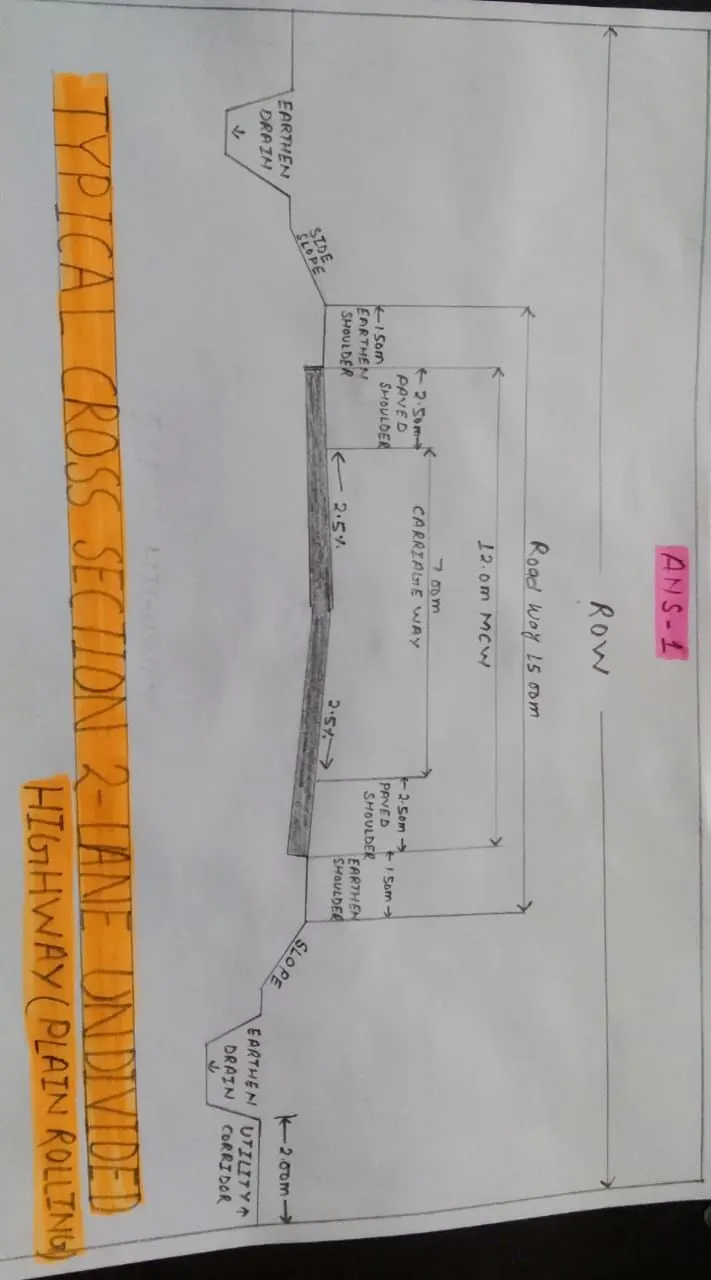
Quick drying of pavement which in turn increases safety
The too-steep slope is undesirable for it will erode the surface. Camber is measured in 1 in n or n% (Eg. 1 in 50 or 2%) and the value depends on the type of pavement surface. The values suggested by IRC for various categories of pavement are given in Table 1. The common types of camber are parabolic, straight, or a combination of