Project 1 - Design and Develop an IOT-based Wireless Wearable Health Monitoring System
MEDI-WATCH (Smart Wrist Watch)
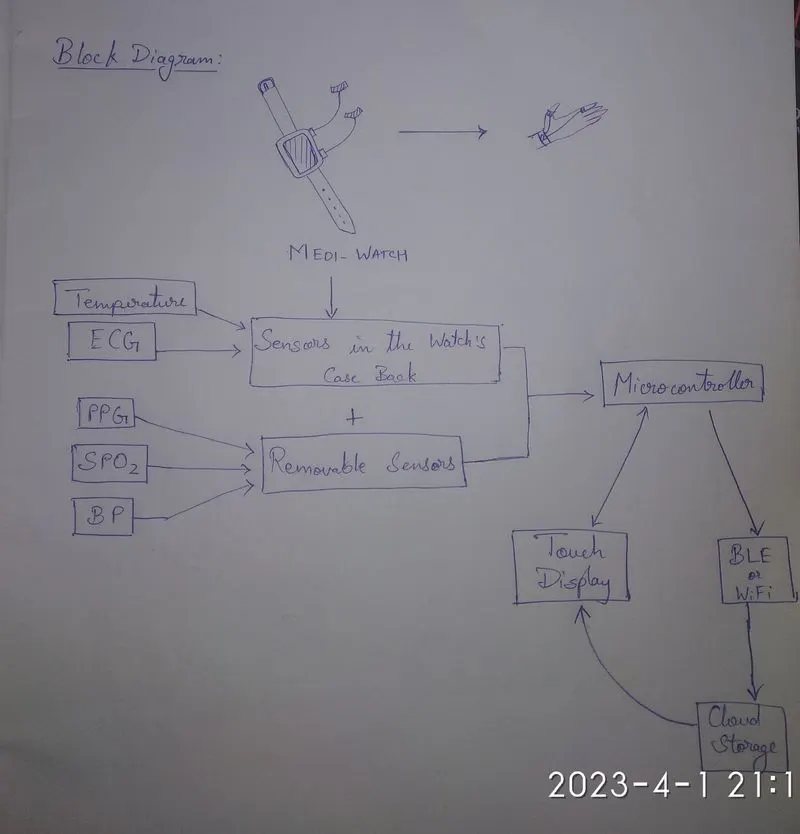
Medi-Watch is a Smart Wearable IOT Based Device Capable of
Monitoring realtime health parameters and records them.
To design an IoT sensor for acquiring ECG, heart rate, pulse oximeter, blood pressure, and body temperature, we would need the following components:
- ECG sensor: An ECG sensor would measure the electrical activity of the heart and produce an ECG waveform.
- Heart rate monitor: A heart rate monitor would measure the beats per minute of the heart and transmit the data to the IoT device.
- Pulse oximeter: A pulse oximeter would measure the oxygen saturation level in the blood and the heart rate.
- Blood pressure monitor: A blood pressure monitor would measure the systolic and diastolic blood pressure and transmit the data to the IoT device.
- Temperature sensor: A temperature sensor would measure the body temperature and transmit the data to the IoT device.
- IoT device: The IoT device would be responsible for collecting the data from all the sensors and transmitting it to a remote server or cloud.
- Power source: The IoT sensor would require a reliable power source to keep it operational.
Once we have all the required components, we can proceed with the following steps to design the IoT sensor:
- Connect the ECG sensor, heart rate monitor, pulse oximeter, blood pressure monitor, and temperature sensor to the IoT device.
- Ensure that all the sensors are calibrated and producing accurate readings.
- Install the necessary software on the IoT device to collect data from all the sensors.
- Configure the IoT device to transmit the collected data to a remote server or cloud.
- Ensure that the power source is sufficient to keep the IoT sensor operational.
- Test the IoT sensor to ensure that it is collecting accurate data and transmitting it reliably.
- Finally, deploy the IoT sensor in the desired location and monitor its performance remotely.
By following these steps, we can design an IoT sensor that can acquire ECG, heart rate, pulse oximeter, blood pressure, and body temperature. Such a sensor could be useful in a variety of healthcare settings, including hospitals, clinics, and remote patient monitoring.
Specification of Parameters
ECG:
- Frequency: 0.05 Hz to 100 Hz
- Amplitude: ± 5 mV
- Sensor: ECG electrodes placed on the chest
- The ECG signal can be wirelessly transmitted using Bluetooth Low Energy (BLE) or Wi-Fi.
Heart rate:
- Frequency: 0.5 Hz to 3 Hz
- Amplitude: ± 5 mV
- Sensor: Photoplethysmography (PPG) sensor placed on the fingertip or earlobe
- The PPG signal can be wirelessly transmitted using BLE or Wi-Fi.
Pulse oximeter:
- Frequency: 0.5 Hz to 5 Hz
- Amplitude: ± 50% of the blood oxygen saturation level
- Sensor: PPG sensor placed on the fingertip or earlobe
- The PPG signal can be wirelessly transmitted using BLE or Wi-Fi.
Cuffless blood pressure:
- Frequency: 0.05 Hz to 100 Hz
- Amplitude: ± 5 mmHg
- Sensor: PPG sensor placed on the fingertip or earlobe
- The PPG signal can be wirelessly transmitted using BLE or Wi-Fi.
Body temperature:
- Frequency: Not applicable
- Amplitude: Not applicable
- Sensor: Temperature sensor such as a thermistor or infrared sensor placed on the skin surface
- The temperature reading can be wirelessly transmitted using BLE or Wi-Fi.
Note that the specific sensors used may vary depending on the design of the wireless health monitoring system. Additionally, the frequency and amplitude ranges provided are general guidelines and may vary depending on the specific requirements of the system.
Flow Diagram:
Design factors:
Designing an IoT-based wearable device for health monitoring involves careful consideration of several factors, including the following:
- Power consumption: Since the wearable device is expected to be worn by the user for extended periods, the device's power consumption should be optimized to extend battery life. Designers can achieve this by using low-power sensors, microcontrollers, and wireless communication protocols. Additionally, the device can be designed to have power-saving modes and sleep modes when not in use.
- Comfort and ergonomics: The wearable device should be designed to be comfortable to wear and not interfere with the user's daily activities. The device should be lightweight and compact, and its shape and size should be optimized to fit various body types.
- Sensor accuracy and reliability: The accuracy and reliability of the sensors used in the wearable device are crucial in ensuring accurate health monitoring. The sensors should be selected based on their ability to provide reliable and accurate data under various conditions, including when the user is active, stationary, or sleeping.
- Data security: Since the wearable device is expected to collect sensitive health data, it is crucial to ensure the security of this data. The device should be designed to use secure wireless communication protocols, and data encryption should be implemented to protect against data breaches.
- User interface: The wearable device should have a user-friendly interface that allows the user to interact with the device easily. The user interface can be designed using buttons, touchscreens, or voice commands. Additionally, the device can be designed to provide feedback to the user, such as through visual or audio cues.
- Compatibility: The wearable device should be designed to be compatible with various smartphones, tablets, and other devices that users may use to access their health data. This can be achieved by using open standards and protocols for wireless communication.
Artifacts:
During the acquisition of signals from the sensors in the wearable device, various types of noise can be added to the signals. The following are some common types of noise and ways to overcome them:
- Power-line noise: Power-line noise is a type of noise caused by the presence of electromagnetic fields from power lines. This type of noise can affect the quality of ECG and PPG signals. To overcome power-line noise, the wearable device can be designed to use shielding techniques to reduce the impact of electromagnetic fields.
- Motion artifact noise: Motion artifact noise is caused by movement or motion of the user's body. This type of noise can affect the quality of ECG, PPG, and blood pressure signals. To overcome motion artifact noise, the wearable device can be designed to use advanced signal processing techniques such as adaptive filtering or wavelet decomposition to remove the noise from the signals.
- Environmental noise: Environmental noise is a type of noise caused by external factors such as wind or temperature changes. This type of noise can affect the quality of temperature and blood pressure signals. To overcome environmental noise, the wearable device can be designed to use temperature sensors that are shielded from the environment or use temperature compensation techniques to remove the effects of environmental noise.
- Sensor noise: Sensor noise is a type of noise caused by the inherent characteristics of the sensors used in the wearable device. To overcome sensor noise, the wearable device can be designed to use high-quality sensors with low noise characteristics. Additionally, advanced signal processing techniques such as Kalman filtering can be used to remove the noise from the signals.
In summary, various types of noise can be added to the signals acquired from sensors in the wearable device. To overcome these types of noise, the wearable device can be designed to use shielding techniques, advanced signal processing techniques, temperature compensation techniques, or high-quality sensors with low noise characteristics.
Communication Protocols:
If Wi-Fi or Bluetooth Low Energy (BLE) is used to transmit data from the wearable device to a smartphone or other device, the following communication protocols may be proposed:
- Wi-Fi: Wi-Fi is a commonly used wireless communication protocol for high-bandwidth applications such as video streaming and file transfers. When using Wi-Fi for data transmission, the device can be designed to support the IEEE 802.11 standard, which is the standard for wireless local area networks (WLANs). Wi-Fi Direct is also an option, which allows two devices to communicate with each other directly without the need for an access point.
- Bluetooth Low Energy (BLE): BLE is a low-power wireless communication protocol that is commonly used in IoT applications. BLE operates on the 2.4 GHz frequency band and is designed for short-range communication. When using BLE for data transmission, the device can be designed to support the Generic Attribute Profile (GATT) and the Generic Access Profile (GAP), which are standard protocols for BLE communication.
Both Wi-Fi and BLE have their advantages and disadvantages. Wi-Fi provides faster data transmission rates and a longer range but consumes more power, while BLE consumes less power and is suitable for short-range communication. The choice of communication protocol depends on the specific requirements of the wearable device and the intended use case.
Flow Diagram of Data Acquisition:
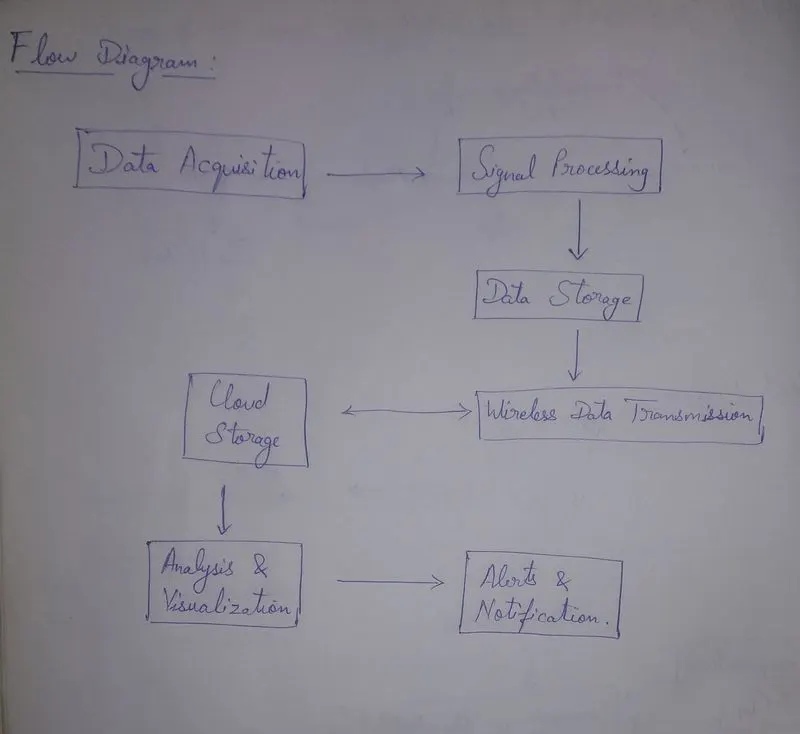
- Data Acquisition: The wearable device will collect data from various sensors such as ECG, PPG, temperature, and blood pressure sensors.
- Signal processing: Once the data is collected, it will be processed using advanced signal processing techniques to remove any noise or artifacts present in the data.
- Data storage: The processed data will be stored in a local memory module within the wearable device for further processing and analysis.
- Wireless data transmission: The data will be wirelessly transmitted to a nearby device such as a smartphone or a tablet using a wireless communication protocol such as Wi-Fi or Bluetooth Low Energy (BLE).
- Cloud storage: The transmitted data will be stored in a cloud storage service for further analysis and processing.
- Analysis and visualization: The stored data will be analyzed using advanced data analytics techniques to gain insights into the user's health status. The results will be visualized in an easy-to-understand manner for the user or healthcare provider to interpret.
- Alerts and notifications: If any abnormalities are detected in the data, the wearable device will generate alerts or notifications to alert the user or healthcare provider about the issue.
Cloud Computing:
Using a Cloud Computing approach to build in intelligence in the data being received from the IoT sensors for the wearable device can provide many benefits, such as improved data analysis, enhanced visualization, and real-time monitoring. The following are some features that can be built into the system:
- Cloud-based data storage: The system can be designed to store all the collected data in a cloud-based storage system, which provides more significant data storage capacity, data accessibility, and data security.
- Advanced analytics: The cloud-based platform can leverage advanced analytics techniques such as machine learning, artificial intelligence, and predictive analytics to gain insights into the user's health status, detect anomalies, and predict potential health issues.
- Real-time monitoring: The system can be designed to monitor the user's health status in real-time. This can enable healthcare providers to intervene immediately when necessary, potentially saving lives.
- Alerts and notifications: The cloud-based platform can be designed to generate alerts and notifications when abnormal data patterns are detected, prompting healthcare providers to take action quickly.
- User-friendly interface: The platform can be designed to present the collected data in an easy-to-understand and user-friendly manner. This can help users and healthcare providers make informed decisions about the user's health status.
- Data privacy and security: The platform can be designed to ensure data privacy and security, which is especially crucial for sensitive medical data.
- Integration with other systems: The cloud-based platform can be designed to integrate with other systems such as electronic health records, telemedicine systems, and hospital information systems. This can provide a more comprehensive view of the user's health status, improving the quality of care delivered.
In case of Emergency:
Here's a scenario of how an emergency situation will be handled and the flow of events when there are abnormal values acquired:
- The wearable device continuously monitors the user's physiological parameters such as heart rate, blood pressure, and body temperature.
- If abnormal values are detected, the device will generate an alert and send it to the cloud-based platform.
- The platform will use advanced analytics to analyze the data and determine the severity of the situation.
- If the situation is deemed critical, an emergency notification will be sent to the user's designated emergency contacts and healthcare providers, along with the user's location.
- The emergency contacts and healthcare providers will receive the notification and take appropriate action to provide assistance to the user.
- If a false alarm is detected, the device will send a notification to the user to confirm if they are okay.
- If the user confirms that they are okay, the false alarm will be recorded in the system as a non-critical event.
- If the user does not respond to the notification, the device will initiate a second notification, and if there is still no response, the emergency contacts and healthcare providers will be notified.
Overall, the system is designed to handle emergency situations in a timely and efficient manner, while also minimizing false alarms. False alarms are an inevitable part of any monitoring system, but the system can be designed to minimize them by incorporating advanced analytics and user feedback mechanisms.
Storing Data in Centralised Database:
For the wearable device mentioned above, a centralized database can be used to store the collected data. Here are the steps for storing and retrieving the data from the centralized database:
- Establish a connection between the wearable device and the cloud-based platform where the centralized database is located.
- Configure the database schema to store the data collected from the wearable device. The schema should include all necessary fields such as timestamps, physiological parameters, and user identifiers.
- Set up a data collection pipeline to transfer the data from the wearable device to the centralized database. The pipeline should include data cleaning and data validation steps to ensure the integrity of the data.
- Store the collected data in the centralized database. The data can be stored in a structured manner using a relational database management system (RDBMS) or in an unstructured manner using a NoSQL database.
- To retrieve the data from the centralized database, query the database using SQL or NoSQL commands based on the user's requirements.
- Filter and process the retrieved data to generate insights and visualizations that are useful for the user and healthcare providers.
- Provide secure access to the retrieved data to authorized personnel such as the user, healthcare providers, and emergency contacts.
Automatic Detection of Abnormal Condition:
For the automatic detection of abnormal conditions in the physiological parameters and generation of alarms, the system can be programmed as follows:
- Collect the data from the wearable device at regular intervals and store it in a centralized database.
- Define thresholds or ranges for each physiological parameter based on the user's baseline data and medical history. These thresholds can be set by healthcare providers or customized by the user.
- Continuously monitor the physiological parameters and compare them to the defined thresholds. If any parameter falls outside of the defined threshold or range, the system will flag it as an abnormal condition.
- Apply advanced analytics techniques such as machine learning to the data to detect abnormal patterns or anomalies that may not be captured by the predefined thresholds.
- Generate an alarm or notification to alert the user, healthcare providers, and emergency contacts of the abnormal condition. The alarm can be sent via email, text message, or push notification.
- Provide recommended actions or interventions to the user or healthcare providers based on the severity of the abnormal condition. For example, for a critical emergency, the system can advise the user to seek medical attention immediately, while for a less severe condition, it can provide guidance on lifestyle changes or medication adjustments.
- Monitor the user's response and provide follow-up notifications or interventions as needed.
Overall, the system can be programmed to handle emergencies by providing timely alerts and recommended actions to the user and healthcare providers. The system can also be integrated with emergency response services to ensure that emergency contacts are notified in a timely manner in case the user is unable to respond. By combining advanced analytics and customized thresholds, the system can provide personalized and accurate detection of abnormal conditions and improve healthcare outcomes for the user.
Security:
When designing an IoT-based health monitoring system, it is important to consider the security aspects to protect the privacy and confidentiality of the user's sensitive health data. Here are some security aspects that can be built into the system:
- Authentication and Authorization: The system should implement strong authentication and authorization mechanisms to ensure that only authorized users can access the data. This can be achieved through multi-factor authentication, role-based access control, and encryption.
- Encryption: All data in transit and at rest should be encrypted using secure encryption algorithms to prevent unauthorized access and ensure data confidentiality.
- Data Integrity: The system should ensure data integrity by implementing measures such as message authentication codes (MACs) and digital signatures to prevent data tampering.
- Firewalls and Intrusion Detection Systems (IDS): The system should have firewalls and IDS to protect against network attacks and unauthorized access.
- Data Backup and Disaster Recovery: The system should have a robust backup and disaster recovery plan in place to ensure that data is not lost in case of a security breach or system failure.
- Regular Security Audits: Regular security audits should be conducted to identify vulnerabilities and assess the effectiveness of security controls.
- Privacy: The system should adhere to privacy laws and regulations such as HIPAA and GDPR, and should implement privacy-enhancing technologies such as differential privacy to protect the user's privacy.
- User Education: Users should be educated on the importance of data security and privacy, and provided with guidance on how to protect their personal health data.
To launch the IoT-based health monitoring product in the market, the following procedure can be followed:
- Conduct Market Research: Conduct a thorough market research to identify the target audience, demand for the product, and competitors in the market. This can be done through surveys, focus groups, and interviews.
- Develop a Business Plan: Develop a comprehensive business plan that outlines the product features, pricing strategy, marketing plan, distribution channels, and revenue model.
- Prototype Development: Develop a working prototype of the product to demonstrate its functionality and features. The prototype can be refined based on user feedback and testing.
- Obtain Regulatory Approvals: Depending on the country or region, the product may need to obtain regulatory approvals from relevant authorities such as the FDA, CE, or ISO.
- Manufacturing: Finalize the manufacturing process and establish relationships with suppliers and manufacturers.
- Marketing and Advertising: Develop a marketing plan to promote the product through various channels such as social media, email marketing, and advertising.
- Distribution: Determine the distribution channels for the product and establish partnerships with retailers or online marketplaces to reach the target audience.
- Launch: Launch the product in the market and monitor its performance and customer feedback. Based on the feedback, make necessary improvements and updates to the product.
- Post-Launch Support: Provide customer support and after-sales service to ensure customer satisfaction and loyalty.
If there are 10 users of the IoT-based health monitoring wearable device connected to a hospital, the concept can work as follows:
- Each user would wear the wearable device, which would continuously monitor their physiological parameters such as ECG, heart rate, pulse oximeter, cuffless blood pressure, and body temperature.
- The data collected by the wearable device would be transmitted wirelessly to a cloud-based server, where it would be stored securely in a centralized database.
- The hospital staff would be able to access the data from the centralized database using a secure login and password. They would be able to view the real-time data and historical trends for each user.
- The hospital staff could set up alerts and notifications for abnormal values detected in the data. For example, if a user's heart rate or blood pressure exceeds a certain threshold, the staff would receive an alert and take appropriate action.
- The hospital staff could also use the data to monitor the health status of the users remotely, and provide timely interventions if necessary. For example, if a user's ECG shows signs of a heart attack, the staff could immediately dispatch an ambulance to their location.
- In case of an emergency, the hospital staff could use the data to provide personalized medical care for the user based on their health history and current condition.
- The hospital staff would ensure that the user's health data is kept confidential and protected from unauthorized access. They would also ensure that the data is backed up regularly and is accessible in case of a disaster or system failure.
Overall, the concept of IoT-based health monitoring wearable device can be scaled up to accommodate multiple users connected to a hospital. By leveraging the power of cloud computing and real-time data analytics, hospitals can provide personalized and proactive care to their patients, improve clinical outcomes, and reduce healthcare costs.
* NOTE: Please find the Attachment.