Project 1 - Creation of user defined data type to implement the user interfaces for working with ‘Set’ (Mathematical Set theory) using Linked List
OBJECTIVE :
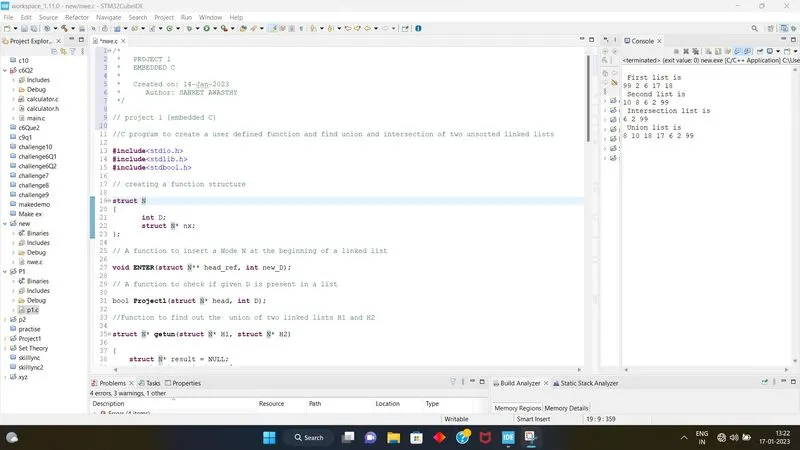
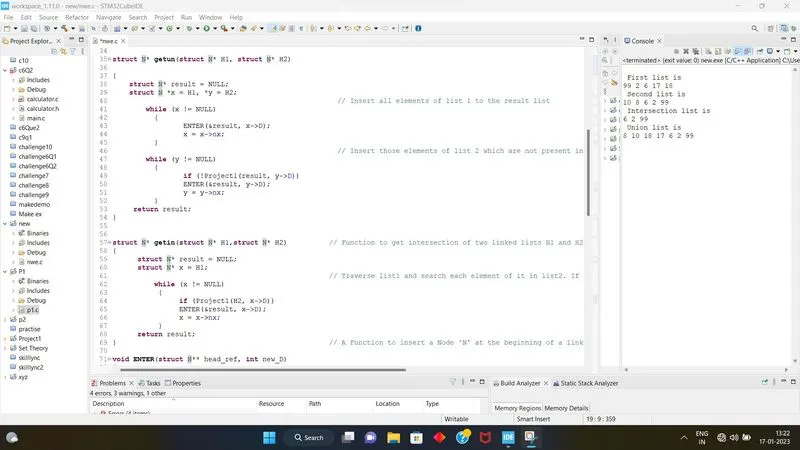
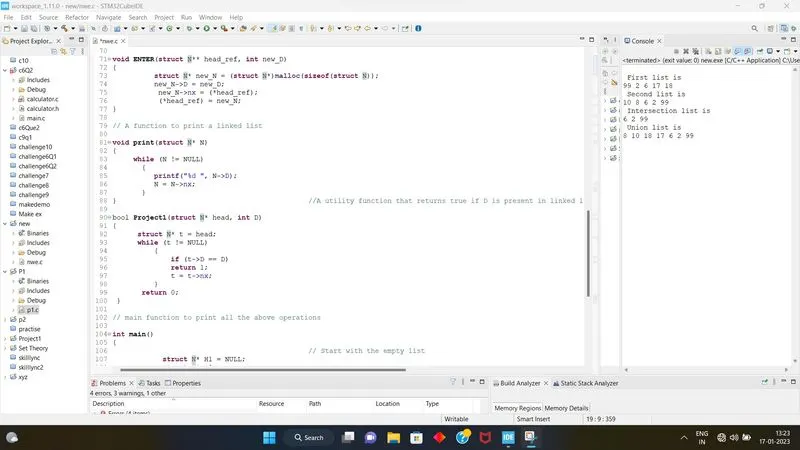
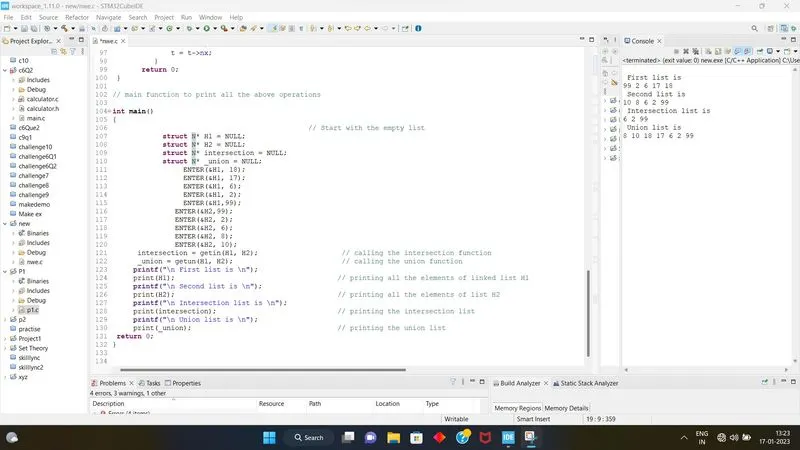
In this project 1 of Embedded C essentials I write a C program to Create a user defined function to implement the user interface for working with mathematical set theory find the union and intersection of elements of two sets by using linked list.
What is linked list ?
A linked list is a data structure in C programming language that consist of a sequence of elements, each containing a reference / link to the next element in the sequence. the elements are typically called nodes, and each node contains two fields: one for the data and one for the link. The last element in the list typically has null link, indicating the end of the list.
key highlights of the project:
- Implimentation of Mathematical set theory using linked list.
- Creation of user defined data type to represant sets.
- use a linked list to dynamically allocates memory for sets
- use #include<stdbool.h> header file that defines the boolean data type 'bool' and the constants 'true' and 'false' in this program.
- Interface for performing set operations like union and intersection.
- use appropriate data structures and algorithms.
- Extensive testing and debugging to ensure the programs correctness and robustness.
overview and other features:
In this project I have created a user defined data type to implement the user interface for working with mathematical set using linked list. This project will allow the user to perform basic set operations such as union and intersection, on the set represanted by linked list. The user defined data type will make it easy to work with sets and the linked list implementation will allow for dynamic memory allocation, making the program efficient and versatile.
use of 'stdbool.h' : This header file was introduced in C99, the latest version of C programming language standard, and it is intended to provide the way to use boolean values in C without having to rely on non standard libraries or conventions. it is typically used as a way represent true or false values in C, and it is compatible to the standard logic operators