Project 1 - Creation of user defined data type to implement the user interfaces for working with ‘Set’ (Mathematical Set theory)
Answer :-
MATHEMATICAL SET THEORY:-
Set Theory is the branch of mathematical logic that studies sets, which can be informally described as collections of objects.
A venn diagram illustrating the intersection of two sets.
Union of the sets A and B, denoted A U B, is the set of all objects that are a member of A or B or both. For ex, the union of {1,2,3} and {2,3,4} is the set {1,2,3,4}.
Intersection of the sets A and B, denoted A ∩ B, is the set of all objects that are members of both A and B. For ex, the intersection of {1,2,3} and {2,3,4} is the set {2,3}.
CODE:-
/*
============================================================================
Name : main.c
Author :
Version :
Copyright : Your copyright notice
Description : Hello World in C, Ansi-style
============================================================================
*/
#include "list.h" //including header file//
int main() //main function//
{
int i,first_list_nodes=0,first_list_items=0,second_list_nodes=0,second_list_items=0; //initializing integer variables//
printf("enter the number of nodes in first list:"); //printing the message and requesting for input//
fflush(stdout); //clear cache memory//
scanf("%d",&first_list_nodes); //reads and stores the data//
printf("enter %d the elements:",first_list_nodes); //printing message to enter first list elements//
for(i=0;i<first_list_nodes;i++) //for loop to scan the first list elements//
{
fflush(stdout); //clear cache memory//
scanf("%d",&first_list_items); //reads and stores the data//
head1=insert_node(head1,first_list_items); //calling insert node function//
}
display_list(head1); //display function called to display the elements//
printf("\n\nenter the number of nodes in second list:"); //printing the message and requesting for input//
fflush(stdout); //clear cache memory//
scanf("%d",&second_list_nodes); //reads and stores the number of datas//
printf("enter %d the elements:",second_list_nodes); //print the message and request the second list//
for(i=0;i<second_list_nodes;i++) //for loop to scan the second list elements//
{
fflush(stdout); //clear cache memory//
scanf("%d",&second_list_items); //reads and stores the data//
head2=insert_node(head2,second_list_items); //calling insert node function//
}
display_list(head2); //display function called to display the elements//
printf("\n"); //next line//
res_union=get_union(head1,head2); //calling function result of union//
printf("\nhere is the result of union:"); //print the message//
display_list(res_union); //display function to display the elements of union//
printf("\n");
res_intersection=get_intersection(head1,head2); //calling function result of intersection//
printf("\nhere is the result of intersection:"); //print the message//
display_list(res_intersection); //display function called to display the elements of intersection//
}
/*
* list.h
*
* Created on: 25-Apr-2022
* Author: mehul
*/
#ifndef LIST_H_ //header file definition//
#define LIST_H_ //defining list.h header file//
#include <stdio.h> //preprocessor//
#include <stdlib.h> //preprocessor//
#include <stdbool.h> //preprocessor//
typedef struct node //defining the node//
{
int data; //declaring integer type data//
struct node *next; //declaring pointer next in structure node//
}Node;
static Node *head1,*head2,*head,*head_union,*head_intersection,*newnode,*tail,*res_union,*res_intersection; //declaring variables as static node//
Node *insert_node(Node *head_ref,int n); //defining the function for insert node//
void display_list(Node *head_ref); //defining the function for display of list//
Node *get_union(Node *head_pointer1,Node *head_pointer2); //defining the function for get union//
Node *get_intersection(Node *head_pointer1,Node *head_pointer2); //defining the function for intersection of elements//
int compare(Node *head,int data); //defining the function for comparision of elements//
#endif /* LIST_H_ */ //end of list.h header file//
/*
* list.c
*
* Created on: 25-Apr-2022
* Author: mehul
*/
#include "list.h" //including list.h header file//
void display_list(Node *head_ref) //definition of display function//
{
if(head_ref==0) //if condition to check address head_ref is zero//
{
printf("list is empty."); //if condition is true print the message//
}
else //if condition is false continue with else//
{
tail=head_ref; //assigning tail i.e,last data address pushed as head_ref//
while(tail !=0) //while loop to check tail is not equal to 0//
{
printf("%d",tail->data); //print the data entered by user//
tail=tail->next; //assigning tail as next address//
}
tail=newnode; //assigning tail to newnode//
}
}
Node *insert_node(Node *head_ref,int n) //definition of insert node//
{
printf("\ninserting elements at the begining...\n"); //print the message//
newnode=(Node*) malloc(sizeof(Node)); //assigning new address with size//
printf("address of created newnode:%p\n",newnode); //print the address of newnode//
newnode->data =n; //push the data of newnode into n//
printf("inserted value is :%d\n",newnode->data); //printing the data of newnode//
newnode->next = head_ref; //assigning the next address to head_ref//
head_ref = newnode; //assigning the address to newnode//
return head_ref; //return to head reference//
}
Node *get_union(Node *head_pointer1,Node *head_pointer2) //definition of get union//
{
while(head_pointer1 !=0) //while loop to check head pointer1 not equal to 0//
{
head_union = insert_node(head_union,head_pointer1->data); //calling insert node function, printing the data of headpointer1 and saving in head union//
head_pointer1 = head_pointer1->next; //next address//
}
while(head_pointer2 !=0) //while loop to check headpointer2 not equal to 0//
{
if(!compare(head_union,head_pointer2->data)) //if condition and calling compare to check if any data present in union present in headpointer2//
head_union = insert_node(head_union,head_pointer2->data); //if the data of headpointer2 not present in head union then copy it in head union//
head_pointer2 = head_pointer2->next; //else go to next data//
}
return head_union; //return program to head_union//
}
int compare(Node *head,int data) //definition of compare function//
{
while (head != NULL) //while loop to check head not equal to null//
{
if(head->data == data) //if condition to check head of data equal to data//
return 1; //if condition is true return that value//
head = head->next; //else assign head to next address//
}
return 0; //return to main program//
}
Node *get_intersection(Node *head_pointer1,Node *head_pointer2) //definition of intersection function//
{
while(head_pointer1 !=0) //while loop to check headpointer1 not equal to 0//
{
if (compare(head_pointer2, head_pointer1->data)) //if condition and calling compare to get common elements//
head_intersection = insert_node(head_intersection,head_pointer1->data); //if condition is true calling insert node function and assigning the data into intersection//
head_pointer1 = head_pointer1->next; //else going to next address//
}
return head_intersection; //return to head intersection in main function//
}
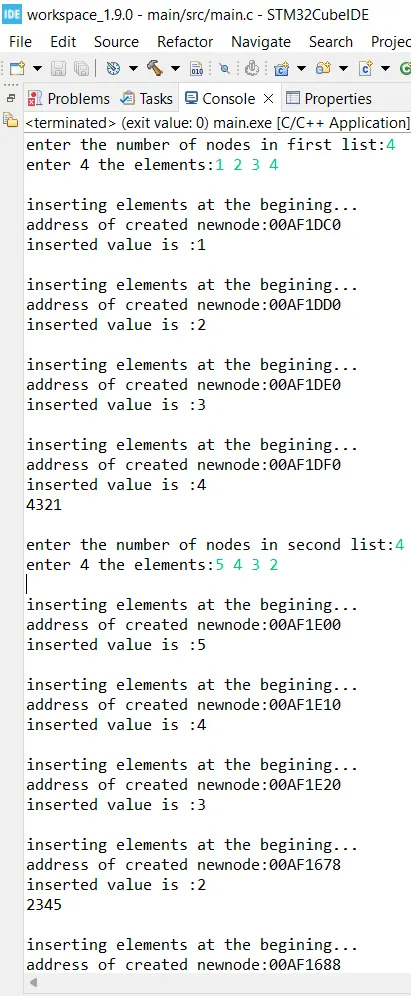
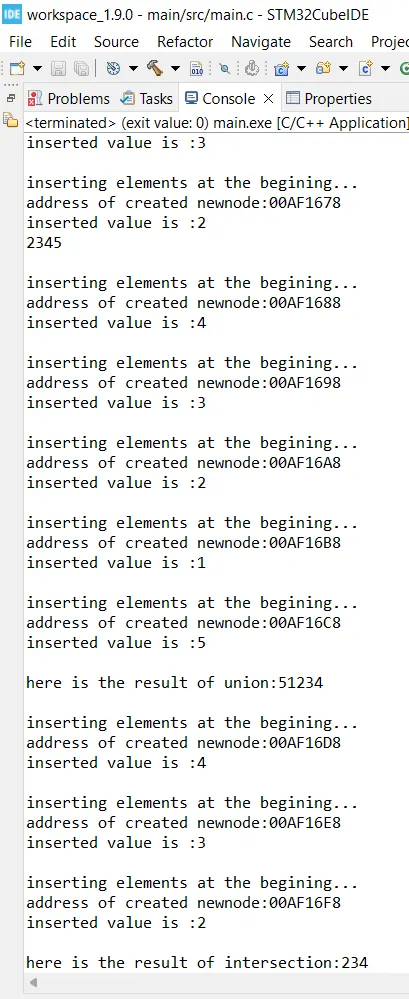
OUTPUT WINDOW:-
OVERVIEW OF THE PROJECT:-
This program gives the overall view of the mathematical set theory, which helps us to find a union from a set of datas. It also helps us to find a intersection elements from the set of datas. The program helps us to get a sufficient knowledge of the c programming language. It helps us how to create header files and source files and making the program to look easier. This program has a various functions, conditional functions and several methods to create the program. This program helps us how to call a function and how to terminate the function.
GOALS:-
- The implementation of interface for mathematical set theory using c programming is done which is showed in the code.
- The set of datas are given and the union and intersection of these sets has been shown in output window.(image address:-https://sklc-tinymce-2021.s3.amazonaws.com/comp/2022/04/Screenshot%20(145)_1650970574.png)
- The two sets given are {1,2,3,4} and {2,3,4,5} the union of these sets we got is {1,2,3,4,5} and intersection of sets we got is {2,3,4}.
Key Highlights of the Project:-
- The creation of 2 lists of data using linked list has been achieved in the program.(refer the screenshots attached)
- The insert node function is used to insert the node 1st and 2nd list accordingly.
- The intersection of data of two list is done by using the intersection function which operates and provides the output.
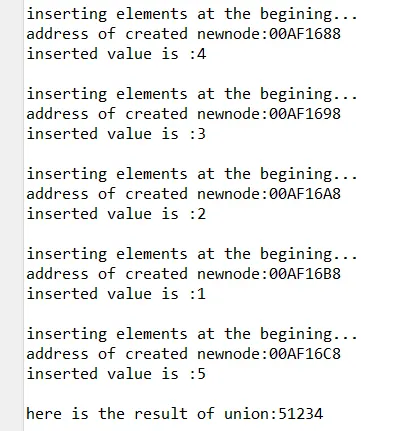
- The union of two list is achieved by using the function union which helps to get the result.
Deliverables of this project:-
- Intersection of data of two lists is shown below in the screenshot :
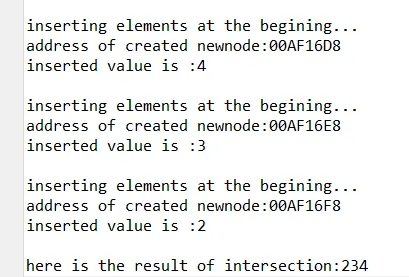
- The two sets {1,2,3,4} and {5,4,3,2} has common elements of {2,3,4}, hence the result we got is 234.
- The two sets {1,2,3,4} and {5,4,3,2} whose union is the elements of both the sets {1,2,3,4,5} is the result.
- Union of data of two lists is shown below in the screenshot :
OUTCOMES OF THE PROGRAM:-
- The program helps us to gain a knowledge of creating the nodes using linked list.
- It helps us to perform the union of two sets or data of two lists.
- It also helps us to find the intersection of two sets or data of two lists.
- It also helps us to compare the elements of two lists or two sets.
- It also helps us to display the elements of union and intersection using different methods.
- The program is very interesting and enjoy executing it.
- The required documents and files of the program are uploaded for the reference.