Project 1_Comparative study of different storey buildings for Seismic forces
Factors influencing the dynamic characteristics of a building :-
* Buildings oscillate during earthquake shaking. The oscillation causes inertia force to be induced in the building.
* The intensity and duration of oscillation, and the amount of inertia force induced in a building depend on features of buildings, called their dynamic characteristics, in addition to the characteristics of the earthquake shaking (beyond the control of an engineer) itself.
* The important dynamic characteristics of buildings are modes of oscillation and damping (assumed constant in most practical cases). A mode of oscillation of a building is defined by associated Natural Period and Deformed Shape in which it oscillates.
* Every building has a number of natural frequencies (how many?), at which it offers minimum resistance to shaking induced by external effects (like earthquakes and wind) and internal effects (like motors fixed on it).
* Each of these natural frequencies and the associated deformation shape of a building constitute a Natural Mode of Oscillation.
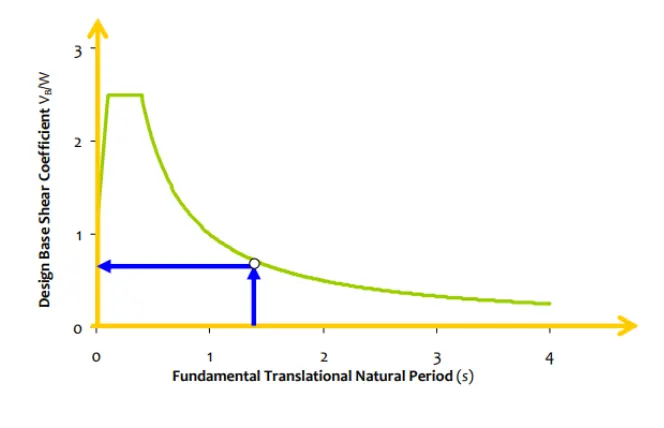
* The mode of oscillation with the smallest natural frequency (and largest natural period) is called the Fundamental Mode; the associated natural period T1 is called the Fundamental Natural Period.
* Regular buildings held at their base from translation in the three directions, have two fundamental translational natural periods, Tx1 and Ty1, associated with its horizontal translational oscillation along X and Y directions, respectively, and one fundamental rotational natural period Tθ1 associated with its rotation about an axis parallel to Z axis.
Factors influencing the Natural Period of a building :-
Structural Element Sizes
- Beams : 300x400mm
- Columns : 400x400mm
- Slab : 150mm thick
Material Properties
- Grade of concrete : M30
- Grade of steel Reinforcement Bars : Fe415
Loading
- Dead Load on beams from infill wall : 10kN/m
- Live load on Floor : 3kN/m2
(what is the seismic mass?)
Buildings are assumed tobe pinned at base
Five storey benchmark Building: Elevation and plan of benchmark building showing the structural moment frame grid(All dimensions are in mm)
Note
1.Bay length in each plan direction is 4m(center to center).
2.All columns at each storey are of the same size.
3.All beams in all buildings are of the same size(300mmx400mm).
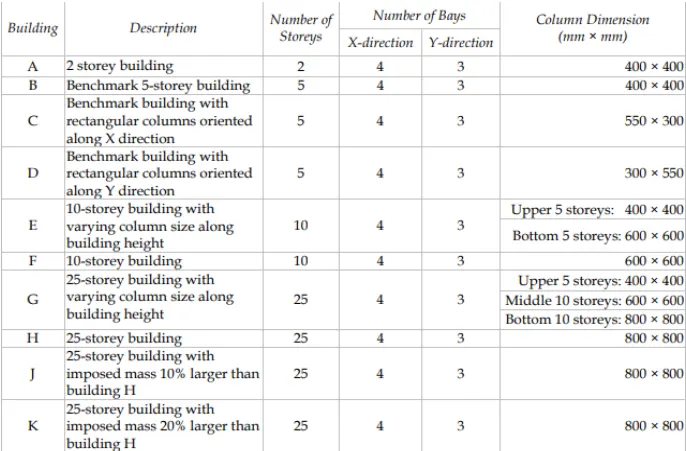
Buildings considered to illustrate concept of natural period: Details of 10buildings considered.
* Effect of stiffness on T : Compare fundamental natural periods of buildings E and F as well as G and H. Why is there a marginal or significant difference in the fundamental natural periods?
* Effect of mass on T : Compare fundamental natural periods of buildings H,J and K. Have the buildings become more flexible or stiff due to change in mass?
* Effect of Building Height on T : How does the fundamental natural periods of Buildings A,B,F and H change with in building height?
* Effect of Column Orientation on T : How does the fundamental natural periods of Buildings B,C and D change with change in column orientation?
Factors influencing the Mode shape of oscillations :-
* Mode shape of oscillation associated with a natural period of a building is the deformed shape of the building when shaken at the natural period. Hence, a building has as many mode shapes as the number of natural periods.
* For a building, there are infinite numbers of natural period. But, in the mathematical modeling of building, usually the building is discretized into a number of elements. The junctions of these elements are called nodes. Each node is free to translate in all the three Cartesian directions and rotate about the three Cartesian axes. Hence, if the number of nodes of discretization is N, then there would be 6N modes of oscillation, and associated with these are 6N natural periods and mode shapes of oscillation.
* Effect of Flexural Stiffness of Structural Elements on mode shapes: Compare fundamental mode shape of Building B in two situations when flexural stiffness of beams relative to that of adjoining columns is very small versus when it is large.
* Effect of Axial Stiffness of Vertical Members on mode shapes: Compare fundamental mode shape of Building H in two situations when axial cross-sectional area of columns is very small versus when it is large.
* Effect of Degree of Fixity at column bases on mode shape: Compare fundamental mode shape of Building B in two situations when base of columns is pinned versus when it is fixed.
Aim :-
Structural Element Sizes
- Beams : 300x400mm
- Columns : 400x400mm
- Slab : 150mm thick
Material Properties
- Grade of concrete : M30
- Grade of steel Reinforcement Bars : Fe415
Loading
- Dead Load on beams from infill wall : 10kN/m
- Live load on Floor : 3kN/m2
(what is the seismic mass?)
Buildings are assumed tobe pinned at base
Five storey benchmark Building: Elevation and plan of benchmark building showing the structural moment frame grid(All dimensions are in mm)

Note
1.Bay length in each plan direction is 4m(center to center).
2.All columns at each storey are of the same size.
3.All beams in all buildings are of the same size(300mmx400mm).
Buildings considered to illustrate concept of natural period: Details of 10buildings considered.