Project 1
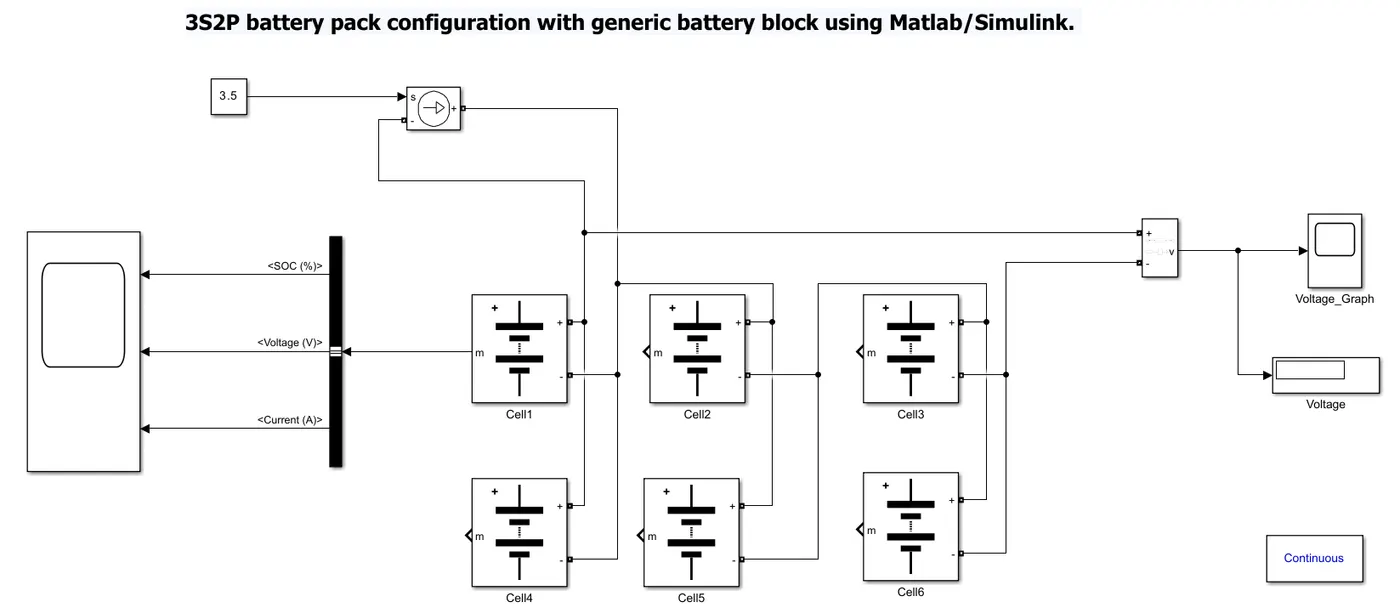
Que1: Design a battery pack for a car roughly 150 Kw with 120 V. Use 3500 mAh 3.6V nominal NMC chemistry cell. Build a 3S2P battery pack configuration with generic battery block using Matlab/Simulink.
a. Design the battery pack configuration.
b. Draw the BMS topology for this battery pack.
Ans:
1) Aim of the Project
The aim of this project is to design a battery pack for an electric vehicle with specified power and voltage requirements using NMC chemistry cells. The battery pack must be safe, reliable, and efficient, ensuring high energy density and power output. Additionally, a Battery Management System (BMS) will be designed to monitor and control the battery pack for safe and optimal operation. A MATLAB/Simulink model will be developed to simulate a 3S2P pack configuration.
2) Battery Pack Design and configuration
To determine the number of cells required in series and parallel, we perform the following calculations:
i) Specifications:
- Power Requirement: 150 kW
- Rated Voltage: 120 V
- Cell Chemistry: NMC (Lithium Nickel Manganese Cobalt Oxide)
- Cell Capacity: 3500 mAh (3.5 Ah)
- Cell Nominal Voltage: 3.6V
ii) Battery current capacity
Battery Current capacity (I) = Power / Voltage = 150 kW / 120 V = 1250 Ah
So, we need to design battery configuration with 150 kW, 120 V, 1250 Ah
iii) Cells in Series
The number of cells required in series to achieve the desired pack voltage:
No. of cells in series = Battery Pack Voltage / Nominal Cell Voltage
= 120 V / 3.6 V = 34 cells
iv) Cells in Parallel
The number of parallel cells required to supply this current:
No. of cells in parallel = Total Current Requirement / Nominal Cell Capacity
= 1250 Ah / 3.5 Ah = 358 cells
v)Final Battery Pack Configuration:
- Series Connection: 34 cells
- Parallel Connection: 358 cells
- Total Cells in the Battery Pack: 34 × 358 = 12,212 cells
This configuration ensures the required power output while maintaining reliability and efficiency.
3) BMS topology for this battery pack.
A Battery Management System (BMS) is essential for monitoring, protecting, and managing the battery pack. It ensures optimal performance and longevity by tracking the State of Charge (SOC), State of Health (SOH), and State of Function (SOF) while preventing overcharging, over-discharging, and overheating.
Battery Management System (BMS) topology refers to the architecture used to monitor and manage battery packs in electric vehicles (EVs), energy storage systems, and other applications. It determines how battery cells, sensors, and control units communicate to ensure safe and efficient battery operation.
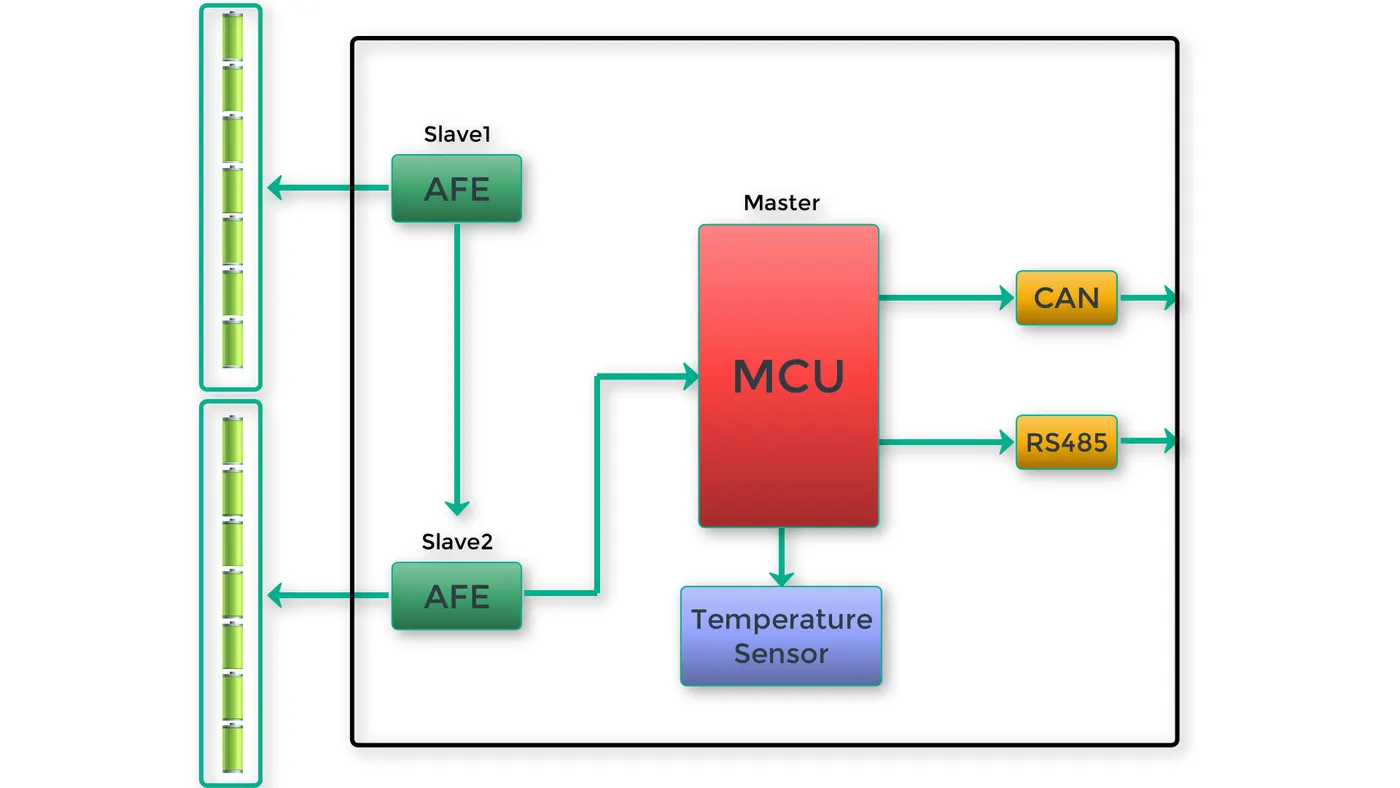
The battery pack consists of 34 cells in series and 358 cells in parallel. The AFE can connected to the 18 cells at a time
Total AFE Required = 34 / 18 = 2 AFE
So we we have to use a master-slave configuration for battery management.
Que 2) Build a 3S2P battery pack configuration with generic battery block using Matlab/Simulink.
Ans:
1) Battery Terms and Definitions:
- Capacity: The amount of energy a battery can deliver in a single discharge, expressed in amp-hours (Ah) or watt-hours (Wh).
- Charge Rate (C-Rate): The charge/discharge current as a proportion of the rated capacity (Ah).
- Example: A 500mAh battery at C/2 rate = 250mA, at 2C rate = 1A.
- Constant-Current Charge: Charging at a fixed current regardless of battery voltage.
- Constant-Voltage Charge: Charging at a fixed voltage regardless of current drawn.
- Cycle Life: The number of charge-discharge cycles before the capacity falls to 80% of the rated capacity.
- Cut-off Voltage: The voltage at which discharge is terminated, also called End-of-Discharge voltage.
- Energy Density: Battery's energy storage per unit volume, measured in Wh/l.
- Power Density: Battery's power output per unit volume, measured in W/l.
- Rated Capacity: Total charge a fully charged battery can provide under specified discharge conditions, measured in Ah.
- Self-Discharge: Loss of charge over time, typically expressed as a percentage of capacity lost per month at a given temperature.
- Specific Energy: Battery's energy storage per unit mass, measured in Wh/kg.
- Specific Power: Battery's power output per unit mass, measured in W/kg.
2) Block Used:
1) Battery
2) Voltage Measurement
3) Controlled Current Source
4) Bus Selector
5) Scope
6) Display
7) Powergui
8) Constant Block
3) Model:
4) Battery Pack Specifications:
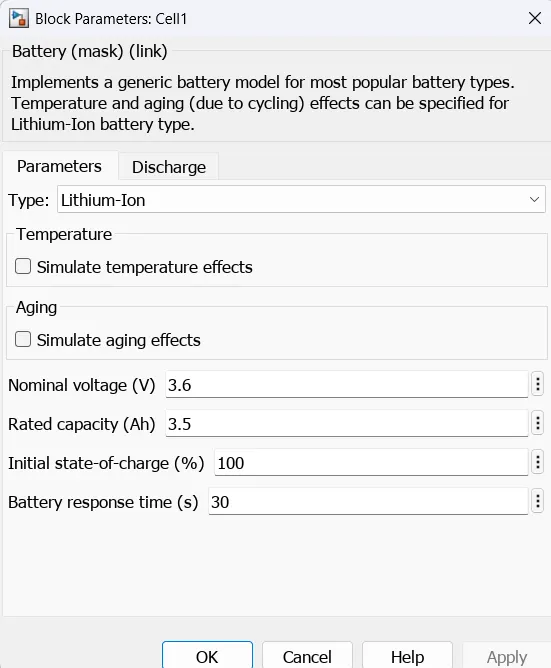
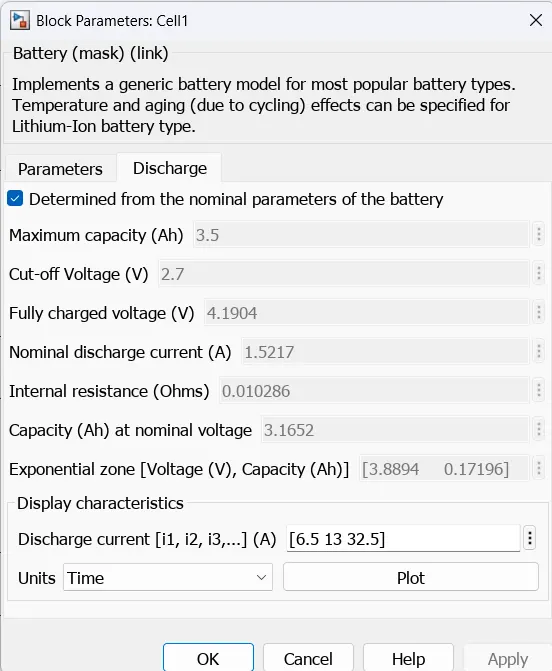
- Nominal Voltage of Cell: 3.6V
- Rated Capacity of Cell: 3.5Ah
- Maximum Voltage of Cell: 4.2V
- Total Number of Cells = No. of Cells in Series × No. of Cells in Parallel
= 3*2 = 6 cells
- Nominal Voltage of Battery Pack = No. of Cells in Series × Nominal Voltage of a Cell
= 3*3.6 = 10.8V
- Rated Capacity of Battery Pack = No. of Cells in Parallel × Rated Capacity of a Cell
=2*3.5 = 7Ah
- Overall Voltage of Battery Pack = Maximum Voltage of Cell × No. of Cells in Series
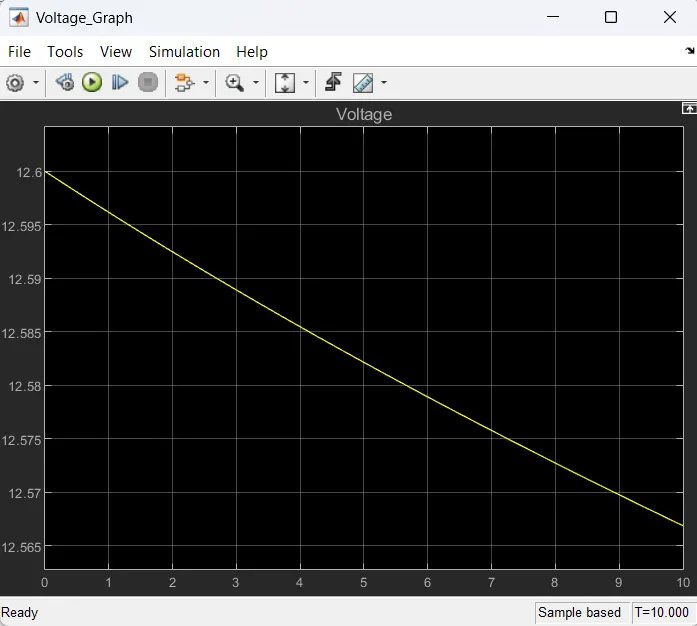
= 4.2*3 = 12.6 V
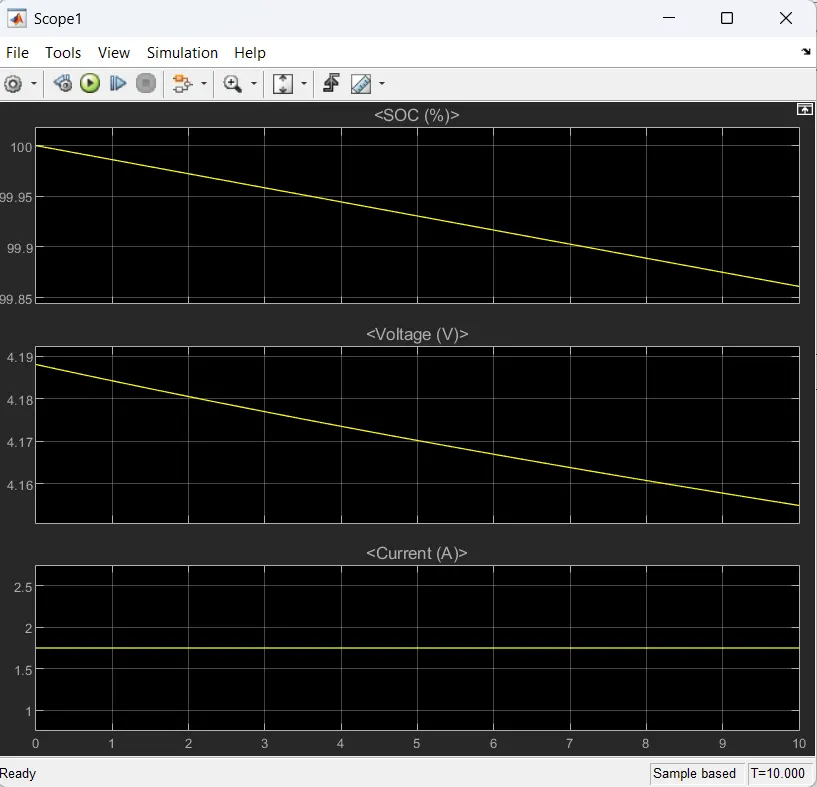
6) Result:
1) Voltage
2) SOC %, Voltage, Current