Project 1 - 2D meshing on the instrumental Panel
OBJECTIVE:
Importing Instrument panel geometry into ANSA.
Clean up the geometry until no topological error is found.
Generate mid surface for the whole component including features.
Mesh the component using manual mesh with given quality criteria.
Improve the mesh flow and solve off elements.
link for the component i am unable to upload due to size :
https://drive.google.com/file/d/1oF9ic3eGucd7mbT5B-b2Te9neRo3P-Nu/view?usp=sharing
QUALITY CRITERIA USED:
|
S.No |
Quality Criteria |
Value |
|
1 |
Target/Average length |
4 |
|
2 |
Minimum Length |
2 |
|
3 |
Maximum Length |
6 |
|
4 |
Aspect |
3 |
|
5 |
Warpage |
15 |
|
6 |
Skewness |
45 |
|
7 |
Jacobian |
0.7 |
|
8 |
Minimum Quad Angle |
45 |
|
9 |
Maximum Quad Angle |
135 |
|
10 |
Minimum Tria Angle |
30 |
|
11 |
Maximum Tria Angle |
120 |
|
10 |
Tria Percentage |
15 |
ABSRTACT:
In this Project-1,
ANSA pre-processor is used to generate mid surface using various
options like casting, offset, middle etc. Created 2D interpretation of the parent geometry.
Extended mid surfaces in order to connect all the generated mid surfaces. Mesh the
component using spot with given quality criteria. Cleared off elements without any kinks
or raised edges
here I have mesh by using castinng method
INTRODUCTION:
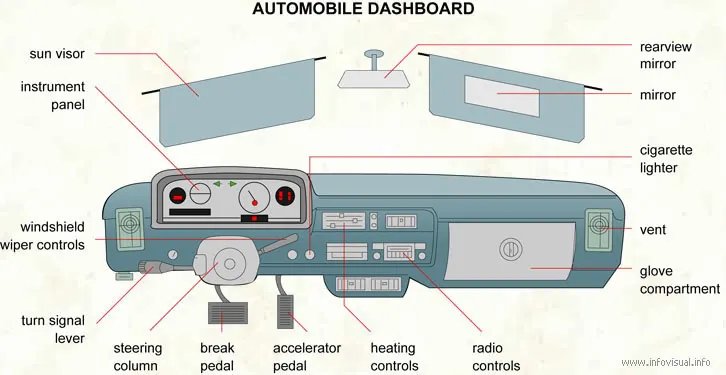
A dashboard (instrument panel (IP), or fascia) is a control panel usually located directly
ahead of a vehicle's driver, displaying instrumentation and controls for the vehicle's
operation. These days car dashboards may include so many indicators like
speedometer, tachometer, odometer, fuel gauge, turn indicators, gearshift position
indicator, seat belt warning light, engine-malfunction lights. Other features may include
a gauge for alternator voltage, indicators for low fuel, low oil pressure, low tire pressure
and faults in the airbag (SRS) systems, lighting controls, safety systems, entertainment
equipment, navigation systems etc
Dashboard can be made from metal as the simplest and cheapest way. This could be
the same base metal as the car, which is steel or Aluminium. The more expensive luxury
Cars are made of exotic wood with a highly polished finish. Usually, top layer on old cars
is PVC. More recently, dashboard coverings have been made of PVC blended with
something called ABS. ABS is an acronym for a block copolymer made of acrylonitrile,
butadiene, and styrene.
PROCEDURE:
Step 1:
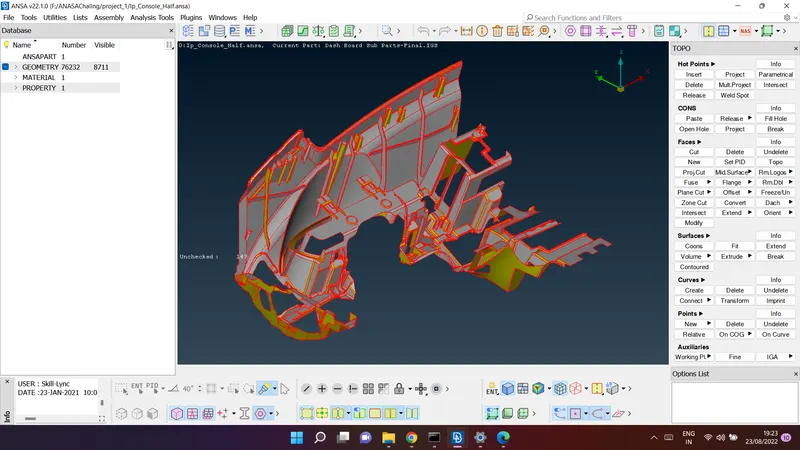
Import the geometry into ANSA and do topo to stitch the surfaces. Assign PID for
the whole geometry.
Step 2:
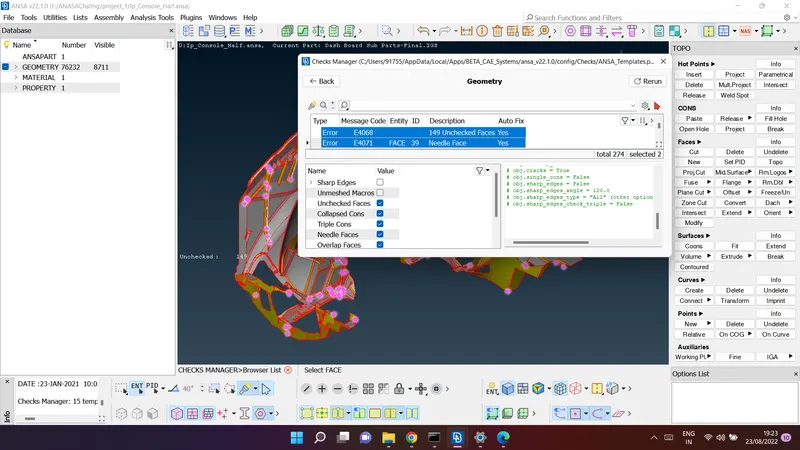
Clean the geometry using checks manager. Enable unchecked faces, collapsed
cons, triple cons, needle faces, overlapped faces, cracks, single cons. Clear all these
issues until no error is found. One can use fix option in ANSA to clear all the errors
automatically. However, sometimes manual intervention is required for fixing some
errors
Step 3
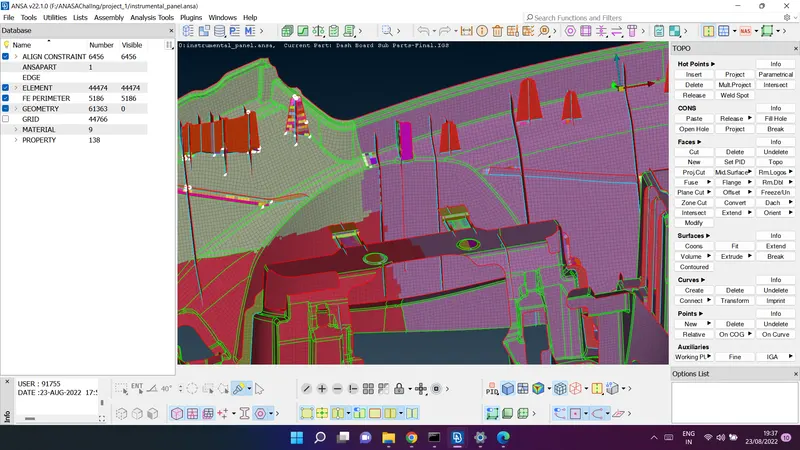
Mid Surface generated using casting
For this component in the instrument panel, I have generated mid using casting
option.
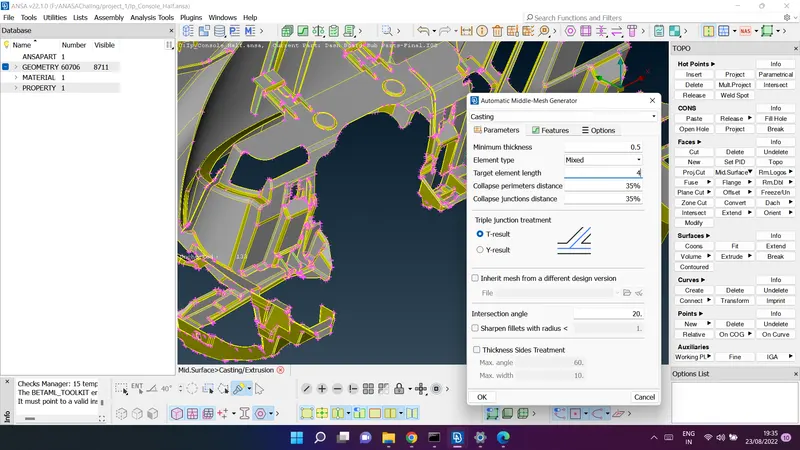
after casting the image will be as shown:
as the casting is get heavy on the whole component i have separated in defferent PID
tools used:
for the element joing :pest option used
to get proper surface draw curve
topo>curve>create
project
mesh> shell mesh>project
fill the mesh
classic mesh> shell mesh >fill
Step 7:
Meshing and Improving mesh flow
In this mid surface there are lot of double cons nearer to each other. Therefore, lot of
topological clean up should be done before starting mesh.
For this dash board, manual mesh is preferred as it has more features connected with
each other. I have used spot mesh option and meshed region by region manually.
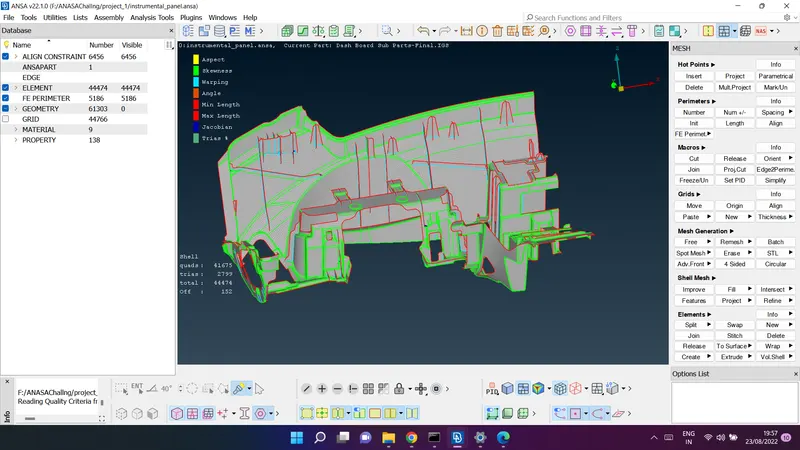
Reconstruct and Smooth:
I have used smooth option in order to clear some off elements at converging places
For better mesh flow reconstruct option can be used. I have removed opposite trias and
trias at the edges using options like swap, split and paste options.
some of the element cannot be clear as it is in the complicated part:
as shown in image:
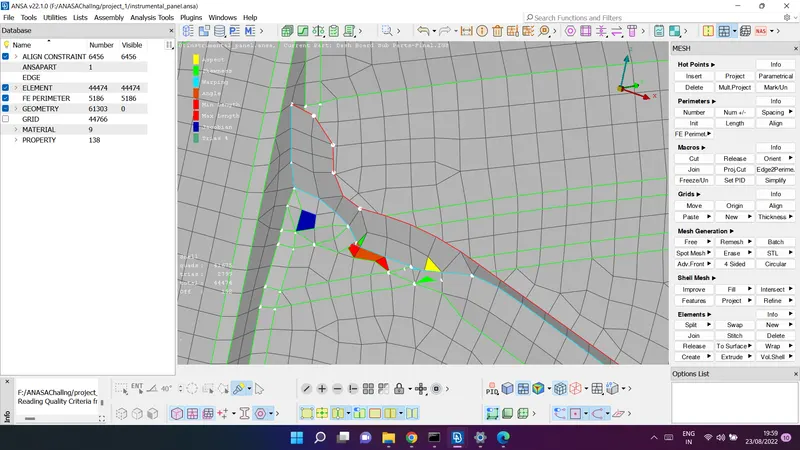
Problematic Faces:
Problematic faces are the areas where lot of double cons present on one surface. Even if
you cut these cons and mesh them, off elements will be generated
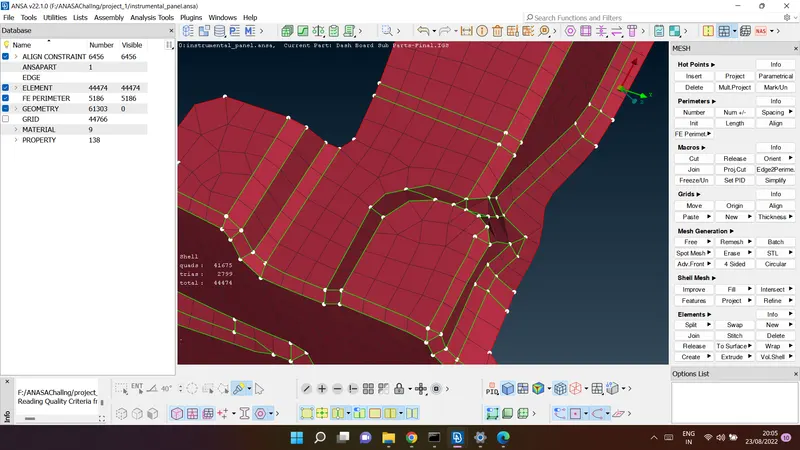
Kinks and raised edges:
Align option can be used in order to eliminate kinks and raised edges. First select source
node i.e., raised edge or kink.
asign thickness:
classic mesh > grid>thickness>convert>(select component ) asign the thickness> ok (click)
Learning Outcomes:
Able to do topological clean-up with no errors.
Assigned separate PIDs for different surfaces.
done the casting with asign thickness
Aware of all the quality criterias and quality parameters during mesh generation.
Understood about mesh generation and implemented mesh generation for complex
geometry.
Learned how to improve mesh flow and remove trias to achieve better mesh flow.
Understood all the concepts regarding mid surface generation and meshing in ANSA.
Conclusion:
In this project, I have generated mesh using castinng options available in
ANSA Able to defeature and do line adujstments in some areas Did topological clean
Able to defeature and do line adujstments in some areas. Did topological clean
up. Understood about transparency mode and the concepts related in generating mid
surface for different features. Able to achieve better mesh flow using
smooth,reconstruct,swap,paste,move options. Eliminated kinks and raised edges.
Successfully generated mid surface and meshed whole Instrument panel usinh ANSA.
Model of ANSA file link:
https://drive.google.com/file/d/1cXByjxIwgdxoHDcP4DcoQ813wILJdBU2/view?usp=sharing