Planetary Gear
AIM:
To understand the Pleanetary Gear Train Mechanism and perform Motion Analysis of the mechanism at different parameters in 3 different situations and also generate the angular velovity of the output part in each case.
Study 1: Motion analysis of the mechanism by giving input to Sun Gear and taking output from the Carrier, keeping the Ring Gear fixed.
The inputs for the Gear Train Mechanism are as follows:
Module, m: 2.5
No. of Teeth in Ring Gear, Tr = 46
No. of Teeth in Sun Gear, Ts = 14
Input Speed of the Sun Gear, Ns = 200 rpm
No. of Planet Gears = 4
Prior to performing the motion analysis of the Epicyclic Gear Train Mechanism, we will perform some elemntary calculations for comparision with the output of tthe motion analysis.
This exercise will be done for one the cases of the problem statement, i.e., where the Rin Gear is fixed and the input is given to the Sun Gear.
The analytical calculations are as follows:
1. By the relationship between module and the number of teeth of a gear, we can find out the pitch circle diamter of all the gears:
m = D/T
Therefore, the PCDs of all the gears are calculated as follows:
Dr = 2.5X46 = 115 mm
Ds = 2.5X14 = 35 mm
Since, by the basic principle of a planetary gear train mechanism, we know that:
Dr = Ds+2XDp. { Dp: PCD of Planet Gear }
Therefore, 115 = 35 + 2XDp,
=> Dp = 40 mm.
The number of teeth in the planet gear can be calculated as: Tp = Dp/m = 40/2.5 = 16.
After finding out the geometrical data of the gears, we can now perform an analytical motion analysis of the Epicyclic Gear Train for the first case of the problem statement.
The following table will be used for performing the same:
| S. No. | Action | Carrier | Sun | Planet | Ring |
| 1 | Carrier Fixed, Sun+1 rev. | 0 | +1 | -(Ts/Tp) | Ts/Tr |
| 2 |
Carrier Fixed, Sun+x rev. |
0 | +x | -x(Ts/Tp) | -x(Ts/Tr) |
| 3 | Add + y rev. | y | y+x | y-x(Ts/Tp) | y-x(Ts/Tr) |
Now for Case:1, we know that the Ring Gear is fixed, and the input Sun Gear has an angular velocity of 200 rpm.
Therefore,
y+x = 200 ............ (1)
y-x(Ts/Tr) = 0 ....... (2)
Using the above equations, we can find out that the angular velocity of the Planet Gear about the center axis of the Sun Gear, i.e.,
Np = y-x(Ts/Tp) = -87.53 rpm = 525.18 deg/sec.
And, the anular velocity of the carrier,
Nc = y = 200-x = 46.6 rpm = 279.6 deg/sec.
Having finished the analytical calculations, we can now proceed with the motion analysis of the mechanism in Solidworks:
Case: 1:-
Input: Sun Gear
Output: Carrier
Fixed: Ring Gear
Angular Velocity of Sun Gear, Ns = 200 rpm.
After giving appropriate mating constraints to the parts, input motion parameter as angular velocoty of 200 rpm is procided to the Sun Gear by ataching a rotary motor to it.
The contacts are provided to the rescpective parts of the assembly using Solid Body Contacts, keeping Motion Analysis as the study of interest.
The gears are selected as per the relations to provide the contacts while assigning Steel as their material without any lubrication.
The study intends to find the angular velocity of the Carrier which is the output of the mechanism.
The plots are shown below:
1. Angular Velcoity of the Carrier:
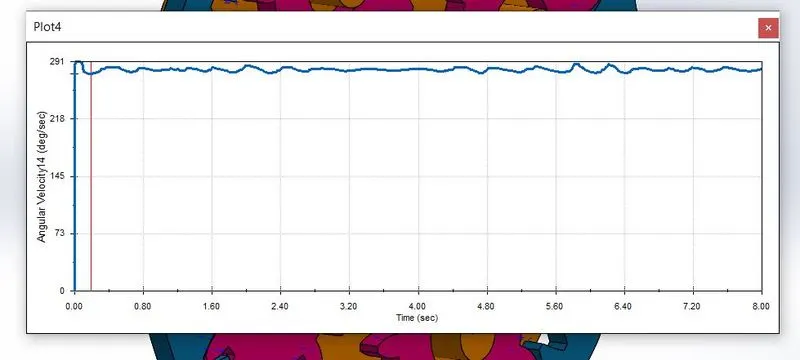
We can observe from the output plot that the average value of the angular velcoity of the Carrier is close to 275 deg/sec.
This value is close to the result of the analytical calculations, as presented above.
2. Angluar Velocity of the Planet Gear:
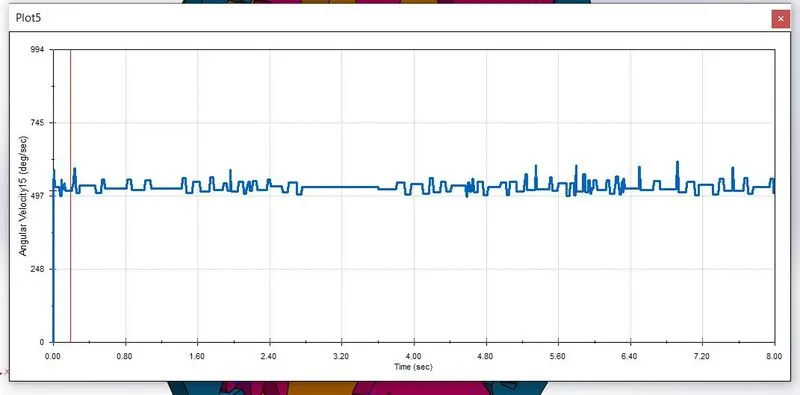
Similarly, the average value of the angular velocity of the Plaber Gear is found to be close to 530 deg/sec, whisch is again close to the result of the analytical calculations.
3. Angular Velcoity of the Sun Gear:
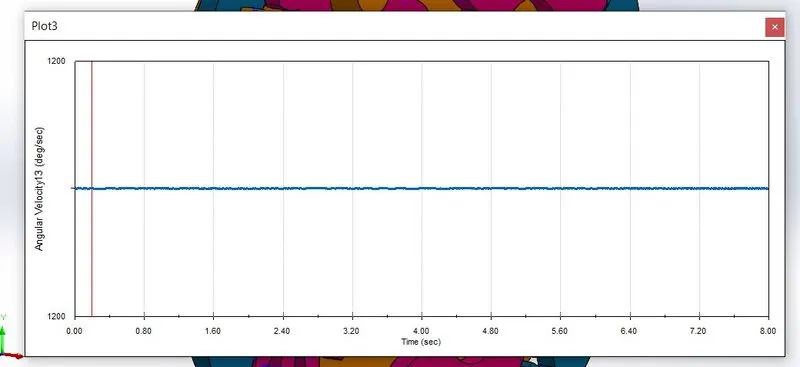
The above plot shows the input angular velocity given to the Sun Gear as 200 rpm or 1200 degrees/sec.
Case: 2:-
Input: Ring Gear
Output: Carrier
Fixed: Sun Gear
Angular Velocity of Ring Gear, Nr = 200 rpm.
After giving appropriate mating constraints to the parts, input motion parameter as angular velocoty of 200 rpm is provided to the Ring Gear by attaching a rotary motor to it.
The contacts are provided to the rescpective parts of the assembly using Solid Body Contacts, keeping Motion Analysis as the study of interest.
The gears are selected as per the relations to provide the contacts while assigning Steel as their material without any lubrication.
The study intends to find the angular velocity of the Carrier which is the output of the mechanism.
The plots of the Case-2 Study are shown below:
1. Angular Velcoity of the Carrier:
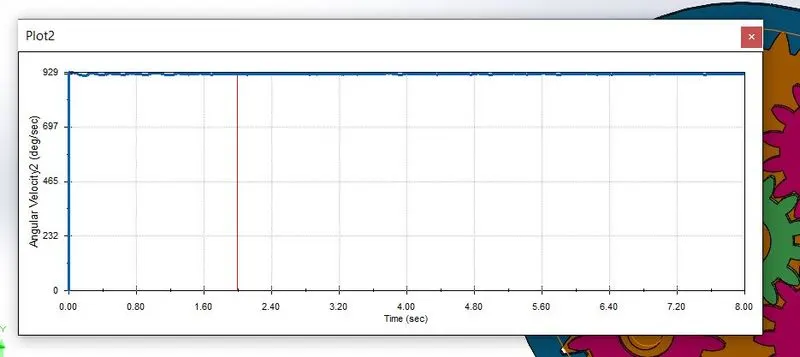
We can observe from the output plot that the average value of the angular velcoity of the Carrier is close to 929 deg/sec.
2. Angular Velcoity of the Ring Gear:
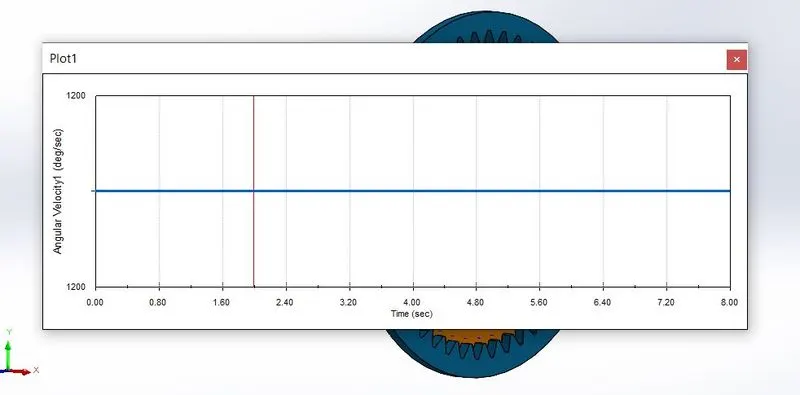
The above plot shows the input angular velocity given to the Ring Gear as 200 rpm or 1200 degrees/sec.
Case: 3:-
Input: Sun Gear
Output: Ring Gear
Fixed: Carrier
Angular Velocity of Sun Gear, Ns = 200 rpm.
After giving appropriate mating constraints to the parts, input motion parameter as angular velocoty of 200 rpm is provided to the Ring Gear by attaching a rotary motor to it.
The contacts are provided to the rescpective parts of the assembly using Solid Body Contacts, keeping Motion Analysis as the study of interest.
The gears are selected as per the relations to provide the contacts while assigning Steel as their material without any lubrication.
The study intends to find the angular velocity of the Carrier which is the output of the mechanism.
The plots of the Case-3 Study are shown below:
1. Angular Velcoity of the Ring Gear:
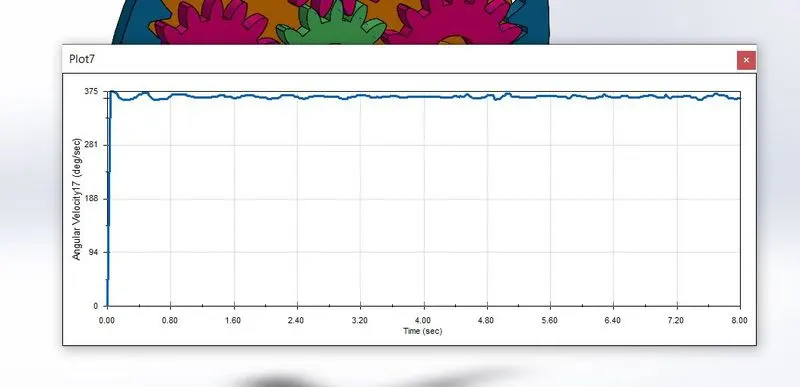
We can observe from the output plot that the average value of the angular velcoity of the Ring Gear is close to 370 deg/sec.
3. Angular Velcoity of the Sun Gear:
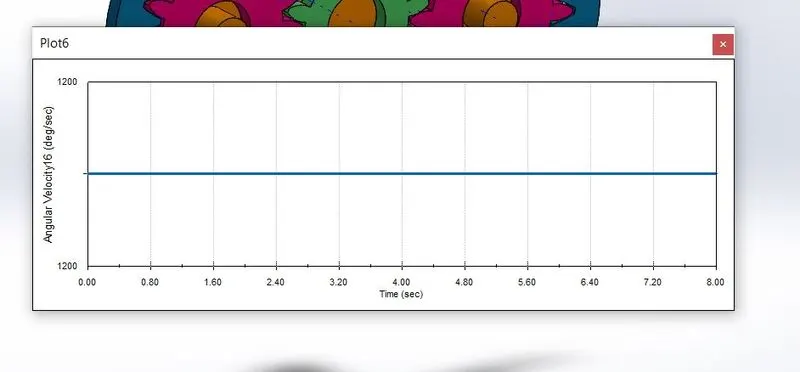
The above plot shows the input angular velocity given to the Sun Gear as 200 rpm or 1200 degrees/sec.
Conclusion:
After observing the output plots and comparing them with each other, it can be observed that the maximum reduction is achieved in the first study, i.e., Case 1, wher the ring gear is fixed.
Therefore in applications, where a higher torque is required as the output, the ring gear is fixed to achieve the same.