Planetary Gear
Motion analysis of planetary gear
About :
A planetary gear (also known as epicyclic gear train ) consists of two gears mounted so that the center of one gear revolves around the center of the other. A carrier connects the centers of the two gears and rotates to carry one gear, called the planet gear or planet pinion, around the other, called the sun gear or sun wheel. The planet and sun gears mesh so that their pitch circles roll without slip. A point on the pitch circle of the planet gear traces an epicycloid curve. In this simplified case, the sun gear is fixed and the planetary gear(s) roll around the sun gear
Epicyclic gearing or planetary gearing is a gear system consisting of one or more outer, or planet, gears or pinions, revolving about a central sun gear or sun wheel. Typically, the planet gears are mounted on a movable arm or carrier, which itself may rotate relative to the sun gear. Epicyclic gearing systems also incorporate the use of an outer ring gear or annulus, which meshes with the planet gears. Planetary gears (or epicyclic gears) are typically classified as simple or compound planetary gears. Simple planetary gears have one sun, one ring, one carrier, and one planet set. Compound planetary gears involve one or more of the following three types of structures: meshed-planet (there are at least two more planets in mesh with each other in each planet train), stepped-planet (there exists a shaft connection between two planets in each planet train), and multi-stage structures (the system contains two or more planet sets). Compared to simple planetary gears, compound planetary gears have the advantages of larger reduction ratio, higher torque-to-weight ratio, and more flexible configurations.
The axes of all gears are usually parallel, but for special cases like pencil sharpeners and differentials, they can be placed at an angle, introducing elements of bevel gear (see below). Further, the sun, planet carrier, and ring axes are usually coaxial.
Bookwheel, from Agostino Ramelli's Le diverse et artifiose machine, 1588
Epicyclic gearing is also available which consists of a sun, a carrier, and two planets that mesh with each other. One planet meshes with the sun gear, while the second planet meshes with the ring gear. In this case, when the carrier is fixed, the ring gear rotates in the same direction as the sun gear, thus providing a reversal in direction compared to standard epicyclic gearing.
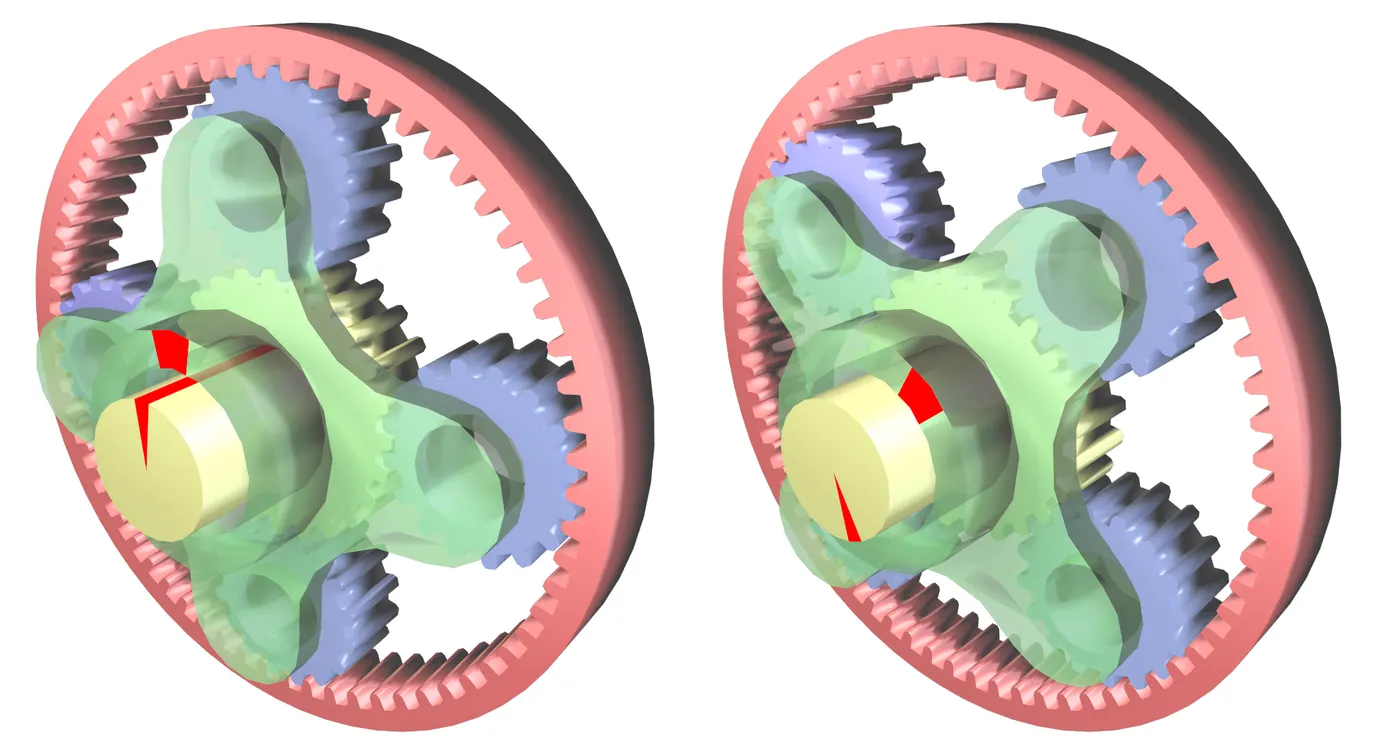
Cases for motion analysis :
Here the input to the given component is a rotary motion at 200 rpm
and output is measured as the angular velocity of the component and one of the component is fixed
| Sl.No | Input | Output | Fixed |
| 1 | Sun Gear | Carrier | Ring Gear |
| 2 | Ring Gear | Carrier | Sun Gear |
| 3 | Sun Gear | Ring Gear | Carrier |
Values given :
We assume the module of each gear is 2.5
number of teeth
for ring gear is 46
for sun gear is 14
We have four planetary gear
Calculating the values for planetary gear :
we know
module (m) = diameter/number of teeth or diameter = number of teeth * module
radius of ring gear = radius of sun gear + diameter of planet gear
therefore for a number of teeth of planet gear
T planetary gear * m = T for ring gear *m/2 - T for sun gear *m/2
caneceeling m and putting the values we got
T planetary gear = 16
for pitch circle diameter :
we know pitch circle diameter = module * number of teeth
therefore, the pitch circle diameter of
ring gear is 115
sun gear is 35
planet gear is 40
Modelling and assembly of planetary gear :
By using the design library of the Solidworks we import the internal spur gear and spur gear after importing the gear we assign the values for ring , planet and sun gear respectively and assigning the value of shaft diameter as 20 mm so that we create the carrier for planetary gear by creating four-shafts connected to plate connected to a shaft such that four shafts fit in planetary gear
For assembling, we coincide all gears and carrier in one plane and make concentric the shafts and the planetary gear
Diagram showing the imported spur gear and internal spur gear for sun gear, planetary gear and ring gear assembled
diagram of the carrier
Diagram of the assembled model of the planetary gear system
For motion analysis, we give the rotational input 200rpm to the input component and solid contact is been given to the
Results
for case 1: Angular velocity of the carrier with ring gear is fixed and input to carrier gear
Case 2: Angular velocity of the carrier with sun gear fixed and input to the ring gear
Case 3: Angular velocity of ring gear with carrier fixed and input to ring gear
Conclusion :
For the first two cases, the angular velocity of the output component increases linearly till first 5 sec then remain nearly steady with time but in the third case the angular velocity of ring gear is averagely steady from the start
Also with the input of 200 rpm, the speed output for each component is higher and at there respective output component
Reference link : https://en.wikipedia.org/wiki/Epicyclic_gearing
Animation video :
for the first case : https://youtu.be/oYh-Gm7P15k
for the second case : https://youtu.be/lRwosgQDrnI
for the third case :https://youtu.be/XJQ_OBg0D_g