Optimization of an IC Engine using GT Power
INTRODUCTION TO OPTIMIZATION:
Optimization is the process of minimizing, maximizing or achieving a certain target in a model's output/ response by systematically changing the one or more sensitive inputs/ factors and subjecting it to contraints. An optimizer is an automated process that iteratively sets the input variables, runs the model, evaluates the model outputs, and changes the inputs again to achieve some optimization objective, or until some stopping criteria are met.
In GT-Suite, there are two different optimizers: Simple and Integrated Design Optimizers (IDO). Simple optimizer is an old optimizer and the IDO is a recently introduced sophisticated optimizer with the following advantages
• It can use the more robust algorithms that are available, including the genetic algorithm, CMA-ES, and Simplex.
• It can accommodate "Sweep" factors, for which a single optimized value will be found for all active cases.
• It can run multi-objective Pareto optimization studies, and provides easy setup for weighted-sum multi-objective studies.
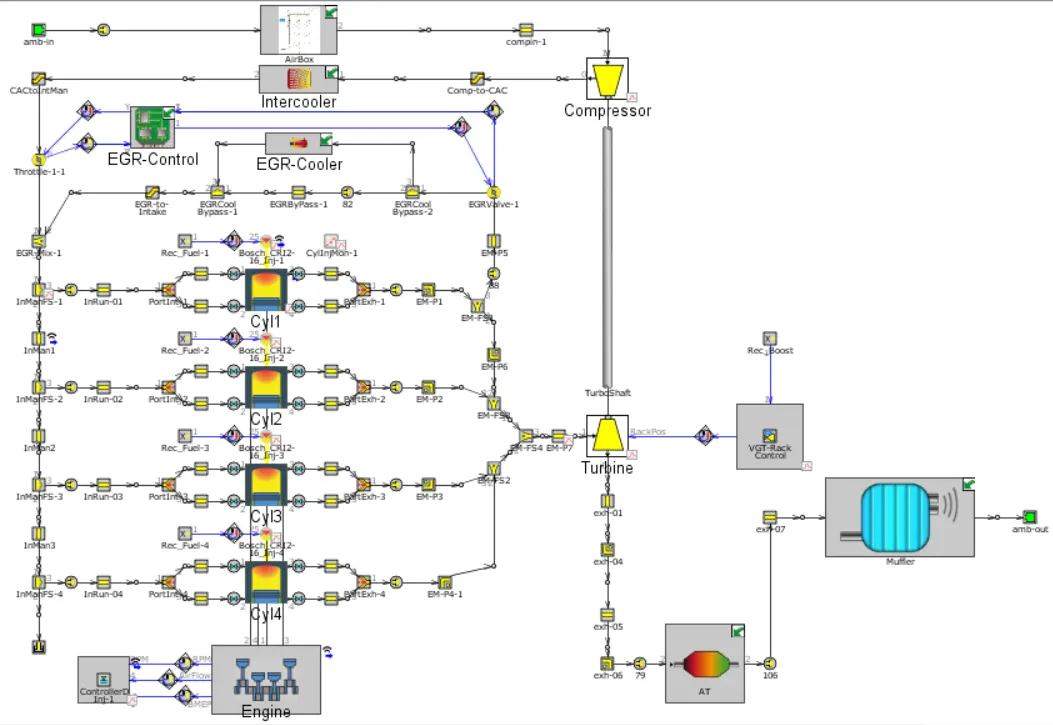
In this project, a model of an 4 cylinder CI Engine with DIPulse predictive combustion model is taken so that, the responses that are to be recorded are sensitive to the factors in GT-Power.
The Plant Model:
Initial Results:
The problem definition of this project is
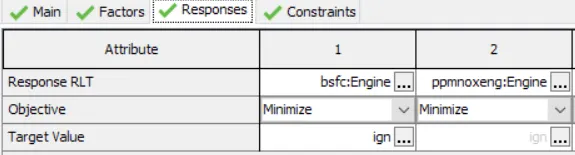
"To Minimize the NOx and BSFC with Start of Injection (SOI) and Rail Pressure as parameter".
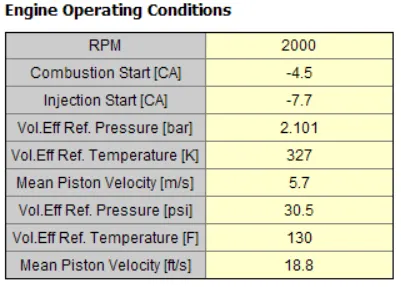
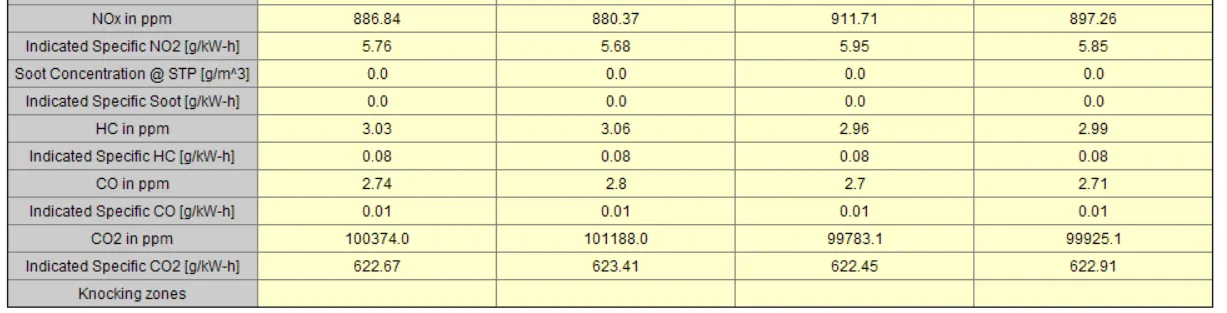
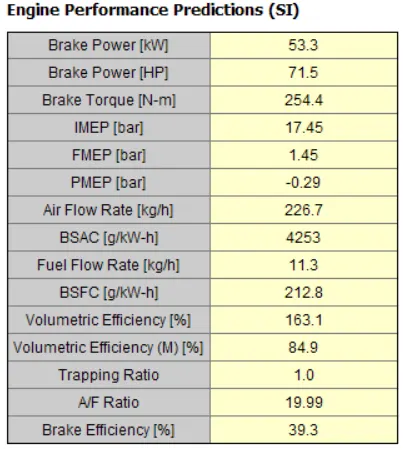
Shown below are the initial results recorded before optimization. The engine was run at 2000 RPM. These values can be used for reference after optimization. The initial results recorded are:
SOI: -4.5, NOx ~900 ppm, BSFC: 212.8 g/KWh
Optimization using Integrated Design Optimizer (IDO):
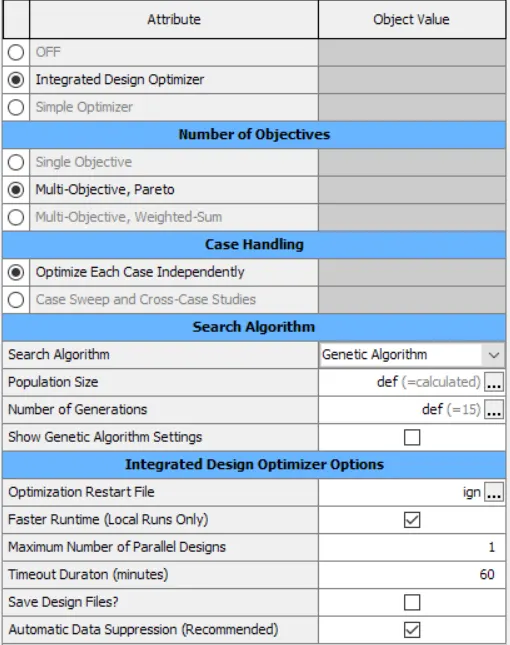
The optimizer settings are shown below. For multi-objective optimization which is used here, the optimizer takes into account multiple objectives.
There are two approaches for multi-objective optimization: weighted-sum and Pareto. The weighted-sum approach is best used when all objectives correlate with each other such that all of them increase or decrease simultaneously as factor values change. The pareto approach is used when the design consist of trade-offs among multiple objectives. The pareto approach creates a Pareto front which illustrates the trade-off between the two factors. A Pareto front is viewed by plotting one response vs. another.
Hence, we go with Multiple objective, Pareto.
Search Algorithm:
The search algorithm chosen is the 'Genetic Algorithm'. Genetic Algorithm is an evoluationary, global search algorithm, specifically NSGA-III (NSGA-III uses to pre-allocated reference set mechanism to choose better diverse solutions in the size of population in free space). Therefore it is recommended by GT that for all problems having medium to high complexity, which would result from many factors, the presence of one or more constraints, and non-linear characteristics.
For two factors (SOI and Rail pressure), the population size is 10. The optimizer will run a total number of designs equal to the population size multiplied by the number of generations. A recommended initial value is 15, which is the “def” value. More generations allow a larger extent of evolution of solutions and therefore allow the algorithm to find the best value more efficiently.
Total number of designs run in this case is 10 * 15 = 150.
Factors and Responses:
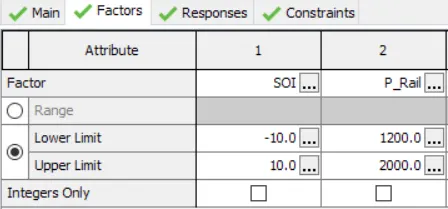
Optimization responses (and constraints) must always be chosen from RLT variables, and the optimizer always extracts and uses the CaseRLT values. Hence it needs to be ensured that the model is set up to reach steady-state. In this case, the factors are SOI (-10 CA to 10 CA) and Rail Pressure (1200 bar to 2000 bar).
The optimizer's factors must be chosen from parameters that exist in Case Setup. The range of the factors must be mentioned either as percentage of base value or as limits. The resolution is used for some search algorithms and is entered with respect to the range (in %). Lower resolution values indicate more precision and usually result in a larger number of designs.
CASE-SETUP:
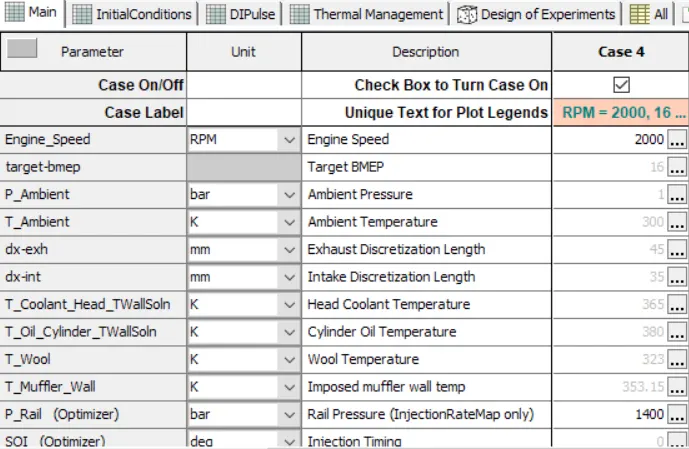
Once the optimizer is setup, the base values for reference of the factors are entered in the case setup.
RUNNING THE CASE:
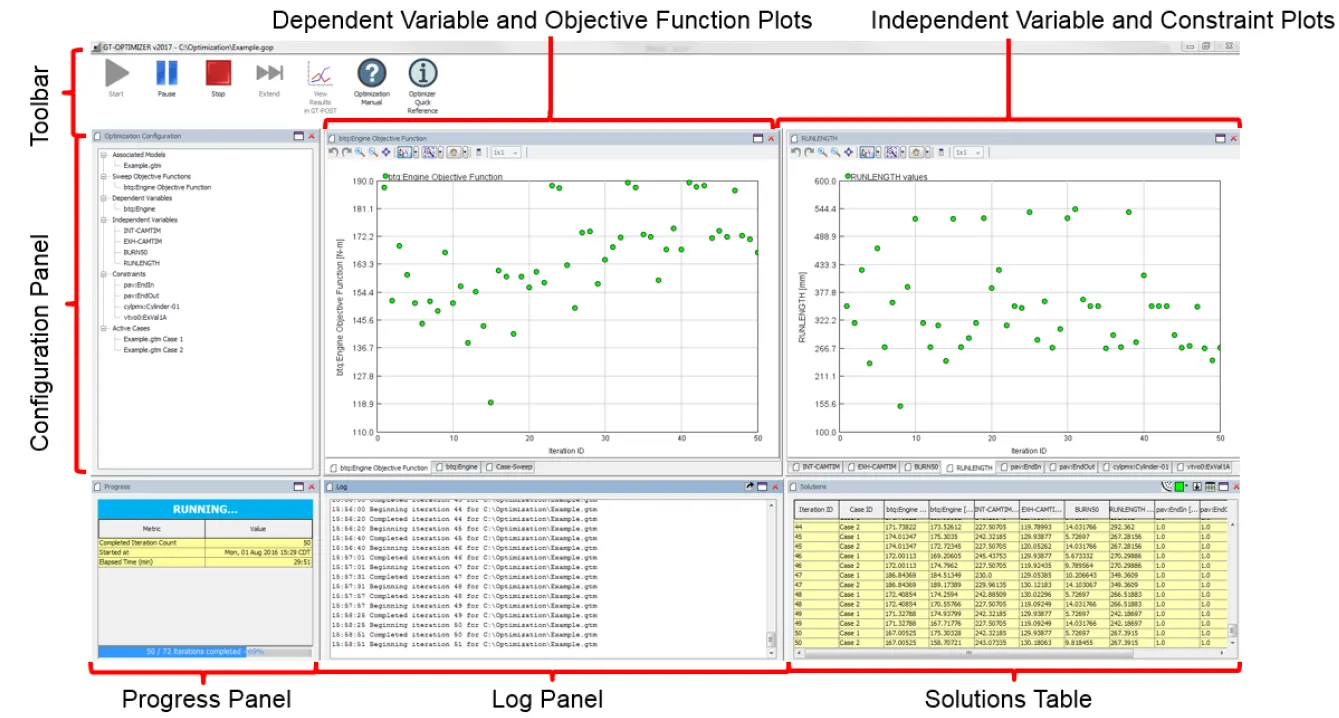
Shown below is the GUI of IDO. GT recommends running the optimizer in parallel computing. This is because, even in a problem as simple as the one taken in this project (with 2 variables and 2 factors) upto 150 design cases are run. The total time for optimization took ~160 minutes in this project.
OUTPUTS AND RESULTS:
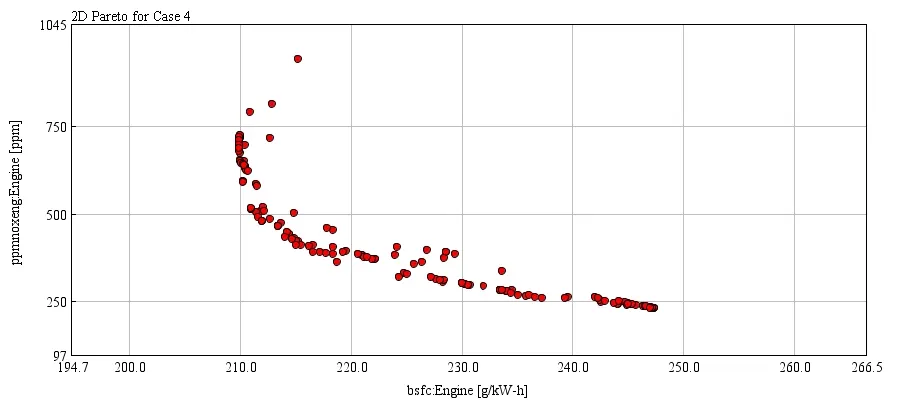
1) The Pareto-front obtained for all 150 designs:
The tradeoff of NOx and BSFC can be clearly seen from the plot below.
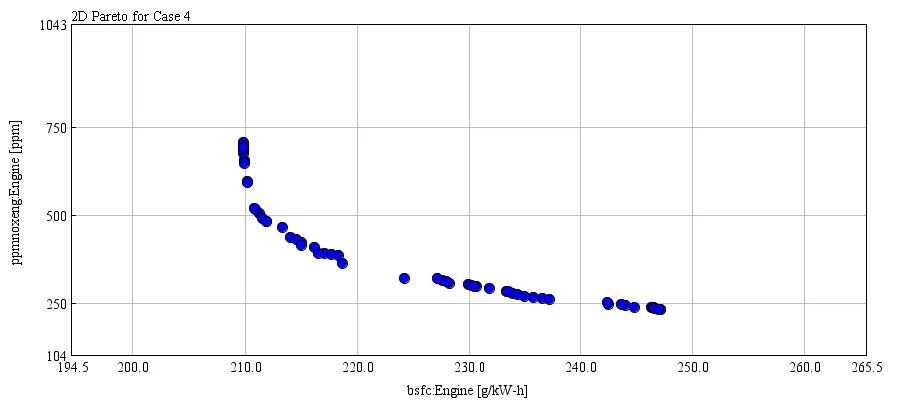
2) The Pareto-front obtained for all good designs:
3) NOx Countour:
From the contour (P_rail and SOI vs NOx) , it can be observed that, at higher rail pressures and advanced injection timings leads to higher NOx ~700+ ppm and vice versa. 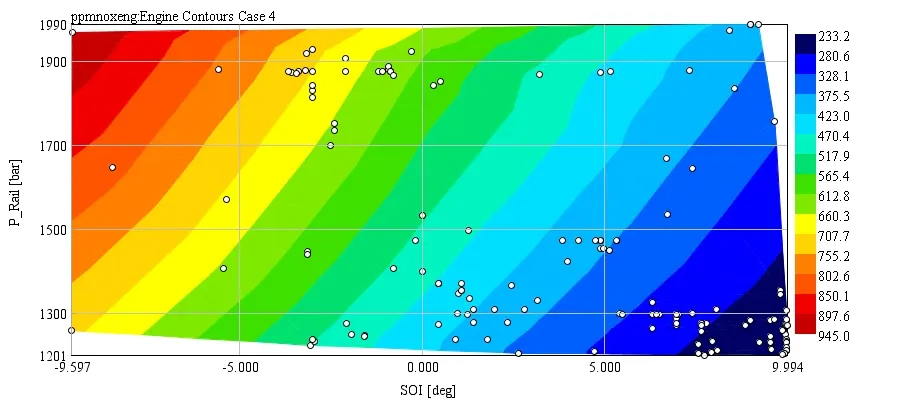
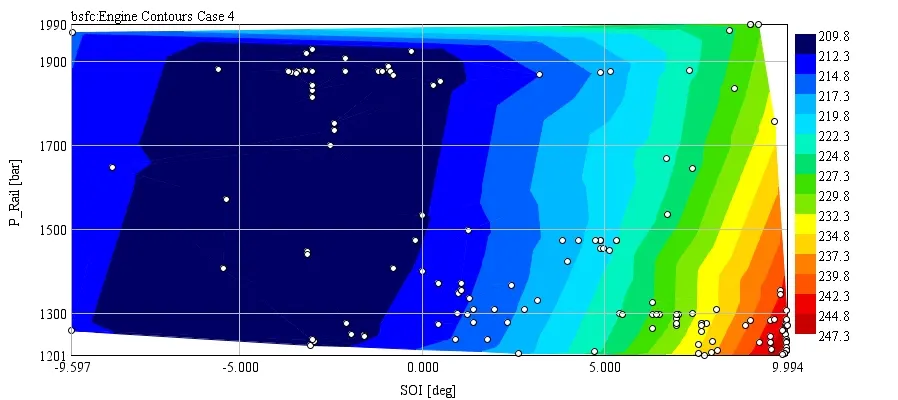
4) BSFC Contour:
From the contour (P_rail and SOI vs BSFC) , it can be observed that, with higher rail pressures and advanced advanced injection timings, the BSFC is low and vice versa. But at the same range of factors, if we take a look at the NOx contour, the NOx values are high. This is the trade-off faced in this problem.
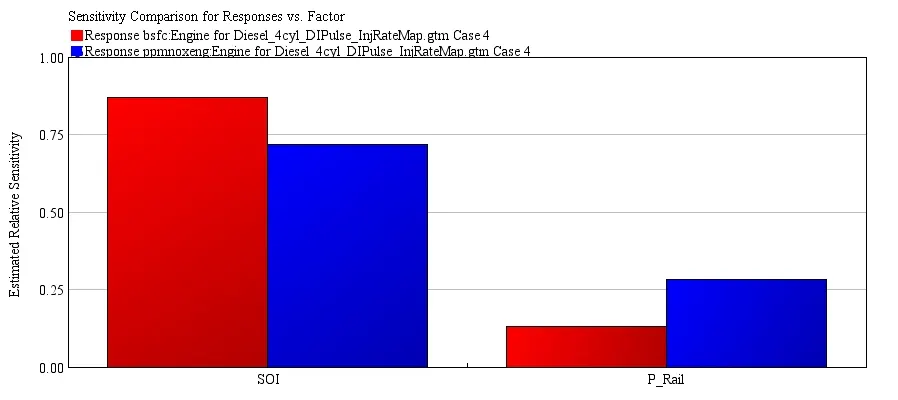
5) Sensitivity of the factors:
From the data obtained from all designs, the optimizer has plotted the sensitivity of each factor w.r.t response. Both BSFC and NOx is more sensitive to SOI than rail pressure.
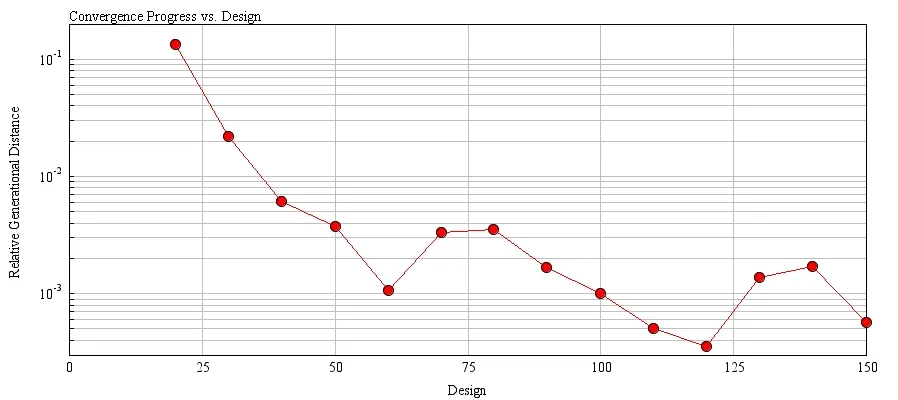
6) Plot of Relative Generational Distance:
Generational distance (GD) is originally designed to calculate the sum of adjacent distances of solution sets obtained by different algorithms and thus GD is a credible indicator to measure the convergence of many-objective evolutionary algorithms.
In this plot we notice that by the end of 150 designs, the GD has reduced from a factor of 10^-1 to less than 10^-3 which indicates that, the results are close to each other in magnitudes in order of 10^-3. This magnitude obtained is of good accuracy and hence we can say that the optimizer has attained convergence.
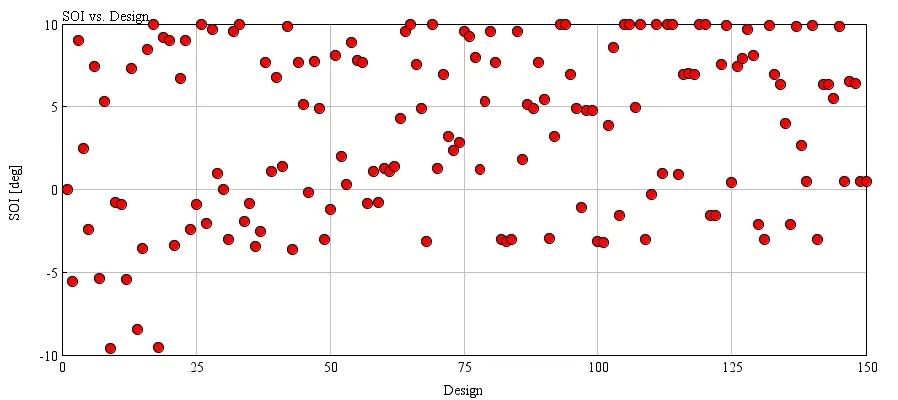
7) SOI vs Design:
With progress is design count, the optimizer realises that advancing the injection timing does not give a good trade-off and hence tries to maintain retarded injection timing.
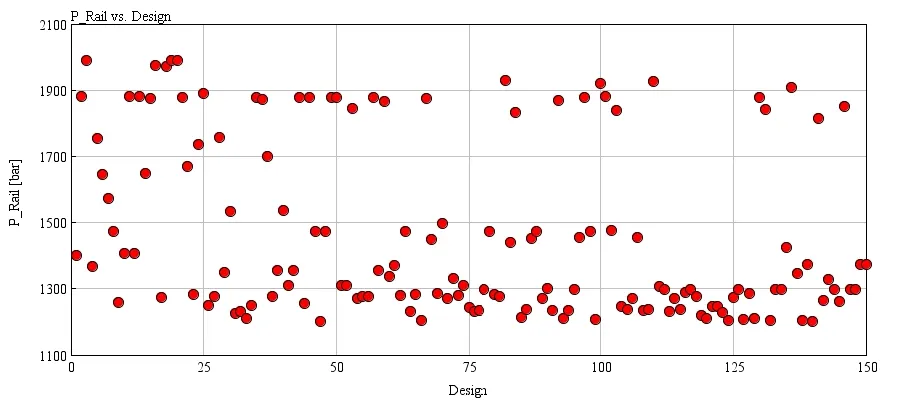
8) Rail Pressure vs Design:
With progress is design count, the optimizer realises that increasing the rail pressure does not give a good trade-off and hence tries to maintain a lower value of pressure in the injectors.
INFERENCE:
The curve shown below is plotted for the best design cases obtained for this problem.
The initial results were: NOx ~900 ppm, BSFC: 212.8 g/KWh.
The range of the optimized values lie in the range of 233-707 ppm of NOx and 209-247 g/kWh of BSFC. Further, to choose a more particular design for our needs, contraints can be added to the same problem such as limiting the max value of pressure or temperature in the cylinder, etc. Adding contraints or targets to the problem would further reduce the number of final optimized designs that we will have at hand and hence wer can obtain the exact design according to the requirement.
CONCLUSION:
Optimization is studied in this project using a 4-Cylinder Engine using predictive combustion model. Factors used are SOI and Rail Pressure in the Injector. The responses NOx and BSFC are to be minimized. The trade-off between NOx and BSFC is captured. The pareto-front of optimized cases are plotted and other trends such as optimizer convergence, sensitivity and variation of design number w.r.t. factors SOI and Rail pressure is captured