Modelling of a Door Bell and Thermister Fan using Simulink
Aim:
1) Making a Simulink model of Doorbell using solenoid block and Creating a situation where the switch is closed for 2 seconds and then released. Observe the physical movement of the plunger.
2) Using a thermistor to sense the temperature of a heater & turn on or turn off the fan.
Temperature source: 20 °C from 0 to 10 seconds, 27 °C from 10 to 30 seconds, 23 °C from 30 to 50 seconds.
Fan conditions: ON if the temperature above 25 °C, OFF otherwise.
Theory:
- BASIC WORKING OF A DOOR BELL:
The most important part of a door bell is its magnetic motor. The magnetic motor constitutes a conventional electromagnet. We know that an electromagnet is an arrangement in which a coil of wire is wrapped around magnetic material which produces magnetic field when electricity is passed through the coil. The greater the coiling of the wire, the higher the amplification of magnetic field. This magnetic field produces a substantial effect on any magnetic substance when brought in the vicinity of its magnetic field. This means that when an iron object is placed in this magnetic field, it will be attracted towards the magnetic field due to polar orientation generated by the electromagnetism.
- BASIC WORKING OF THERMISTOR:
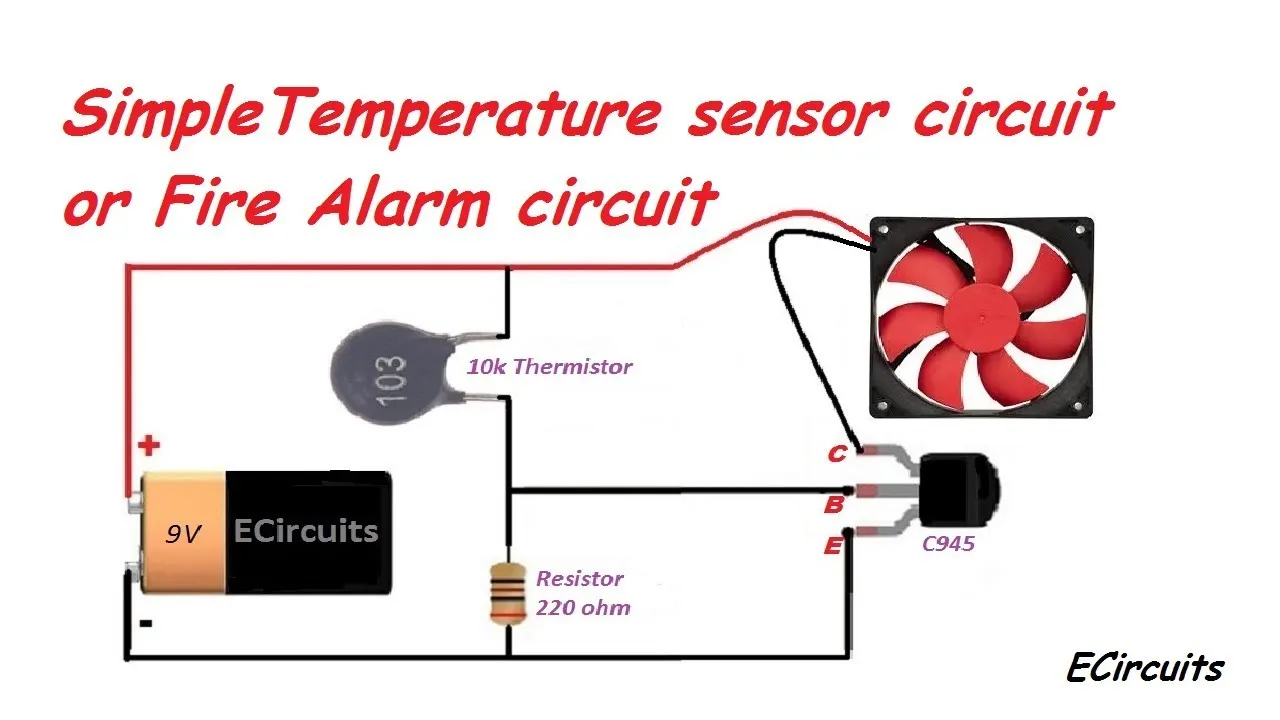
A thermistor is an inexpensive and easily obtainable temperature sensitive resistor, thermistor working principle is, it’s resistance depends upon the temperature. When temperature changes, the resistance of the thermistor changes in a predictable way. The benefits of using a thermistor is accuracy and stability.
Procedure:
1) Door Bell Circuit:
1. In this model, we are first giving a pulsing input with the help of a pulse generator.
2. Now we are introducing the inputs into solenoid circuit using the switch. In question of the challenge at has been given that the switch is closed for 2 secs and then released. We are then connecting the switch to the battery and solenoid. In the solenoid parameters we are providing the spring constant value less in order to obtain less damping effect while working of the door bell.
3. We connect the output of the solenoid to an Ideal Translational Motion Sensor to measure the distance of the plunger from the bell and therefore, we provide the initial position of the motion sensor as 5mm.
4. Then we connect it to a Translational Mechanical Reference so that the system is fixed at a place or grounded. Then we also connect a solver configuration to it in order to get the output. After that we use the ps- simulink convertor to connect the signal to the output. We place the output as a scope to get a plot.
5. We then run program we the stop time as 15 secs. Finally, we obtain a graph for it. in graph we find that there is a delay for 2 secs initially then the electric bell is pressed for 2 secs then again it is released. The Simulink model is also shown below.
2) Thermister Fan Circuit:
1. In this model, we are providing a signal builded input to a controlled temperature source. In signal builder according to the questions we have provided the input i.e. 0 to 10 secs 20 celcius, 10 to 30 secs 27 celcius & 30 to 50 secs 23 celcius. Here in signal builder we have given the temperuture values as Kelvin because the thermistor takes values only in Kelvin.
2. After that, we build a thermistor circuit using thermistor, an current sensor or an ammeter and a power source or battery for completing the circuit. The output of the circuit will be connected to input switch of the fan circuit. The thershold value for the condition for which fan should be On is typed as threshold value of the input switch.
3. Now we provide the motors parameters for getting optimum power output of the fan. Then we connect a rotational motion sensor to find the angular velocity of the motor. Then we connect a reference for each of these.
4. We finally obtain a graph for the fan speed and it is constraint to the value i.e 25 celcius as mentioned in the question. The Simulink model is also shown below.
Conclusion:
1) We have prepared a Simulink model of Doorbell using solenoid block and we have also created a situation where the switch is closed for 2 seconds and then released.
2) We have prepared a Simulink model of Thermistor to sense the temperature of a heater & turn on or turn off the fan. We also observed that the fan is turned ON when the temperature is above 25 °C and turned OFF when the temperature is below 25 °C.