Model the NI-MH battery State of Charge and plot the State of Charge and Voltage values.
Problem statement: Model the NI-MH battery State of Charge and plot the State of Charge and Voltage values.
COPONENTS:
1. Battery:
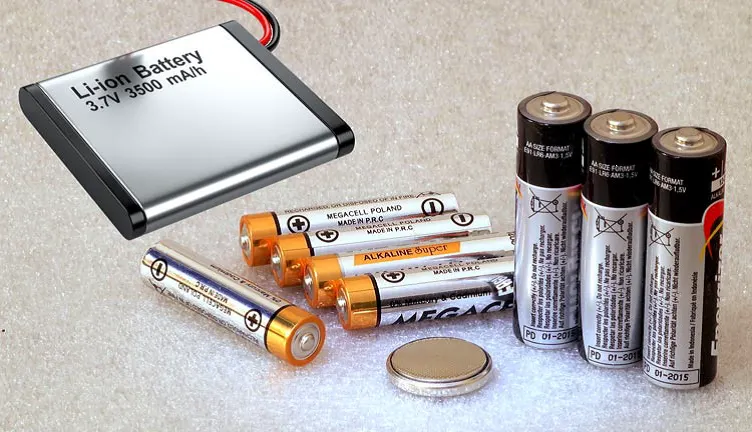
A battery is an electrochemical device in which electrical energy is converted and stored in chemical form for storage.
2. Applications:
3. Voltage:
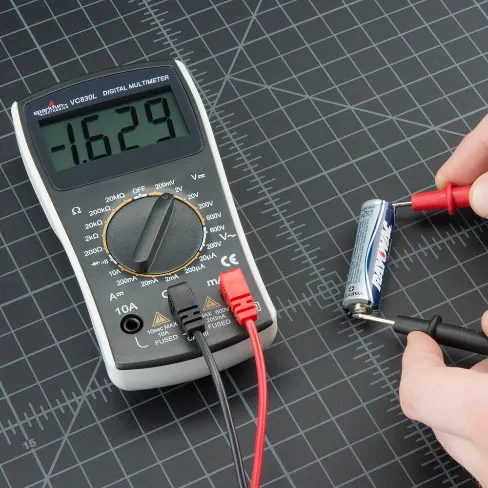
The term “voltage” in a battery refers to the difference in electric potential between the positive and negative terminals of a battery. A greater difference in potential results in a greater voltage. The battery voltage is measured as volt(V).
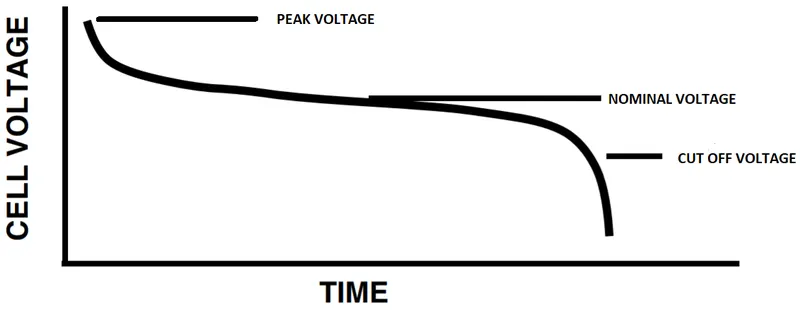
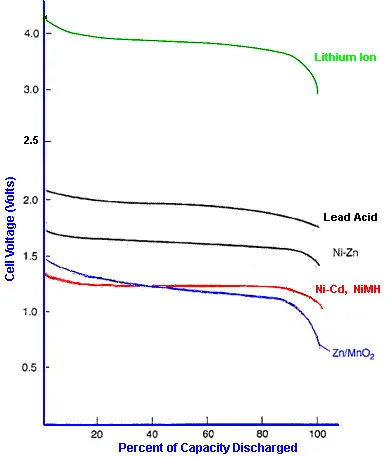
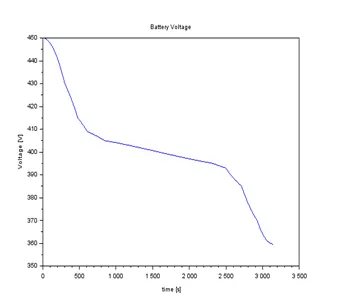
When we measure the voltage of the battery when it is being discharged, we can observe the below graph which represents the discharge characteristics of the battery.
a. Peak Voltage:
The peak voltage refers to the maximum voltage a cell obtains when it is fully charged and it will be above nominal voltage.
b. Nominal Voltage:
The reported or reference voltage of the battery. Also referred as the normal voltage of the battery when charged.
c. Cut Off Voltage:
Batteries cannot be discharged below a certain level or permanent damage occurs to the battery. This voltage is called Cut off Voltage and it depends on the type of battery.
4. Current:
A flow of charge is known as a current. Batteries put out direct current. Current is measured in Amps (A).
5. Battery Capacity:
Battery capacity is the measure of charge stored in the battery. The battery capacity represents the maximum amount of energy that can be extracted from the battery under certain specified conditions. Battery capacity is measured in ampere-hours (Ahr).
6. State of Charge:
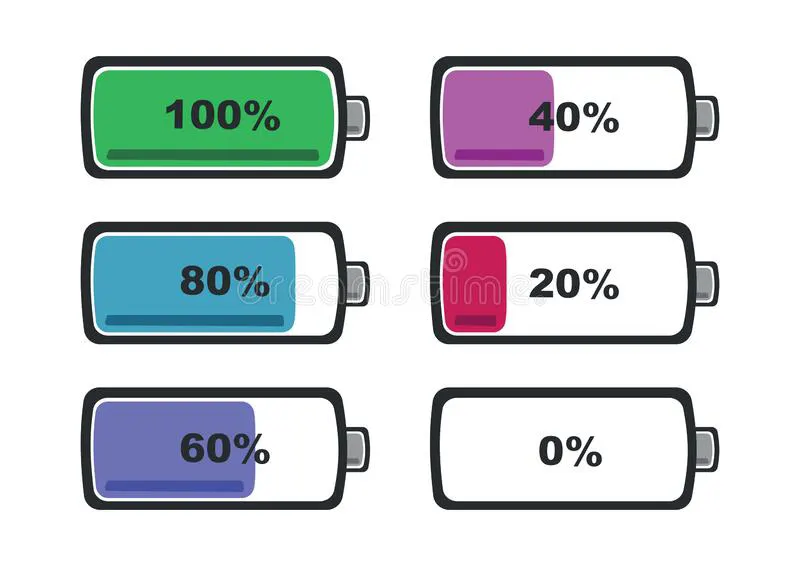
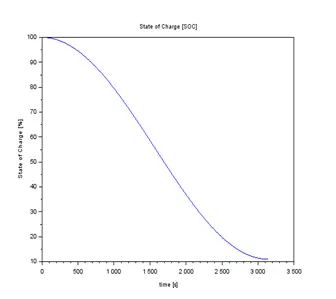
State of Charge (SOC) of a cell denotes the capacity that is currently available as a function of rated capacity. The unit of SOC is percentage. The value of SOC varies between 0% to 100%. If the SOC is 100%, then the cell is said to be fully charged, whereas a SOC of 0% indicates the cell is completely discharged.
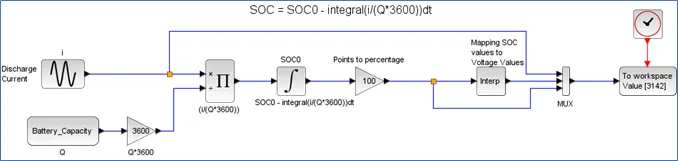
The state of charge of a battery can be estimated by taking into account the amount of electrical current which is going in and out of the battery.
SOC=SOC0–∫𝑖/(Q∗3600)dt
where:
• SOC = state of charge [%]
• SOC0 = initial state of charge [%]
• i = electrical current [A]
• Q = battery capacity [Ah]
7. Simulation time:
Simulation time refers to the time up to which the simulation has to be run. The simulation time can be calculated by the below formula. Where in the frequency ω is 0.001 rad/s.
tsim= 𝜋/𝜔
Where,
tsim = Simulation time in seconds
ω = frequency in rad/s
Model Inputs:
|
Sl No |
Parameter |
Value |
Units |
|
1. |
Maximum Discharge Current (i) |
150 |
A |
|
2. |
Frequency (ω) |
0.001 |
rad/s |
|
3. |
Simulation time (tsim) |
3142 |
S |
|
4. |
Battery Capacity |
93.6 |
Ah |
|
5. |
Initial SOC |
100 |
% |
Program:
|
a. To import the Battery Specifications Values and to store the values in variables: |
b. To plot the Xcos model outputs: |
|
//Import the excel sheet data = csvRead("Battery Specifications.csv") //Battery Capacity Battery_Capacity = data(2,1) Battery_Initial_SOC = data(2,2) Battery_SOC = data(2:11,3) Battery_Voltage = data(2:11,4) plot(Battery_SOC,Battery_Voltage) |
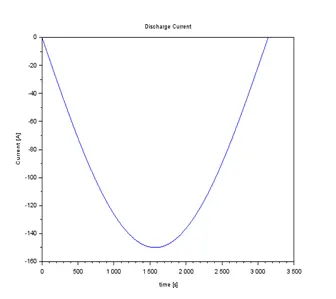
//Input current scf(0) plot(Value.time,Value.values(1:3142,1)) xlabel("time [s]") ylabel("Current [A]") title("Discharge Current") //voltage scf(1) plot(Value.time,Value.values(1:3142,2)) xlabel("time [s]") ylabel("Voltage [V]") title("Battery Voltage") scf(2) //state of charge plot(Value.time,Value.values(1:3142,3)) xlabel("time [s]") ylabel("State of Charge [%]") title("State of Charge [SOC]") |
Here are the blocks needed to build the model
|
Sl No |
Block Name |
Block Image |
Palette |
|
1. |
GENSIN_f |
 |
Sources |
|
2. |
PRODUCT |
 |
Mathematical Operations |
|
3. |
CONST_m |
 |
Sources |
|
4. |
INTEGRAL_m |
 |
Continuous time systems |
|
5. |
INTRPLBLK_f |
 |
Lookup Tables |
|
6. |
MUX |
 |
Signal Routing |
|
7. |
CLOCK_c |
 |
Event handling |
|
8. |
TOWS_c |
 |
Sinks |
Model:
Results:
|
a. Battery Discharge Current: |
b. Battery State of Charge: |
||
 |
 |
||
|
c. Battery Voltage: |
|||
 |
|||