Indoor Ventilation
Problem Statement:
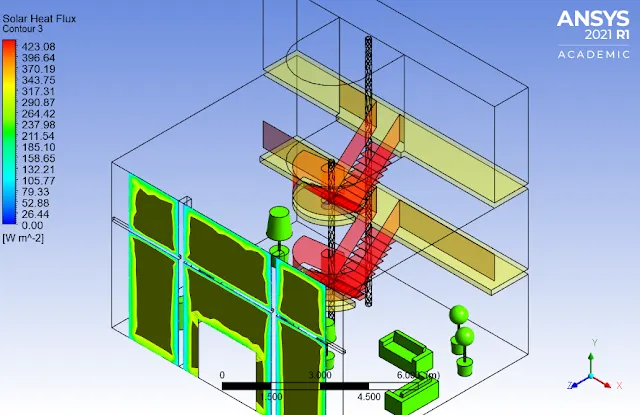
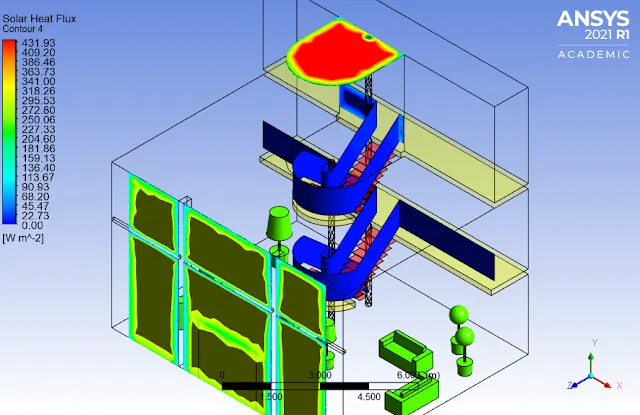
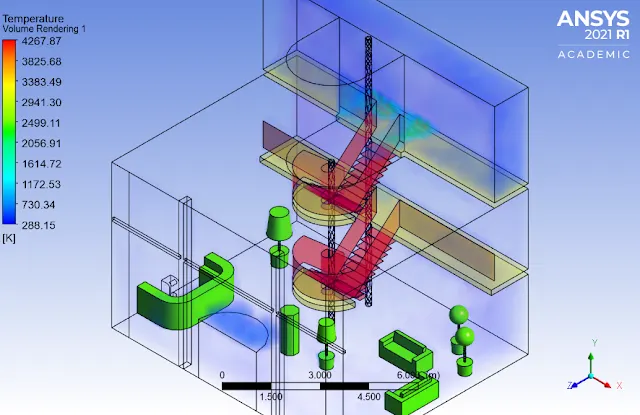
The problem considered is ventilation of the reception area of Fluent Europe's office at Sheffield, England. The front wall of the reception is almost fully glazed from the ground floor to the ceiling of the first floor level. There is also a small glazed area on the roof above the second floor landing.
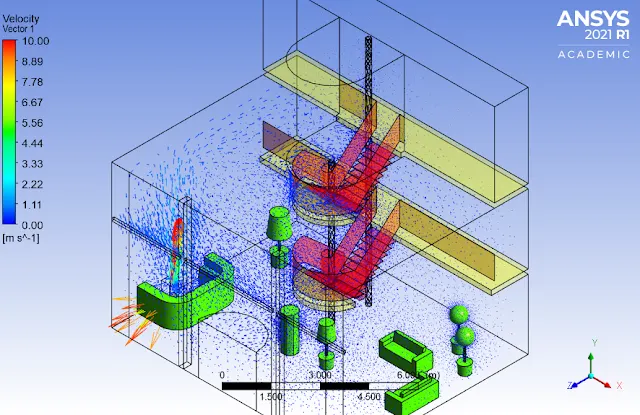
This simulation looks at the typical expected loads in the middle of summer on a normal day. The adjoining rooms and offices are air-conditioned and maintained at a constant temperature of around 20 0C. So heat will be transferred through the internal walls to these rooms. Some heat will also be transferred to the floor. As the floor is a concrete base it is assumed to have substantial thermal mass and a fixed temperature. Outside conditions are considered to be pleasant and normal at 25 0C. An external heat transfer coefficient of 4 W/m^2 K is used to capture convective heat transfer from outside the building. There is an air cooling unit located behind the receptionist's desk.
CFD
Computational Fluid Dynamics (CFD) is the process of mathematically modeling a physical phenomenon involving fluid flow and solving it numerically using the computational process.
In a CFD software analysis, the examination of fluid flow in accordance with its physical properties such as velocity, pressure, temperature, density and viscosity is conducted. To virtually generate an accurate solution for a physical phenomenon associated with fluid flow, those properties have to be considered simultaneously.
A mathematical model of the physical case and a numerical method are used in a CFD software tool to analyze the fluid flow. For instance, the Navier-Stokes (N-S) equations are specified as the mathematical model of the physical case. This describes changes in all those physical properties for both fluid flow and heat transfer. A mathematical model varies in accordance with the content of the problem such as heat transfer, mass transfer, phase change, chemical reaction, etc. Moreover, the reliability of a CFD analysis highly depends on the whole structure of the process.
Theory
Air Circulation in the Room
- Air circulates inside the room creating local rotational flow regions called vortices.
- There are no vortices near the back wall of the room because of the outlet vent location at the bottom of this wall.
Temperature of the Room
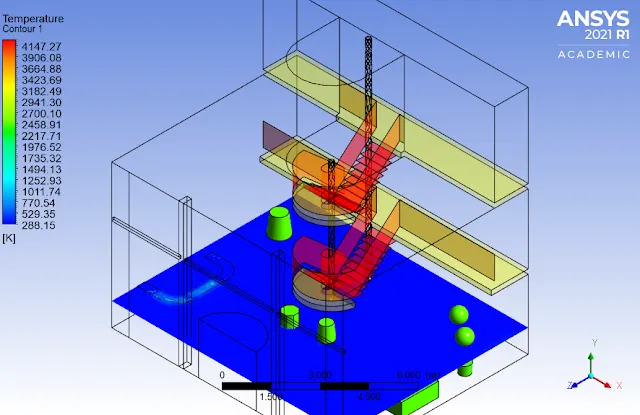
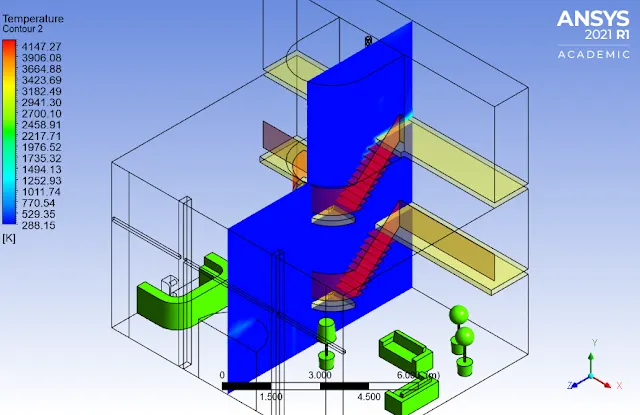
- Temperature distribution on the side walls, windows and the door show that heat transfer between warm walls and cool air inside is more effective closer to the floor where the walls are cooled to lower temperature.
- The room walls are warmer compare to the air inside which is indicated by the red color on the walls This suggests heat is quickly rejected from warm walls by the circulating air and the inside of the room is maintained at a comfortable temperature.
- Since the inlet vent is located at the center of the top wall, cool air is blowing directly into the center of the room. This keeps the central portion of the room relatively cooler compared to the other areas of the room
Computational Geometry
Solution: