Introduction to National Building Code and Steps in a Construction project
1) Why are building codes or standards essential for the modeling/ efficiency of drawings in Revit ?
- ans-A building code (also building control or building regulations) is a set of rules that specify the standards for
constructed objects such as buildings and nonbuilding structures.
Building codes specify minimum standards for the construction of buildings. The codes themselves are not legally
binding. They serve, rather, as "models" for legal jurisdictions to utilize when developing statutes and regulations.
The main purpose of building codes are to protect public health, safety and general welfare as they relate to the
construction and occupancy of buildings and structures.
The building code becomes law of a particular jurisdiction when formally enacted by the appropriate governmental
or private authority. as we follow the standard codes of building in software it gives us the drawing as per the
specification in code book which are ready for construction and can be followed by vendor. building codes are
among these essential tools. Residential and commercial building codes provide a comprehensive set of minimum
health, safety and energy standards for the design, construction and maintenance of new houses and buildings ar
major renovations.
- Codes are :-
a) National building code .
b)Municiple corporation guidelines .
c)IS 456:2020
2) From the National Building Code list the groups that will be essential to you when you begin modeling in Autodesk Revit.
ANS-National building codes list the groups that will be essential in modelling a project in revit are:
a) civil engineer
b)architect
c) structural engineer
d) electrical engineer
e) plumbing engineer
f)fire protection engineer
g) HVAC engineer
h) environmental specialist
i) town planner jurban engineer
k)landscape architects
L) security system engineer
m) interior designer
n) quantity surveyor
o) project manager
p)other specialists.
3) List the five major steps that occur in project cycle . The steps should include from conceptualization of project to maintenance and final stage.
ANS- Project management can be divided into five very distinct phases:
Initiation
Planning
Execution
Monitoring and control
Termination
The first two steps - Initiation and planning - are pre-project phases, when you and your team will typically do all the
prep work and lay a strong foundation. The bulk of the project action happens during the execution. The monitoring
and control phase runs simultaneously with epy execution, whereas the termination stage is an assessment and
finalization of your project.
INITIATION: the project initiation phase is very important.
The initiation lays the foundation for all future steps, all the way to the project's closure. In this stage, you and your
team will identify the key issues the new project will strive to solve. You will determine how feasible this project is and
whether it actually makes sense to go ahead with its execution. By the end of this phase, everyone involved should be
very clear on the project rationale. This is the phase in which you will specify who is involved in the project, begin to
organize teams and identify key stakeholders. You'll also determine what resources this project will require, as well as
where to source them.
PLANNING :
Once the initiation stage is over, your project will enter the planning stage. As its name implies, this phase is
everything to do with the planning and preparation of the project. Plan everything correctly, and your project is
guaranteed to be a success.
Before you can begin executing your project, you'll need to create a detailed plan of action. A project plan brings
clarity and systernatization to what can quickly become a very chaotic process. During the planning phase, you
should come up with a clear understanding of the following points.
Project vision
- Project schedule and deadlines
- Team composition
• Group and individual responsibilities
Resources available, including budgets, and how these will be utilized
• Tools that you'll use
• Project workflows
When planning, you and your team will come up with a roadmap that specifies the milestones of your project with
the steps you'll be taking to achieve them. In addition, you'll also come up with a clearer understanding of the
timeline of the project as well as deadlines that each team member will have to stick to. Most crucially, you will
gather and allocate resources to where they're needed: finances, time, tools and teams will all become very specific
and measurable.
When building a house, this would be the stage of drawing up building and floor plans, as well as determining and
purchasing all necessary materials. And if we take our analogy even further and view any given project as a building
then the planning stage would be its foundation - and if you know a thing or two about buildings, the foundation is
arguably the most important part. The quality of the foundation determines whether your building - home or
otherwise - will stand the test of time and even whether you'll be able to build it in the first place. In the same way
with poor planning, your project is inevitably bound to crumble and crash, without having made it to completion.
EXECUTION:
In this stage, your project finally comes to life. During the execution, you'll implement your plan and begin to take all
the steps necessory to carry out the project. This is the longest and most important phase of your project, in which
all of the action happens. By the end of this stage, you will see the physical manifestation of the pre- execution
brainstorming and planning. In the execution, the building blocks are actually laid down, and brick by brick, your
project building or house' is formed.
If you're the PM, this stage will require
Set tasks for team members
Create and organize workflows
- Motivate your team(s)
• Use resources that were allocated for the project in an effective way
• Ensure that deadlines are being met and everything is progressing smoothly
- Respond quickly to any stumbling blocks
• Keep stakeholders updated on how the project is progressing
The key focus here is on deliverables, both internal and external: from reports that are shared between teams to
more tangible products that are given out to customers and stakeholders. The project manager will need to keep an
eye on how the project execution progresses and monitor each stage of the process closoly - but we'll go into more
detail on that below. It's also equally important to ensure that teams stay motivated and on track at all times.
Finally, this stage is also characterized by its increased communication and collaboration. During the execution, tho
will be plenty of interaction between and within teams, as a result of the constant stream of tasks. Thus, in this stage
it's important to make sure that teams have the right tools for efficient and effortless communication, and that PMs
have the necessary tools for managing these communications.
PROJECT MONITORING AND CONTROL
Some models of the project management lifecycle do not separate the monitoring and control and the execution
phases as these run simultancously and are therefore very interdependent. Nevertheless, this fourth stage foaturos
plenty of important distinguishing characteristics and deserves a special mention.
In the monitoring phase, the project manager will typically control:
• Cost
- Communications
- Quality of outputs and quality of performance
- Risks - new risks, os well as those that were pre-determined in phase two
In fact, in this phase, most of the responsibility falls on the project manager, but teams and individuals can also
control and monitor the project process. The project manager's key responsibilities in this stage all center around
ensuring that the project is progressing according to the plan and schedule approved in the second phase. This
involves managing budgets and all other resources, and making sure every single step of the project is meeting
deadlines. During this stage, the PM will also be responsible for foreseeing and identifying any issues and bottlenecks,
as well as acting quickly to fix them. A lot of assessment and analysis happen at this stage, including evaluating
individual and team performance, calculating key performance indicators (KPIs) and performing quality control.
Though monitoring isn't as active as the execution, it still demands a lot of involvement. As it runs alongside
execution you won't notice it as a separate phase as such, but you will need to balance the two phases. This is
because each step of the project execution plan requires control and close monitoring.
TERMINATION STAGE :
The termination stage (also often referred to as the 'closure' stage) of the project is all about analysis and
assessment. In this phase, the PM and teams will take stock of the project, what went well and what could've been
improved.
A project manager's checklist for the closure phase of the project would typically look something like this - you'll
need to make sure you have.
Released all deliverables
- Tied up any loose ends and made sure that all aspects of the project have been completed
- Evaluated group and individual performance
- Sent reports to all key stakeholders
- Performed a final analysis and evaluation of the project's success
This stage is all about winding everything down and closing up the project by making sure you've completed all tasks
and sent out final reports to key stakeholders.
What's equally important in the termination is its evaluation aspect. One of the key distinguishing features of this
stage is its heavy emphasis on post-project analysis. Were the project goals met? Was the initial problem solved?
How about the team - did they meet their goals? Were they able to stick to deadlines and to what degree of quality
were they able to complete their tasks? You will need to consider all of these questions in order to give the team
constructive feedback and boost performance in future projects.
In our construction analogy, this final step would be you polishing things off and evaluating the work that's been
done, as well as listing what went well and what could've been improved.
4) Give examples of different disciplines involved in construction of a project
ans) different disciplines involved in the construction of project are as follows.
a) civil engineer
b)architect
c) structural engineer
d) electrical engineer
e) plumbing engineer
f) fire protection engineer
g)HVAC engineer
h)environmental specialist
i) town planner
f)urban engineer
k)landscape architects
1) security system engineer
m)interior designer
n) quantity surveyor
o) project manager
p)other specialists.
STRUCTURAL ENGINEER:
Structural engineers are involved in the design, analysis, and maintenance of structures like buildings and bridges.
These structures are designed to fit budget requirements and strength loading and capacity factors from various
sources.
They must consider the conditions that their structure will endure, including loads from people and vehicles as well
as environmental loads such as wind and snow,
Structural engineers can be involved in many other types of civil engineering projects as well, as many works on
designing telecom towers, tunnels, retaining walls, and more. Anywhere a structure needs built to resist loads,
chances are there's a structural engineer involved.
GEOTECHNICAL ENGINEERS
Geotechnical engineers utilize their understanding of soil strength and structural design to design foundations,
andlyze pavement strengths and depths, assist in the design of dams, tunnels, embankments, levees, mines, and
more.
Their understanding of soil, its strength, how it behaves under stress and when it's saturated are important to virtually
any construction project. Their foundation design can
span beyond buildings and into things such as cranes, platforms, and more.
The field of geotechnical engineering is constantly changing and many formulae and calculations that are used
today weren't around as little as 40 or 50 years ago.
ENVIRONMENTAL ENGINEERS:
Environmental engineers are tasked with analyzing and avoiding potential environmental risks.
They are tasked with helping to protect preserved areas of nature and keep building sites water sources, and air free
of pollution and environmental detriment.
Environmental engineers must have a strong core understanding of science and math, including hydrology and
drainage as well as air science.
WATER ENGINEERS:
Water engineers might have some overlap with environmental engineers in that both can assist in keeping waterways and water sources clean, but water engineers are more focused on developing water distribution systems, water treatment systems, and waterways that are clean and eflicient. Furthermore, they assess the impacts and how to avoid flooding, keeping groundwater sources protected and clean, Furthermore, they assess the impacts and how to avoid flooding, keeping groundwater sources protected and clean, and mitigating soil erosion impocts in many areas, including along riverbanks and roadsides. These engineers should have a strong comprehension of fluid dynamics, drainage, and environmental principles.
CONSTRUCTION ENGINEERS:
Construction engineers are generally on-site engineers at construction projects that ensure quality and best
management practices when constructing any project. They are generally employed by contracting companies who do the building for consulting or design-build companies. They are needed for any construction project and thus they have the potential to see a wide range of projects unfold
before them. Construction Engineers are responsible for ensuring that a project is constructed safely and that there are no red flags that arise during construction.
TRANSPORTATION ENGINEERS:
Transportation engineers have a wide range of responsibilities and are tasked with the design and maintenance of
railroads, roadways, ports, airports, and any other system that accommodates passengers or commerce for
transportation. Beyond designplonning is on important aspect in determining the most effective routes and modes of
transportation for a given area. They can also analyze traffic and crash data lo develop transportation systems that are sale and ellicient. It's the
job lo identify the transportation needs of a city, state, or country, and provide for those needs in a way that is sale,
ellicient, and cost-effective
5) How are buildings classified ? Place the following buildings under each category
a. Four unit apartments
b. School with capacity of 1000 students
c. A single unit shop.
d. Multi story Shopping complex
e. Steel machine factoy
a. Four unit apartments
b. School with capacity of 1000 students- educational building
c. A single unit shop.- mercatile building
d. Multi story Shopping complex - commercial building
e. Steel machine factory - industrial building.
RESIDENTIAL BUILDINGS:
These are buildings which are used for normal residential purposes and should facilitate activities such as sleeping,
living and cooking. The building must include one dr more family residencies, apartments, flats and private garages.
EDUCATIONAL BUILDINGS:
These are buildings housing educational institutions such as schools or colleges which are affiliated and recognized
by an appropriate board, university or any similar affiliation authority. The building should promote the aggregation
of instructional, educational and recreational activities pertaining o educational purposes. Further, it is mandatory
for the building to have proper residential lacilities for essential stall who need to reside within the campus. Apart
from this, the institution should also have a hostel exclusive o he institute either within its premises or'outside.
INSTITUTIONAL BUIDINGS:
These types of buildings consist of buildings that are constructed by the government, semi-government
organizations or registered trusts for specilic purposes. Those specilic purposes include medical treatment purposes
such as trealment of physical or mental illness, children's hospitals, old age homes, centers for the care of orphans
or abandoned women, auditoriums or complexes meant to be used for cultural or allied activities, religious
accommodation facilities such as dharamshalas, jails, correctional facilities, detention centres, juvenile
relormatories, elc.
ASSEMBLY BUILDINGS
These are defined as buildings or ports of them which houses public gatherings congregated with the intent of
amusement, recreation, social, religious, patriolic, civil, travel or other similar purposes, Buildings such as movie
houses, droma theatres, drive- in theatres, assembly halls, clubhouses, town halls, auditoriums, exhibition halls.
museums, mangal karvalayas, gymnasiume, sports complexes, restaurants, boarding houses dance clubs.
gymkhanas, places of worship, bus slops taxi stands, railway stations, airports, piers etc, are categorized as
assembly buildings.
MERCANTILE BUILDINGS:
In these types of buildings, either the entire building or a part of it is used for housing shops, stores or showrooms
where display and sale of wholesale goods, retail goods or merchandise is carried out. Such buildings should also
accommodate office, storage and service facilities essential for the business which should be located in the same
building.
INDUSTRIAL BUILDINGS:
Buildings used to manulocture, assemble or process products or materials are termed as industrial buildings. They
include manulacturing units, assembly plants, (actories, mills, power plants, oil refineries, gas plants, dairy plants,
laboratories, etc.
6) Distinguish the roles of Design team and Management team
ans)DUTIES OF DESIGN ENGINEER/ DESIGN TEAM
Use specialized software to create models and drawings of products
Research new materials and methods of development
Organize and maintain existing engineering records
Construct prototypes and confirm designs with design/purchasing team
Perform physical testing on engineering prototypes
Ensure components and assemblies adhere to applicable industry and business standards
Key Responsibilities of a Project Manager
Initiating, project managers begin each new project by defining the main objectives of the project, its purpose,
and_Planning. Once the charter is approved, project managers work with key stakeholders to create an integrated
project. Executing. During this phase, team members complete the work that has been.
8) We have identified requirements for modeling from question 7, Use these numbers from code book and verify the numbers used in modeling the unit from week 2 to week 4. If the numbers are not reasonable, use the numbers obtained from the code book to create a revision of the mode.
This model resembles the actual modeling requirements for Project 1 of course work
a. Height Limitations
b. Area Limitations
c. Room sizing
d. Wall height
e. Thickness based on fire life and safety
I. Passageway requirements.
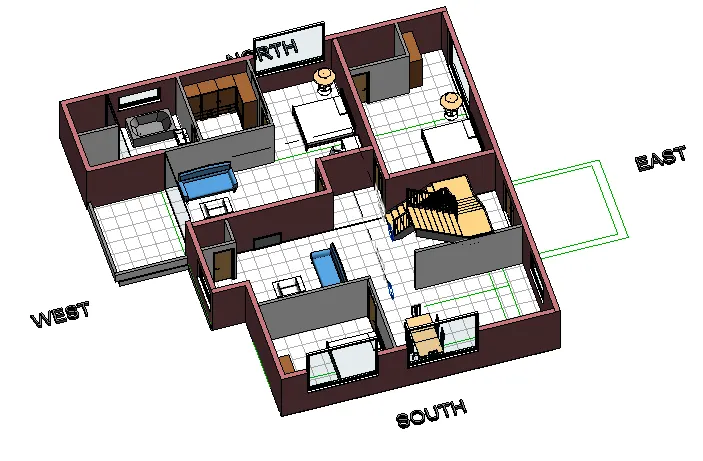
ans) AIM : to model the project as per neb requirements.