Internal Geneva Mechanism
AIM:
To understand the Internal Geneva Mechanism and perform Motion Analysis of the mechanism at different parameters and also analyze different outputs like contact forces, angulary velocity, etc, which can be used as inputs for designing the parts.
MOTION STUDY SETUP:
Having generated the 3D parts of the Driven Wheel and Driven Wheel of the Internal Geneva Mechanism, the parts are assembled with the required constraints.
On the completion of the assembly, it is opened with the Solidworks Motion feature in Solidworks.
The setup provides with the options to explore Animation, Basic Motion and Motion Analysis of the mechanism.
In an engineering point of view, Motion Analysis is a very important study that can be used to find out different related parameters.
The setup provides an option of a Rotary Motor, which can be used to provind motion to the driving component, i.e, the Driver Wheel.
Infact, linear motion can also be provided for mechanisms involving the same.
The parameters of the input motion can be in terms of Constant Speed, Total Distance with time, Oscillating Motion, Datapints and Expressions, etc.
In the present case, constant speeds of 10 rpm and 20 rpm are used for two different studies.
If required, delay or lag can also be provied in the input motion.
Done with input motion parameter, the next step is to provide contacts using Solid Body Contacts, keeping Motion Analysis as the study of interest.
The driven and driven wheels are selected to provide the contacts while assigning Steel as their material without any lubrication, as the study intends to find the contact forces between the parts in dry condition.
The calculator provided is used to find the contact forces between the parts, while selecting the faces which come into contact when the mechanism is in action.
However, a lot of other outputs such as Displacement, Velocities, Forces, Energy, Interia values, etc can be found using the Motion Analysis Study.
In the present case, the desired output is the Contact force magnitude between the mating surfaces.
The setup also provides options such as Springs, Dampers, Gravity, etc. which can be used as inputs for a lot of different studies.
Study 1: Motion analysis of the mechanism by rotating the driver wheel at 10 rpm.
The plots are shown below:
Plot 1: Contact Force vs Time (10 rpm):
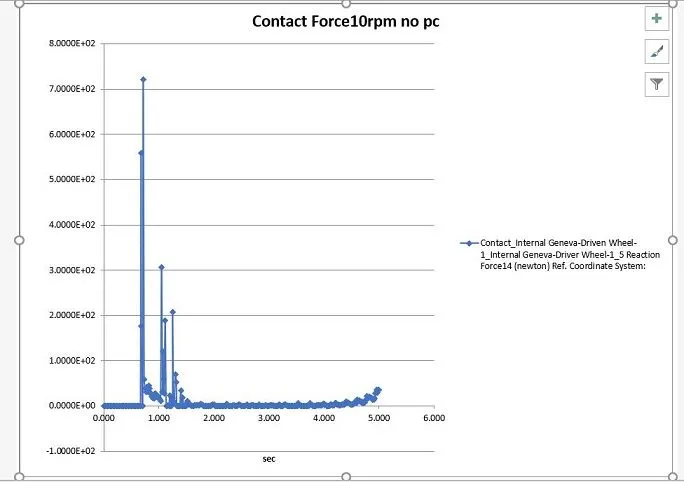
It can be observed that the contact force between the driver and the driven wheel is more at the start of the motion i.e., when the pin enters the guiding slot on the driven wheel, and it is negligible when the pin is sliding along the slot during the mechanism.
On one complete cycle, the force again reaches its maximum value at the same location.
Plot 2: Angular Displacement of the driven wheel:
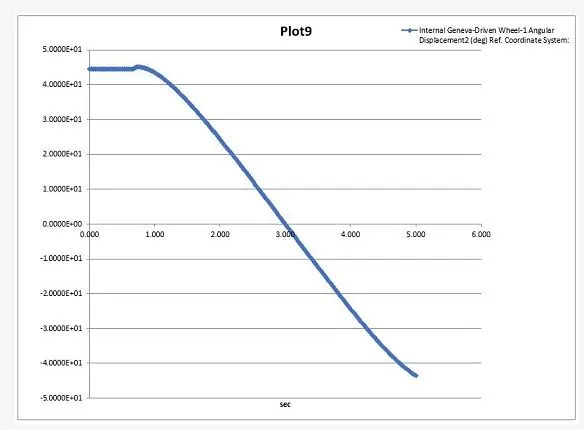
As per the orientation of the assembly when the motion analysis was done, the graph above shows that the diven wheel rotates by a total of 90 degress angular displacement from an initial position of +45 degress to -45 degrees.
The included angle between the 2 slots on the driven wheel is also 90 degrees.
Precise Contact Selection:
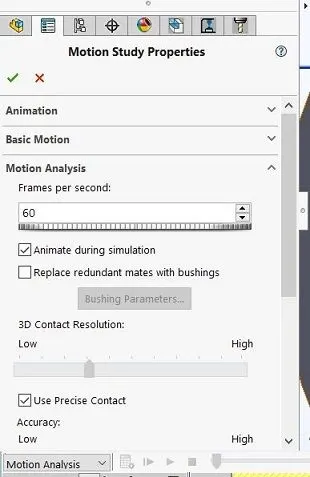
Plot 3: Contact Force with Precise Contact (10 rpm & 60fps):
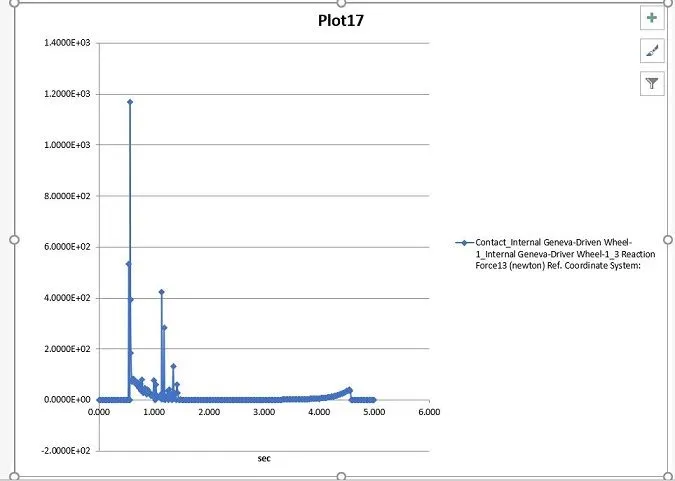
It can be observed that by using precise contact, the graph is more smooth and represents the contact forces at different locations more precisely.
It also shows a higher value of contact forces at the same locations as predicted by the no precise contact method.
Plot 4: Driver Wheel's Angular Velocity at 20 rpm:
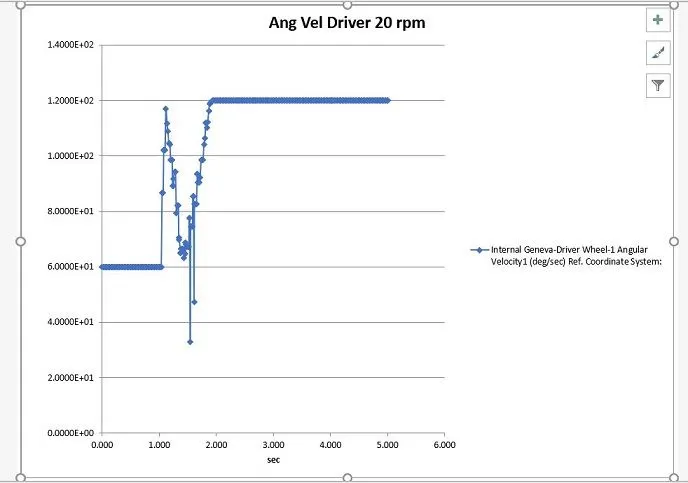
On camparing the above praph of angular velocity variation with time, with the contact force variation with time;
it can be observed that at points where the contact forces are higher, the angular velocity fluctuates and then becomes constant when the contact forces are negligible.