Identification of Cracks
1 (a)
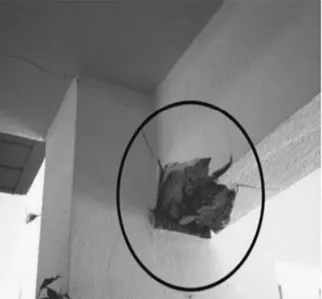
MODE OF FAILURE :
The above crack is due to the Shear failure of the beam.
- Shear failure occurs when the beam has shear resistance lower than flexural strength and the shear force exceeds the shear capacity of the materials of the beam.
- Cracks in concrete beams due to increase in their shear stress appears near the support such as wall or column.
- When the design shear stress is exceeded by the applied loads , shear cracks can be observed as the initial warning with the increase of the loading.
- These cracks are called shear cracks and are inclined at 45 degree with horizontal.
- Shear stress is maximum at a distance of d/2 from the support where d is the effective depth of beam.
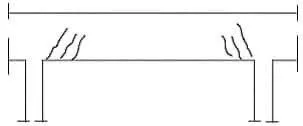
REPAIRS FOR SHEAR FAILURE OF BEAMS :
- Immediate attention shall be made in such situations to avoid excessive loads and to investigate the effect of the cracking on structural elements..
- Due to the risks these cracks pose to your home, structural cracks should be fixed by a competent foundation repair contractor as soon as possible.
- Installing carbon fiber strips or reinforcing steel beams to the damaged walls.
1 (b)
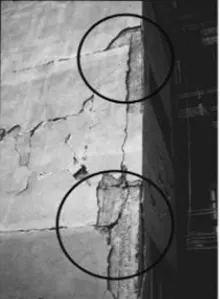
MODE OF FAILURE :
The above disfunction accurs due to Concrete Cracking.
- When installed properly, concrete is one of the most durable and long lasting products you can use around your home. But it is important for contractors to follow the guidelines with respect to concrete placement.
- Shrinkage is the main cause of cracking. This happens due to excessive mixing of water in the mix.
- Also, rapid drying of slab will significantly increase the possibility of cracking.
- Improper strength concrete is poured on the job which also causes cracking.
REPAIRS FOR CONCRETE CRACKING :
- Know the allowable water for the mix that is being poured.
- Make sure that the necessary water is available for the reaction for drying by adequately curing the slab.
- Verify the strength of the concrete you are pouring should be poured at.
1 (c)

MODE OF FAILURE :
This failure occurs due to Beam – Column Connection failure.
- These cracks happen due to formation of plastic hinges at undesirable locations.
- When the structure is subjected to high shear forces during seismic activity, such cracks take place.
- If they are inadequately reinforced, they will result in loss of strength and stiffness and collapse.
- Shear failure governs in beam column connection.
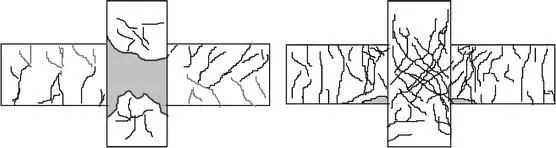
REPAIRS FOR BEAM-COLUMN CONNECTION FAILURE :
- Formation of plastic hinge must occur at the end of beams and not at the beam-column connection.
- Beams and column strengthening techniques should be applied in order to avoid such failures.
2 (a)
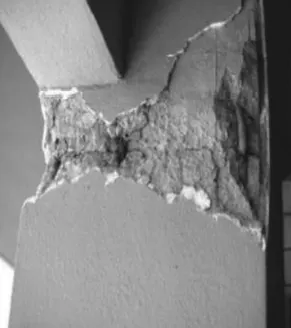
This crack is due to Compression Failure in Columns .
- The column can fail in compression due to increase of the axial stress than its capacity as the reinforcement and concrete have some capacity based on their area of section.
REPAIRS FOR COMPRESSION FAILURE IN COLUMNS :
- Encasement or enlargement of the column cross section.
- Cathodic protection to stop reinforcing steel corrosion.
- Chloride extraction to retard the reinforcing steel to stop steel corrosion.
2 (b)
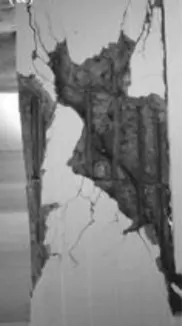
The given failure is due to Lack of Confinement Reinforcement.
- Vertical elements subjectedto cyclic loadings are subjected to failure of this nature.
- Failure causes mainly due to the lack of links in the area where there are higher shear forces.
- In structural elements like columns , high shear stresses are generated near the connections and lack of links in those areas cause this failure.
REPAIRS FOR FAILURE OF COLUMNS DUE TO LACK OF CONFINEMENT REINFORCEMENT :
- To avoid such failures, the column should be made with a sufficient cross-sectional area compared to allowable stress.
2 (c)
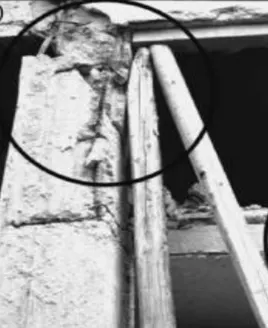
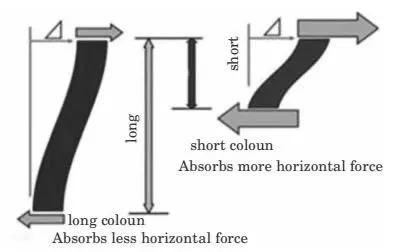
The given crack is due to Short Column Failure.
- In this case, larger deformation occurs at the base of the column.
- Disintegration of core concrete takes place and the steel is buckled .
- In short column failure, failure occurs by direct compression only.
REPAIRS FOR CRACK DUE TO SHORT COLUMN FAILURE :
- Addition of steel plate assembly to increase moment capacity.
- Supplement columns.