Identification of Cracks
1. What is the mode of failure or damage of the beams in the figure above? Are the damages repairable? Elaborate.
Answer -
a)
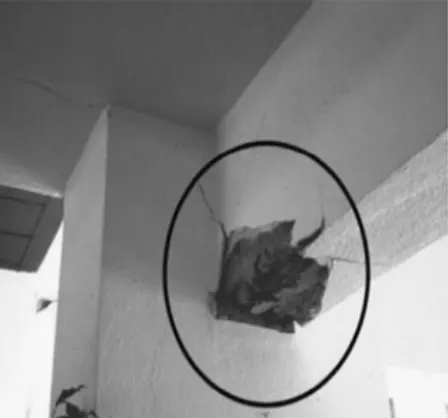
Mode of Failure - Flexural Tension Failure.
This crack will be formed due to the flexural failure of a beam. The Flexural stength known as modulus of Rupture, bend
strength or fracture strength, is a material property defined as the stress in a material just before it yields in a flexure test.
The flexural strength represents the highest strength experienced within the material as its moment of rupture. It is
measured in terms of stress. To overcome to this type of failure main steel is provided at the bottom/top of the beam.
This failure occurs when the load on beam exceeds its flexural capacity. Here failure starts by yielding steel reinforcement
followed by crushing of concrete at compressive side. It initially cracks at the tension side of the beam then extends to
compressive side. This can be avoided by providing main steel on both tension and compressive side of the beam.
Here the damages are repairable by providing additional steel screw up with the main steel replacing the failed steel.
b)
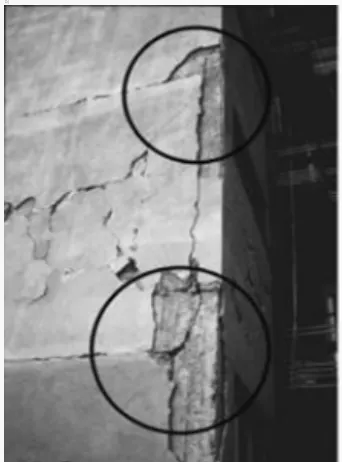
Mode of Failure - Failure due to errors in construction.
This occure due to change in concrete grade or lack of strength in the concrete due to failure of supplier during concreting. Sometimes
it can be due to high slump concrete usage. This will mainly lead to formation of honecomb structure in the concerte. Honeycomb is voids
in concrete formed to due to improper compaction or incomplete filling of the concrete. This can be repaired by choosing grade of concrete.
wisely, using air entrained concrete, fibre reinforced concrete/polymar concrete. Also to provide proper compaction during the placement of
concret. Can also provide thick concrete cover.
c)
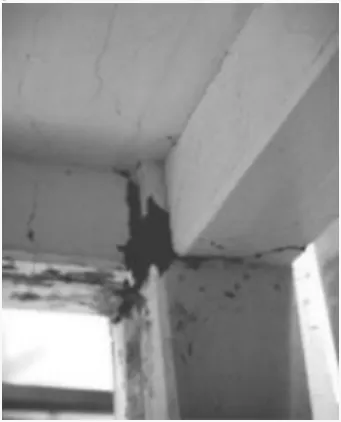
Mode of Failure - Beam - Column Connection Failure.
Beam Column connection failure is the common type of failure in the earthquake zone areas. It is maily due to formatiom of plastic hinge
at the ends in strong column and beam weak combinations. It can be repaired by providing achorage bars at the Joint/ onnection.
The bond performance of the bars anchored in a joint affects the shear resisting mechanisms to a significant extent.
Question 2:
a)
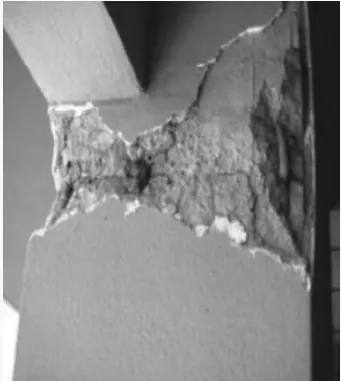
Mode of Failure - Flexural Compressive Failure of Column.
This crack will be formed due to flexural failure of a column. Column have the most important role in all structural members of a building.
According to the base civil engineering concepts, column failure wants to be occuring after beams and other components damages.
Performance of the existing buildings in earthquakes indicates that the beams are less vulnerable to damage during the earthquakes
and their damage appears to be less critical to performance as compared with that of columns and columns beam joints.
b)
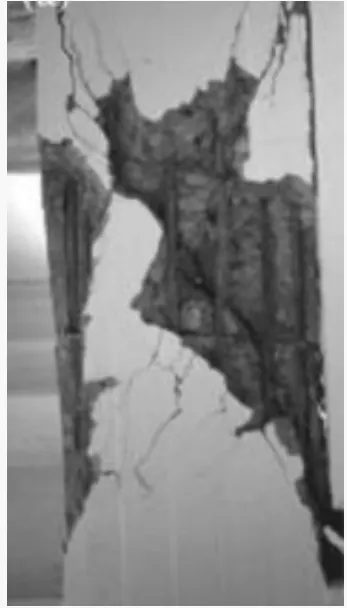
Mode of Failure - Shear Failure of Column.
This crack will be formed due to shear failure of column. Lateral loads in a structure are carrying by vertical elements such as columns and
shear walls. When there is no shear walls, Columns caary these lateral loads. Lateral loads are generated by winds, earthquake loads,
from retainig structures etc. Shear links are provided to columns based on the shear forced on them. Further , the size of the column
is increased in the direction of shear to increase the shear capacity.
c)
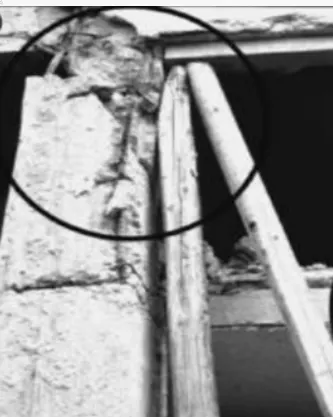
Mode of Failure - Short column effect/Buckling Failure.
This cracks are formed due to short column failure. In short columns, Failure takes place due to yielding and we define this phenomenon as
Crushing. Short columns are classified as based on slenderness ratio of the effective length and least lateral dimension of the column.
Failure of column usually occurs due to anyone of the following stresses developed in the column. Short column will fail only beacause
of direct compressive stress developed in the column or we can also say that short column will usually fail due to direct compression
or crushing.