Hood design-Week 2
Hood
Objective: To create a hood assembly using the given data using NX CAD.
Introduction
The hood or bonnet is the hinged cover over the engine of motor vehicles. Hoods can open to allow access to the engine compartment, or trunk on rear-engine and some mid-engine vehicles for maintenance and repair.
The car’s hood consists of an inner panel and outer panel. The inner panel of the hood is designed keeping in mind the forces that act on the car during a crash, the hinges for the opening and closing of the hood and it also has locking mechanism. The inner panel is provided with embosses, which are designed to direct the forces during a crash outward and not towards the passengers. The outer panel provides a cover to the inner panel and adds aesthetics to the car.
Functions of hood
- Its main function is to direct access to the engine, battery and other crucial parts of the cars for repair and maintenance and to protect these parts from direct sunlight and dust.
- It is used to provide aerodynamic stability to the car.
- The hood plays and important part during a crash by deflecting the forces away from the car body.
- It is required to supply pure air so filter is provided on the bonnet to supply filtered inlet air.
- Hoods are provided with different vent designs for cooling purpose of an engine and carburettor at high speed.
- Scoops on hood having another function of supply of air for supercharger in case of supercharged engines.
- Hoods are also used mount blowers which are used to supply air for superchargers.
Materials used for manifacturing a car hood
Hoods are typically made out of the same material as the rest of the body work. This may include steel, aluminium, fiberglass or carbon fibre. However, some aftermarket companies produce replacements for steel hoods in fiberglass or carbon fibre to make the vehicle lighter.
Design aspects/Design criteria
- Vehicle quality: The hood plays an important role in the dynamics of the car. Parameters such as aerodynamics, torsional stiffness, dent resistance, corrosion resistance and also to reduce NVH levels.
- Passenger safety – The hood plays an important role during a crash by deflecting the forces outwards or away from car body.
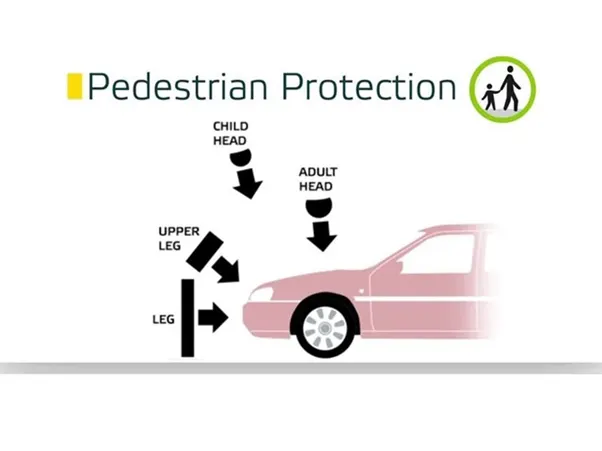
- Pedestrian safety – The European New Car Assessment (Euro NCAP) is a European car safety performance assessment program which has developed test specification and rating systems for vehicles. The tests include a series of tests using impactors designed to mimic a collision at 40kmph. They describe a situation in which pedestrian is situated laterally and the car first hits one of his/her legs.
- Car aesthetics – The hood is one of the major contributors for the car’s looks.
Euro NCAP for pedestrian safety
The European New Car Assessment Programme (Euro NCAP) is a European voluntary car safety performance assessment programme (i.e., a New Car Assessment Program) based in Leuven (Belgium) formed in 1996, with the first results released in February 1997. It was originally started by the Transport Research Laboratory for the UK Department for Transport, but later backed by several European governments, as well as by the European Union. Their slogan is "For Safer Cars".
Test Procedures
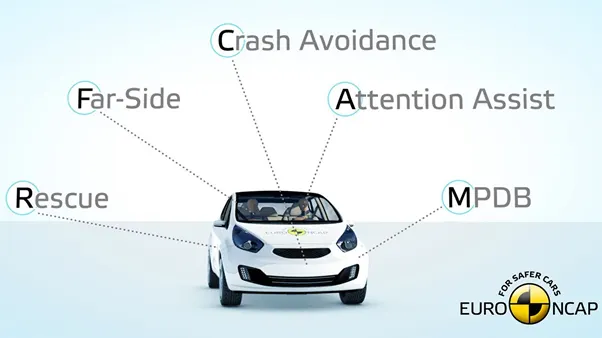
- Mobile progressive deformable barrier - The test car is propelled at 50 km/h (31 mph) into a moving deformable barrier mounted on an oncoming 1400 kg trolley, also travelling at 50 km/h at a 50% overlap. This represents hitting a mid-size family car. Two adult male THOR-50M dummies are seated in the front and two child dummies are placed in the back. The aim is to assess the crumple zones and the compatibility of the test car.
- Full width rigid barrier - The test car is driven into a rigid barrier with full overlap at a speed of 50 km/h (31 mph). A small female dummy is seated in the driving position and in the rear seat. The aim is to test the car's restraint system, such as airbags and seat belts.
- Mobile side impact barrier - A deformable barrier is mounted on a trolley and is driven at 60 km/h (37 mph) into the side of the stationary test vehicle at a right angle. This is meant to represent another vehicle colliding with the side of a car.
- Side pole - The car is propelled sideways at 32 km/h (20 mph) against a rigid, narrow pole at a small angle away from perpendicular to simulate a vehicle travelling sideways into roadside objects such as a tree or pole.
- Far side impact - The body in white (frame) of the vehicle is attached to a sled is propelled sideways to provide accelerations experienced by the vehicle in the side and pole tests, but on the far side of the vehicle. The far side testing was implemented in 2020 to help combat far side injuries (where the driver is struck from the opposite side). The ‘excursion’ of the dummy - the extent to which the dummy moves towards the impacted side of the vehicle - is measured.If the vehicle is equipped with centre airbags then a co-driver (front passenger) is added in either the mobile side impact or the pole test to evaluate its effectiveness.
- Whiplash - The vehicle seat is propelled forwards rapidly at both 16 and 24 km/h (9.9 and 14.9 mph) to test the seat and head restraint's capabilities to protect the head and neck against whiplash during a rear impact.
Sheet metal operations to produce a hood
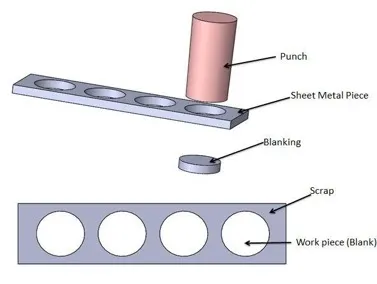
- Blanking - Blanking is a steel manufacturing process in which a flat, geometric shape (or “blank”) is created by feeding a coil of sheet metal into a press and die. In this process the blank is punched out from large metal sheet. Here is visual depiction of this process
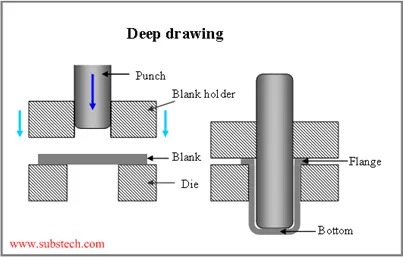
- Deep drawing - Deep drawing is a sheet metal forming process in which a sheet metal blank is radially drawn into a forming die by the mechanical action of a punch. It is thus a shape transformation process with material retention. The process is considered "deep" drawing when the depth of the drawn part exceeds its diameter. This is achieved by redrawing the part through a series of dies.
-
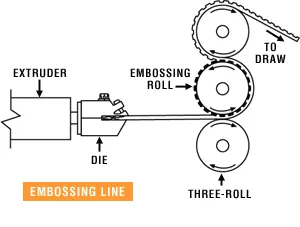
Embossing - is a metal forming process for producing raised or sunken designs or relief in sheet material by means of matched male and female roller dies, theoretically with no change in metal thickness, or by-passing sheet or a strip of metal between rolls of the desired pattern.Metal sheet is drawn through the male and female roller dies producing a pattern or design on the metal sheet. Depending on the roller dies used, different patterns can be produced on the metal sheet.
-
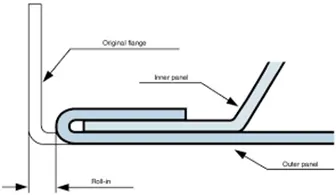
Hemming - Hemming and seaming are two similar metalworking processes in which a sheet metal edge is rolled over onto itself. Hemming is the process in which the edge is rolled flush to itself, while a seam joins the edges of two materials.Hems are commonly used to reinforce an edge, hide burrs and rough edges, and improve appearance.
Design Methodology
| 1 | Download all the data provided |
| 2 | Create an assembly file and add all the components |
| 3 | Create hood inner panel using the given outer panel as referrence and using the master data. |
| 4 | Assemble the given hinges onto the inner panel. |
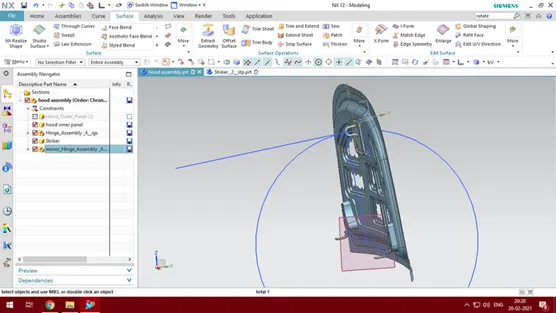
| 5 | Draw hinge axis and from the mid-point of hinge axis draw a circle so as to locate the position of the striker. |
| 6 | Assemble the striker |
Given master data
Hemming data
Inner panel
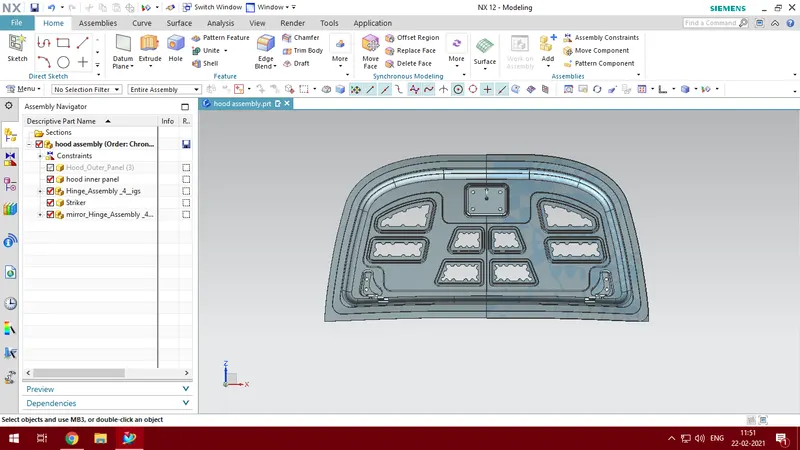
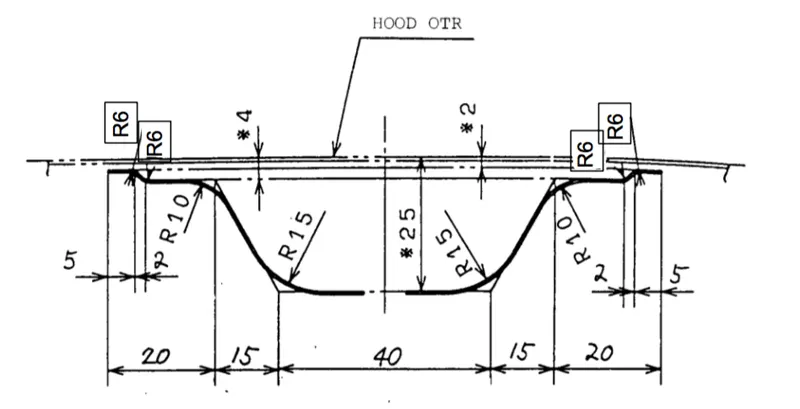
- The inner panel is designed using the given outer panel as reference and also using the given master data.
- The embosses on the inner panel are created as per the data given by the CAE team. The design provided or embosses created is such that the forces experienced during a crash or accidents is deflected away from the car body and not towards its centre.
- Provisions are made for mounting the hinges.
- The inner panel has a thickness of 0.75mm.
- Mastic points are provided on the emboss to accomodate the mastic seals which is used to join the inner and outer panel. These mastic seals have a thickness of 5mm and diameter of 60-80mm.
Mastic points
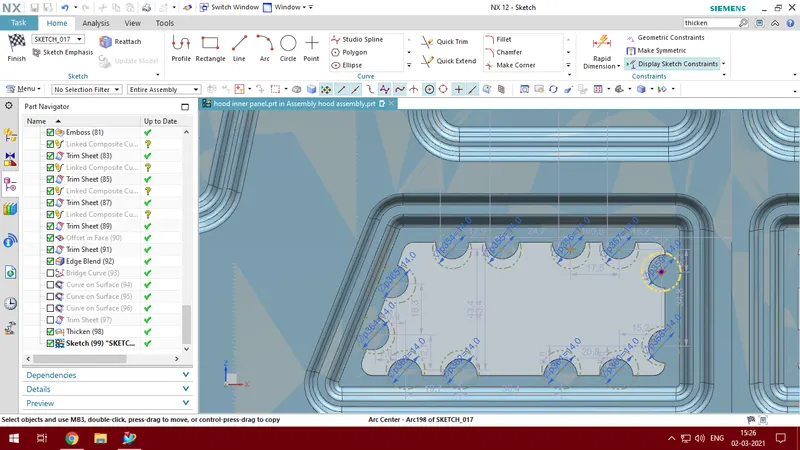
- The mastic points are encircled. Many such mastic points are provided on the embosses to accomodate mastic seals to provide a tight seal between the inner and outer panels which also helps to reduce NVH levels.
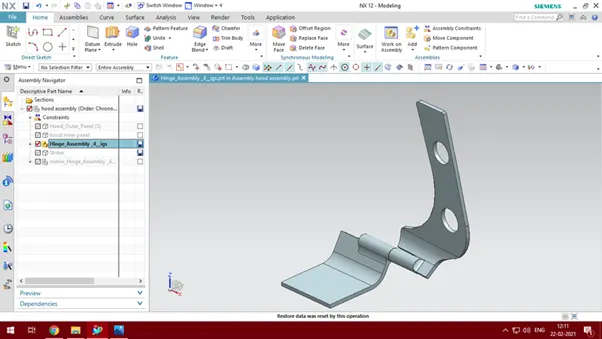
- Hinges – The hinges help in the opening and closing of the hood.
- Latch and striker – This is the locking mechanism which helps to lock the hood to the car body.
- In order to position the latch and striker on the inner panel, first we have to draw an hinge axis. From the mid-point of this axis a circle is drawn. The trajectory of the striker must be tangential to this circle. This determines the position of the latch and striker on the hood inner panel.
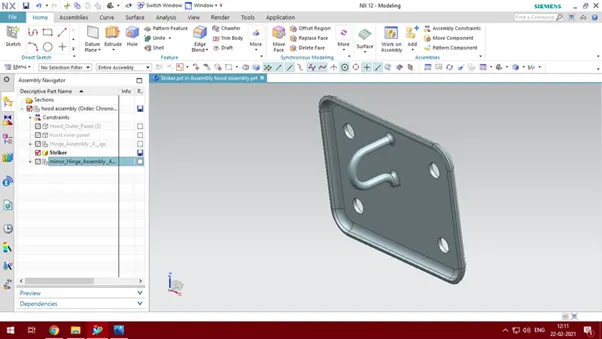
Positioning the striker
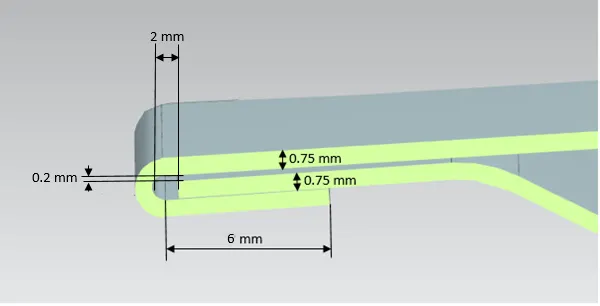
- Hemming – Both the outer and inner panels are joined together by hemming.
Conclusion
The hood assembly is created as per given master data.