Design of Car Hood considering the pedestrian safety and vehicle safety
Abstract:
Traffic accidents are terrible scourge that occur in many countries, specially fordeveloping countries where transportation affairs like tangled yarn.Besides functioning as anengine compartment cover, the hood of modern compact SUV can also help to manage theimpact energy of a pedestrian’s head in a vehicle-pedestrian impact.
Vehicle safety factors should simultaneously consider occupant and pedestrian safety, given that pedestrians are the third largest category of traffic fatalities. Most pedestrian deaths occur due to traumatic brain injury, resulting from the hard impact of the human head against the vehicle's stiff hood or windshield. Therefore, how to design a pedestrian-friendly vehicle and propose a new hood structure is a matter of urgency for minimising pedestrian head injuries. In this study, three kinds of sandwich hood structures are proposed for reducing pedestrian head injuries, including carbon fibre-reinforced polycarbonate, carbon fibre-reinforced foam and aluminium-reinforced polycarbonate. In assessing the friendliness of vehicle hoods, this study adopts the EEVC/WG17 regulations on headforms for hood tests. The finite element method is used to simulate the impact between the vehicle's hood and the headform impactor. The software used in simulation is LS-DYNA. The results predicted by the headform-hood tests show that the hood structure with aluminium-reinforced polycarbonate material provides enough absorption capability to protect pedestrians from the impacts of accidents. It is also stiff enough to keep pedestrians' heads away from the inner parts of the engine cavity. The analysis models and sandwich materials proposed herein contribute to efforts to design vehicle hood structures and pave the way for developing pedestrian protection technologies.
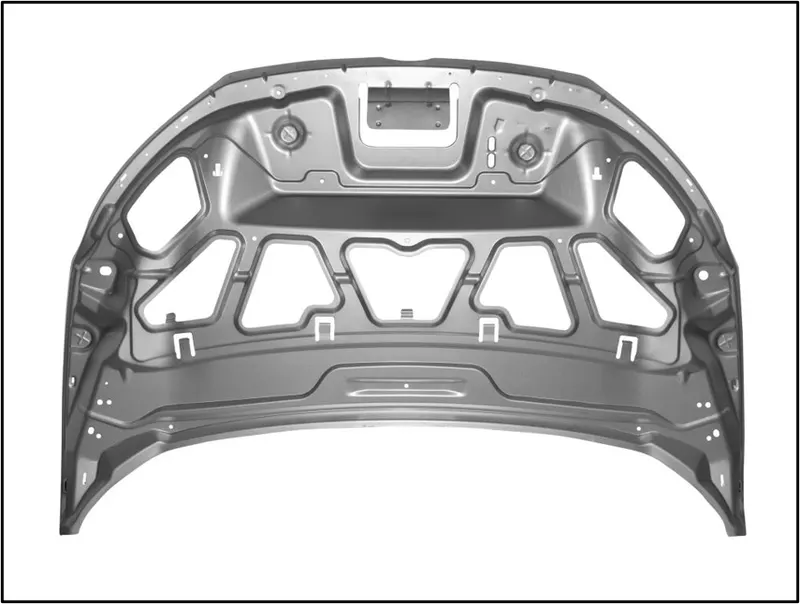
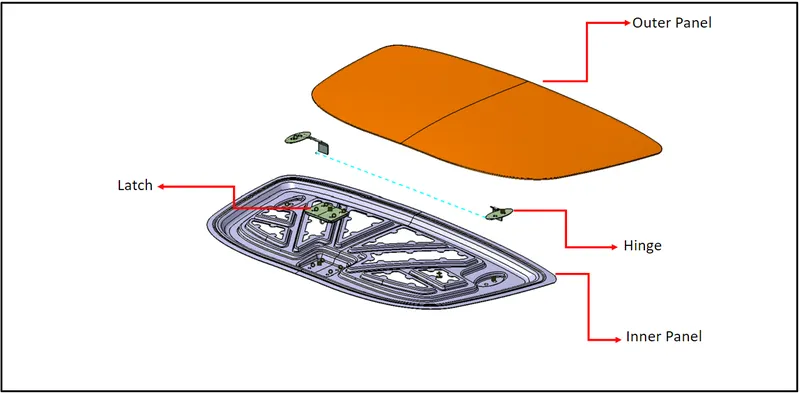
Design and Manufacturing of the Car Hood
The front hood has been cut from general assembly shapes of an electric prototype vehicle. The design of this it was done using CATIA V5 software program using surface design and composite design modules. It was performed behind it based on the shape of the external surface of the model .The hood are some fixing points and reinforcement zone for its hardening, this element was modelled in according with similar element from actual cars.
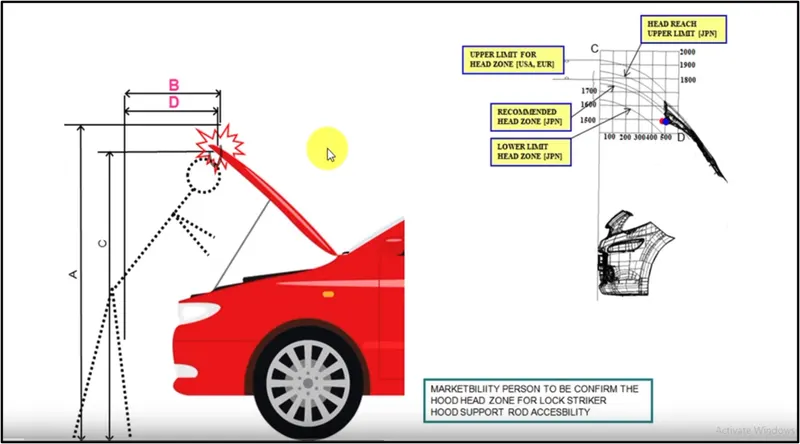
- Head Clearance criteria:
Head clearance is decided upon the zone or country. So same car if it is made for different country will have different opening angle depending on the country or region.
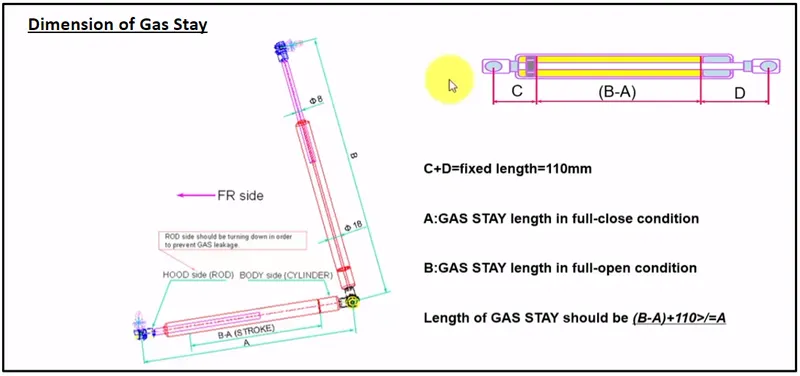
The distance C and D shown in the image is represented as graph in the upper right corner of the image. Choosing the right head zone position will decide upon the angle of the hood opening.
Product engineers will also get input from the marketing team for deciding head zone.
When a car crashes on the pedestrian, the whole human body wraps around the front shape of the car and the head impacts on the bonnet or the windscreen. The distance on which the head impacts on the car from the ground is called as the Wrap Around Distance (WAD).
To be specific the Wrap Around Distance is a measurement of distance from the ground to the head impact zone over the outer surface of the car. The wrap around distance is measured longitudinally in the center of the vehicle from the ground.
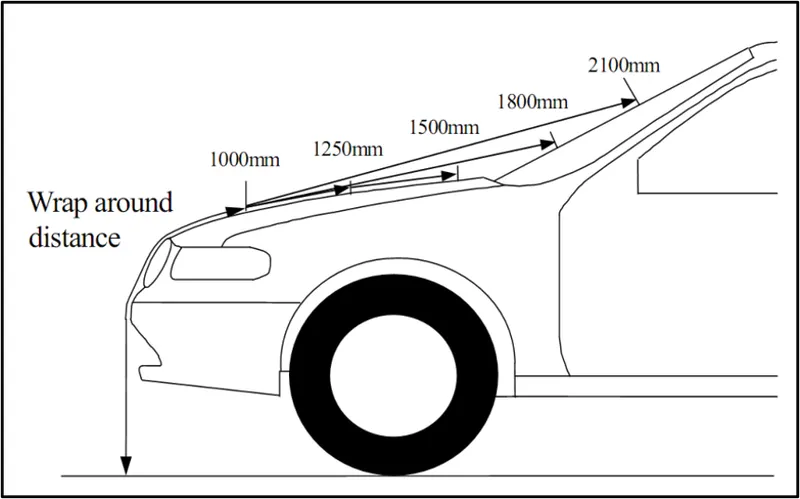
The severity of the injury caused by the frontal crash depends on the type and shape of the vehicle, speed of the vehicle and the movement of the pedestrian relative to the vehicle. In addition to these parameters, the wrap around distance plays a major role in the safety measurement of a pedestrian. During the crash analysis, based on the Wrap Around Distance(WAD), two test areas will be created namely Child head impact zone and the Adult head impact zone. The child head impact zone is between 1000 to 1700 mm WAD and the adult head impact zone ranges between 1700 to 2100 mm WAD.
- Support Rod and Gas Stay
There are two types of support is there,
- Gas stay
- Support rod
1.Gas stay
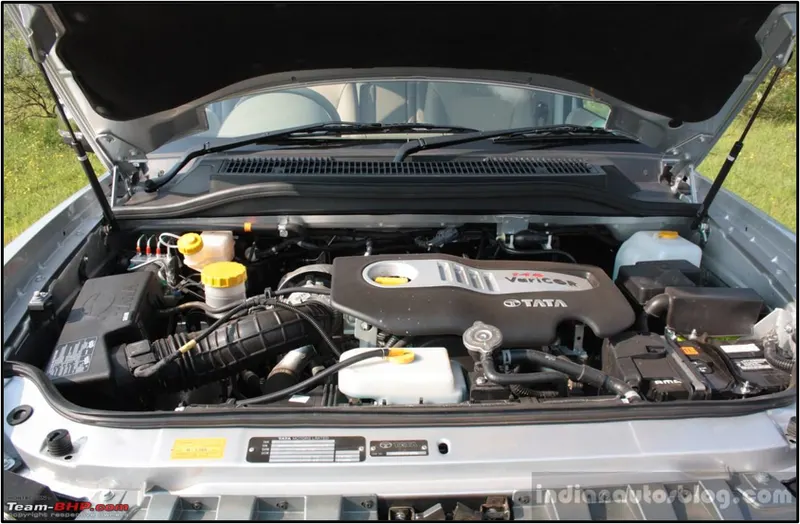
spring stays are designed to be used on upward lifting doors, once you have opened the door slightly the spring will push the door to the fully open position, Euro fit stock various size springs depending on the door size requirements. This is mostly used for where the car bonnet weight is heavy.Struts contain nitrogen gas under pressure and some oil to damp movement and to lubricate the seals.
- Support Rod
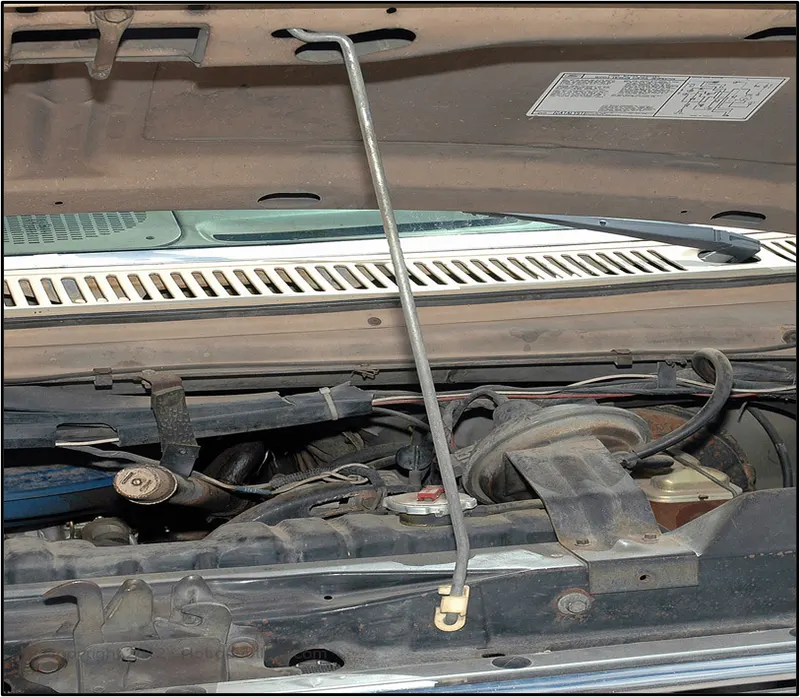
1)Support Rod can be mounted with grommet side on the engine compartment of Body and rod locking hole on hood or vice versa.
2)Grommet and the clip of the rod are standard parts.
Support rod is used to increase the support force, automatic buffering, stable and reliable, strong load-bearing capacity, safe use, not easy to fall, avoid hot hands, support the engine more easily, and balance the force without shaking.
Materials and manufacturing method
The materials used for manufacturing of front hood it was carbon fibre/epoxy. The balanced woven fabrics Twill 2X2 by 200g/m2 were used. The distribution layers were [90/0 ±452/90/0].
For the matrix L285 epoxy resin and hardener 286 from Lange-Ritter (Germany) was used. The mixing ratio according to the company prescription was 100:40 parts by weight. The epoxy blocks were used to obtain the front hood mould. There was milling by CNC machines. To have a sufficient sealing surface of the vacuum bag the borders of the mould were extended by 100 mm. Two moulds were manufacturing, one for exterior of the hood and one for back part (Fig. 5). The surface of the moulds was mechanical processing by glass paper sanding by 1000 grit.
Deep drawing is one of the most widely used processes in Hood manufacturing. Apart from its use in many other sectors, it is applied in the automotive industry for the manufacturing of car body parts.
The deep drawing process is a forming process which occurs under a combination of tensile and compressive conditions. A flat sheet metal blank is formed into a hollow body open on one side or a hollow body is formed into a hollow body with a smaller cross-section.
Deep drawing processes are divided into three types:
- Deep drawing with tools
- Deep drawing with active means
- Deep drawing with active energy
In the automotive industry, deep drawing is usually carried out using rigid tools.
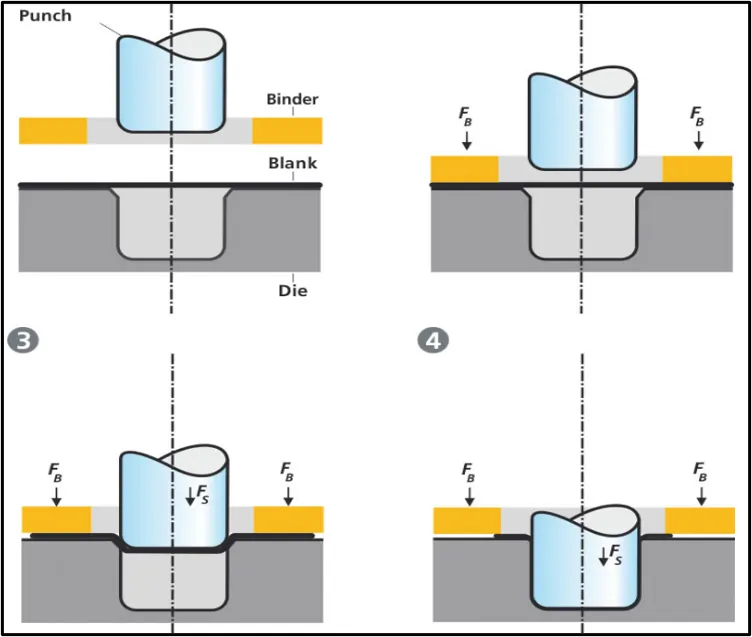
- The figure illustrates the deep drawing process. The rigid tools consist of a punch, die and binder. In deep drawing, the plate holder closes after the metal sheet blank has been inserted.
- Next the sheet is clamped between the die and the binder. This process slows down the flow of the sheet while it is being drawn and thereby prevents wrinkles from forming under the binder. The punch stretches the sheet over the die radius and forms it in the die. The amount of punch force necessary for forming is thereby continually increased up to the lower dead center of the punch.
- Whereas in pure deep drawing there is no reduction of sheet metal thickness, forming is achieved in stretch forming purely as a result of a decrease in sheet metal thickness. Stretch forming is extensively used for the forming of only slightly curved parts with low depth of draw (e.g. roofs, doors).
- When drawing complex car body parts in practice, there is usually a combination of stretch and deep drawing involved. It is necessary that the sheet metal is stretched as well as possible without reaching the material’s limits (e.g. splits, wrinkles).
- There are approximately 300 to 400 sheet metal parts which fit together to form the body of a car. In order to manufacture high quality sheet metal parts optimally for their particular use, specialized software simulates the complete deep drawing process.
Spring back Effect:
Springback is the geometric change made to a part at the end of the forming process when the part has been released from the forces of the forming tool. Upon completion of sheet metal forming, deep-drawn and stretch-drawn parts spring back and thereby affect the dimensional accuracy of a finished part.
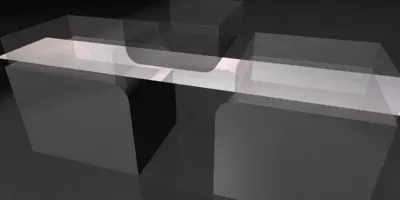
Through the application of new materials, the number of problems increases. Forming parts made of these materials are more affected by springback than parts made from conventional deep-drawn steel. Concerning classic sheet metal defects such as splits and wrinkles, strain in the sheet metal is decisive. If springback occurs, such models are not enough to predict a deformation. In this case, the stresses are decisive and a considerably higher accuracy is crucial.
During the development of tools, springback is compensated by software in order to remove the part from the tool straight away in the required dimensions. Intense tryout loops, which occur at a very late stage in the development of the tool, are reduced to a minimum. Simulation software can not only detect springback early on, it can also compensate for it. In this way, tooling processes are improved and manufacturing costs are significantly decreased. Springback compensation thus minimizes the risk of costly changes to tools or processes later on.
Trimming:
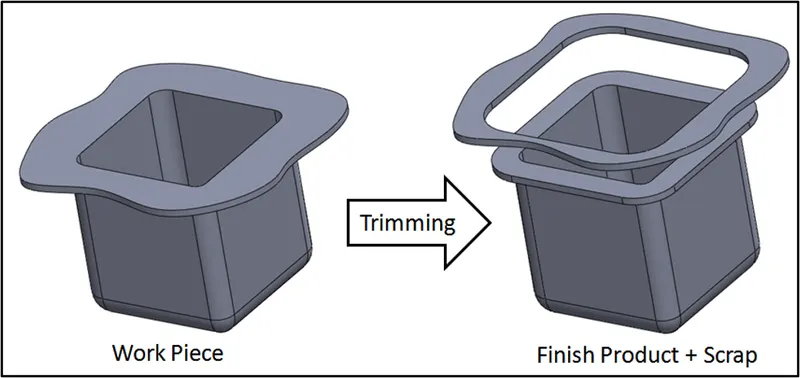
In the Trimming process,excess metal that is necessary to draw the part is cut away from the finished part.
Hemming:
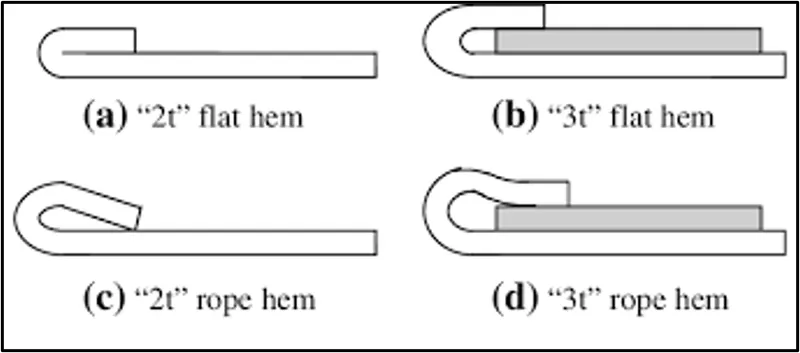
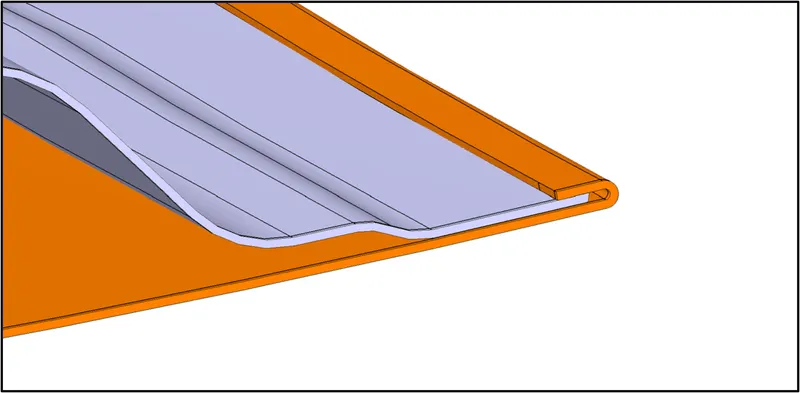
Hemming is a sheet metal forming process in which sheets are joined by bending it usually to 180°. Automotive body panels and automotive parts such as deck-lids, trunk-lids, doors, hoods and tailgates are formed by hemming process.Normally hemming operations are used to connect parts together, to improve the appearance of a part and to reinforce part edges.
Design of Car Hood using Catia V5
- Class A surface refers to those surfaces which are VISIBLE and abide to the physical meaning, in a product. This classification is primarily used in the automotive and increasingly in consumer goods.the Class A Surface will be given by Styling team.
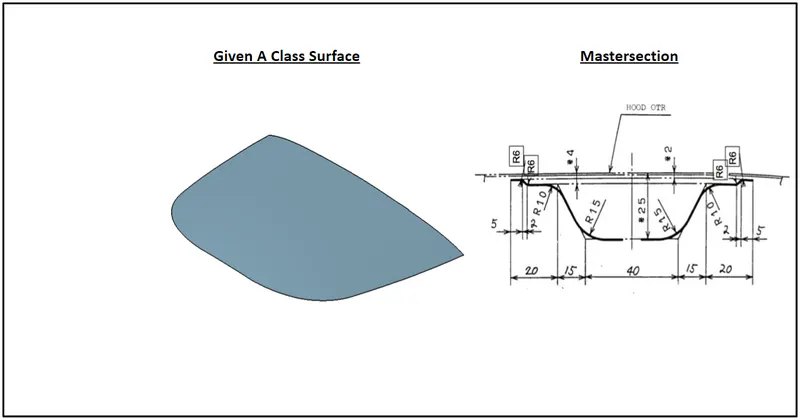
- By using the A class surface and Master section the Inner panel of the hood has been designed as follows:
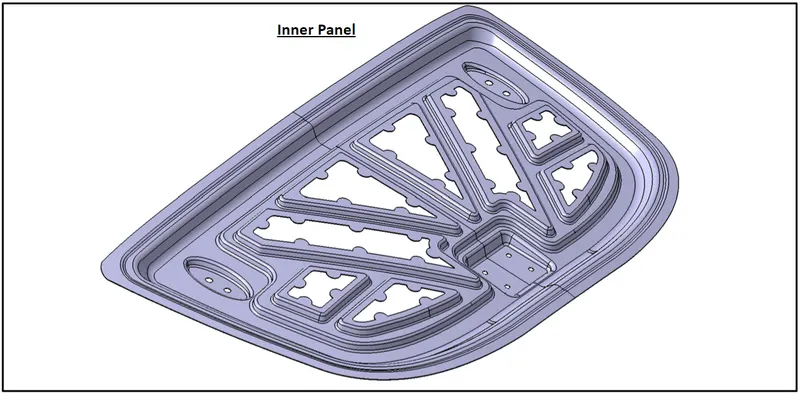
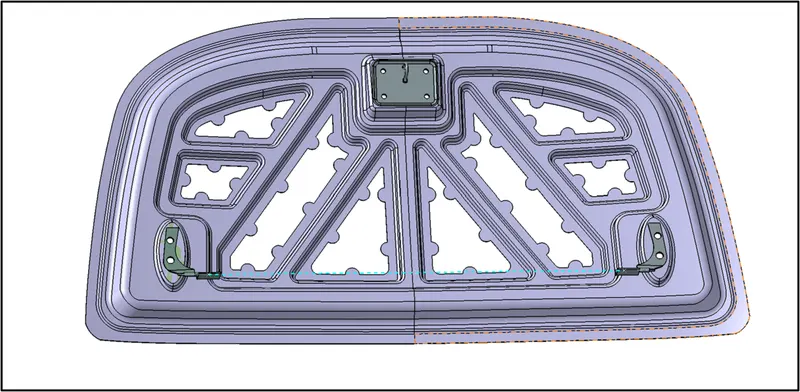
Design of inner panel consist:
1.Flanges 2. Embosses 3.Split surfaces 4.Mastic point 5. Hinge 6.Latch space
Flange: Following the master sketch we will made flanges for inner panel.
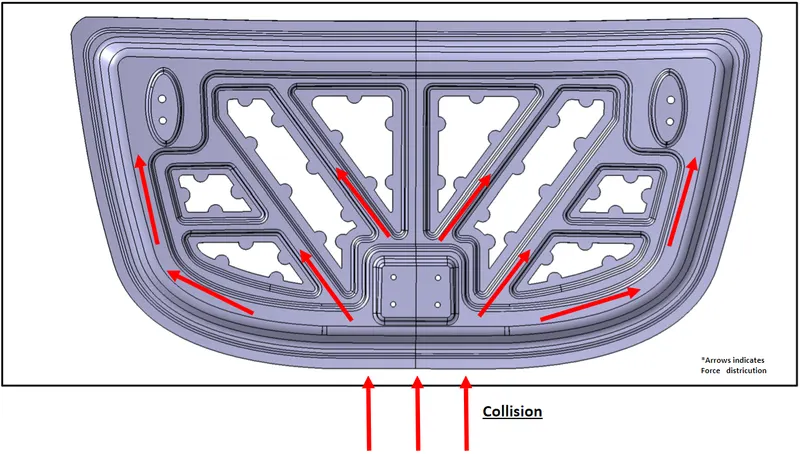
Embosses - Embosses has been given to create extra strength in inner panel and embosses design needs to be inspired by force dissipation phenomena like here I have made embosses in a way if any object hit from front most of the force will get dissipated by its design towards the upper left & right corner so that less force reach at occupants end.
Some split or cut is given on embosses to reduce head impact result.
Mastic points are also given to apply mastic sealant. A white paste like sealant to join inner panel and outer panel with each other by providing some heat to it. In heat it gets hardened.
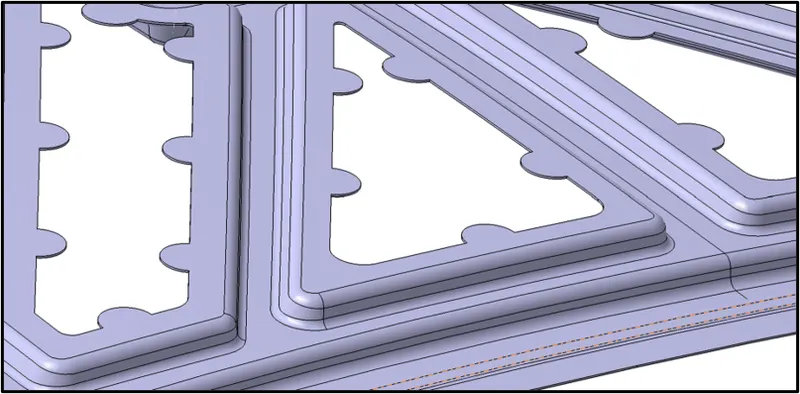
Mastic data:
It is basically an NVH topic mastics are point / surfaces given on embosses for applying mastic sealant to join outer and inner panel and also give good value of NVH.
So mastic sealants are joining material used to join inner and Outer panel and at the same time reduces the NVH value.
One spot of mastic sealant provides strength locally at around 80 mm so we need to put these mastic points in such a way that it covers the most of the hood region except reinforcement area of latch and hinge because that alone provide good NVH so no worries there.
Here I have spotted points where I have applied mastic data when mastic sealant will be applied and while undergoing hot bath it gets hardened & make the joint strong.
designing inner panel one must take care of spaces to provide on panel for latch and hinge.
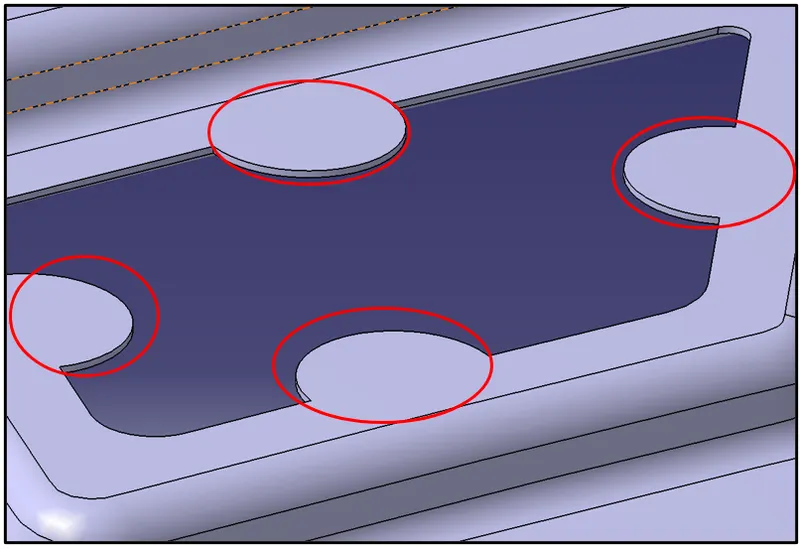
We use mastic sealant because we cannot provide spot welding on outer panel as it won't look good from outer side and car’s aesthetic will compromise in doing so.
Distribution of force in case of collision:
The inner panel is designed in such a way that in case of collision ,the impact force must goes in outward direction ,so that the impact on the driver and front passenger must reduce
Trajectory for Hood opening and Closing:
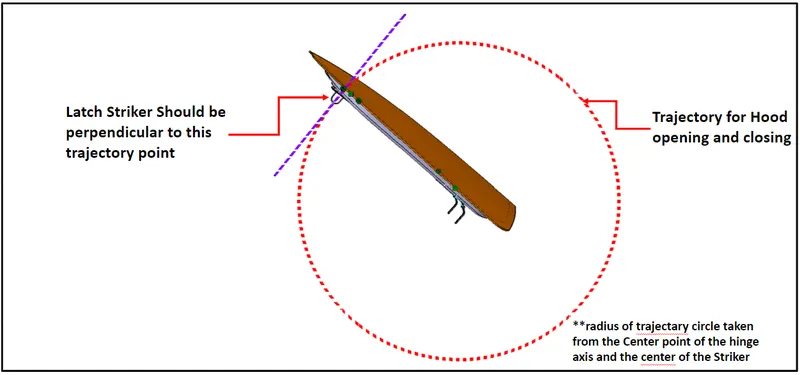
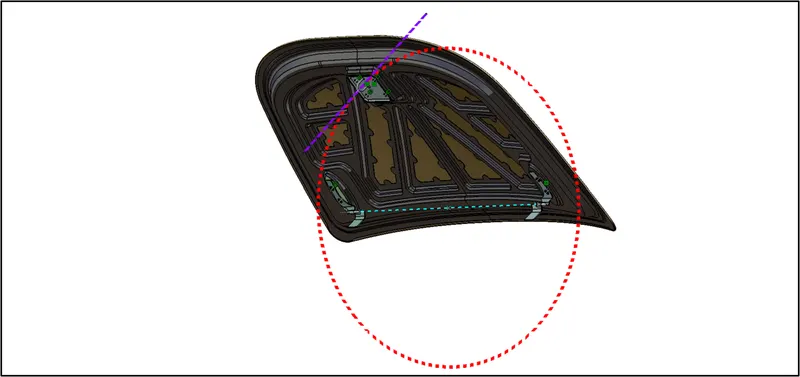
For the proper opening and closing of the hood, the striker should be positioned at a correct position. The striker should be perpendicular to the trajectory of the hood. The flanges are positioned at their respective positions. Then the line is drawn at a straight. Now the trajectory is derived from the hinge axis and the center distance from the striker. It is denoted using the circle.
Pedestrian Safety Measures:
A lot has been done in this field by far-
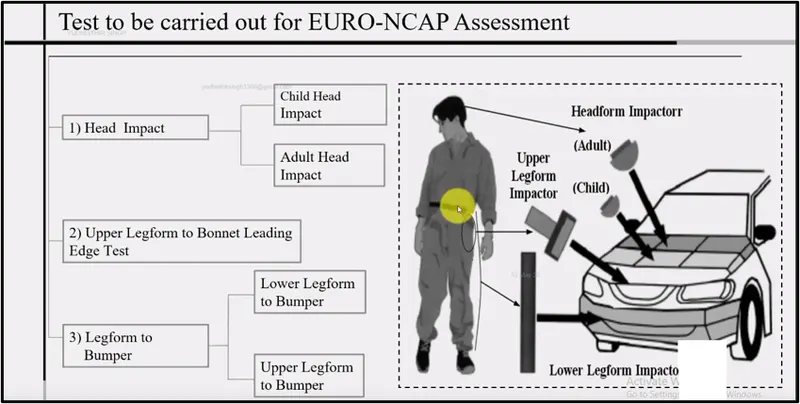
Euro NCAP the European car assessment program is European car safety performance assessment program based in Leuven and founded in 1997.
They published safety reports on new cars and awards star ratings based on the performance of the vehicle in a variety of crash test including front side and pole impacts and impacts with pedestrian. The top rating is 5 star
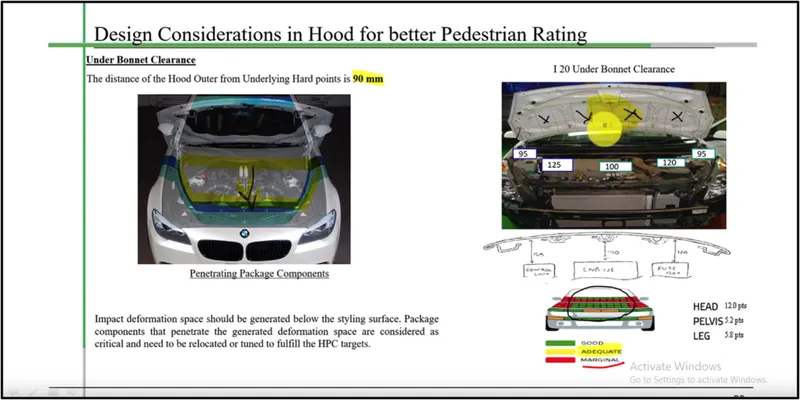
So here in Hood we separate the whole area of hood into several small part / region during frontal crash. Hood is the major portion a person is gonna come in contact with. So Euro NCAP specified some guidelines under which we distribute hood region into several parts and try to get more green region.
Here below I have pasted an image to get an overview.
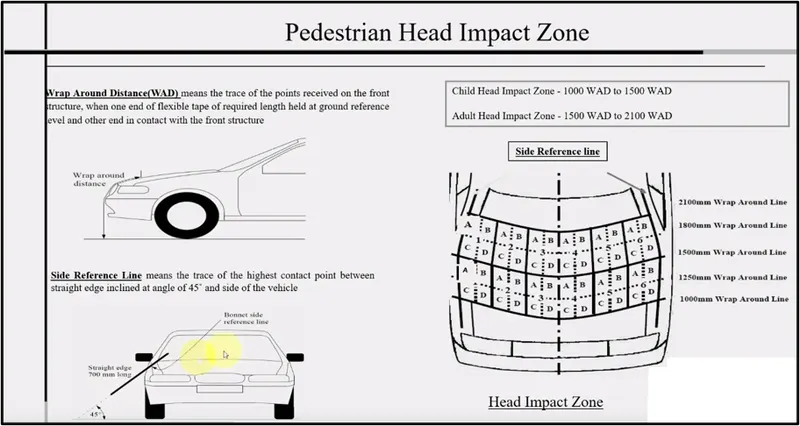
This region is basically distributed in relation to the height of children and adults who come in contact from front while accident. So, here the main motto is to achieve more green region and for that we provide splits in embosses so that during head impact the consequences of collision come less effective. So here I have given splits accordingly to improve head impact zone effectiveness in providing less damage to the person who hit it.
Outer panel:
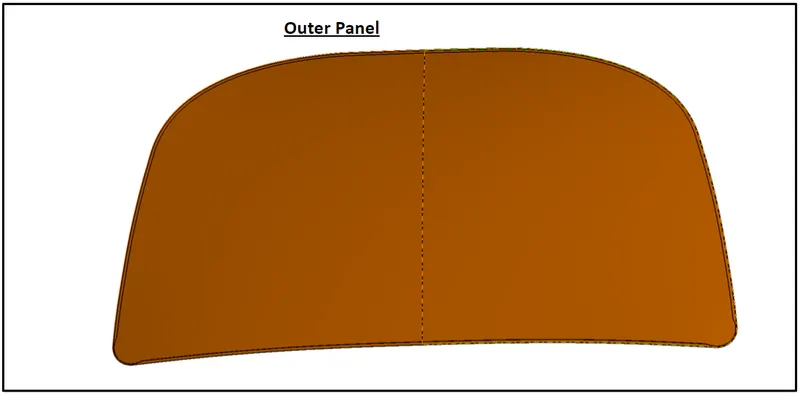
Design of outer panel is mainly inspired by aesthetic but there is some engineering also to it. Here main purpose of outer panel is to cover the inner panel to provide aesthetic look at the same time Panel must be curve & sleek so that it behave aerodynamically and air hitting from front reflect from it efficiently. So here rather than using seam and spot welding we use hemming method to join outer and inner panel. Hemming is a type of folding or wrap-around process in which roller bend and press the extrapolated flange in a way that it holds the inner panel firmly, then a sealant is also provided in between them under folds to get water tightening.
While hemming we provide relief around corner as it helps in easy hemming or undistorted hemming while roller took turn around any corner.
It’s thickness is also 0.75 mm maximum
Hinge and hinge reinforcement:
Hinge is a mechanical bearing that connects two solid objects typically allowing only a limited angle of rotation between them it has one degree of freedom. So here hinge is providing rotation to hood about it’s own axis and also keep it connected to the fender portion.
So while creating space for hinge we need to provide emboss there, because of emboss and hole its strength got affected so to compensate that we provide hinge reinforcement.
Hinge reinforcement has thickness around 1 to 1.5 mm to provide reinforcement to hinge embossed region.
Conclusion:
Thus the Car hood is designed using the given A Class surface and given mastersections as well understood the design parameters to be considered for the hood design.