Hood design-Week 2
Hood Design in NX
Introduction
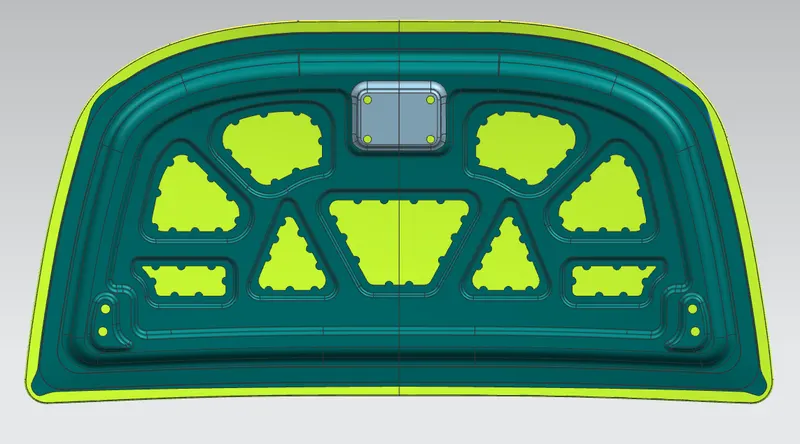
A car hood panel is one of the most important components of the BIW (body in white), The term car hood is a North American term, used primarily in America and Canada .car hood is the metal part that covers the engine of an automobile, it is considered as the closure sheet-metal component. A hood panel consists of two panels that are hemmed together to form the automotive hood assembly.
The inner panel of the hood is not visible to the customer but this is the engineering feature of the outer panel. The outer panel has the aesthetic look to it but on its own is very weak and not capable of handling force during impact. This puts the passenger’s life in danger, so we need to design the inner panel so as to provide strength to the outer panel
Design Data
As per the standard data as given
Hood Thickness Information
- Outer Panel Thickness = 0.75mm
- Inner Panel Thickness = 0.75mm
- Reinforcement Thickness = 1.5mm
Master Section and Specification :
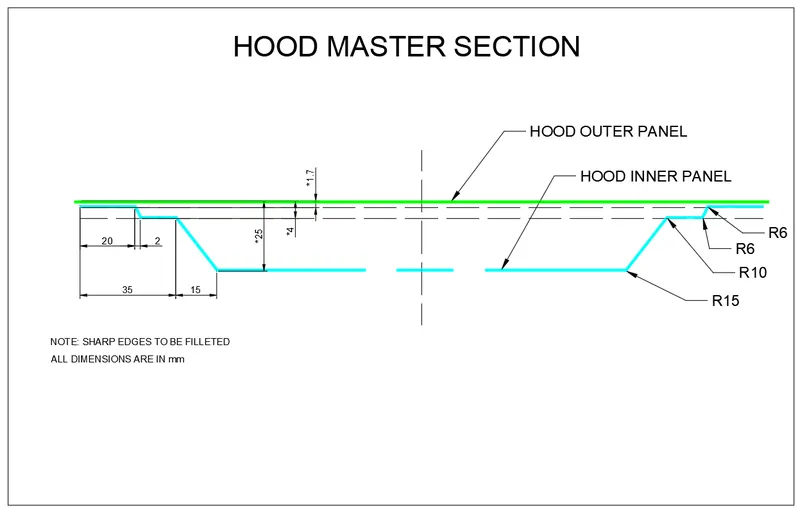
Upon designing the initial structure based on the master section, embossing was performed to strengthen the structure as well as to integrate channels to direct shock flow and dissipate maximum energy away from the cabin. With successful designing of these channels using the process of embossing, latch and hinge placements are designed for attachment of this structure to the vehicle.
Once the structure for the inner panel is prepared, reinforcement is provided to compensate for the strength drop which occurred due to the inclusion of latch and hinge placement. At this stage, the NVH team also contributes to implementing . major design changes and the inclusion of components to reduce vehicle vibration and noise control.
Apart from hemming, the center region of the inner panel structure is kept in contact with the outer panel using mastic sealants. Mastic sealants are rubberized components placed between the outer and inner panel to provide annexed contact. These sealants help maintain the outer panel aesthetically pleasing as well due to the absence of welds, nuts or bolts in the process of consolidation
DESIGN Components
- Inner panel
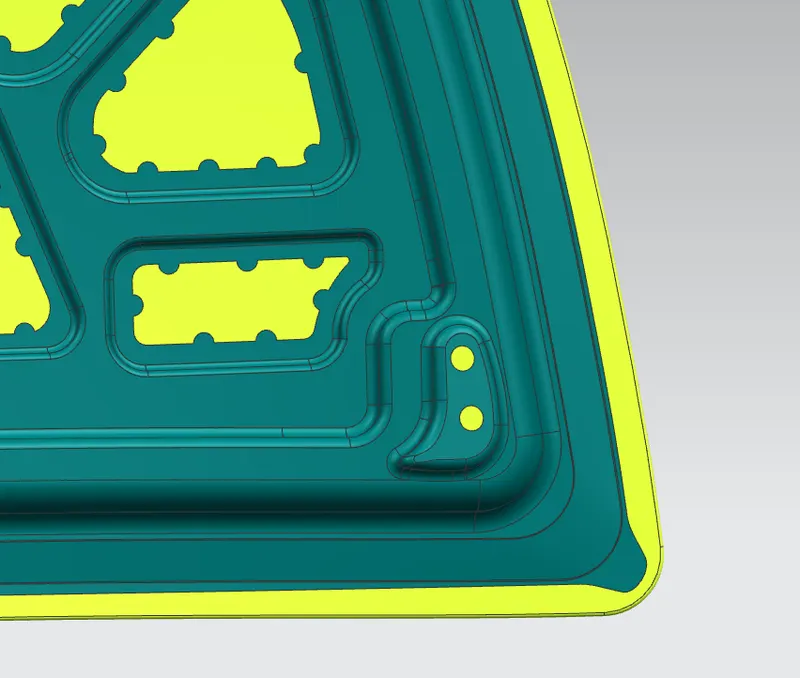
The inner panel supports the outer panel. it consists of embosses & holes. Embosses provide stiffness as well as it dissipates energy towards reinforcement. The master section represents the initial emboss shape and size. Then we provide the emboss for the latch and hinge elements after fixing the location.
- Hood outer panel
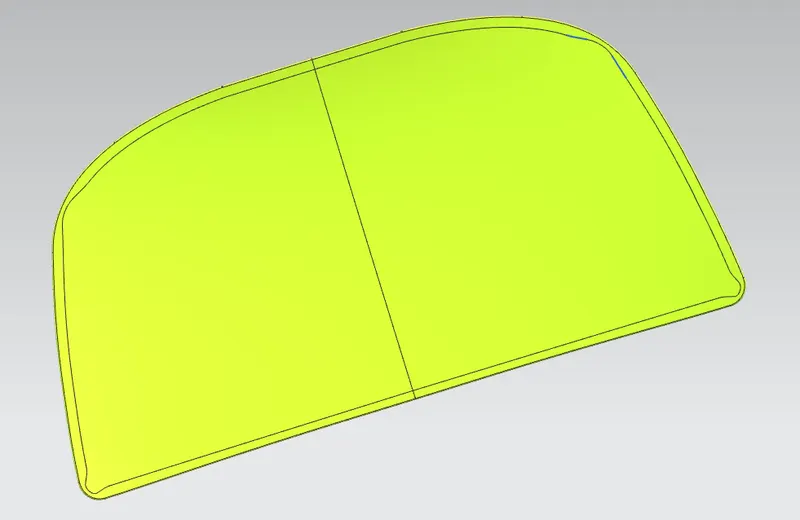
The metal sheet embossing operation is commonly accomplished with a combination of heat and pressure on the sheet metal, depending on what type of embossing is required. Theoretically, with any of these procedures, the metal thickness is changed in its composition.
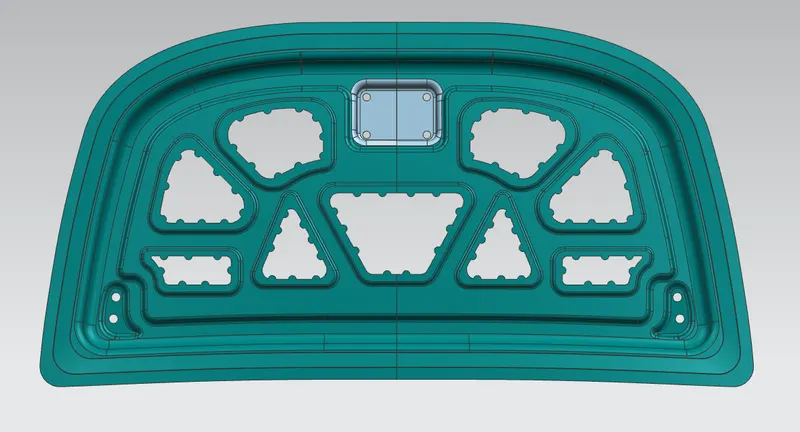
Inner panel is the part that gives strength and rigidity to the outer panel. The master section represents the initial emboss shape and size. Then we provide the emboss for the latch and hinge elements after fixing the location.
- Reinforcement
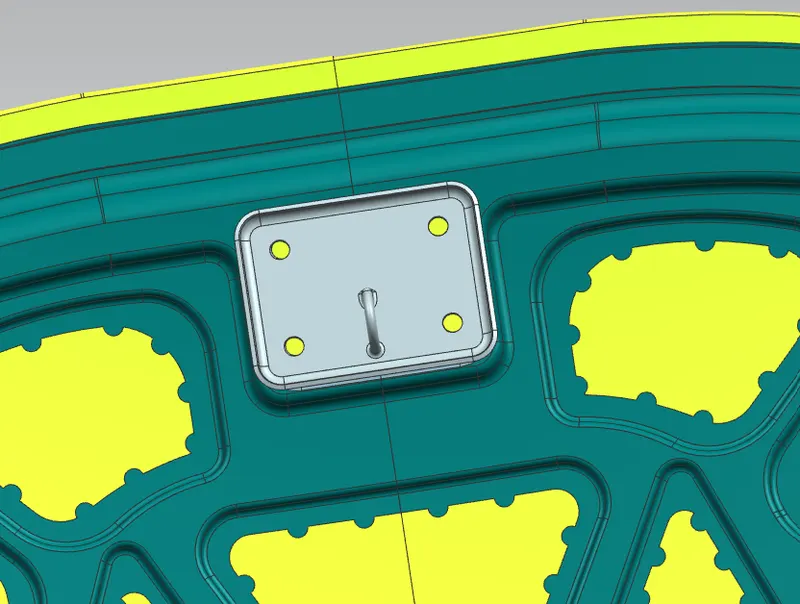
he material that strengthen the existing material when adding to it are called reinforced material. As the latch and the hinges will be placed on the embosses so that strength at these position will be less and that portion can get easily damaged due to movements.
In order to provide strength at these places a 1.5 mm thickness reinforcements will be placed. Reinforcement will be a metal part spot welded into the emboss of the hinge and the striker. It can't be seen from the outside as it will be welded in the back portion of the hood inner panel.
- Latch Trajectory
Latch trajectory is given by the circle drawn from the hinge axis point. Hinge axis point is the centre point of the hinge axis. First, we can fix either the latch or the hinge. If we have fixed the hinge position then we should plot the Trajectory circle for the latch. For proper mating condition the striker axis through the tip of the striker should be tangential to the latch trajectory.
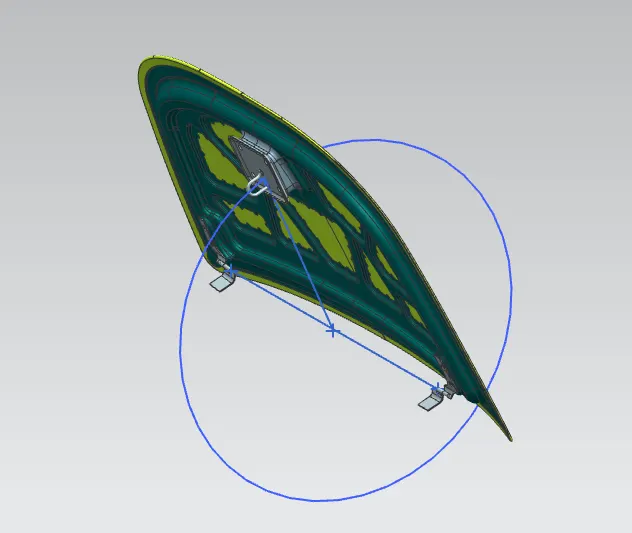
- HINGE
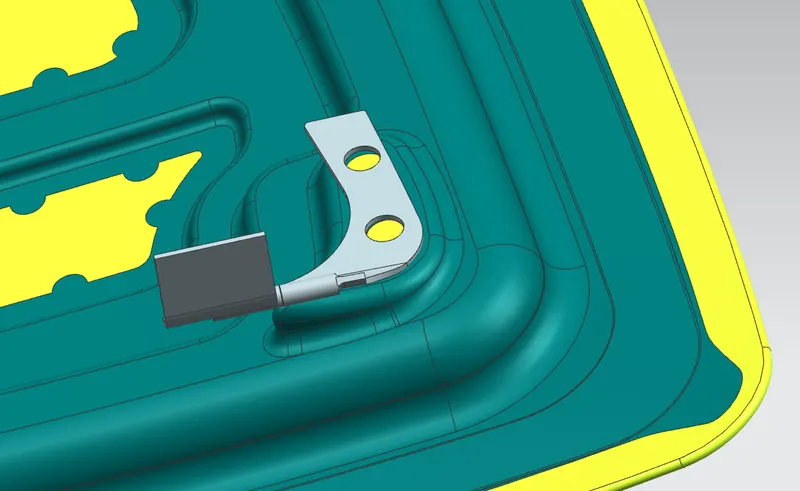
Hinges are used to connect the hood & cowl panel of an automobile. it enable the opening & closing operation of the hood. the hinge should be made strong enough to to handle the weight of the hood and also to handle the force action on it during the collision.
- Emboss
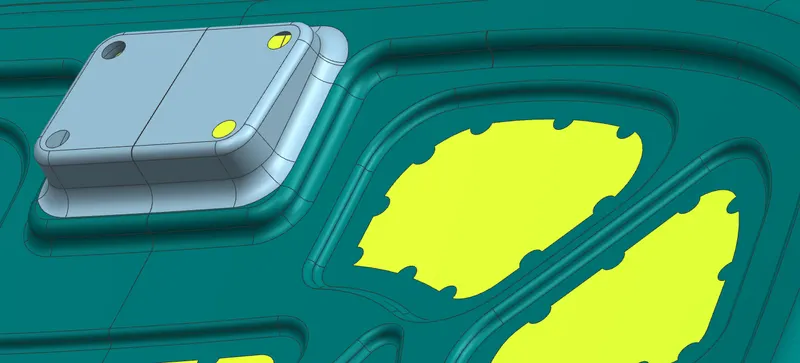
Throughout the inner panel we provide different embosses. We can increase the stiffness of the inner panel through these embosses. The shape and size of the embosses also determines the direction of the force distribution resulted from frontal collision. The force should be always distributed away from the passengers. Here in the figure the embosses are designed in such a way that the force is directed to either sides of the car.
Manufacturing considerations for the emboss creation
1. The distance between the outer edges of the emboss should be a minimum of 5mm.
2. Draft angle should be provided to the emboss with 7degree">degreedegree - 9degree">degreedegree for the easy removal of the part from the die.
3. No sharp corners to be provided in the emboss can it would lead to inefficient manufacturing.
4. The height of the emboss should not be more than 5mm.
- Mastic Data
They can provide thermal and acoustical insulation, and may serve as fire barriers. They may have electrical properties, as well. Sealants can also be used for simple smoothing or filling. They are often called upon to perform several of these functions at once.
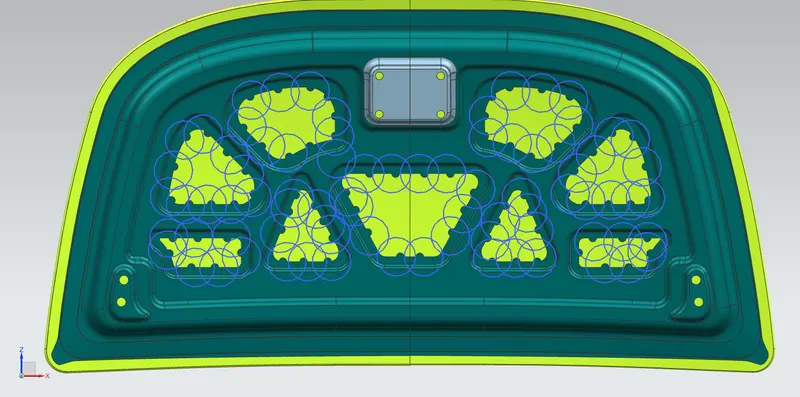
A sealant has three basic functions: It fills a gap between two or more substrates; it forms a barrier through the physical properties of the sealant itself and by adhesion to the substrate; and, it maintains sealing properties for the expected lifetime, service conditions, and environments. The sealant performs these functions by way of correct formulation to achieve specific application and performance properties.
- Deep Drawing
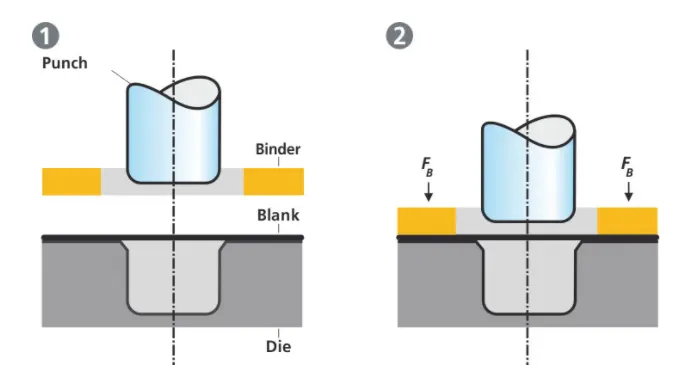
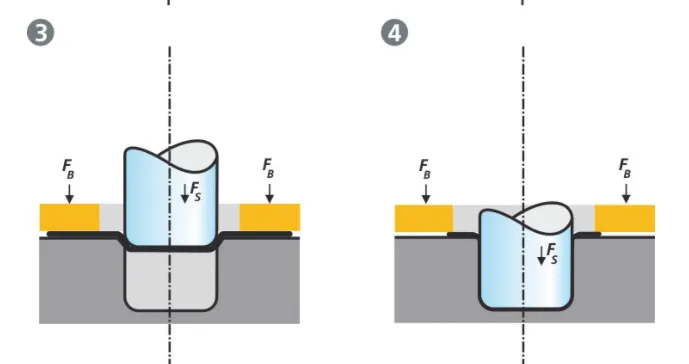
The deep drawing process is a forming process which occurs under a combination of tensile and compressive conditions. A flat sheet metal blank is formed into a hollow body open on one side or a hollow body is formed into a hollow body with a smaller cross-section.
Deep drawing processes are divided into three types:
- Deep drawing with tools
- Deep drawing with active means
- Deep drawing with active energy
In the automotive industry, deep drawing is usually carried out using rigid tools.
The deep drawing operations is shown above
The rigid tools consist of a punch, die and binder. In deep drawing, the plate holder closes after the metal sheet blank has been inserted.
Next the sheet is clamped between the die and the binder. This process slows down the flow of the sheet while it is being drawn and thereby prevents wrinkles from forming under the binder. The punch stretches the sheet over the die radius and forms it in the die. The amount of punch force necessary for forming is thereby continually increased up to the lower dead centre of the punch.
Whereas in pure deep drawing there is no reduction of sheet metal thickness, forming is achieved in stretch forming purely as a result of a decrease in sheet metal thickness. Stretch forming is extensively used for the forming of only slightly curved parts with low depth of draw (e.g. roofs, doors).
When drawing complex car body parts in practice, there is usually a combination of stretch and deep drawing involved. It is necessary that the sheet metal is stretched as well as possible without reaching the material’s limits (e.g. splits, wrinkles).
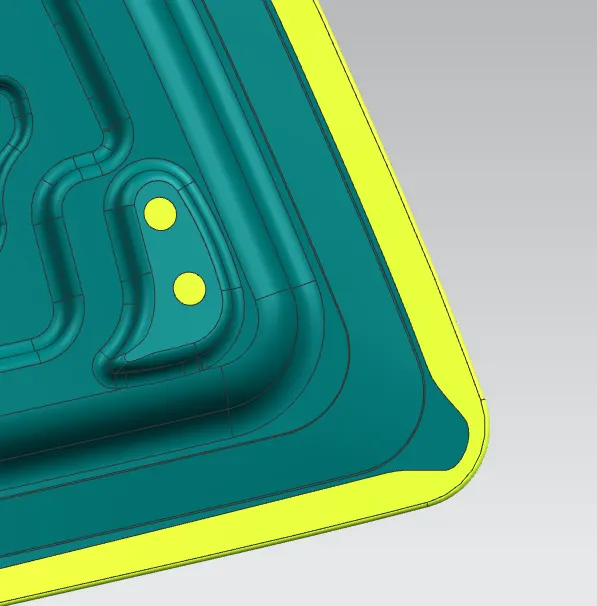
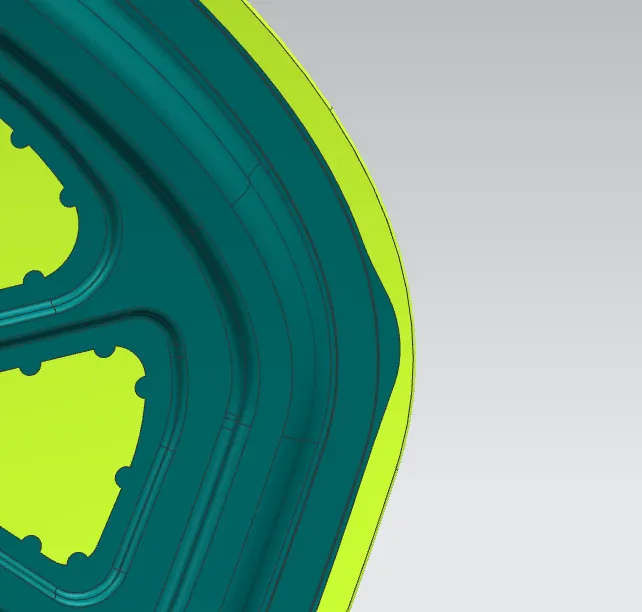
- Corner Relief:-
There are many types of Hemming process but in Hoods Roller hemming is used. In this process the roller will be rolling over the edges of the Outer panel to close it with the inner
panel. These roller will be rolling over 2-3 time for perfect closing. so, the certain force is being used by rollers to all the corners but there are some areas where the roller cannot tighten the part properly so thats why we give some relief to the corners.
- Hemming
Conventional die hemming is suitable for mass production. In die hemming, the flange is folded over the entire length with a hemming tool. Normally the actual hemming is a result of a forming operation in which the flange is formed with a hemming tool after the drawing and trimming operations have been completed.
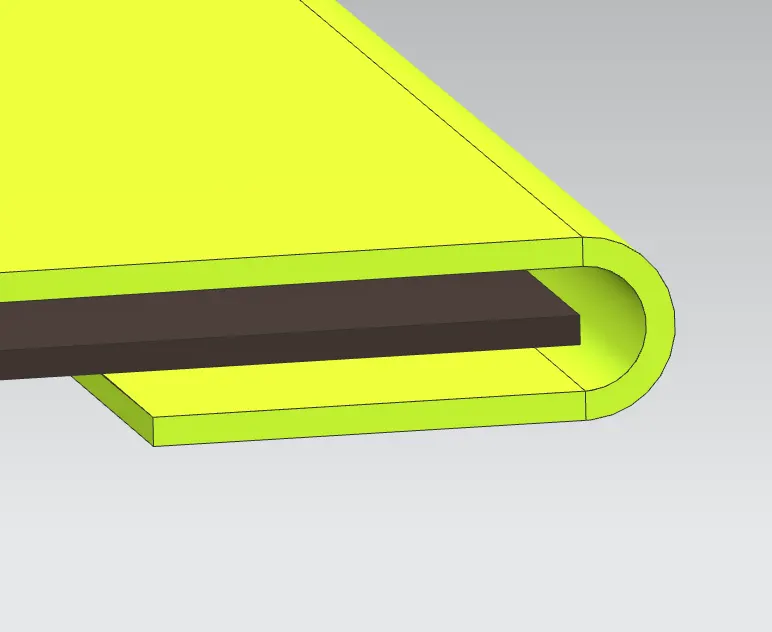
If weld or bolts were used to join the hood panels then the design and the aerodynamic features would get damaged so hemming is more significant to use.
Hemming is a sheet metal forming process in which sheets are joined by bending it usually to 180°. Automotive body panels and automotive parts such as deck-lids, trunk-lids, doors, hoods, and tailgates are formed by hemming processes.
Roll hemming is carried out incrementally with a hemming roller. An industrial robot guides the hemming roller and forms the flange. Roll hemming operation can also be divided into several pre-hemming and final hemming process steps.
-
Conclusion:
1. The design considerations for the Hood is taken are discussed and taken into consideration while designing the hood.
2. The manufacturing feasibility of the hood is taken into consideration.
3. Draft Analysis is performed to check if the faces are clearing for the required draft angle for manufacturing the emboss.