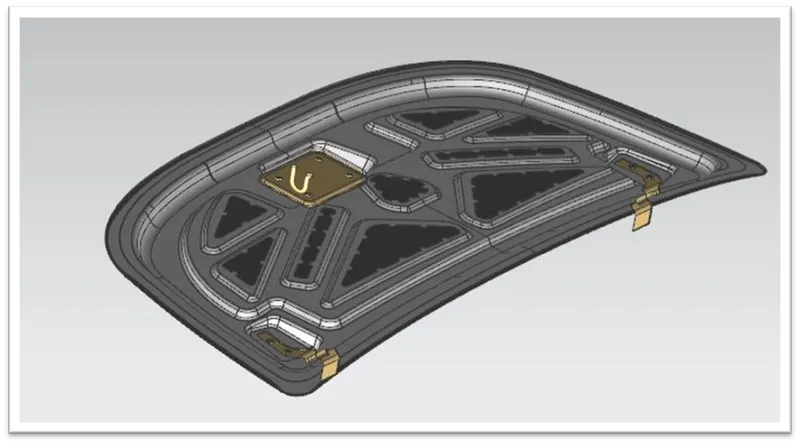
Design of Hood
https://drive.google.com/drive/folders/19g7tc_iD6I1hAVCLdla22A72Oh_csq9_?usp=sharing
AUTOMOTIVE SHEETMETAL HOOD DESIGN USING NX CAD
OBJECTIVE:
Main objective of the project is to create the Hood Sheetmetal design in NX cad, and also designing of inner panel, outer panel, Some reinforcements.
SOFTWARE USED: NX 12.0
- To design the Sheetmetal HOOD in NX by using some Surface features.
- NX Software is a flexible and powerful integrated solution that helps you deliver the products faster and efficiently.
- NX Cad software is widely used automotive, aerospace, thermal power station. Because of it is having modelling, drafting and manufacturing platform.
INTRODUCTION:
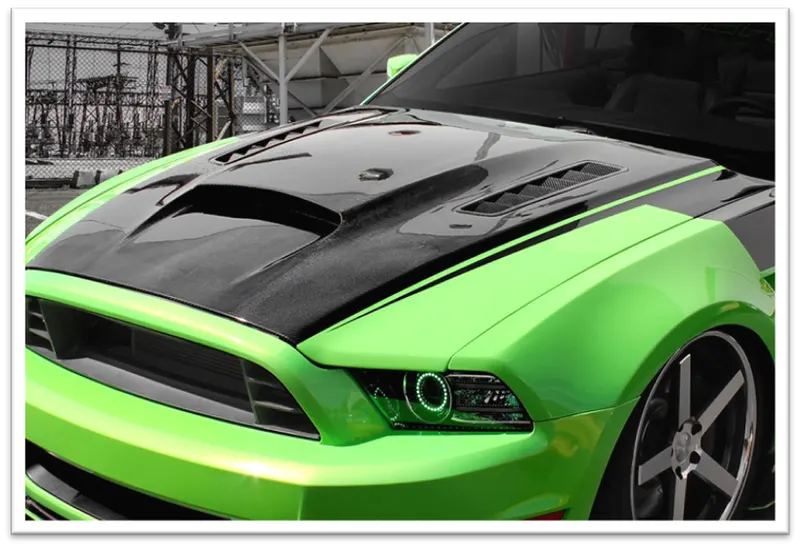
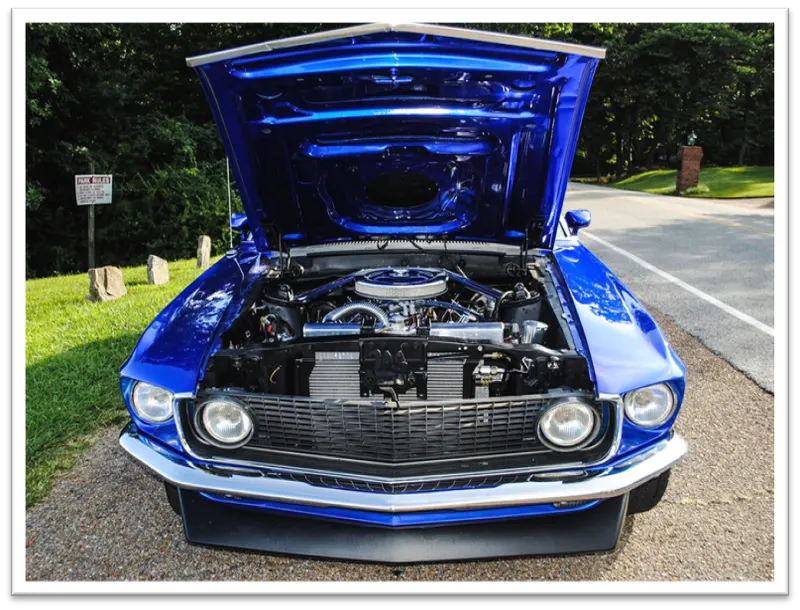
The hood or bonnet is the hinged cover over the engine of motor vehicles. Hoods can open to allow access to the engine compartment, maintenance and repair.
A car hood is having the two panels, one is hood inner panel and another one is hood outer panel. Car outer panel is just aesthetic look of the car. But the most important is inner panel because, they will give the strength to the Hood assembly.
Hoods are usually made from the same material as the rest of the body. This can be steel, aluminum, fiberglass, or carbon fiber. However, some aftermarket companies produce fiberglass or carbon fiber steel hood replacements to make the vehicle lighter.
PEDESTRIAN SAFETY PROBLEM:
- Safety, a parameter which was long overseen in India when it came to buying cars, has now become an important parameter for many car buyers nowadays.
- Occupant safety is taken care of with features such as airbags, structural strength and so on. But another safety aspect is the vulnerable road users such as a pedestrian.
- The Indian cars were lacking basic safety features such as front airbags and ABS. But with the implementation of the first phase of BNSVP, it was mandatory for the cars to have 2 front airbags and ABS as standard.
- It will also raise the hood of the car in order to provide a safe layer. This will reduce the impact on the pedestrian involved.
VEHICLES TESTED FOR PEDESTRIAN SAFETY:
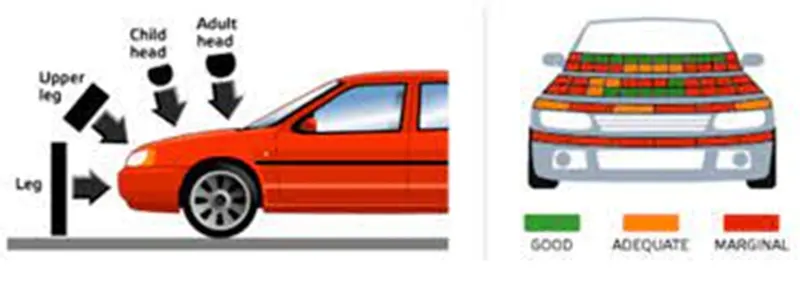
Globally, various NCAPS are present that carry on the pedestrian safety tests on new vehicles and rate them accordingly.
Example: The Euro NCAP has five parameters for pedestrian safety test for the new vehicles.
1.HEAD IMPACT:
- This test is carried out for a vehicle speed of 40 km/h. To have an estimate of the potential head injury in the fateful event of a vehicle striking an adult or a child, a head form impactor is used in a series of impact tests and the impact sites are then assessed for and rated accordingly.
- This test will give essential information about the deformation clearance, energy-absorbing structures and deployable protection systems such as pop-up bonnets and external airbags in a new vehicle.
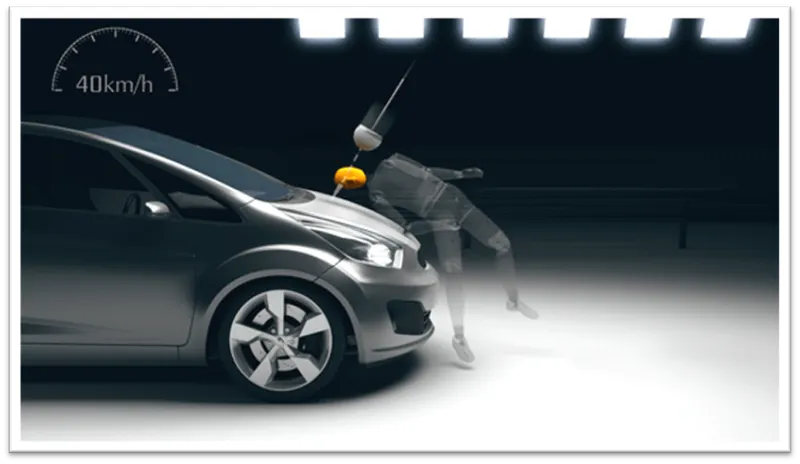
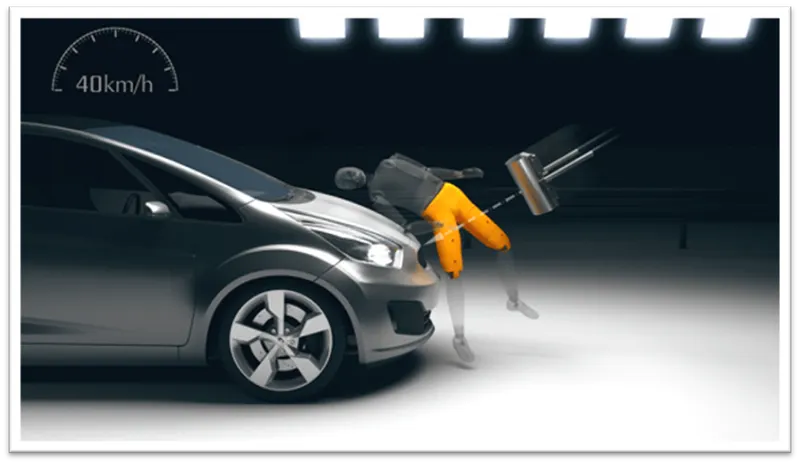
2.UPPER LEG IMPACT:
- The facility carries out the test at the vehicle speed of 40 km/h. An adult upper leg form impactor is used in a series of impact tests and then the impact sites are assessed.
- The protection is then rated as good, adequate, marginal, weak or poor. The test procedure allows to check the energy-absorbing capacity of the structures of a vehicle and also check whether the geometry of the vehicle allows mitigation of injuries.
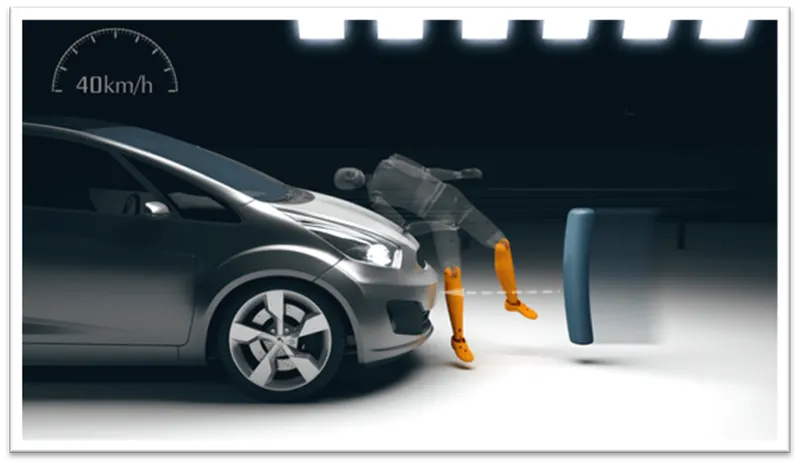
3.LOWER LEG IMPACT:
- Euro NCAP carries the test at the same speed standard as the above ones. It uses an adult leg impactor and a series of tests are carried out. Impact sites are then assessed and the protection rating is offered.
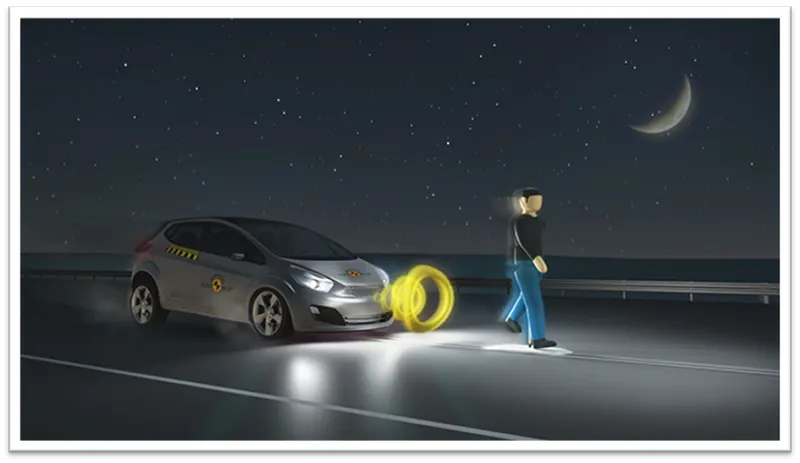
4.AEB PEDESTRIAN:
- For this test, the NCAP uses a specially-designed pedestrian form which has articulated limbs to replicate the walking motion of a human.
- Cars are assessed on the basis of how forgiving the front-end design is in case of impact. AEB pedestrian tech may not be able to completely avoid a collision in some cases.
- The tests are done in the day as well as night to ensure vulnerable road users are protected all the time.
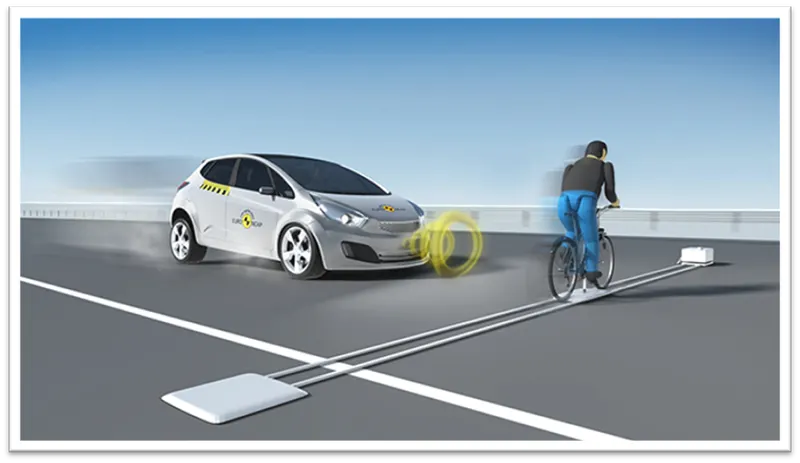
5. AEB Cyclist:
- For this test, euro NCAP uses a specially designed cyclist form which will replicate the actual cyclist on the road. Euro NCAP offers the highest rating if the collision is completely avoided.
- The vehicle is also awarded if the speed is reduced as any reduction in speed of impact can significantly reduce the injury to the vulnerable user.
DESIGN SPECIFICATION FOR THE AUTOMOTIVE HOOD COMPONENT:
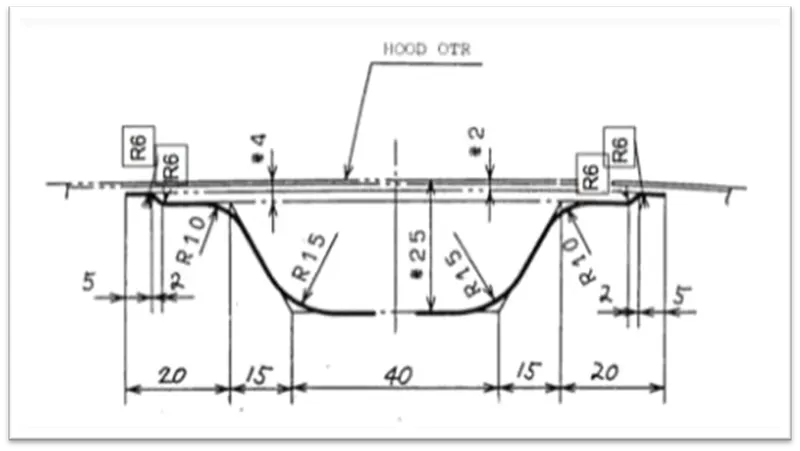
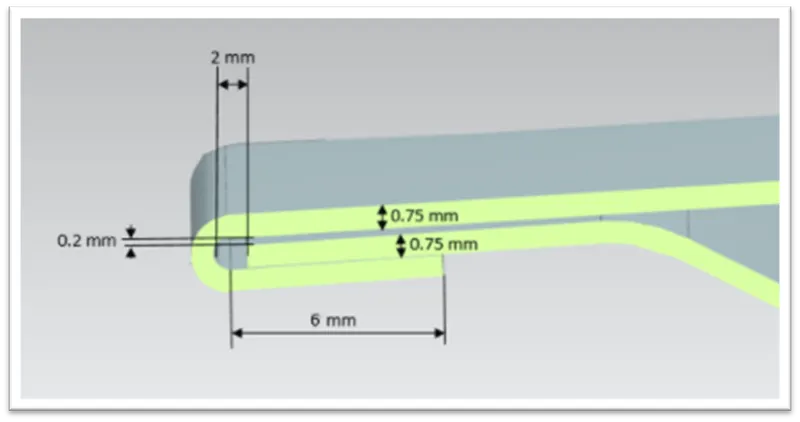
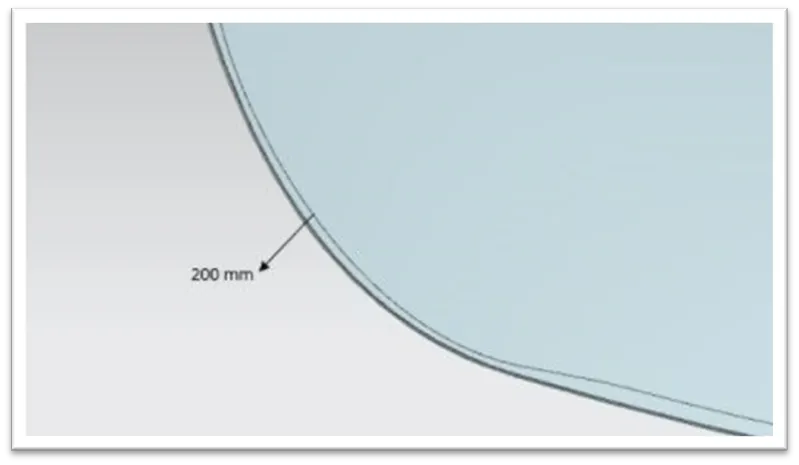
Master section data, hemming, Front and rear section relief data are given below,
MASTER SECTION INFORMATION:
HOOD THICKNESS INFORMATION:
- OUTER PANEL THICKNESS – 0.75mm
- INNER PANEL THICKNESS – 0.75mm
- REINFORCEMENT THICKNESS – 1.5mm
HEMMING DATA INFORMATION:
FRONT REAR SECTION INFORMATION:
REAR RELIEF SECTION INFORMATION:
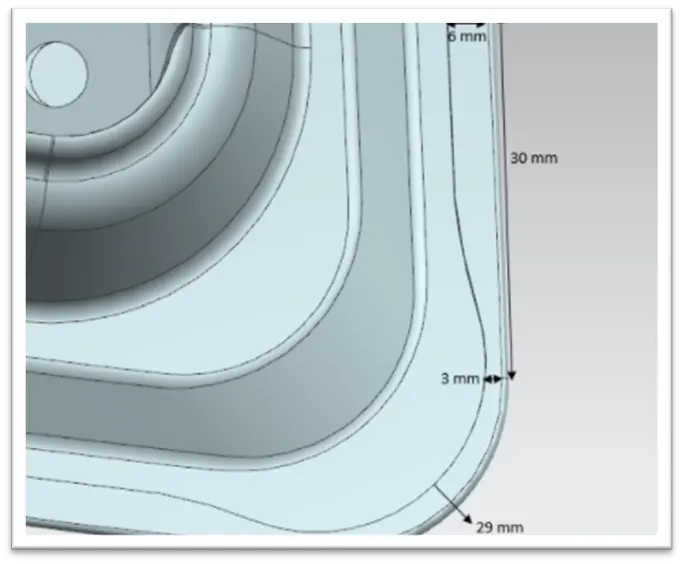
EMPOSSING IN SHEETMETAL PART:
- The metal sheet embossing operation is commonly accomplished with a combination of heat and pressure on the sheet metal, depending on what type of embossing is required.
- Theoretically, with any of these procedures, the metal thickness is changed in its composition. Metal sheet is drawn through the male and female roller dies, producing a pattern or design on the metal sheet.
- Depending on the roller dies used, different patterns can be produced on the metal sheet. The pressure and a combination of heat actually "irons" while raising the level of the image higher than the substrate to make it smooth.The term "impressing" refers to an image lowered into the surface of a material, in distinction to an image raised out of the surface of a material.
Example: Aluminium (all alloys), Steel (all alloys)
CHARACTERISTICS:
- The ability to form ductile metals.
- Use in medium to high production runs.
- The ability to maintain the same metal thickness before and after embossing.
- The ability to produce unlimited patterns, depending on the roll dies.
- The ability to reproduce the product with no variation.
MANUFACTURING PROCESS OF SHEETMETAL:
- Deep Drawing
- Hemming
DEEP DRAWING:
- Deep drawing is one of the most widely used processes in sheet metal forming. Apart from its use in many other sectors, it is applied in the automotive industry for the manufacturing of car body parts.
- The deep drawing process is a forming process which occurs under a combination of tensile and compressive conditions. A flat sheet metal blank is formed into a hollow body open on one side or a hollow body is formed into a hollow body with a smaller cross-section. [DIN 8584]
Deep drawing processes are divided into three types:
- Deep drawing with tools
- Deep drawing with active means
- Deep drawing with active energy
In the automotive industry, deep drawing is usually carried out using rigid tools.
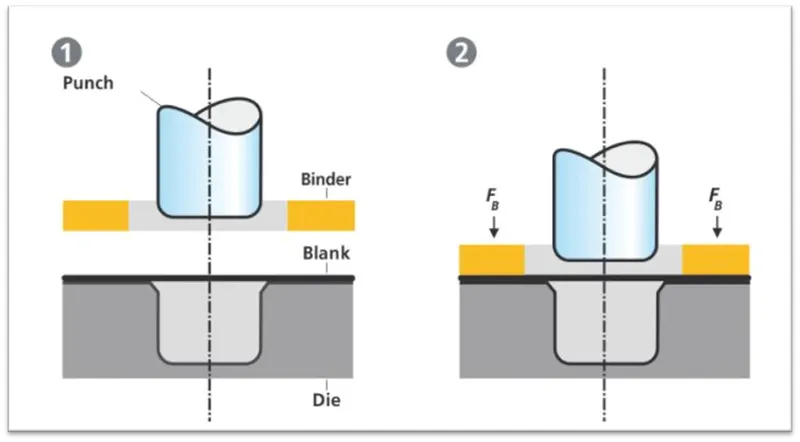
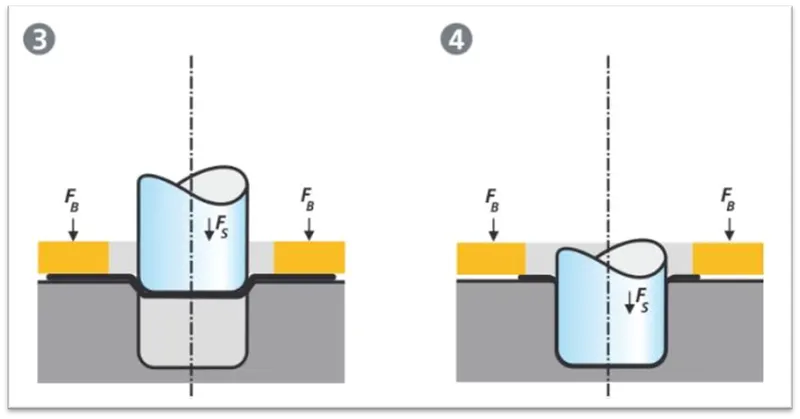
- The rigid tools consist of a punch, die and binder. In deep drawing, the plate holder closes after the metal sheet blank has been inserted.
- Next the sheet is clamped between the die and the binder. This process slows down the flow of the sheet while it is being drawn and thereby prevents wrinkles from forming under the binder.
- The punch stretches the sheet over the die radius and forms it in the die. The amount of punch force necessary for forming is thereby continually increased up to the lower dead center of the punch.
- Whereas in pure deep drawing there is no reduction of sheet metal thickness, forming is achieved in stretch forming purely as a result of a decrease in sheet metal thickness.
- When drawing complex car body parts in practice, there is usually a combination of stretch and deep drawing involved. It is necessary that the sheet metal is stretched as well as possible without reaching the material’s limits (e.g. Splits, wrinkles).
- There are approximately 300 to 400 sheet metal parts which fit together to form the body of a car. In order to manufacture high quality sheet metal parts optimally for their particular use, specialized software simulates the complete deep drawing process.
HEMMING:
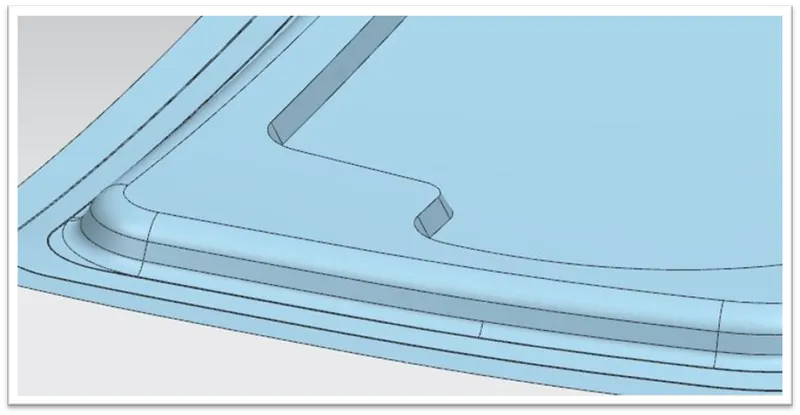
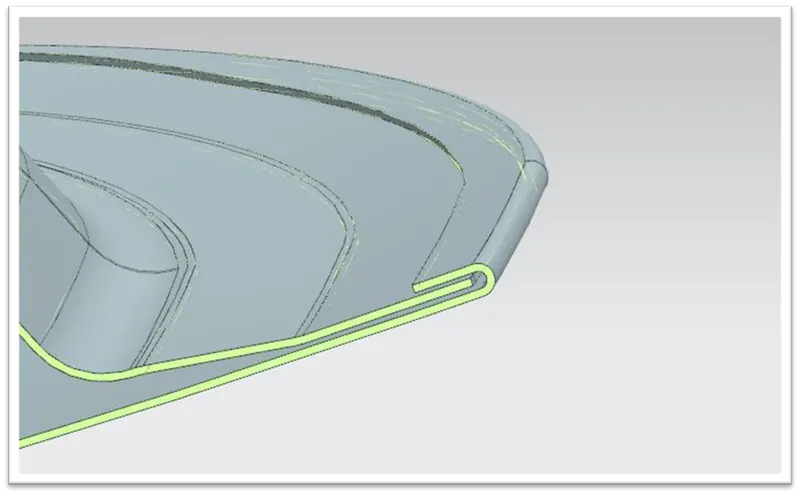
- Hemming is a forming operation in which the edges of the sheet are folded or folded over another part in order to achieve a tight fit. Normally hemming operations are used to connect parts together, to improve the appearance of a part and to reinforce part edges.
- In car part production, hemming is used in assembly as a secondary operation after deep drawing, trimming and flanging operations to join two sheet metal parts (outer and inner) together. Typical parts for this type of assembly are hoods, doors, trunk lids and fenders.
- The accuracy of the hemming operation is very important since it affects the appearance of the surface and surface quality. Material deformations, which occur during the hemming process, can lead to dimensional variations and other defects in parts.
- Typical hemming defects are splits or wrinkles in the flange, material overlaps in the corner areas or material roll-in. This is why it is important to use simulation tools in order to, on the one hand, better understand the hemming process and, on the other hand, significantly reduce the number of “trial and error” loops during tryout and production.
There are various types of hemming operations:
- Conventional die hemming
- Roll hemming
CONVENTIONAL DIE HEMMING:
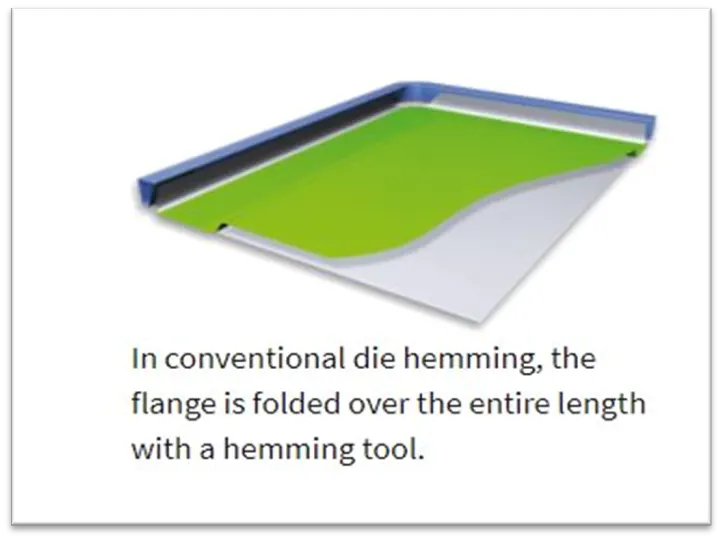
- Conventional die hemming is suitable for mass production. In die hemming, the flange is folded over the entire length with a hemming tool.
- Normally the actual hemming is a result of a forming operation in which the flange is formed with a hemming tool after the drawing and trimming operations have been completed.
- The formed flange is then hemmed in several process steps. These steps include, for example, the pre-hemming and final hemming depending on the respective opening angle of the flange. Production plants for conventional die hemming are very expensive, but the cycle times are very low.
ROLL HEMMING:
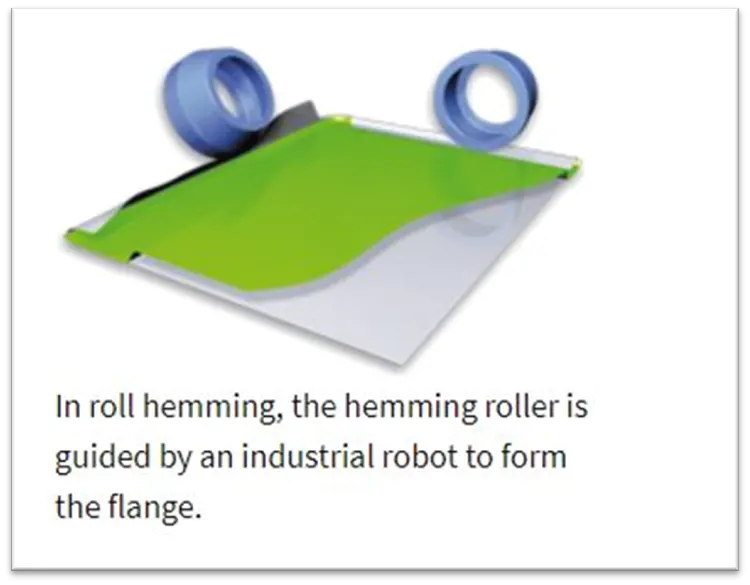
- Roll hemming is carried out incrementally with a hemming roller. An industrial robot guides the hemming roller and forms the flange.
- Roll hemming operation can also be divided into several pre-hemming and final hemming process steps.
- Roll hemming is very flexible to use and tool costs are significantly lower as compared to those of conventional die hemming.
- However, the cycle times are much higher since the hemming is realized using a hemming roller which follows a defined path.
 HOOD COMPONENTS:
- Latch
- Hinge
LATCH:
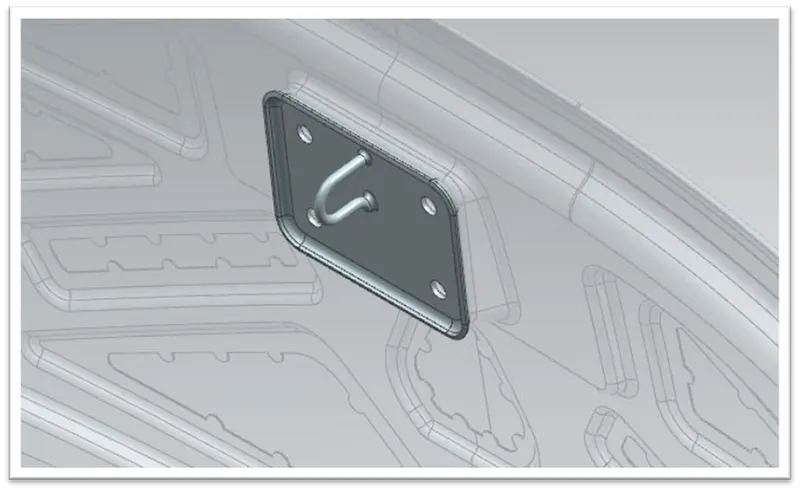
- The hood latch mechanism in a car is a simple device. It is used for keep your car hood in closed condition. The hood latch system begins inside the compartment of the car. Located on the driver's side.
- When tension is applied to the cable from the hood release handle, it pivots the secondary latch, which pulls away from a retaining seat located under the hood. By design, the secondary latch then releases the hood a few inches before a safety latch takes over.
HINGE:
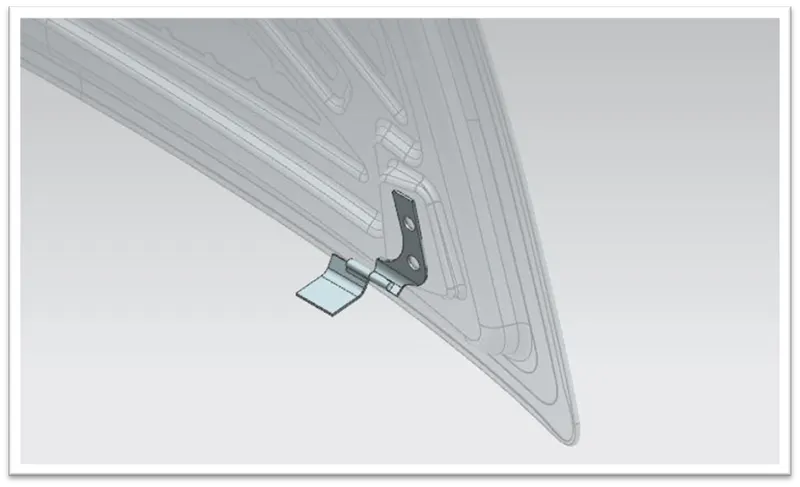
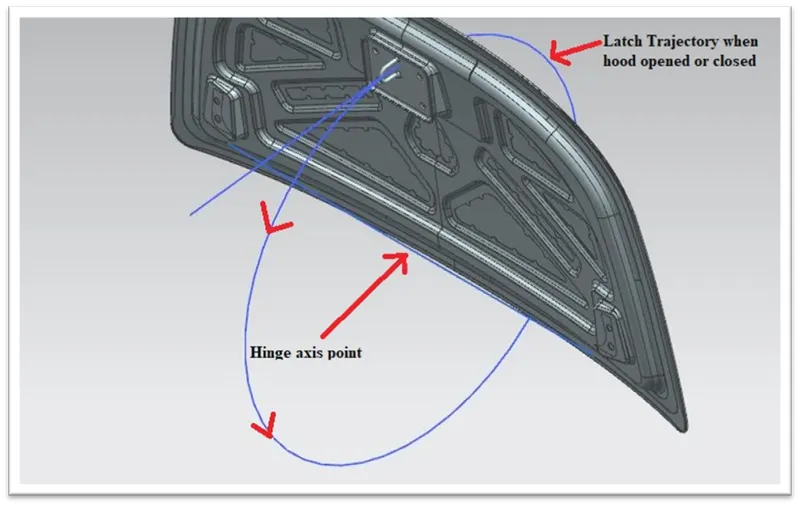
It is acts like a door hinge and allows the hood to pivot open and closed. The latch must perpendicular to the hinge axis. So that the hoods open and close properly.
RELIEF IN SHEETMETAL:
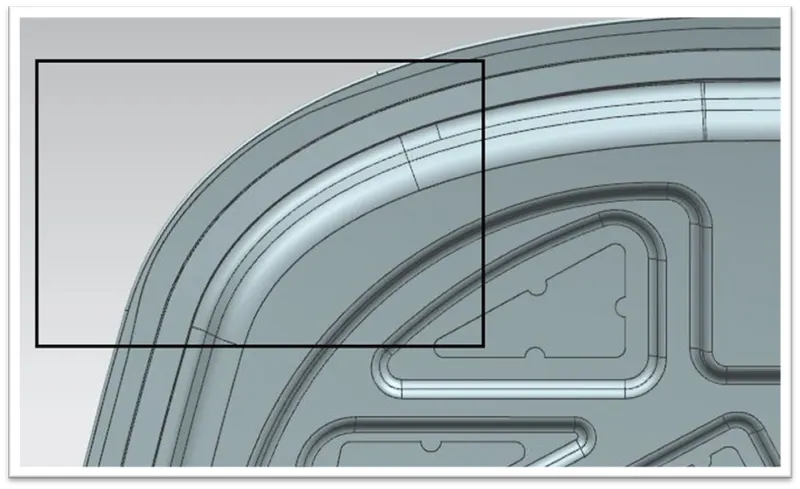
Use the Corner Relief tool to add relief to one or more corners of a sheet metal part. ... Relief helps to control sheet metal material behavior and to prevent unwanted deformation during unbend operations.
- Front section relief
- Rear section relief
FRONT SECTION RELIEF:
REAR SECTION RELIEF:
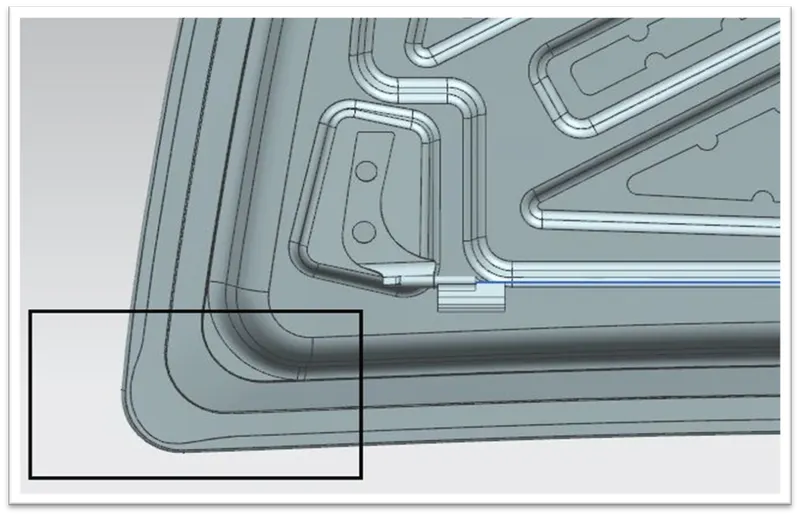
DESIGN OF HOOD:
A car hood is having the two panels, one is hood inner panel and another one is hood outer panel. Car outer panel is just aesthetic look of the car. But the most important is inner panel because, they give the strength to the Hood assembly.
Inner and outer panel is not welded together, which is spoil the outer look of the car, so that we have to join the inner and outer panels in hemming operation.
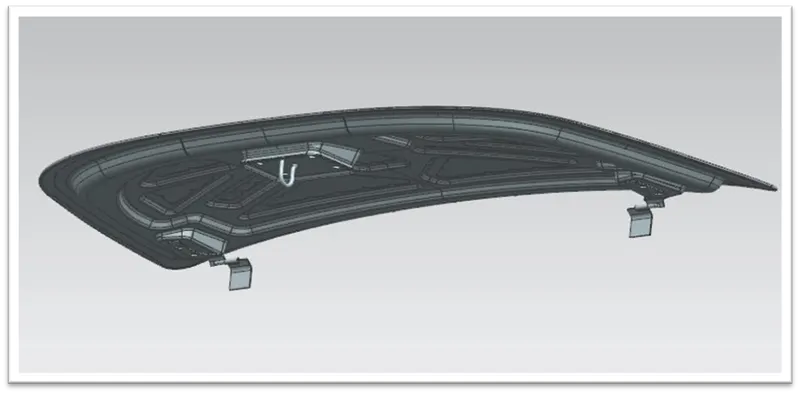
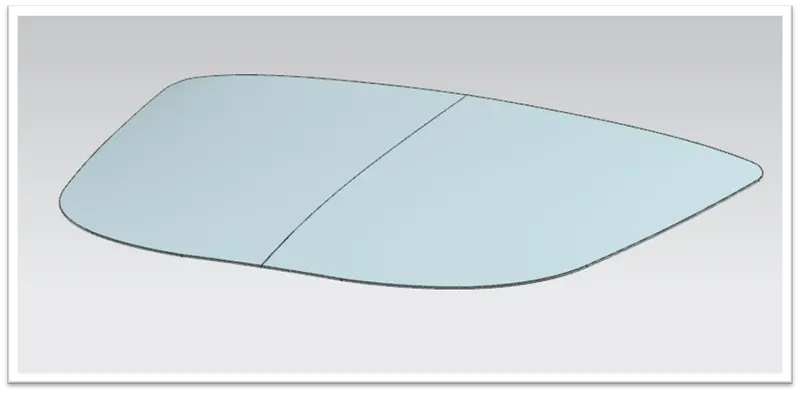
OUTER PANEL:
Outer panel is just outer skin of the inner panel, which gives the aesthetic look of the car. This is not having the any type of welded points or rivet. It is connected by the hemming operation.
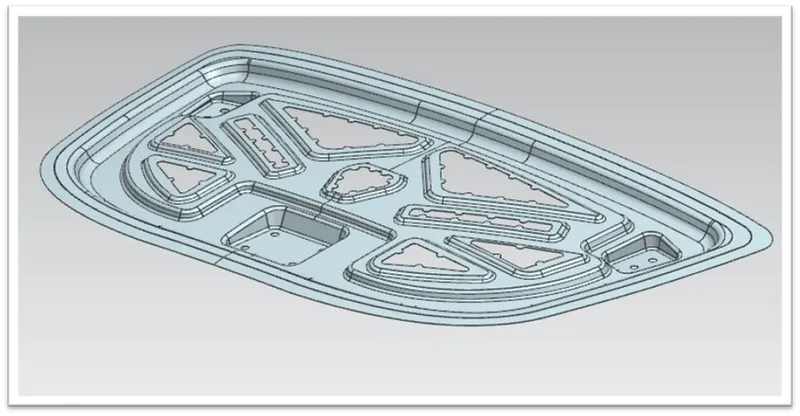
INNER PANEL:
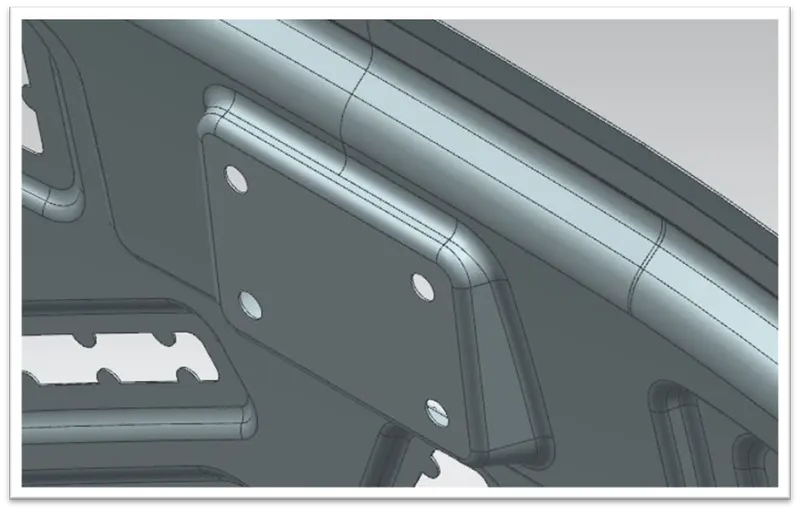
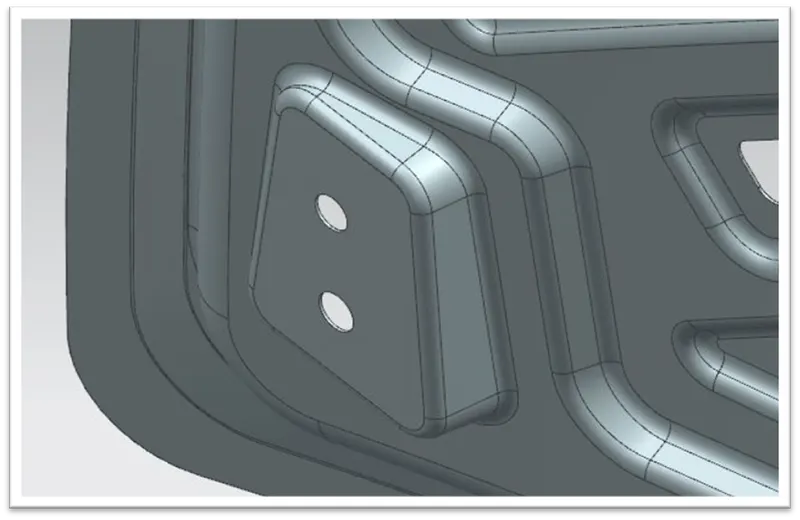
Inner panel is most important, because of outer panel is only aesthetic look of the car. but the Inner panel will give the strength of the hood. It is having the embossing on the inner panel, mastic points and some patterns.
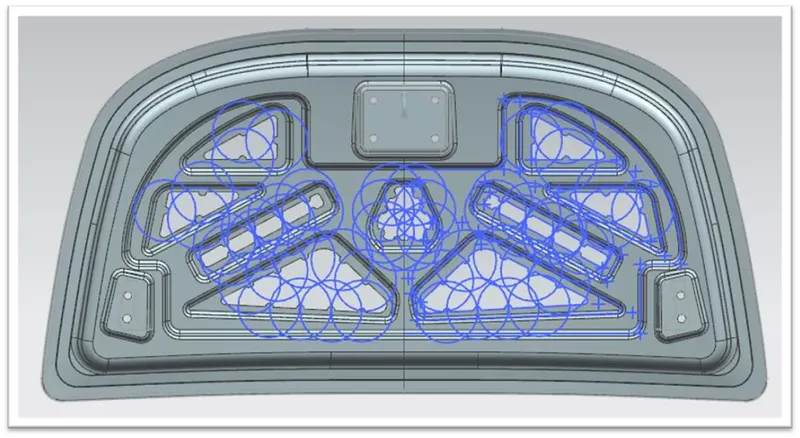
MASTIC POINTS:
The Mastic sealant or the Mastic point is an elastic compound that behaves like a rubber. The mastic points are defined on the hood inner panel where the hood can easily deform. They help the hood outer panel to come back to its original shape after it gets deformed. The mastic has an influence area of 80mm.
It will give the three methods in one operation, it fills the gap between the two or more substrates, it forms a barrier through the physical properties of the sealant itself, and by adhesion to substrates.
LATCH TRAJECTORY MOTION:
While the opening and closing the hood in car, latch perfectly aligned with the striker point and also the latch trajectory line is perpendicular to the hinge axis.
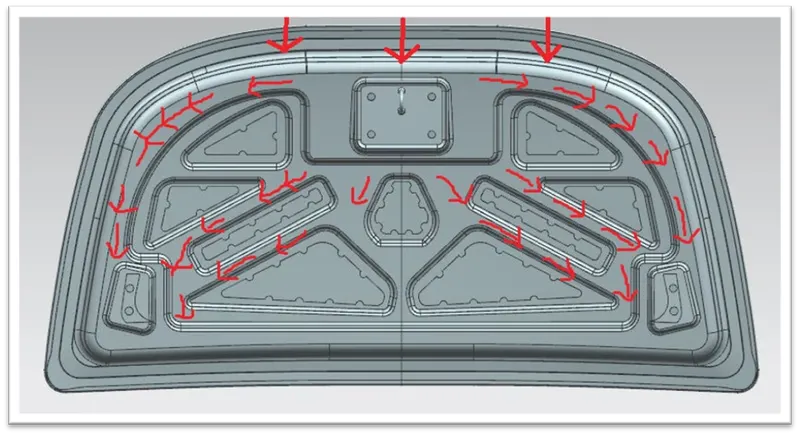
IMPACT FORCE DISTRIBUTION IN HOOD DESIGN:
When force acting on the hood, all the forces must be going to outside of the hood. Because of the force go outside direction driver and passenger are safe while accidents any happens.
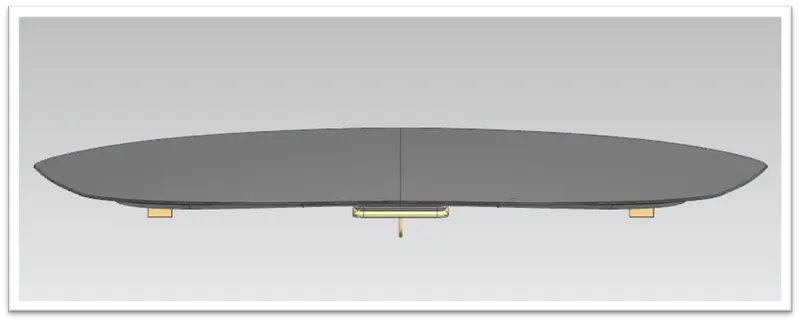
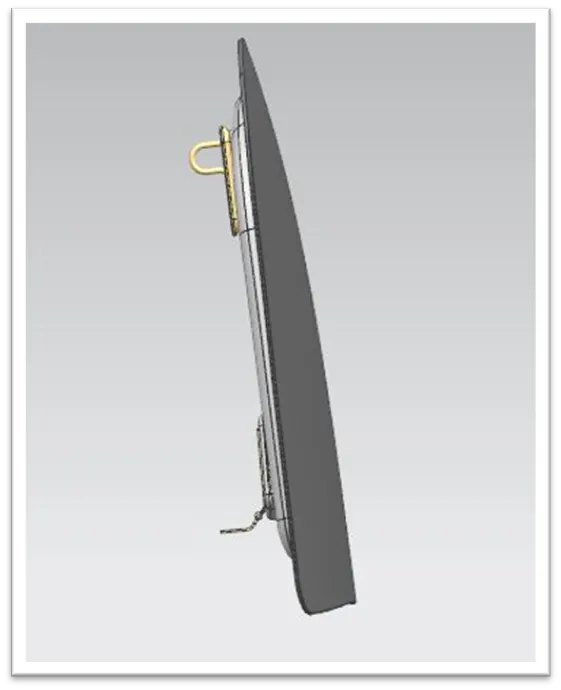
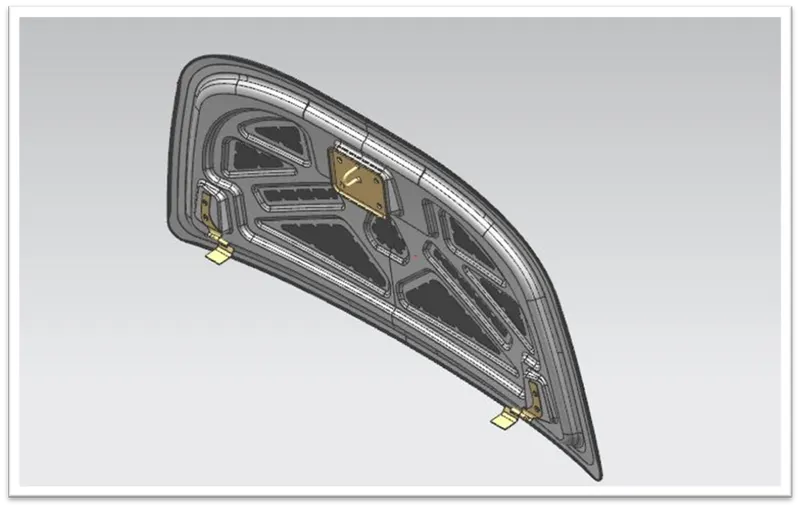
HOOD DESIGN VIEW:
FRONT VIEW:
TOP VIEW:
RIGHT VIEW:
ISOMETRIC VIEW:
CONCLUSION:
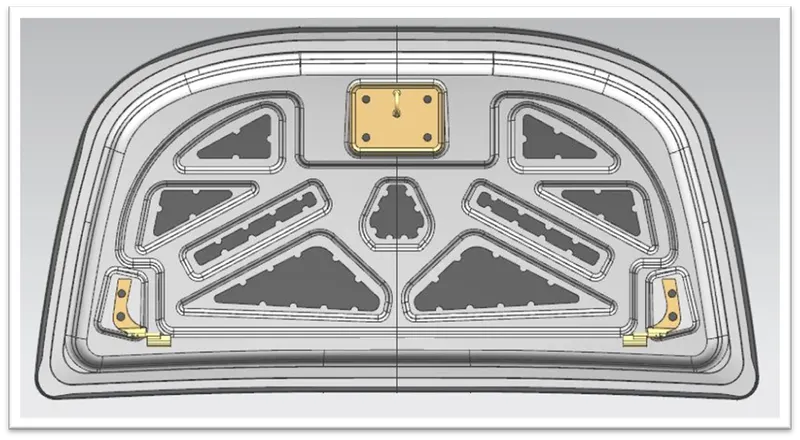
Therefore, we have designed the Hood inner panel, Hood outer panel, and Hinge part and Striker are assembled together to form a Car hood.