Hood design-Week 2
AIM:
Our aim for this project is to create a hood assembly from the hood outer panel which is provided as an input surface to us according to the master section sketch.
INTRODUCTION
The hood is the hinged cover over the engine of motor vehicles. Hoods can open to allow access to the engine compartment (or trunk on rear-engine and some mid-engine vehicles) for maintenance and repair. From a design perspective, hood should meet some specific conditions like pedestrian safety, a hood head zone for the lock striker, force distribution when subjected to frontal collision (occupant safety), manufacturability, etc.
Procedure:
Hood outer panel: Outer panels are the aesthetic elements of a car. It is the styling team that provides the skin for the outer panel. The shape, position, and size of the hood should satisfy the safety norms. So while designing the hood we should give more importance to pedestrian safety.
Latch Trajectory: Latch trajectory is given by the circle drawn from the hinge axis point. The hinge axis point is the center point of the hinge axis. First, we can fix either the latch or the hinge.
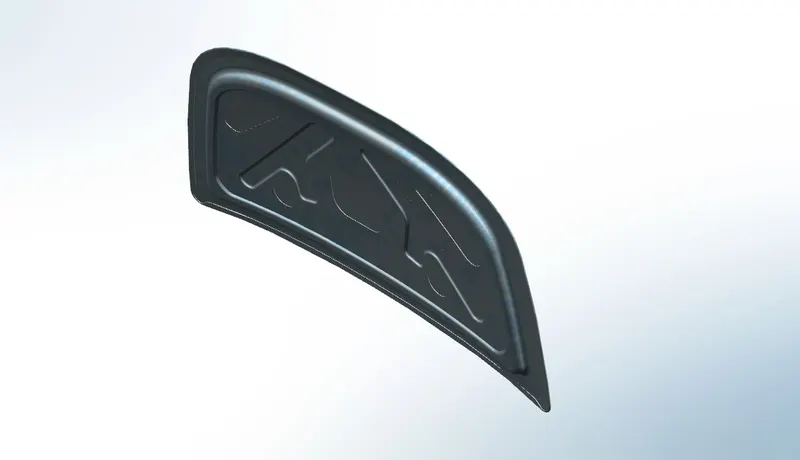
Emboss: We provide different embosses throughout the inner panel. We can increase the stiffness of the inner panel through these embosses. The shape and size of the emboss also determine the direction of the force distribution resulting from a frontal collision. The force should be always distributed away from the passengers. Here in the figure the embosses are designed in such a way that the force is directed to either side of the car.
Hemming: Hemming is a forming operation in which the edges of the sheet are folded or folded over another part in order to achieve a tight fit. Normally hemming operations are used to connect parts together, to improve the appearance of a part, and to reinforce part edges. In-car part production, hemming is used in assembly as a secondary operation after deep drawing, trimming, and flanging operations to join two sheet metal parts (outer and inner) together. Typical parts for this type of assembly are hoods, doors, trunk lids, and fenders. The accuracy of the hemming operation is very important since it affects the appearance of the surface and surface quality. Material deformations, which occur during the hemming process, can lead to dimensional variations and other defects in parts. Typical hemming defects are splits or wrinkles in the flange, material overlaps in the corner areas, or material roll-in. It is important to provide required reliefs at the corners.
There are two types of hemming operations:
- Conventional die Hemming
- Roll hemming
Final Assembly
Conclusion
In this challenge, I learned to design the hood inner panel, outer panel with the help of a master sketch and the styling surface. And also learned the assembly of the Hood inner panel, Outer panel, and the reinforcements like latch and hinge assembly.