Hood design-Week 2
HOOD DESIGN
Objective: To Design and Develop the Hood Assembly using NX 12.0. The Hood Assembly consists of the Outer Panel, Inner Panel, Latch Striker and Hinges.
Introduction: The Hood is an opening body panel that covers the engine in a front-engine vehicle. The hood is also considered as another type of door in a vehicle as it consists of an outer panel and inner panel. The inner panel provides strength while the outer panel functions as the metal cover.
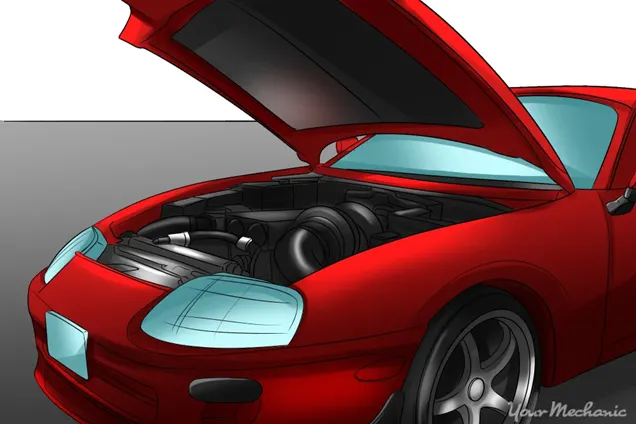
Figure 1: Car Hood
Theory:
Design requirements for the HOOD and its components:
A car hood, also referred to as a bonnet in some other countries, is the hinged cover that rests over the engine of a front-engine vehicle. Its purpose is to provide access to the engine for repair and maintenance. A concealed latch is typically used to hold down the hood. Car hoods are typically constructed from steel and sometimes from aluminum. Hoods may also be constructed from various other materials, including carbon fiber, fiberglass. The hood design may vary from one make and model to another.
Concerns regarding the severity of a potential pedestrian head injury during a collision with a motor vehicle have led to advanced hood designs on many models.
A car hood is meant to protect the performance parts of your vehicle, including the engine, while also providing easy access for repairs and maintenance. It is possible for the hood to incur damage as well. One of the most common types of damage is to the hinge, which is the device that connects the hood to the body of the vehicle. Over time, the hinge can become loose or may fall off completely. The hood is also prone to receiving scratches and dents. Although this might appear to be a minor problem, dents and scratches can lead to depreciation in the value of your vehicle. Scratches and dents can also lead to exposure to the elements that can result in rust and corrosion. This can be a serious problem that can ultimately expose the engine in your car to snow, sunlight, and rain. When this happens, it can impact the performance of your car's engine.
Functional Requirements:
- Hood Head Zone for Lock Striker:
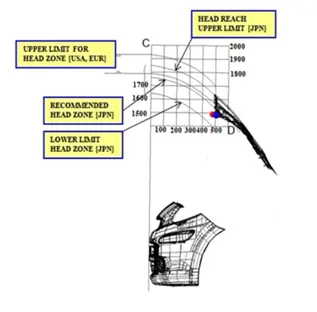
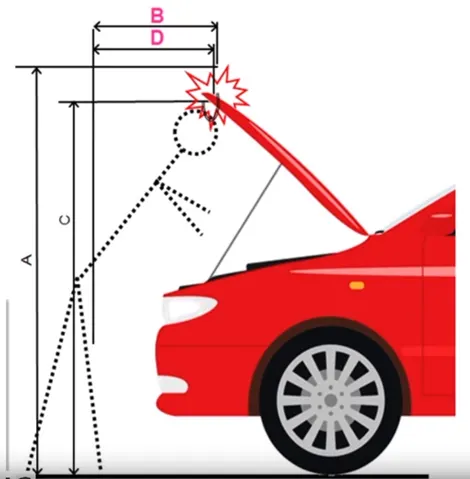
The Hood Head Zone for Lock Striker is an important criterion that is to be taken into consideration while designing the Hood. It differs from region to region and depends on the average human height in that region. It determines the opening angle of the hood.
The following figure shows a graphical representation of the upper and lower limits for various regions.
- Hood Stay
A hood stay is an apparatus for an engine room of a car, which can safely keep an engine hood in an open state even if an external force is abruptly generated due to vibration, wind and can facilitate an opening/closing operation of the engine hood. In other words, it is a device for supporting the engine hood of a motor vehicle in its open position.
Purpose: An automotive engine hood is arranged to be opened for the purpose of inspecting of the engine room, replenishing cooling water and/or engine oil, changing parts, making repairs, etc.
Types of Hood Stay:
1) Support Rod – A Support Rod is a device for supporting the engine hood of a motor vehicle in its open position by means of a rod.
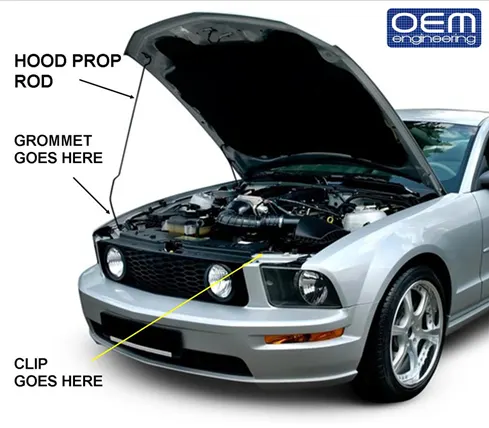
2) Gas Stay – A Gas Stay is a device for supporting the engine hood of a motor vehicle in its open position by means of an actuator which is activated by gas.
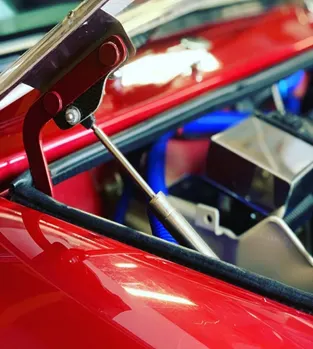
| Sr.no | Types of Hood Stay | Advantages | Disadvantages |
| 1. | Support Rod |
Cost effective, Simple |
When striking with the automotive body panel, to leave scars which are very likely to cause rust. The metal rod is often too hot to be gripped by hand when one attempts to keep the engine hood open for inspecting the engine room immediately after the vehicle has been stopped. |
| 2. | Gas Stay | No man power is required | Costlier |
Important Regulations:
EURO NCAP
The European New Car Assessment Program (Euro NCAP) is a European voluntary car safety performance assessment program based in Leuven (Belgium) formed in 1996.

They publish safety reports on new cars, and awards 'star ratings' based on the performance of the vehicles in a variety of crash tests, including front, side and pole impacts, and impacts with pedestrians.
Euro NCAP's ratings consist of percentage scores for Adult Occupant, Child Occupant, Vulnerable Road Users and Safety Assist and are delivered in the overall rating of stars, 5 being the best and 0 being the worst.
5-star safety: Overall excellent performance in crash protection and well equipped with comprehensive and robust crash avoidance technology
4-star safety: Overall good performance in crash protection and all round; additional crash avoidance technology may be present
3-star safety: At least average occupant protection but not always equipped with the latest crash avoidance features
2-star safety: Nominal crash protection but lacking crash avoidance technology
1-star safety: Marginal crash protection and little in the way of crash avoidance technology
0-star safety: Meeting type-approval standards so can legally be sold but lacking critical modern safety technology
Some cars have dual ratings as the lower is for the vehicle with standard equipment, while the higher is for the vehicle when equipped with certain options, often in the form of a safety pack.
Sheet Metal Joining Operations:
- Deep Drawing
Deep drawing is one of the most widely used processes in sheet metal forming. Apart from its use in many other sectors, it is applied in the automotive industry for the manufacturing of car body parts.
Process definition:
The deep drawing process is a forming process which occurs under a combination of tensile and compressive conditions. A flat sheet metal blank is formed into a hollow body open on one side or a hollow body is formed into a hollow body with a smaller cross-section. In the automotive industry, deep drawing is usually carried out using rigid tools.
The figure illustrates the deep drawing process. The rigid tools consist of a punch, die and binder. In deep drawing, the plate holder closes after the metal sheet blank has been inserted.
Next the sheet is clamped between the die and the binder. This process slows down the flow of the sheet while it is being drawn and thereby prevents wrinkles from forming under the binder. The punch stretches the sheet over the die radius and forms it in the die. The amount of punch force necessary for forming is thereby continually increased up to the lower dead center of the punch.
Whereas in pure deep drawing there is no reduction of sheet metal thickness, forming is achieved in stretch forming purely as a result of a decrease in sheet metal thickness. Stretch forming is extensively used for the forming of only slightly curved parts with low depth of draw (e.g. roofs, doors).
When drawing complex car body parts in practice, there is usually a combination of stretch and deep drawing involved. It is necessary that the sheet metal is stretched as well as possible without reaching the material’s limits (e.g. splits, wrinkles).
There are approximately 300 to 400 sheet metal parts which fit together to form the body of a car. In order to manufacture high quality sheet metal parts optimally for their particular use, specialized software simulates the complete deep drawing process.
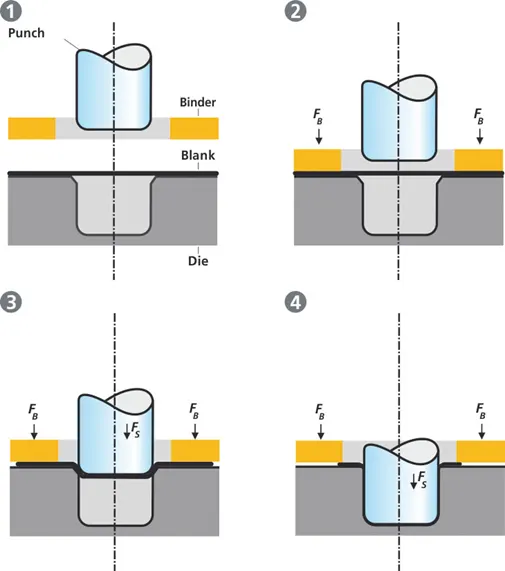
Figure 2: Illustration of Deep Drawing Process
- Hemming
Hemming is a forming operation in which the edges of the sheet are folded or folded over another part in order to achieve a tight fit. Normally hemming operations are used to connect parts together, to improve the appearance of a part and to reinforce part edges.
In car part production, hemming is used in assembly as a secondary operation after deep drawing, trimming and flanging operations to join two sheet metal parts (outer and inner) together. Typical parts for this type of assembly are hoods, doors, trunk lids and fenders.
The accuracy of the hemming operation is very important since it affects the appearance of the surface and surface quality. Material deformations, which occur during the hemming process, can lead to dimensional variations and other defects in parts. Typical hemming defects are splits or wrinkles in the flange, material overlaps in the corner areas or material roll-in. This is why it is important to use simulation tools in order to, on the one hand, better understand the hemming process and, on the other hand, significantly reduce the number of “trial and error” loops during try out und production.
There are two types of hemming operations: Conventional die hemming and Roll hemming
Conventional die hemming
Conventional die hemming is suitable for mass production. In die hemming, the flange is folded over the entire length with a hemming tool. Normally the actual hemming is a result of a forming operation in which the flange is formed with a hemming tool after the drawing and trimming operations have been completed. The formed flange is then hemmed in several process steps. These steps include, for example, the pre-hemming and final hemming depending on the respective opening angle of the flange. Production plants for conventional die hemming are very expensive, but the cycle times are very low.
Roll hemming
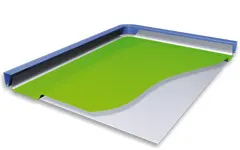
Roll hemming is carried out incrementally with a hemming roller. An industrial robot guides the hemming roller and forms the flange. Roll hemming operation can also be divided into several pre-hemming and final hemming process steps. Roll hemming is very flexible to use and tool costs are significantly lower as compared to those of conventional die hemming. However, the cycle times are much higher since the hemming is realized using a hemming roller which follows a defined path.

- Mastic Joint Sealant
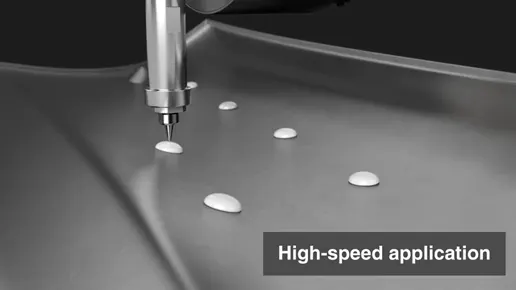
Mastic Sealants are used for gluing the Inner panel of hood to the outer panel. In addition to the hemming process, mastic sealants improve the strength locally within a range of 80mm dia. It also provides reinforcement and is a popular choice when one surface is to be adhered to another in a durable bond.
- Emboss definition:
Embossing is a metal forming process for producing raised or sunken designs or relief in sheet material by means of matched male and female roller dies, theoretically with no change in metal thickness. The Hood Inner Panel is provided with various Embosses so as to steer away the forces that would act on the hood in case of a crash, thereby reducing the impact to the vehicle and occupants. The Embosses are not provided on the Outer Panel for aesthetic reasons since it is a Styling Surface.
Design of Hood on NX 12.0
Inputs:
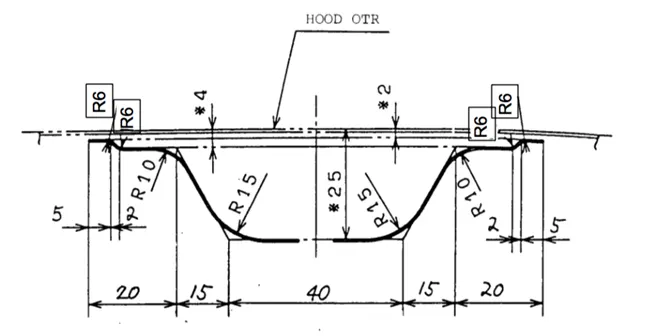
Master sketch:
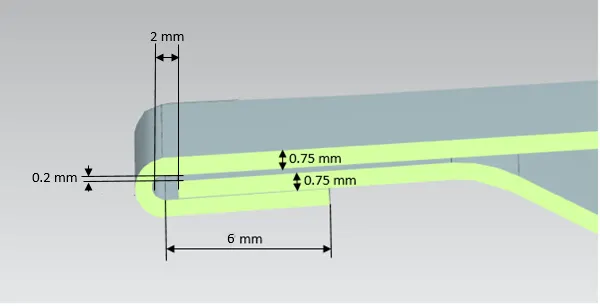
Hemming data:
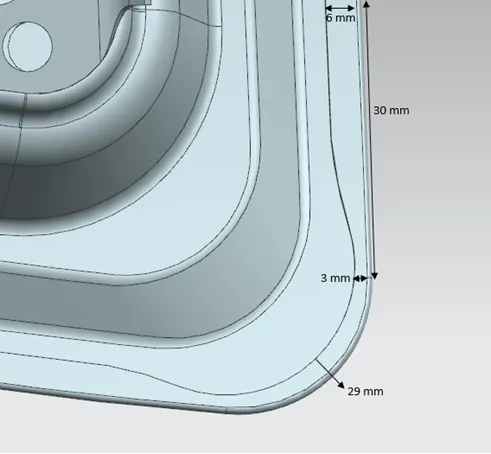
Rear Relief Section:
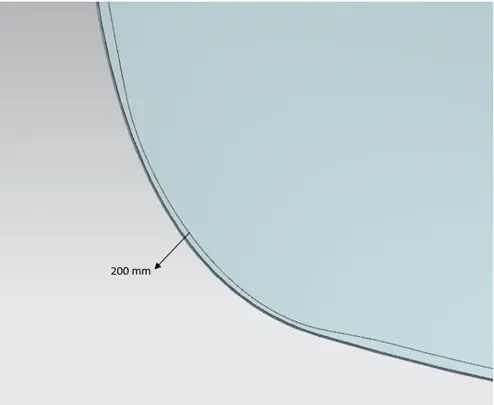
Front Relief:
Data to be used:
Hood Thickness Information:
- Outer Panel Thickness = 0.75mm
- Inner Panel Thickness = 0.75mm
- Reinforcement Thickness = 1.5mm
The Hood consists of the following components which are designed on NX 12.0
- Hood Outer Panel
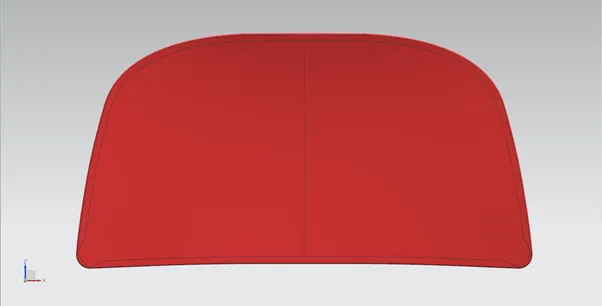
Figure 3: Front View
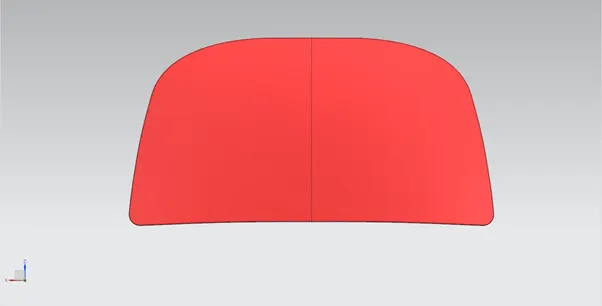
Figure 4: Back View
2. Hood Inner Panel
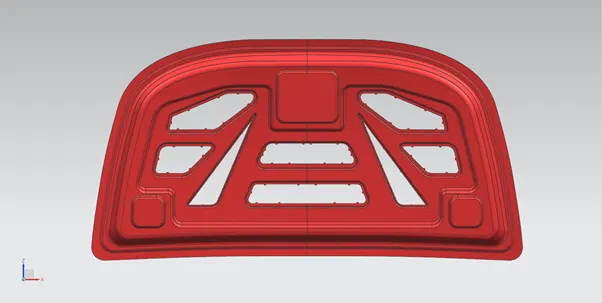
Figure 5: Front View
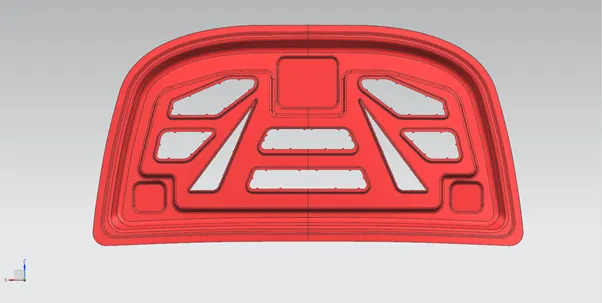
Figure 6: Back View
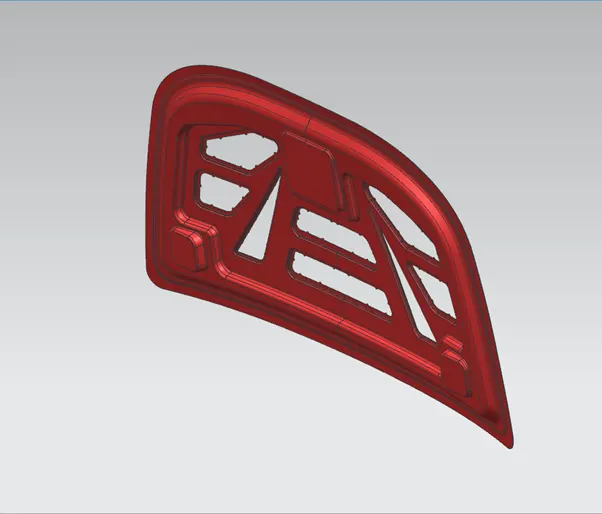
Figure 7: Trimetric View
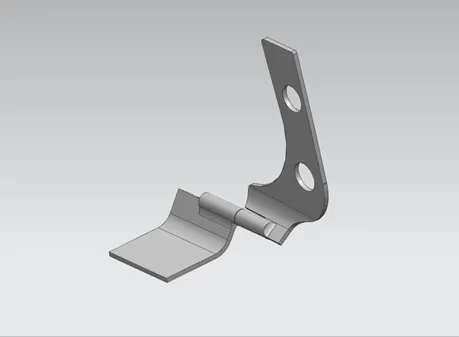
3. Hinges
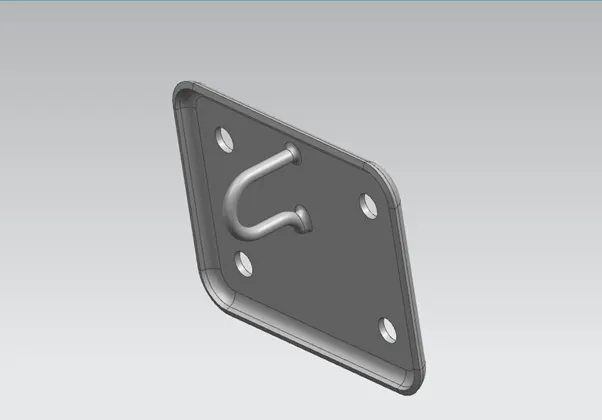
4. Latch Striker
Hood Assembly:
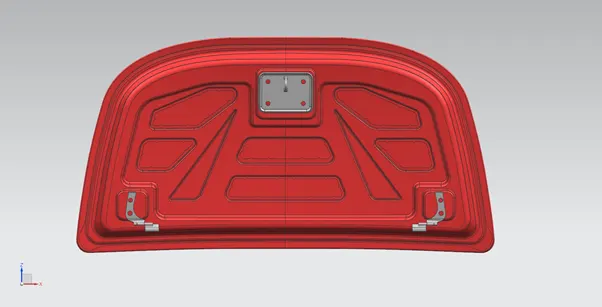
Figure 8: Front View
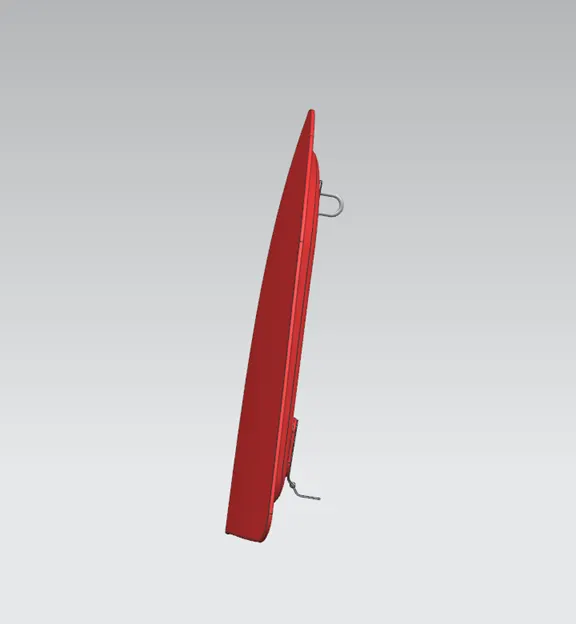
Figure 9: Side View
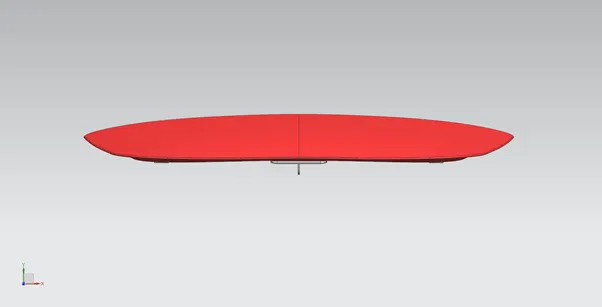
Figure 10: Top View
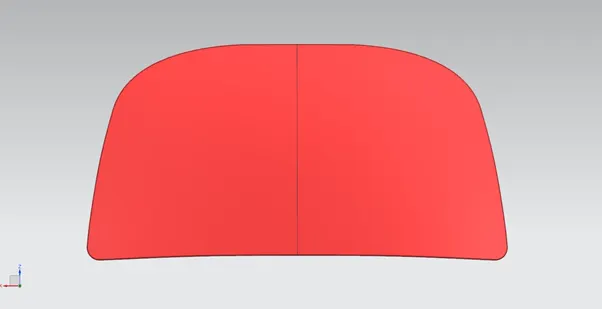
Figure 11: Back View
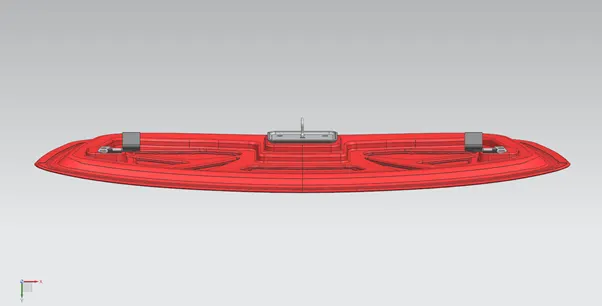
Figure 12: Bottom View
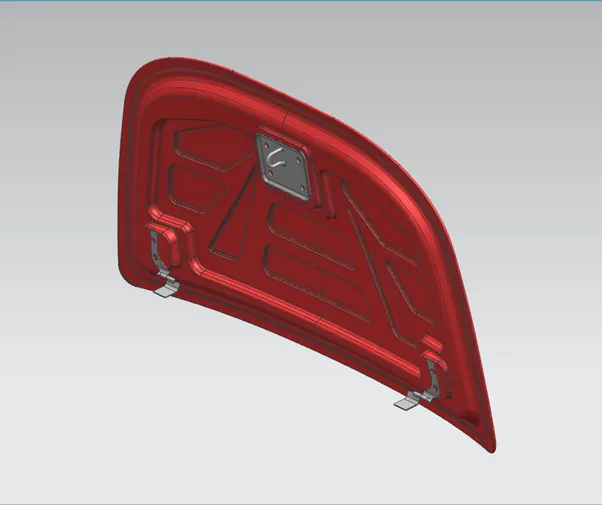
Figure 13: Trimetric View
The following commands are used for creating the above components:
- Offset Surface
- Trim Sheet
- Offset in face
- Through curves
- Sew
- Edge Blend
- Projected curve
- Emboss
- Datum Plane, Datum CSYS
- Extend Sheet
- Mirror Geometry
- Point, Line
- Untrim
- Thicken
- Law Extension
- Face Blend
- Curve on Surface
- Wave Geometry Linker
- Move Component
- Mirror Assembly
The following Assembly constraints are applied for creating the Hood Assembly:
- Fix
- Parallel
- Distance
- Touch Align
Latch Trajectory:
- Once, the Hinges are constrained on the Hinge Emboss, a hinge axis is created along which the movement of hinge takes place.
- Through the centre of this hinge axis, a circle is created which is the trajectory of the Latch Striker.
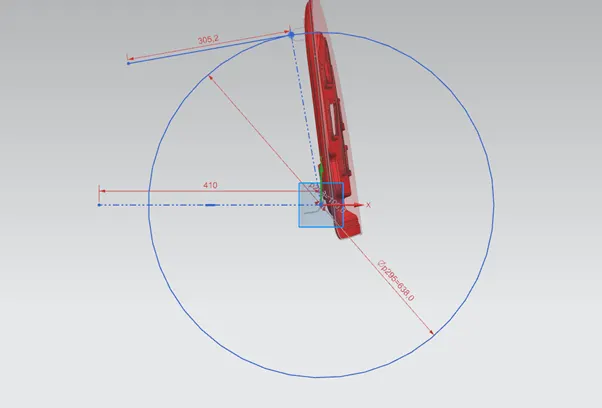
Figure 14: Latch Trajectory
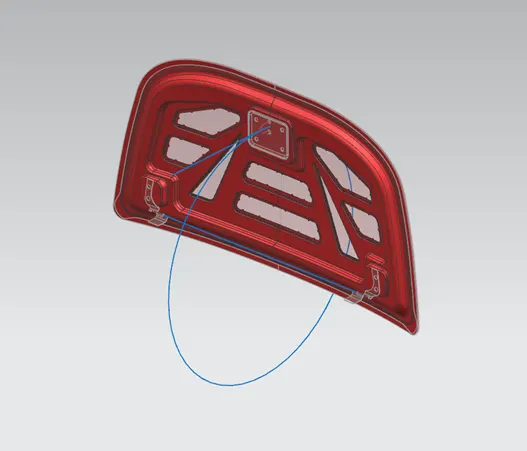
Figure 15: Hinge Axis
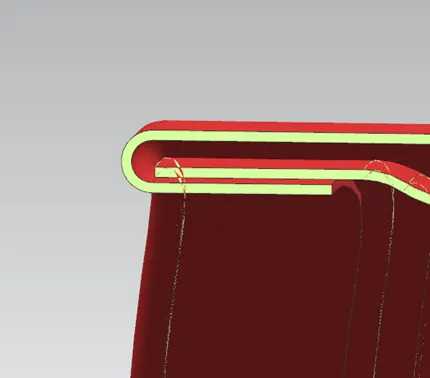
Figure 16: Hemming
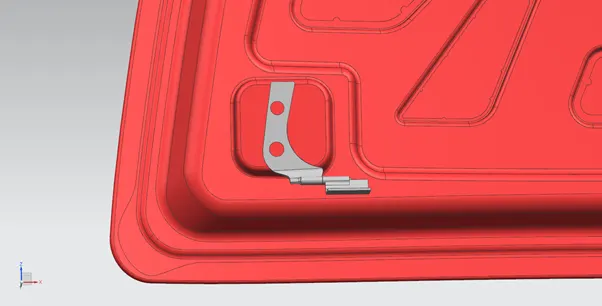
Figure 17: Rear Relief Section
Conclusion: Thus, The Hood is designed and developed on NX 12.0. The Surface, Curve and Assemblies workbench have been worked on for the same.