Hood design-Week 2
HOOD AND ITS COMPONENS
HOOD:
The Hood is also known as bonet. It acts as a cover for engine compartment. It is a critical component for frontal crash and pedestrian safety component.
Hood is the one which dissipates energy from the car body to outside. The hood is the opening body panel that covers the entire engine in front engine vehicle. It is considered as another type of door in a vehicle as it consists of an outer and inner panel. The inner panel provides strength while the outer panel funtions as the metal cover.
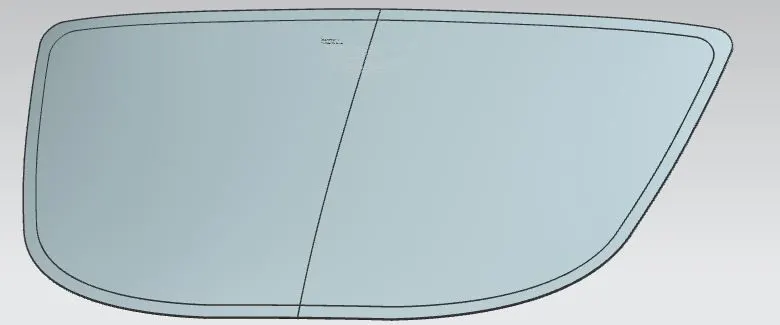
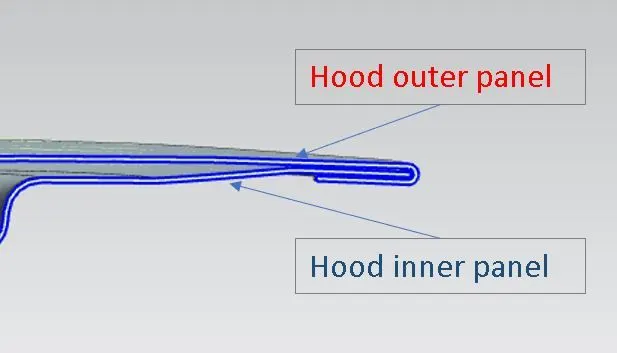
Components come under Hood:
Hood stay:
Hood stay is an apparatus for an engine room of a car, which can safely keep an engine hood in an open state even if an external force is abruptly generated due to vibration, wind and can facilitate an opening or closing operation of engine hood.
Hood stay must be positioned in considerations with the battery position.
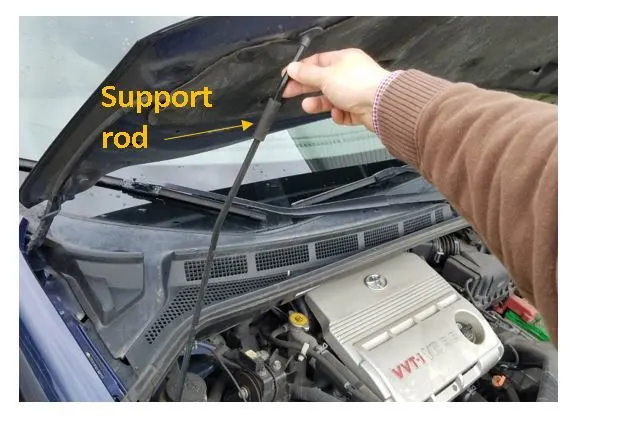
Types of Hood stay: 1) Support Rod 2) Gas stay
1) Support rod:
A metal rod is positioned between hood and engine compartment for support in an open condition.
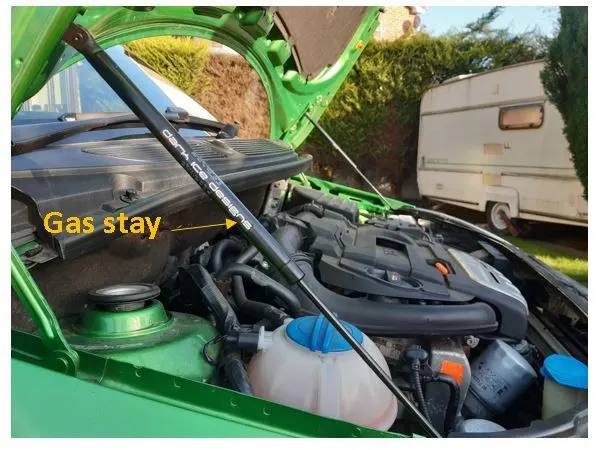
2) Gas stay:
Similar to support rod. But it doesn't require man power to open hood. It is costlier compared to support rod
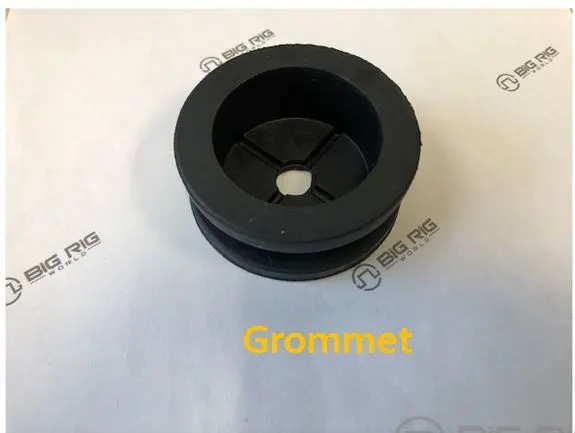
Grommets:
It is a standard parts used to keep the part in rest condition. These will be on engine and hood compartment
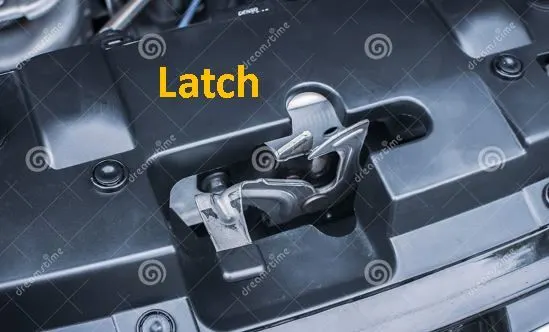
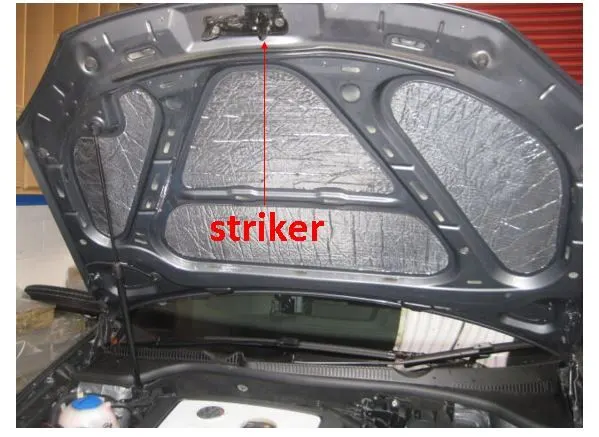
Latch and striker:
Latch is a mechanism used to hold and loosen the striker from the hood when it is in closing and opening condition.
Striker is u shaped clamp which is assembled on hood to mount the latch in engine compartment.
Reinforcement:
Reinforcement is applied in order to improve strength when there is loss in strength. Reinforcements made on on latch and striker. Thickness of the reinforcement varies.
Emboss:
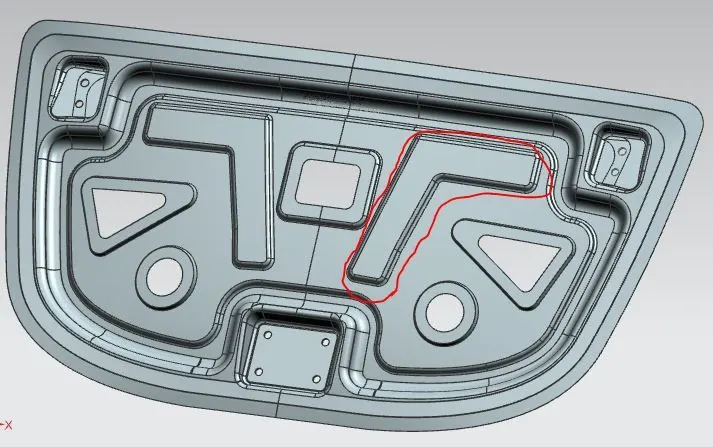
Embossing referes to the process of making raised relief images into paper or metal or anything.
Hinge:
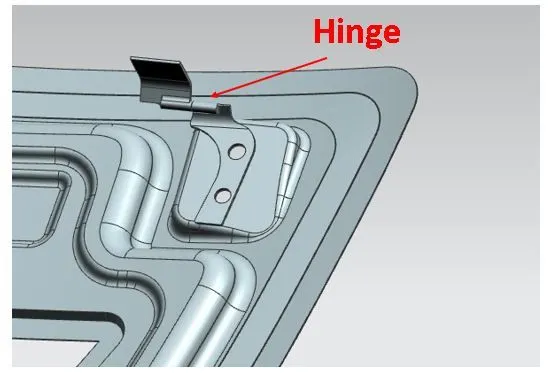
Hinge is an element which is used to rotate metal or anything which is attached to it.
Latch Trajectory:
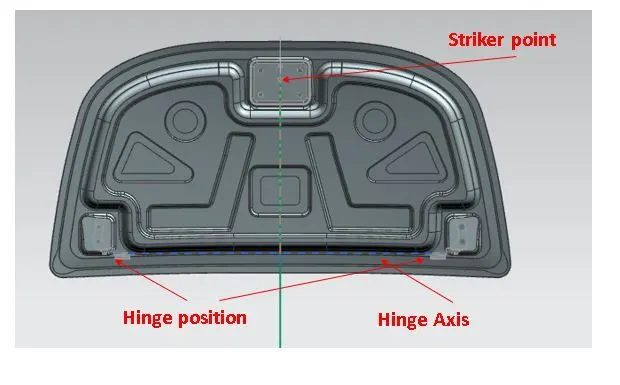
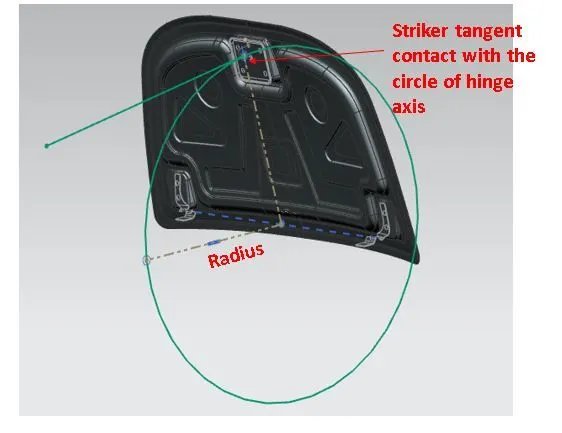
The striker in the hood needs to be attached to the engine compartment in order to close the hood.
we need to fix the striker point or the hinge axis. Both are correlated. If one moves, the other one also
moves.
why maintain trajectory?
Latch is positioned perpendicular otherwise it will not close. circle is the trajectory of the hood opening. the circle center is the position for the hinge axis.
The circle is exactly perpendicular to the projectory on this region locally, then our hinge position is correct.
Trajectory is going to contact with the engine compartment .i.e., the latch position. If it's not proper closing, it becomes hard.
Methods of joining inner and outer panel:
1) Mastic seal
2) Hemming
3) Spot welding
4) Gloving
Mastic Seal :
Mastic seal is a small rubber which is situated between inner and outer panel. Inside the hot furnace it will be hardened and joined between inner and outer panel. Thickness of mastic will be 5mm.
Mastic seal is used for appearance parts. Mastic seal is applied between 80mm diameter to other mastic seals
Hemming:
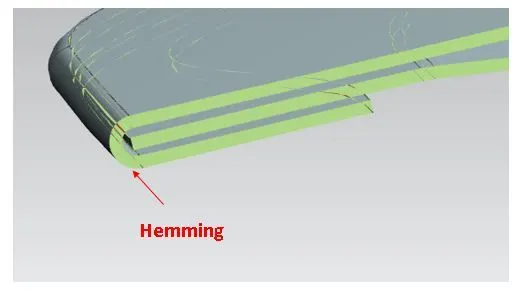
Hemming is a joining method for assembly of inner and outer panel since outer panel is an appearance part.
Hems are folds to the edge of parts. It depends upon the hems radius, thickness and feature of parts. while in corner area, relief should be applied.
Deep Drawing:
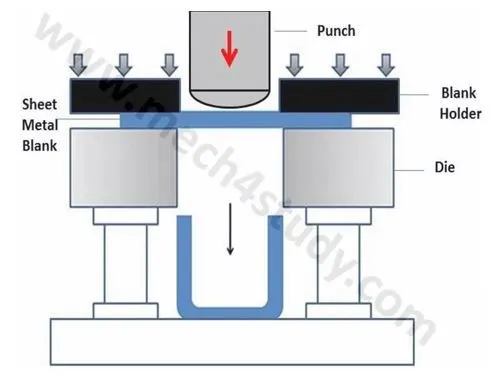
Deep Drawing is a sheet metal foming process in which a sheet metal blank is radially drawn into a forming die by the mechanical action of punch. The process is considered deep as the depth of the product exceeds its diameter.
Design considerations in Hood for better pedestrain rating:
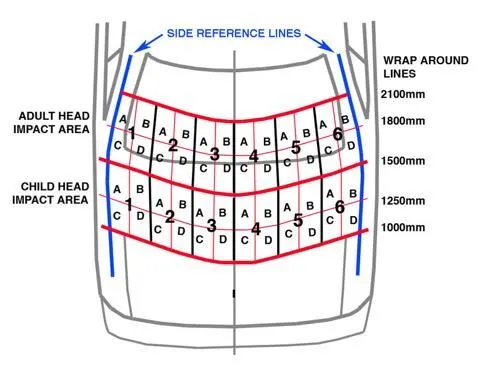
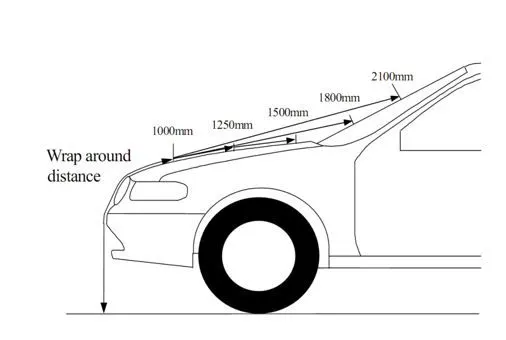
1) Wrap Around distance:
wrap around distance is the distance from the ground to the hood's end.When the car crashes the pedestrian, the human folds around the car and the head impacts on the hood or the windscreen.
It depends upon the size of the hood and the length of the car.
Side Reference line:
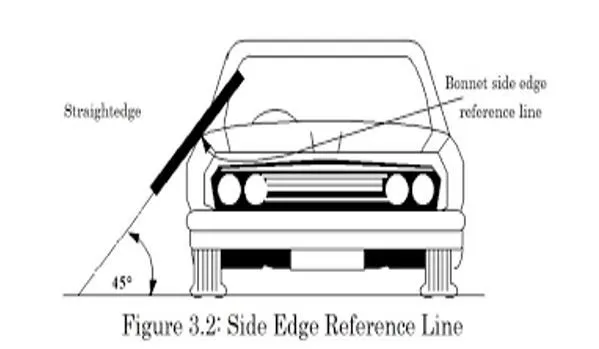
From the ground,takes 45 degree line that touches the end point of the car, it is known as side reference line. If the side reference line touches the fender, it is known as inlaid hood. If the side reference line touches the hood, it is known as wrap around hood.
EURO-NCAP ASSESSMENT
EURO-NCAP is a team which analyses various tests to understand how much car is safer to drive.
Impact zone:
Whenever there is pedestrian impact, it lies between two regions 1) child impact zone (1000 to 1500 WAD) and 2) Adult impact zone ( 1500 TO 2100 WAD) WAD means Wrap Around Distance.