Hood design-Week 2
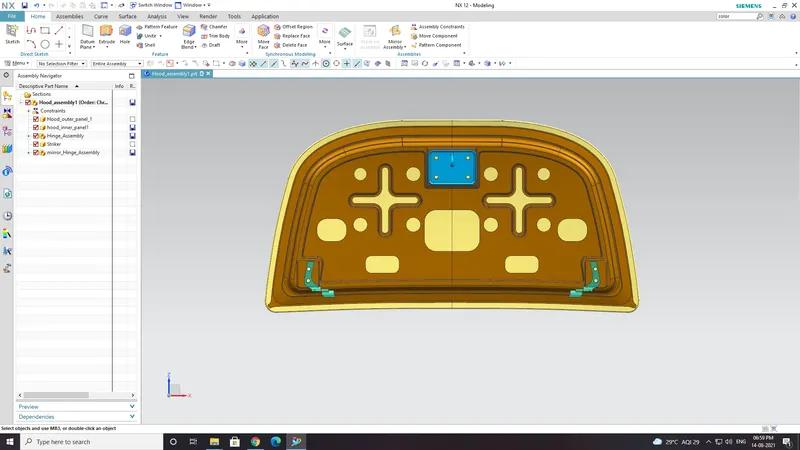
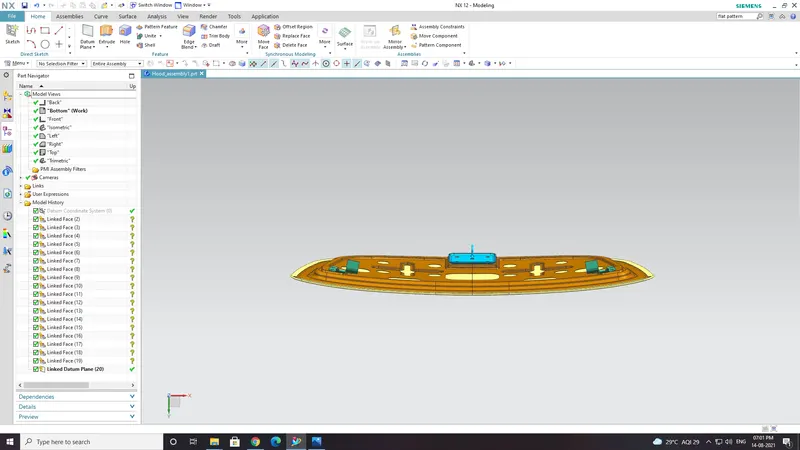
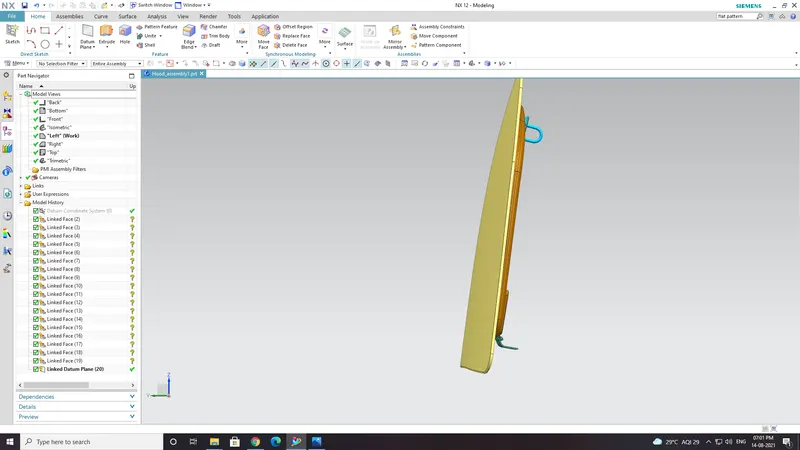
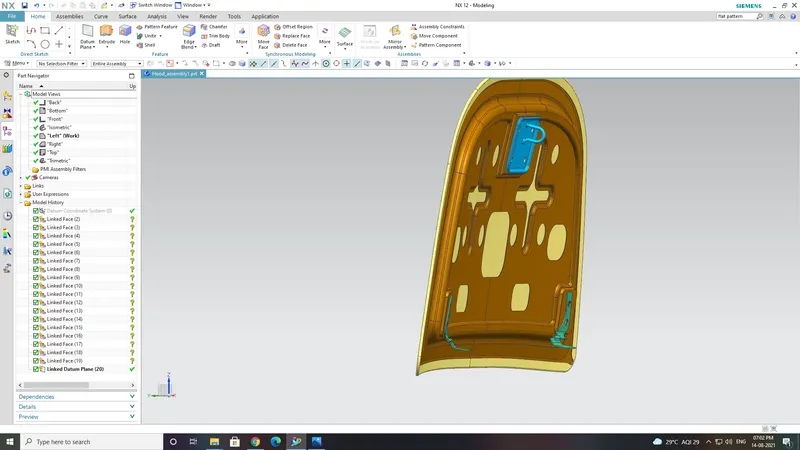
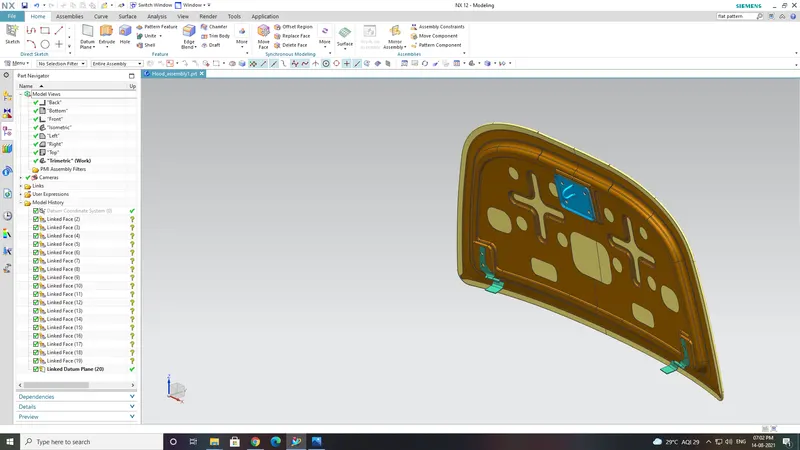
AIM : Design Hood outer panel, inner panel and the necessary reinforcements by following the Master section mentioned with the design parameter explained in the videos. Submit an assembly of Hood inner panel, outer panel, latch, hinge and the reinforcements
A detailed report about the Hood Design which includes a detailed explanation about hood and its components, Latch trajectory, Mastic data, Emboss definitions, manufacturing process like deep drawing and hemming, and all the parameters followed in the design.
HOOD CONSIDERATION :
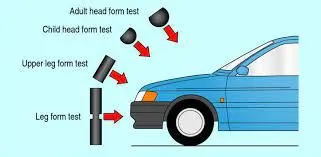
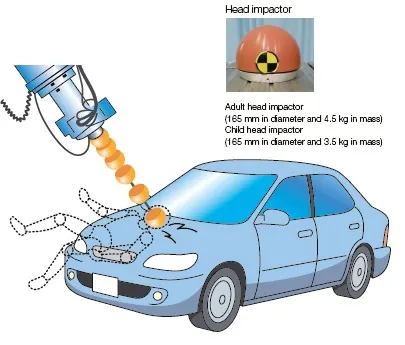
Car accidents in which pedestrians are hit by cars moving at a certain speed and their heads collided against car bonnets or front windshield are assumed.An adult or a child pedestrian’s head simulated impactor (head impactor) are projected toward the car bonnet, etc., from the testing machine. The impact received by the head impactors is measured and then evaluated using head injury criterion (HIC).
Discharge velocity is 40 km/h (equivalent to a vehicle colliding with a pedestrian at a speed of 50 km/h).
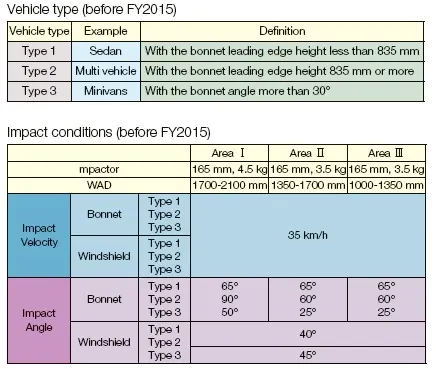
Before FY2015, it was 35 km/h (equivalent to a vehicle colliding with a pedestrian at a speed of 44 km/h).
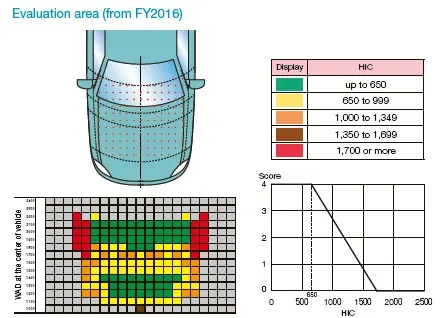
The distance between the ground and the evaluated areas of the cars,i. e., Wrap Around Distance (WAD) is measured according to the length of the area where the pedestrians’ heads hit in accidents. Impact location area for adults and children’s head is set based on the data of actual accidents. In the crosswise direction, the side line of the impact test area is from the line obtained by tracing the contact points between a straight edge and the side of the bonnet where the straight edge contacts the bonnet bumper at 45 degrees (Bonnet Side Reference Line) to the inside half diameter of the head impactor.
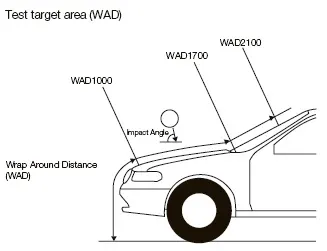
Impact angle in the test is 65° for adult pedestrian’s head impactor and 50° for child pedestrian’s head impactor.
Before 2015, test vehicles were divided by the vehicle type and tests were conductedin each testing area under each impact condition.
The impact position of the test is the point of intersection of two lines on the vehicle center line: one is drawn with 100 mm pitch from the point of WAD 1000 in front‐back direction and the other is the lines drawn with 100 mm pitch from the point of WAD 1000 in left-right direction. The injury criteria determined through testing are used and scored on an evaluation function (sliding scale). The total score of above tests are evaluated.
Impact area → HIC → Evaluation function → Score
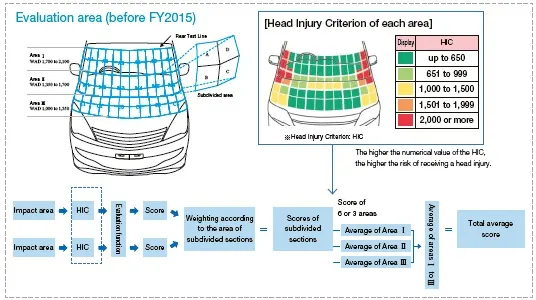
Evaluation procedure before FY2015 was as follows.
Areas I, II, and III are divided into six sections from left to right (up until FY2010, Area III was divided into three sections). Each of the six sections is then subdivided into four quadrants.
In each of the 18 sections, one or two points that are thought to have the highest injury criteria are selected (the points must be in different quadrants). The injury criteria determined through testing are used as representative criteria and scored on an evaluation function (sliding scale).
The test scores are averaged to produce an average score for each section, and then the total average score is calculated.
Design a specification for automotive hoood
With help of master section.
Following parts are
1. Hood outer panel.
2. Hood inner panel.
3. Hinge assembly .
4. Striker.
Hood Thickness Information
- Outer Panel Thickness = 0.75mm
- Inner Panel Thickness = 0.75mm
- Reinforcement Thickness = 1.5mm
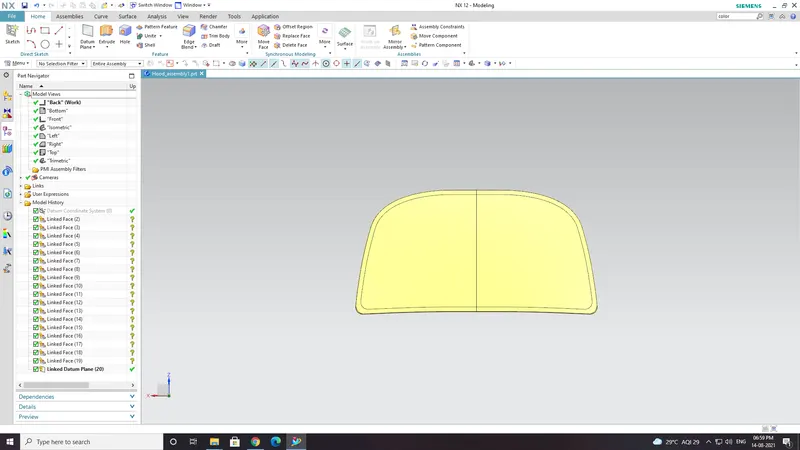
Master sketch:
Hemming Data:
Inner panel :
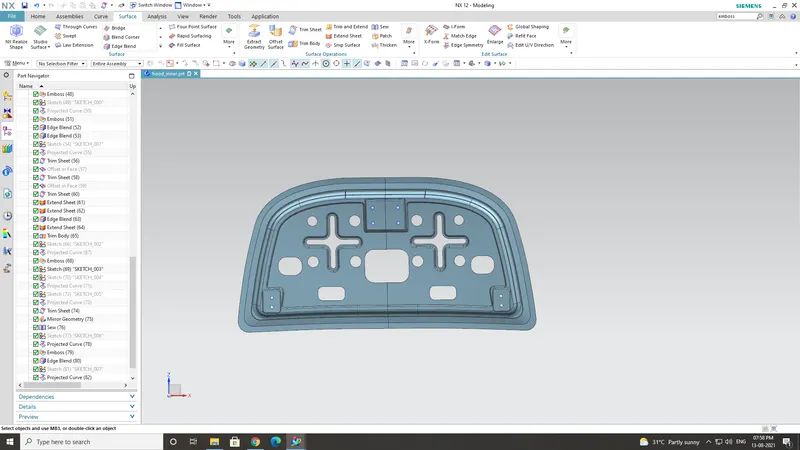
Hood inner panel for a vehicle is provided to improve rigidity, durability, and pedestrian protecting performance by comprising a composite structure in which a multi-cone structure and a frame structure are individually arranged on the front and the rear.
Outer pannel :
he hood design and shape influence many first impressions of a vehicle. Hoods are a significant place to save weight. They enable design change and aerodynamic improvements. Plastics composites allow complex geometric shapes with deep undercuts. Engineers can add a see-through plastic window while meeting FMVSS frontal crash requirements. And, today’s technologies allow OEMs to duplicate the Class-A color and finish of the rest of the vehicle. Plastics offer all this and sometimes for even less.
Hinge assembly :
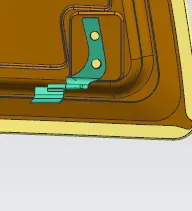
Hinge assembly which is used to fixes the hood to fenders in car. The latc must be fixed in perpendicular to the hinge axis so that hoods opens or closes properly.
Striker :
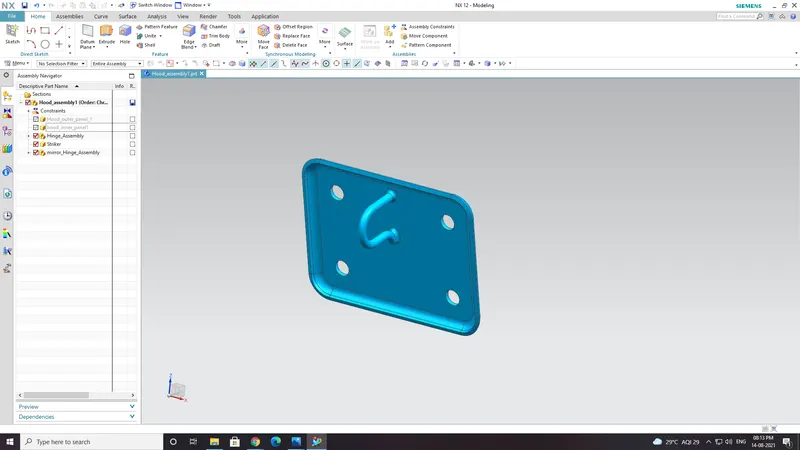
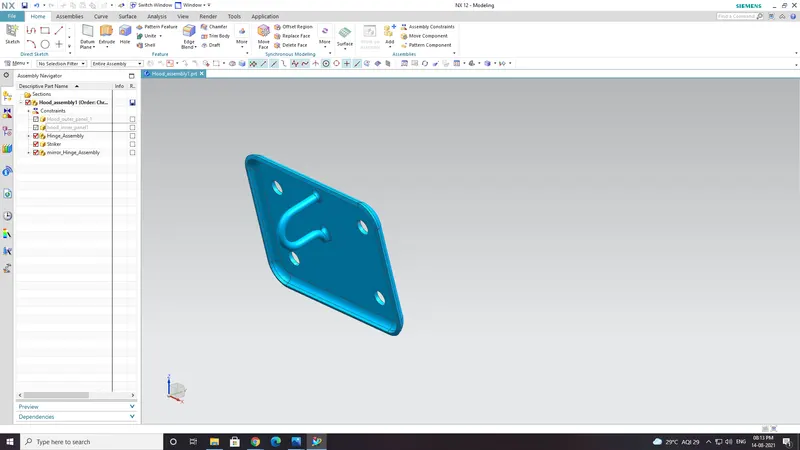
striker and latch is used for closing or locking the hood with the car.
Process involved in hood sheet meat is
- Hemming
- embossing
- punch cutting
- deep drawing
- blanking
Hemming :
Hemming is metalworking processes in which a sheet metal edge is rolled over onto itself. Hemming is the process in which the edge is rolled flush to itself, while a seam joins the edges of two materials.
The process for both hemming and seaming are the same, except that the tonnage requirement is greater for seaming. The process starts by bending the edge to an acute angle. A flattening die is then used to flatten the hem
Hemming is a sheet metal forming process in which sheets are joined by bending it usually to 180°. Automotive body panels and automotive parts such as deck-lids, trunk-lids, doors, hoods and tailgates are formed by hemming process. This paper present a systematic review of sheet metal hemming process based on materials used in hemming process.
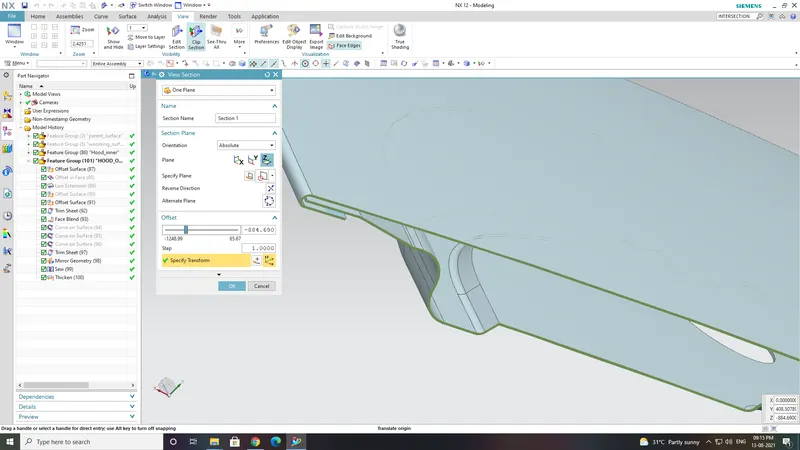
Deep drawing is a sheet metal forming process in which a sheet metal blank is radially drawn into a forming die by the mechanical action of a punch. It is thus a shape transformation process with material retention. The process is considered "deep" drawing when the depth of the drawn part exceeds its diameter. This is achieved by redrawing the part through a series of dies. The flange region (sheet metal in the die shoulder area) experiences a radial drawing stress and a tangential compressive stress due to the material retention property. These compressive stresses result in flange wrinkles
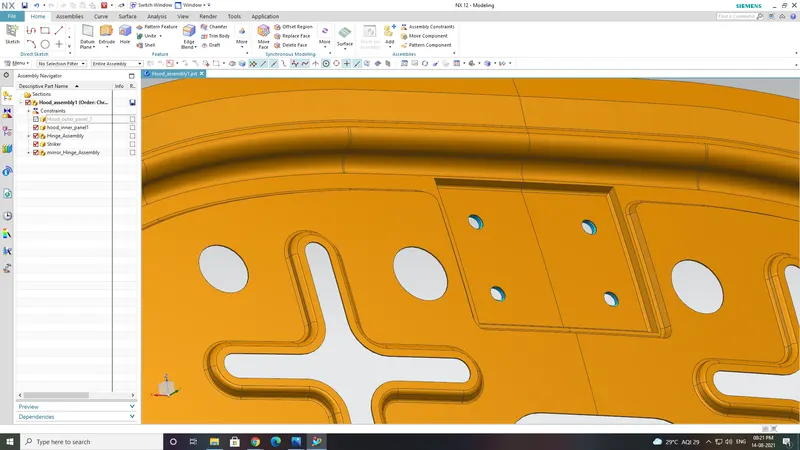
Embossing :
The metal sheet embossing operation is commonly accomplished with a combination of heat and pressure on the sheet metal, depending on what type of embossing is required. Theoretically, with any of these procedures, the metal thickness is changed in its composition.
Metal sheet is drawn through the male and female roller dies, producing a pattern or design on the metal sheet. Depending on the roller dies used, different patterns can be produced on the metal sheet. The pressure and a combination of heat actually "irons" while raising the level of the image higher than the substrate to make it smooth. The term "impressing" refers to an image lowered into the surface of a material, in distinction to an image raised out of the surface of a material.
In most of the pressure embossing operation machines, the upper roll blocks are stationary, while the bottom roll blocks are movable. The pressure with which the bottom roll is raised is referred to as the tonnage capacity.
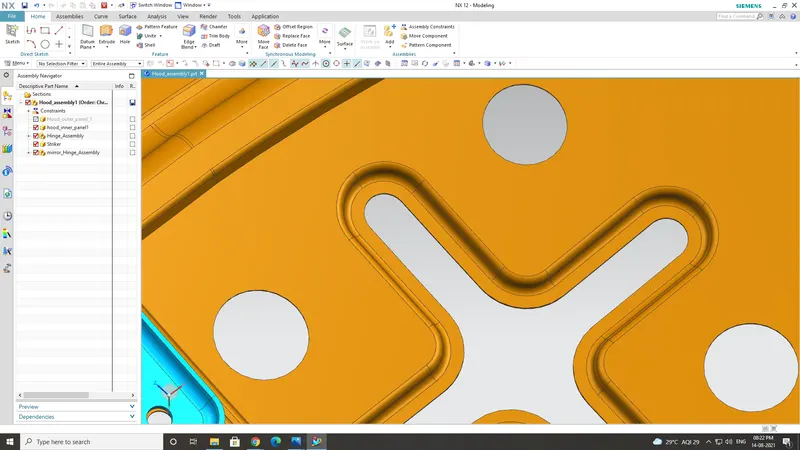
Latch trajectory :
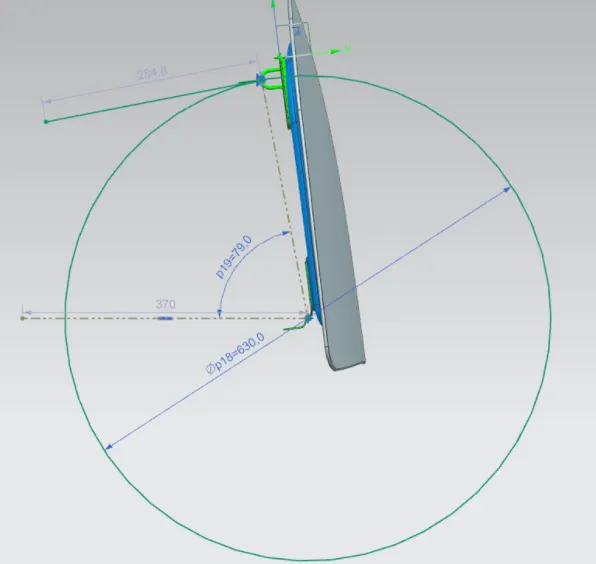
HOOD ASSEMBLY :