Hood design-Week 2
HOOD DESIGN
Objective:
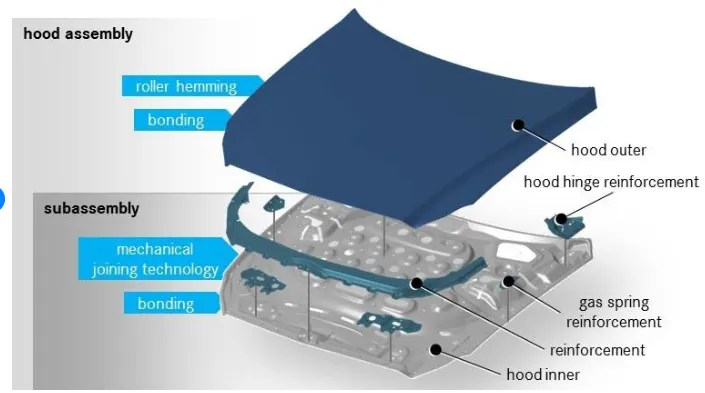
To design and model the car hood with inner panel outer panel and required reinforcements .
Software used: NX 12.0
The following tasks are performed:
-
Develop the inner panel
-
Develop the outer panel with hemming data.
-
Providing the proper embossing.
-
Providing mastic data
-
Positioning all the reinforcements.
Master sketch:
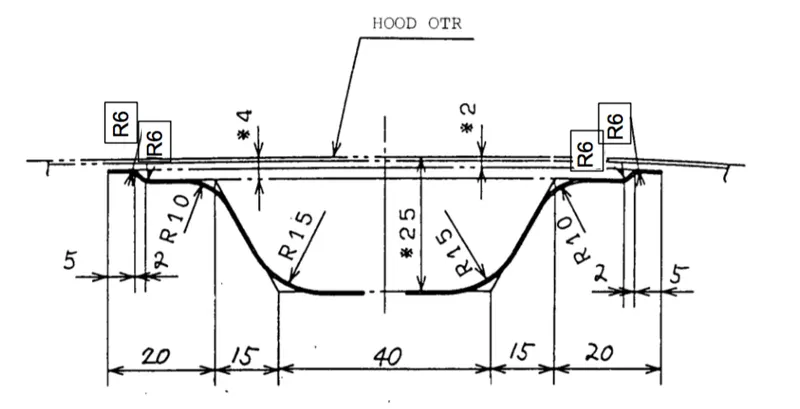
Data to be used:
-
Outer Panel Thickness = 0.75mm
-
Inner Panel Thickness = 0.75mm
-
Reinforcement Thickness = 1.5mm
Hood:-
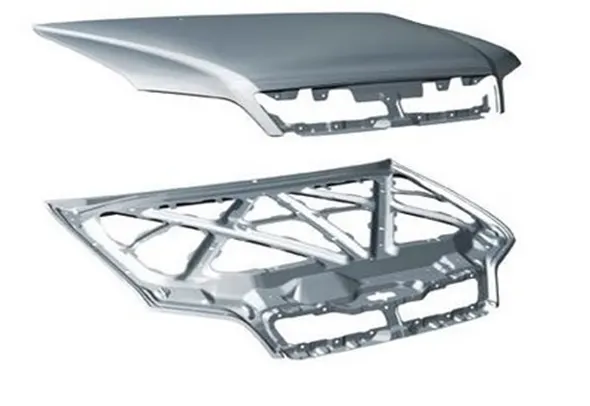
The car’s hood consists of an inner and an outer panel. The inner panel provides strength, while the outer panel is just a metal cover. The underside of the hood is often covered with a sound-absorbing material. Some high performance cars have ‘hood scoops’ which channel outside air directly to the air filter, which gives improved performance and efficiency.
The hood or bonnet is the hinged cover over the engine of motor vehicles that allows access to the engine compartment for maintenance and repair. On passenger cars, a hood may be held down by a concealed latch. On race cars, or cars with aftermarket hoods (that do not use the factory latch system) the hood may be held down by hood pins. A hood may sometimes contain a hood ornament, hood scoop, and/or wiper jets. Hood are typically made out of steel or aluminum, although aftermarket manufacturers may manufacture hoods out of fiberglass, carbon fiber, or dry carbon.
In Japan and Europe, regulations have come into effect in recent years that place a limit on the severity of pedestrian head injury when struck by a motor vehicle. This is leading to more advanced hood designs, as evidenced by multicone hood inner panel designs as found on the Mazda RX-7 and other vehicles.
The hood release is a small lever, which is usually mounted under the dash. It is connected to the hood latch by a cable. The hood latch has a safety feature, which requires a second latch to be released before the hood will open. This is to prevent accidental opening while driving.
Hood scoop:
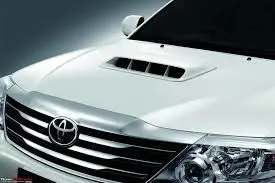
A bonnet scoop or hood scoop, sometimes called bonnet airdam and air dam, is an upraised component on the hood of a motor vehicle that either allows a flow of air to directly enter the engine compartment, or appears to do so. It has only one opening and is closed on all other sides. Its main function is to allow a direct flow of air to the engine, hence the need for it to be upraised so as to effectively channel air to the engine compartment. It may be closed, and thus purely decorative, or serve to enhance performance in several possible ways.
Cool air
In most modern vehicles, internal combustion engines "breathe" under-hood air or air ducted from under the front bumper through plastic and rubber tubing. The high operating temperatures in the engine compartment result in intake air that is 28°C (82°F) or warmer than the ambient temperature, and consequently less dense. A hood scoop can provide the engine with cooler, denser outside air, increasing power.
Ram air
At higher road speeds, a properly designed hood scoop known as ram-air intake can increase the speed and pressure with which air enters the engine's intake, creating a resonance supercharging effect. Such effects are typically only felt at very high speeds, making ram air primarily useful for racing, not street performance.
Pontiac used the trade name Ram Air to describe its engines equipped with functional scoops. Despite the name, most of these systems only provided cool air, with little or no supercharging effect.
Inter-cooler scoops
Some engines with turbochargers or superchargers are also equipped with top mounted intercoolers to reduce the temperature and increase the density of the high-pressure air produced by the compressor. Channeling outside air to the intercooler (which is a heat exchanger similar to a radiator) increases its effectiveness, providing a significant improvement in power.
PURPOSE OF HOOD DESIGN :
-
Safety of the passenger.
-
Covers all engine, radiator, and other necessary components.
-
Reduce air effect due to its aerodynamic shape design.
-
Reduce engine noise which helps for a quieter drive.
-
Provide access to engine maintenance.
-
Absorbs most of the impact forces when a frontal crash occurs.
Types of hood Support:
-
Gas stay
-
Support Rod
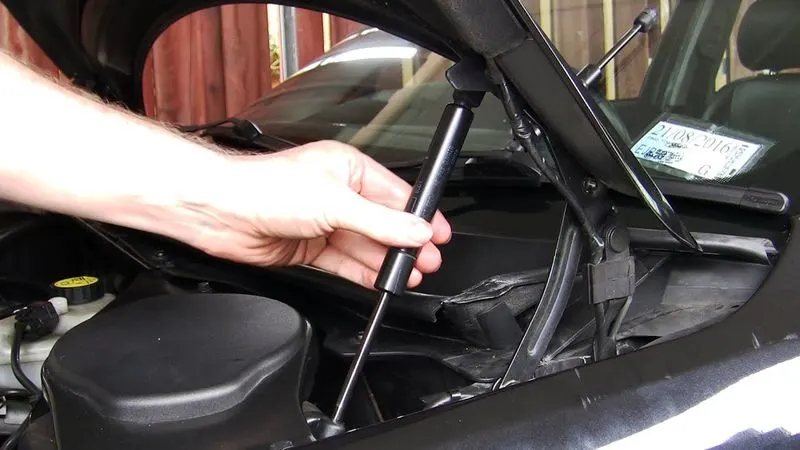
1.Gas Stay:
These are used to lift tha car hood or bonnet , its purpose to just give the lifting force to the hood , then it automatically opens the car hood by means of gas pressure. This is used where the car bonnet size is heavy to lift .
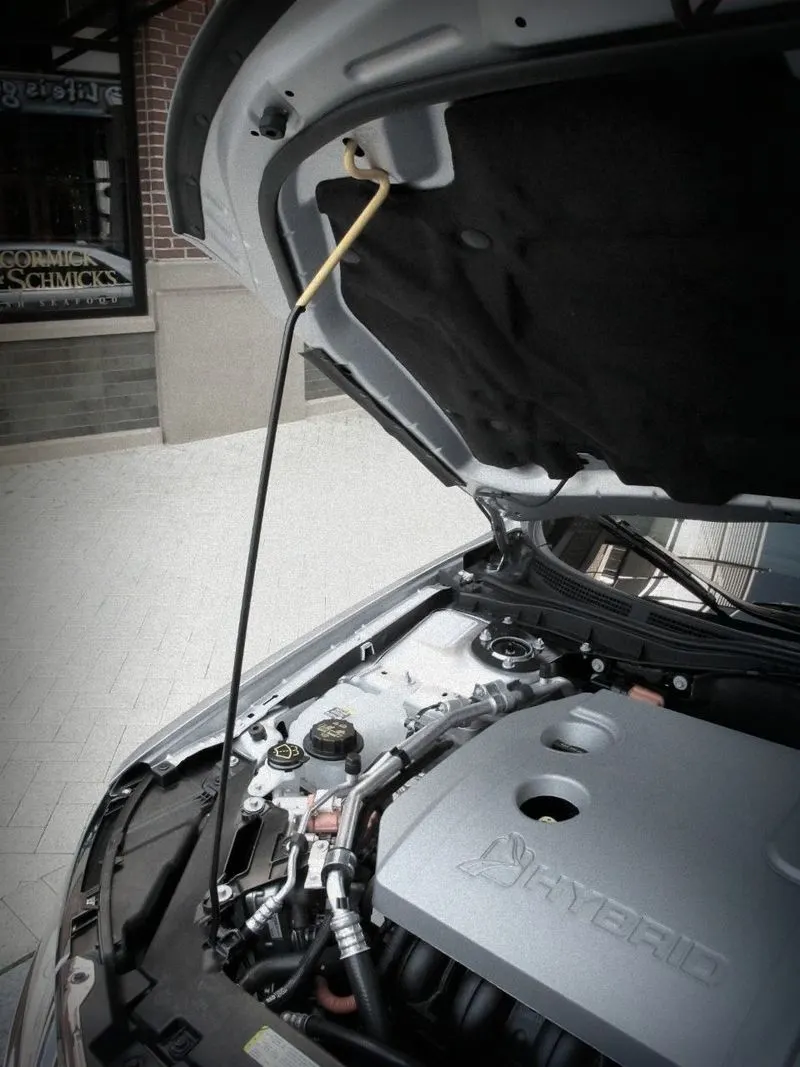
2.Support rod:
This is widely used in many car, because this very easy and cheap. In this type we have to lift the hood by ourselves and place the support rod in the space provided either in the hood or engine component. This is mostly used for where the car bonnet weight is small.
SAFETY REQUIREMENT WHILE DESIGNING HOOD:
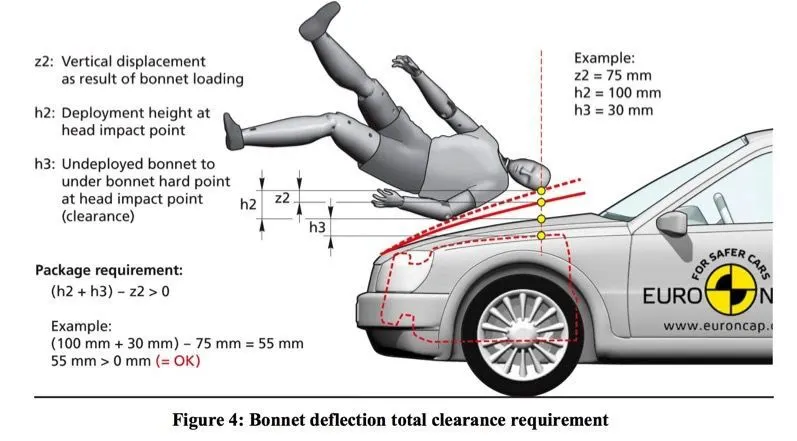
Safety is the most important criteria in automobile designs which concentrates on both pedestrian and occupant safety. The pedestrians are the most vulnerable road users and are at high risk of traffic accidents. The major reason for the fatality of the pedestrian in traffic accident is due to the head injury resulting from the hard impact of the head against the stiffer hood or the ground. This leads to the necessity of new inner hood panel which is less stiffer and pedestrian friendly.
The head impact analysis on the present hood of the car was done to study the response of the adult head form at two different locations. Structural and modal analysis for the same present hood assembly was done to observe the local and global stiffness. In order to reduce the head injury of the pedestrian the local stiffness over the area of head impact has to be reduced thus the new design of hood inner panel was focused on that and the structural and model analysis was done for the new design. The design with lesser local stiffness and similar global stiffness compared to the existing hood was finalized.
Child Head Impact:
Car-pedestrian accidents account for a considerable number of automobile accidents in industrialized countries. Head injury continues to be more concerned with Automobile impacts. Because the head is the most seriously injured part in many collisions including in pedestrian automobile collisions. To reduce the severity of such injuries international safety committee have proposed subsystem tests in which head foam impactors are impacted upon the car hood
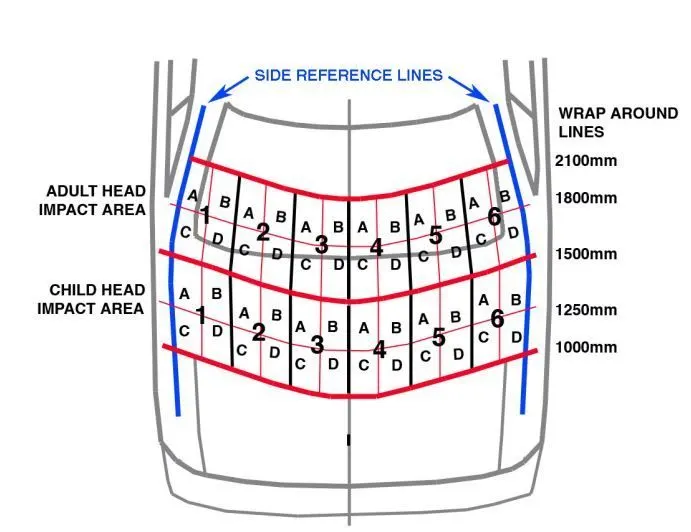
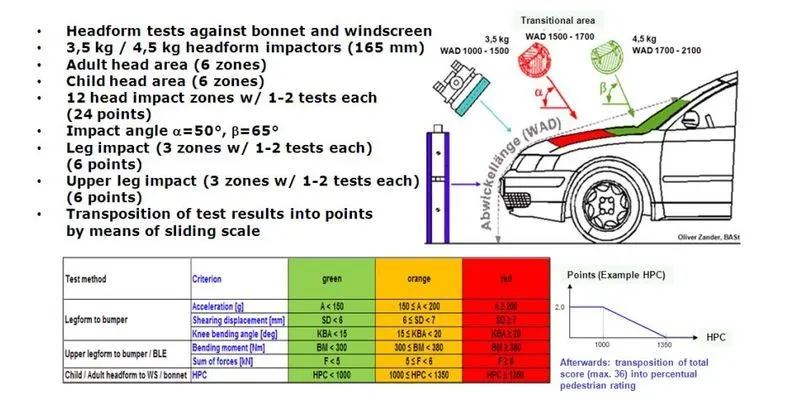
Currently in India, Automotive Indian Standard (AIS) 100, Amendment 1 is used to evaluate the performance of vehicles against pedestrian safety. This standard has been harmonized from the international evaluation standard Global Technical Regulation No. 9 (GTR 9), whose purpose is to bring about an improvement in the construction of the fronts of vehicles and, in particular, those areas which have been most frequently identified as causing injury when in collision with a pedestrian or other vulnerable road user. The tests required are focused on those elements of the child and adult body most frequently identified as sustaining an injury, i.e. the adult head and leg and the child's head. To achieve the required improvements in the construction of vehicles, the tests are designed in such a way that they will represent the rear world accident scenario.
Pedestrian Safety:
According to the requirements of the Australian New Car Assessment Program (ANCAP) for pedestrian protection, it needs to define zones of car hood for analysis, as shown in Figure 4. It can be noted that when the collision projection point locates between (Wrap Around Distance) WAD 1000 and WAD 1500, the head type will use the children head type. The adult head type will be used while the collision projection point locates between WAD 1700 and WAD 2100. In the collision projection point located at WAD 1000 when the children head type will be used.
SHEET METAL OPERATIONS:
-
Blanking and piercing
-
Deep drawing
-
Embossing
-
Hemming
Blanking and piercing:
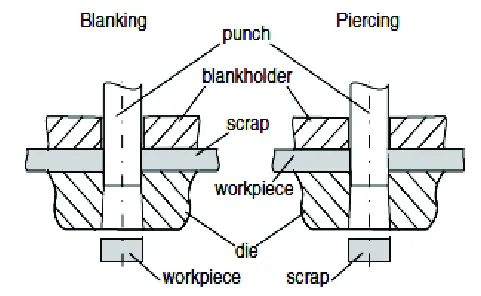
In the blanking, piercing, and shearing process a punch and die are used to modify webs. The tooling and process between the two are the same, only the terminology is different. In blanking the punched-out piece is used and called blank whereas in piercing the punched-out piece is scrap. The process for parts manufacturing simultaneously with both techniques is often termed pierce and blank, an alternative of piercing is punching.
Pros
-
Reduces the body weight
-
Improves the strength of the body
-
Distributes the impact forces
Deep drawing:
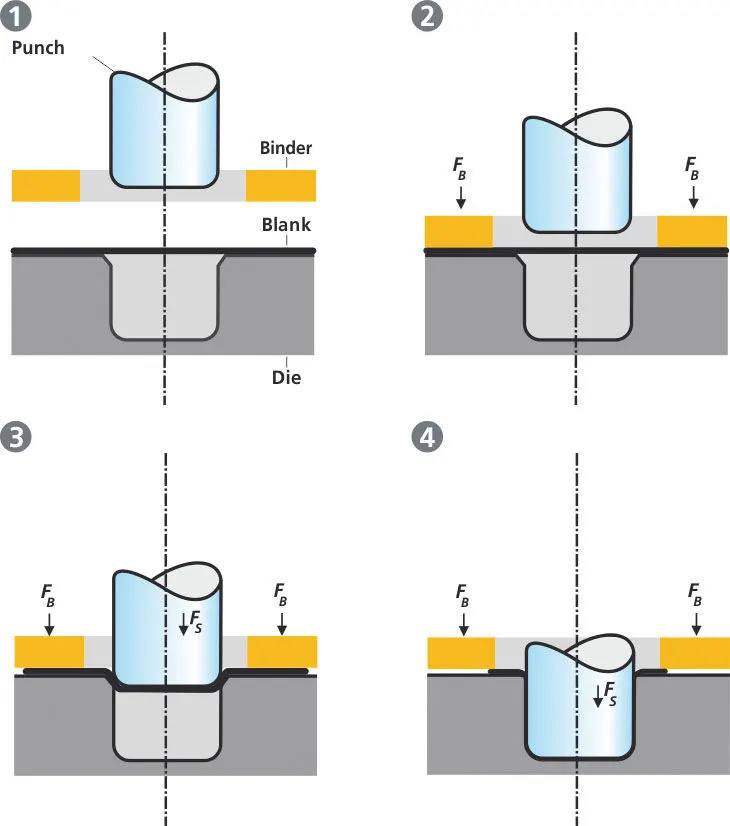
Deep drawing of sheet metal is used to form objects with depths. It is plastic deformation in which a flat sheet metal or plate is formed into a recessed 3-D part with depth several times the thickness of metal. In this sheet, a metal blank is radially drawn into a forming die by the mechanical action of a punch. It is thus a shape transformation process with material retention. The material used is generally aluminum as it can absorb twice the crash energy as of mild-steel while keeping the overall weight lower than mild-steel.
Pros
-
It is a very cost-effective method of producing various types of individual parts which are seamless products
-
Faster cycle times
Embossing:
Sheet metal embossing is a stamping process for producing raised or sunken designs or relief in sheet metal This process can be made by means of matched male and female roller dies or by passing sheet or a strip of metal between rolls of the desired pattern.
It is done by pressing a sheet into a female die which has a design attached to it. this is usually done with a male counterpart underneath the paper so that the two and design is transferred to the sheet
Pros
-
Embossing enables us to highlight the important elements of the products .
-
Transfers even the finest details .
-
Permanent design that lasts forever.
Hemming:
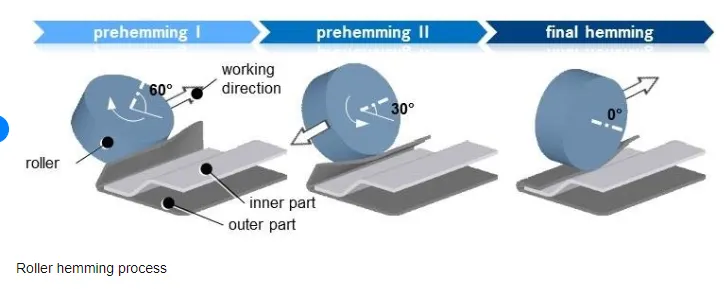
Hemming is a sheet metal forming process in which sheets are joined by bending them to 180 degrees. Automotive body panels and automotive parts such as deck-lids, doors, hoods, and tailgates are formed by the hemming process, in this process usually, a sheet is bent with the help of the inner and outer sheets. hemming is formed in which the edge of the sheet is folded over another parting to achieve a tight fit.
Pros
-
To fasten two sheet metal parts by folding the edge of the sheet back on itself.
Types of hemming
-
Rolled hemming
-
Closed hemming
-
Teared drop hemming
-
Open hemming
Mastic Points:
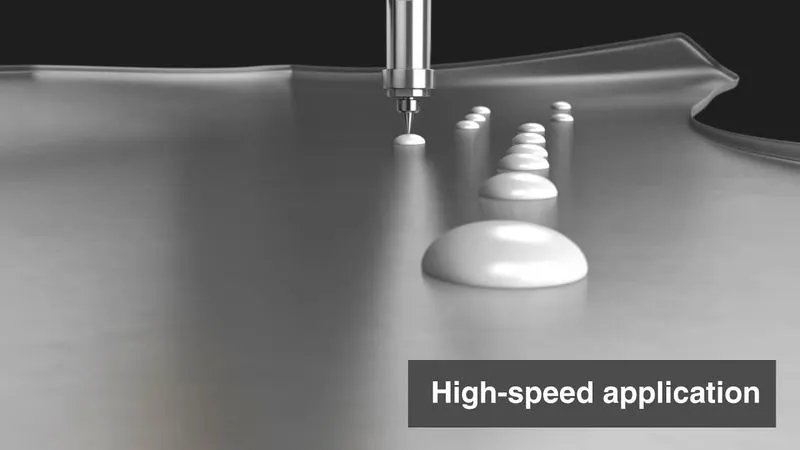
Mastic points are areas where the inner hood panel is joined with the outer panel hem using a mastic glue. This mastic glue keeps the inner panel stuck to the outer panel.
The main purpose of the outer panel is for the aesthetic looks. Thus we cannot use bolts or welding. This has to be done with the help of the hemming and mastic sealants. Mastic sealants are elastic compound that behaves like the rubber. It is placed between the outer and inner panel. Initially is it in paste form, but after the hot furnace bath it gets hardened thus joining the outer and inner panel. Mastic sealant has the tendency to increase the strength of the panel and has influence of 80mm diameter.
Pros
-
One positive characteristic of mastic sealant is that it has a very smooth exterior while keeping its rigid form underneath.
-
Surfaces do not have to be primed when using this type of sealant, and although applied thick, it adheres smoothly to any surface. It is important that the area to be joined or sealed be clean and dry, just like any other sealant on the market.
-
Mastic sealant may be used outdoors as well because of its waterproof quality. It can be applied on rain duct leaks outdoors, for example.
-
It is also favored for areas under high or low temperatures such as heater vents or drier vents and contains ultraviolet inhibitors to make sure that it is protected from damaging effects of the sun that will often weaken other types of sealants. That makes it a good choice for use on roofs, or any surface that is constantly exposed to sunlight. Most mastic sealants will also work well with metal because they do not corrode over time.
-
It functions well in areas with mild vibration and heat, like heating ducts.
Cons
-
Mastic sealant is not recommended for areas that have too much joint movement, or anything that will be moved a long length.
-
It works well with constant pressure on it, but not constant movement.
-
It also works best when applied thickly and is not recommended if only a thin layer is needed such as touch ups. Another sealant is a better choice for those types of repairs.
Important commands used to Design:
Offset Surface:
The feature is used to create another body at an offset distance from the original body.
Offset in Face:
To create a curve on the selected face this feature is used.
Trim Sheet:
This Feature is used to trim the extra or unwanted sheet for the work part.
Through Curve:
Create a body through multiple section where the shape changes to pass through each section.
Law Extension:
This feature is used to create a law controlled extension from a base sheet, dynamically of based on law for distance and angle.
Trim and extend:
This is used to trim or extend a set of edges or face to the intersection with another set of edges or face.
Face Blend:
This feature is used give smother faces.
Edge Blend:
The sharp edges of the face are converted to smooth edges.
Bridge Curve:
This feature is used to create tangent blend curve between two curves which are not connected to each other.
Emboss:
This feature is very important feature as it modifies a body faces made by projecting a section along a vector, with option for end cap location and shape.
Projected Curve:
As we cannot draw a sketch on the surface, so by drawing a sketch on the plane parallel to the give surface and used project curve it will project the curve on the face.
Trim Body:
Trims off the extra portion of the body.
Extend Sheet:
It is used to extend the sheet body by distance or to the intersection with another body.
Datum plane:
This is mostly used feature which helps to create a plane that is used to construct other sketches.
Wave Geometry Linker:
This feature is used to copy geometry from other part in the assembly into the work part.
Mirror Geometry:
It mirrors the entire geometry along the plane.
Sew:
This feature is used to combine the sheet bodies by sewing common edges together, or combines solid bodies by sewing common faces.
Thicken:
This feature is used to add a thickness to the set of faces.
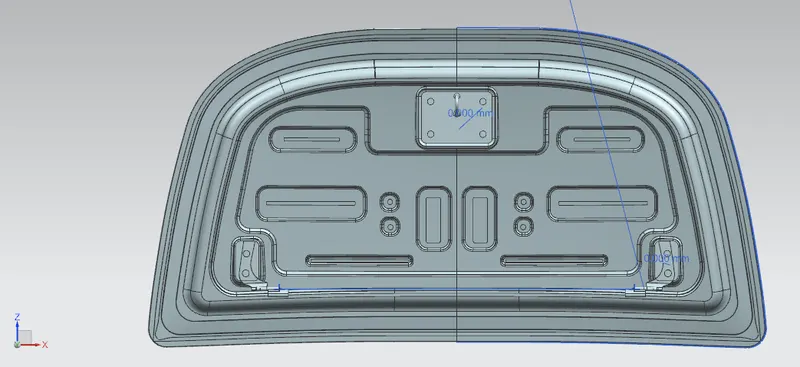
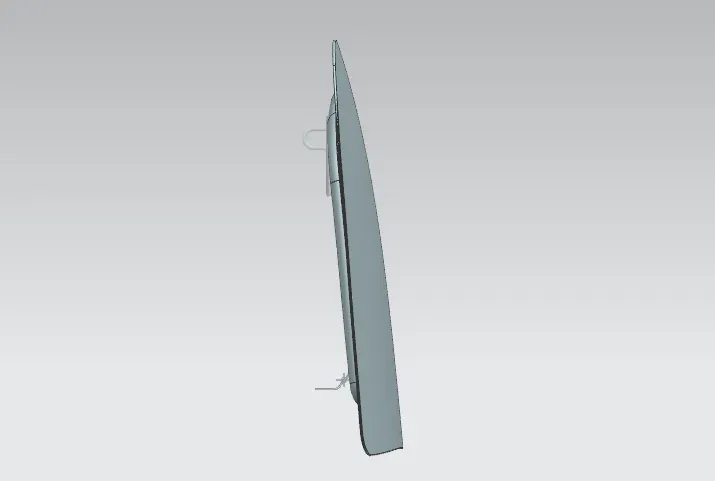
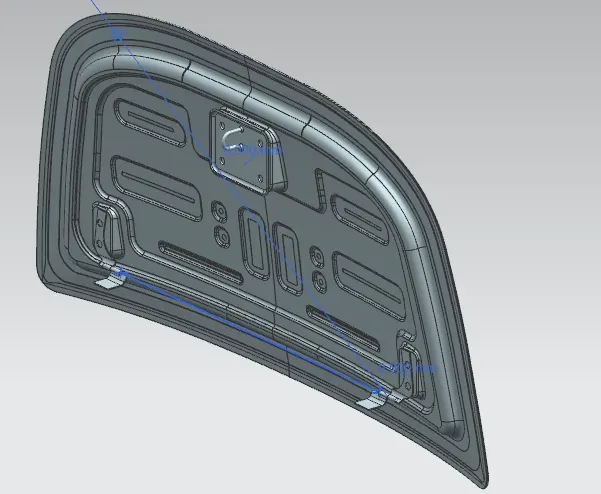
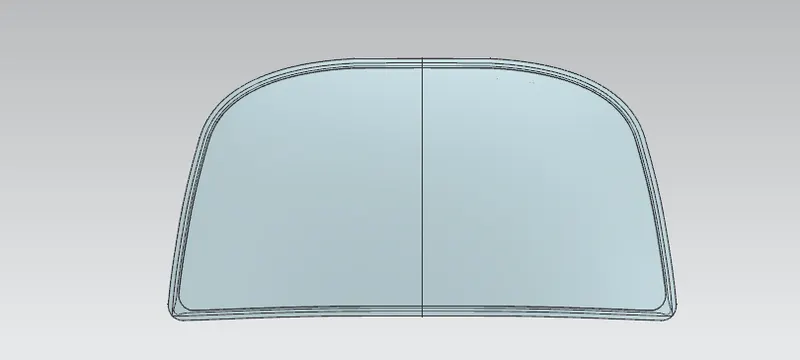
Views of the designed hood:
Front view:
Side views:
ISOMETRIC VIEW:
Back view:
Conclusion:
1. All the components of hood are designed and assembled using assembly Section.
2. All the safety related features are given in the report.
3.The latch and striker position are studied.
4.All the necessary Reinforcements were added to the design.