Hood design-Week 2
Hood Design
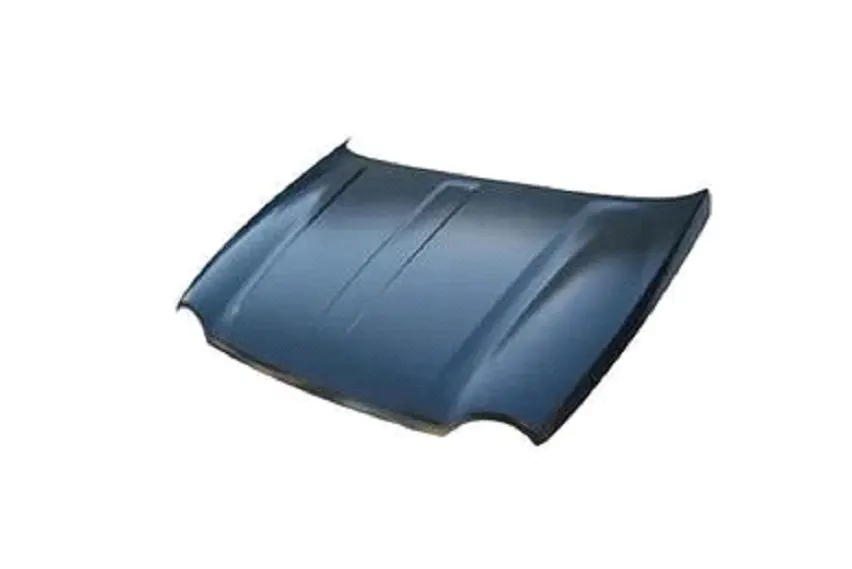
Introduction: Hood is a component of a car at the front portion. It is used to decorate the car and add luxurious look. The shape of the bonnet is made aerodynamic in order to minimize the air effect.
The hood or bonnet in white (BIW) is the hinged cover over the engine of motor vehicles. It's utilized to protect the engine and other accessories as well it absorbed the most of the impact force across the body which provides safety to the vehicle. It also allows access to the engine and its components for maintenance and repairs work. The car’s hood consists of an inner and an outer panel. The inner panel provides strength, while the outer panel is just a metal cover. It has only one opening and is closed on all other sides. It is hinged thin sheet which covers and protects the main parts of car like engine. This is the one which dissipates the energy outside the car body rather than sending to inside the car body. The hood design must be in aerodynamic shape, fancy and luxurious looks.
<!-- [if gte mso 9]><xml>
<!-- [if gte mso 9]><xml>
Purpose of Hood design
1. Protection of vital component:-
<!-- [if !supportLists]-->• <!--[endif]-->Hood generally is used to covering car engines, radiators, and many other parts, therefore, the hood must be designed in such a way that all the maintenance on the engine.
<!-- [if !supportLists]-->• The hood or bonnet is the hinged cover over the engine of motor vehicles that allows access to the engine compartment, or trunk for maintenance and repair.
<!-- [if !supportLists]-->• When cars come across any accident from the front portion most of the time the hood system gets damaged and absorbs some part of the impact energy resulting from the crash.
2. Pedestrian safety:-
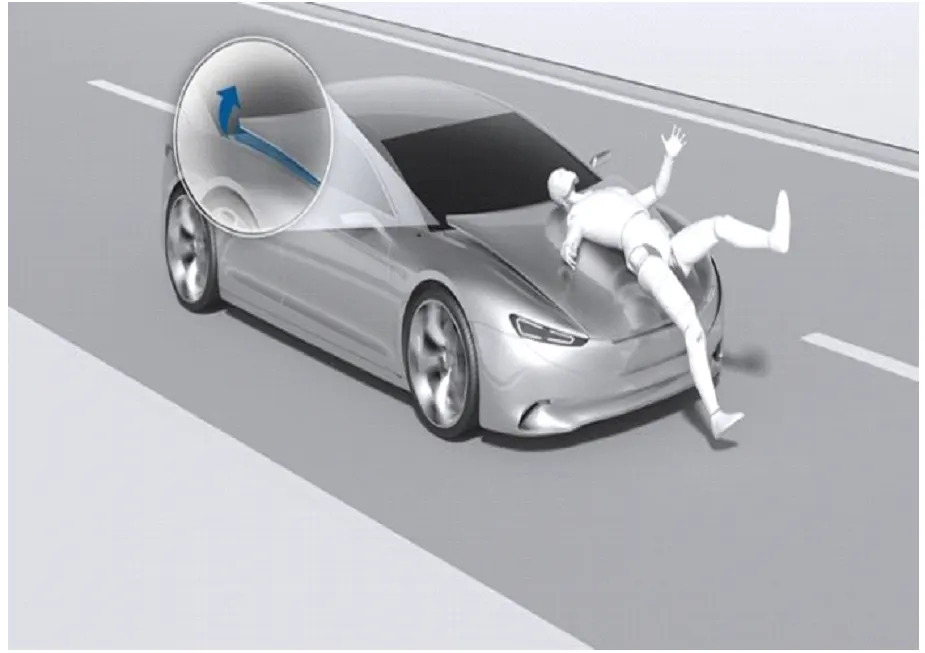
<!-- [if !supportLists]-->• With a constant rise in road accidents, it is high time safety standards are given the center stage. The number of injuries and fatal deaths has increased resulting from street accidents due to the increased urban population and amount associated with private vehicles. So the hood of the car designed in such a way that there is very little damage occurs.
<!-- [if !supportLists]-->• Most pedestrian deaths occur due to traumatic brain injury, resulting from the hard impact of the human head against the vehicle's stiff hood or windshield. Therefore, how to design a pedestrian-friendly vehicle and propose a new hood structure is a matter of urgency for minimizing pedestrian head injuries.
<!-- [if !supportLists]-->• In this study, three kinds of sandwich hood structures are proposed for reducing pedestrian head injuries, including carbon fiber-reinforced polycarbonate, carbon fiber-reinforced foam and aluminium-reinforced polycarbonate. In assessing the friendliness of vehicle hoods, it is most importance that we make sure not to place re-enforcement on the areas prone to high head impact.
<!-- [if !supportLists]-->• Also, the child impact area is designed with lesser thickness than the adult impact area so that in the event of a frontal collision where a child is involved, the bonnet will absorb the impact of the crash and crumble to protect the child’s head from absorbing the force. The hood of most vehicles is usually fabricated from sheet metal, which is a compliant energy absorbing structure which poses a comparatively small threat.
<!-- [if !supportLists]-->• Most serious head injuries occur when there is insufficient clearance between the hood and the stiff underlying engine components. A gap of approximately 10 cm is usually enough to allow the pedestrian’s head to have a controlled deceleration and a significantly reduced risk of death.
 <!-- [if gte mso 9]><xml>
3. Inside safety:-
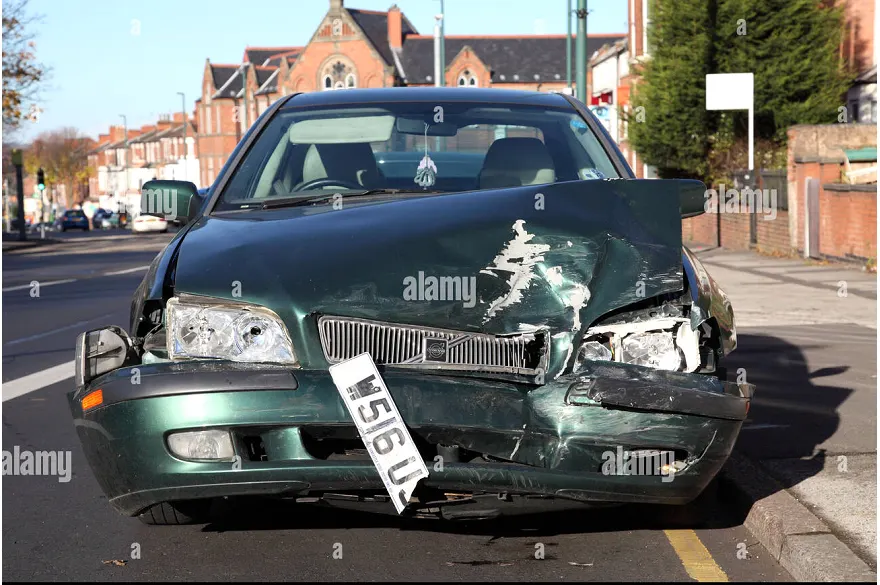
<!-- [if !supportLists]-->• The hood cover is important to protect engine, radiator, battery and other accessories along with this, it helps in keeping the passengers safe inside the car.
<!-- [if !supportLists]-->• This is how, when cars come across any accident from the front portion most of the time the hood system gets damaged and absorbs some part of the impact energy resulting from the crash. In this way it protects the passenger inside the car from several injuries.
<!-- [if gte mso 9]><xml>
3. Aerodynamics :-
<!-- [if !supportLists]-->• Hood is made aerodynamic in shape to reduce air effect and used to decorate the front portion of the car and to add a luxurious look of car.
<!-- [if !supportLists]-->• Bonnets are designed to reduce air resistance as the air flows around the car.
<!-- [if !supportLists]-->• The design of the bonnet is vital since it affects the aerodynamic flow around the car.
<!-- [if !supportLists]-->• <!--[endif]-->Drag reduction in cars is evident by the angle of windscreen inclination. Windscreen inclination affects the height of the vehicle.
<!-- [if !supportLists]-->• The curvature of the windscreen should be optimized in order to avoid the cross-wind effect.
<!-- [if !supportLists]-->• Hood inclination should be optimized for minimum drag.
<!-- [if !supportLists]-->• The angle of windscreen inclination proposed such that it does not affect driver visibility.
<!-- [if !supportLists]-->• <!--[endif]-->It should accumulate the raindrops and dirt effectively.
<!-- [if !supportLists]-->• Windscreen inclination angle selected such that it does not affect the stability due to change in vehicle dimensions.
<!-- [if !supportLists]-->• The windscreen inclination is obtained by taking visibility concerns into account.
3. Reduces engine noise :-
<!-- [if !supportLists]-->• The engine hood, additionally represents an aesthetic component on the engine cover, if it is well designed could be able to reduce noise emissions of the engine, producing a better acoustic comfort on the cabin and a better insulation outside of the engine compartment.
<!-- [if !supportLists]-->• <!--[endif]-->The characterization of acoustic transmission of the engine compartment is performed with an experimental method. The technique was improved with an electroacoustic system including an inverse filtering method. The results on such characterization are achieved with the Sound Transmission Loss technique, (TL) which has been measured in several positions surround the vehicle hood.
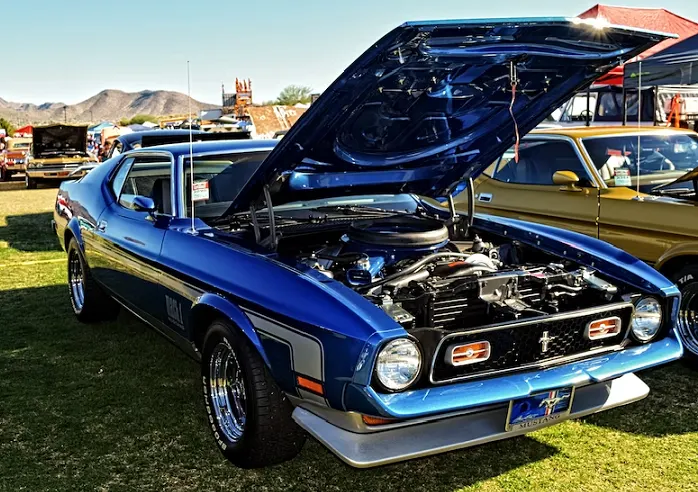
Hood stay study
The movement of the hood can be controlled by some device or apparatus and this apparatus used to rest the hood in an open state. This is important because while working on front compartment like engine, the external force is abruptly generated due to vibration and wind. So, it is important to keep hood in open state. It also allows access to the engine and its components for maintenance and repairs work. As Hood stay is done by
1. Gas stay
2. Support rod
1. Gas stay :-
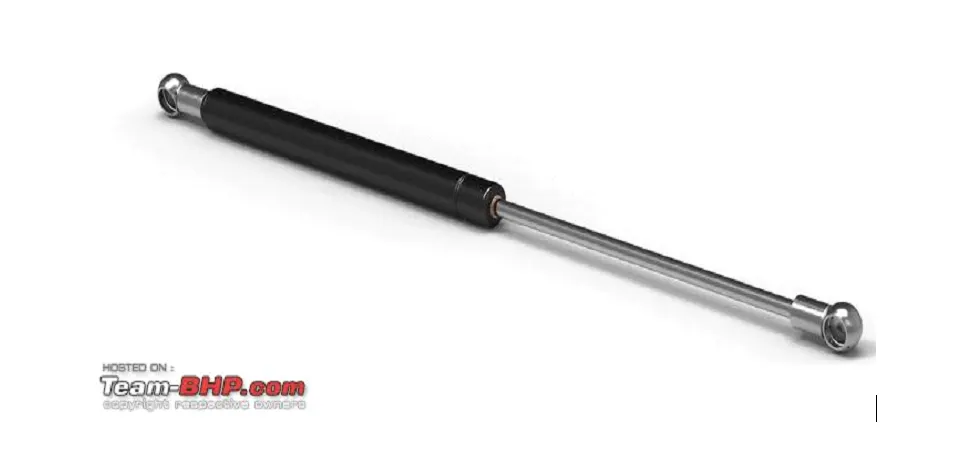
<!-- [if !supportLists]-->• <!--[endif]-->A gas stay is a type of spring that, unlike a typical mechanical spring that relies on elastic deformation, uses compressed gas contained within an enclosed cylinder sealed by a sliding piston to pneumatically store potential energy and withstand external force applied parallel to the direction of the piston shaft.
<!-- [if !supportLists]-->• Luxury carmakers provide a gas stay to lift the hood and hold it in place. It takes minimum efforts to lift. Gas struts work by compressing the gas within a cylinder.
<!-- [if !supportLists]-->• The compressed air causes pressure to build on one side of the piston and decrease on the other, creating movement in an arc-like motion.
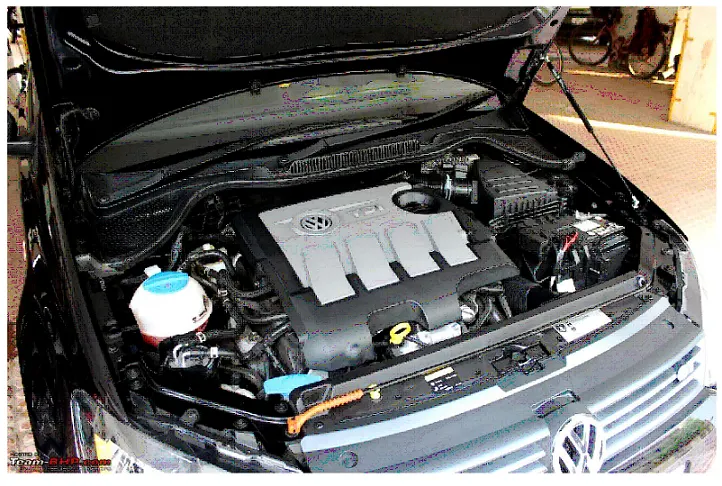
<!-- [if !supportLists]-->• It is not very hard to retrofit a gas strut in the engine bay to lift the hood of the car. All we need is a gas strut of a required force rating that can push the hood (the force rating is primarily determined on the basis of the weight of the hood) and the stroke length (which determines how high can the hood be held) and 2 clamps which will be mounted to the existing holes in the structure.
<!-- [if gte mso 9]><xml>
<!-- [if gte mso 9]><xml>
2. Support rod:-
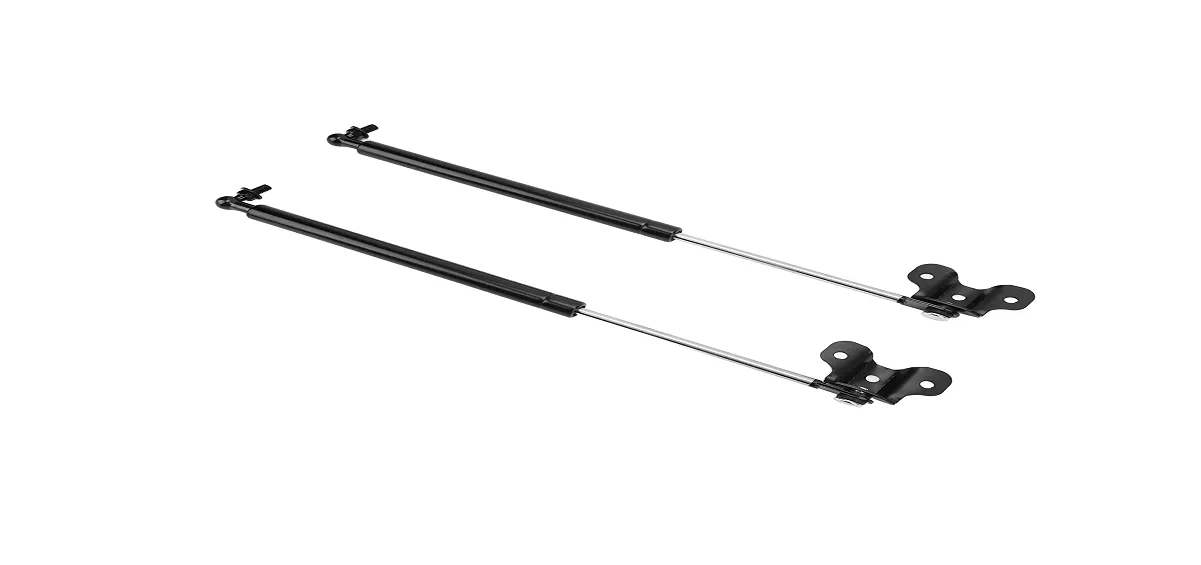
<!-- [if !supportLists]-->• This is the most commonly used rod for opening and closing the hood at a certain angle and also used to fix the hood in opening condition.
<!-- [if !supportLists]-->• The length of the support rod is predefined to open the hood. So, that the hood opening can be varied.
<!-- [if !supportLists]-->• Support rod will always be placed opposite side of the battery’s position. So that it doesn't interfere with rod.
<!-- [if !supportLists]-->• One end of the rod is hinged to the engine compartment and the other end is set free so that it can be locked to the hood inner panel when the hood is opened. This is usually used when the weight of the bonnet is small.
<!-- [if gte mso 9]><xml>
<!-- [if gte mso 9]><xml>
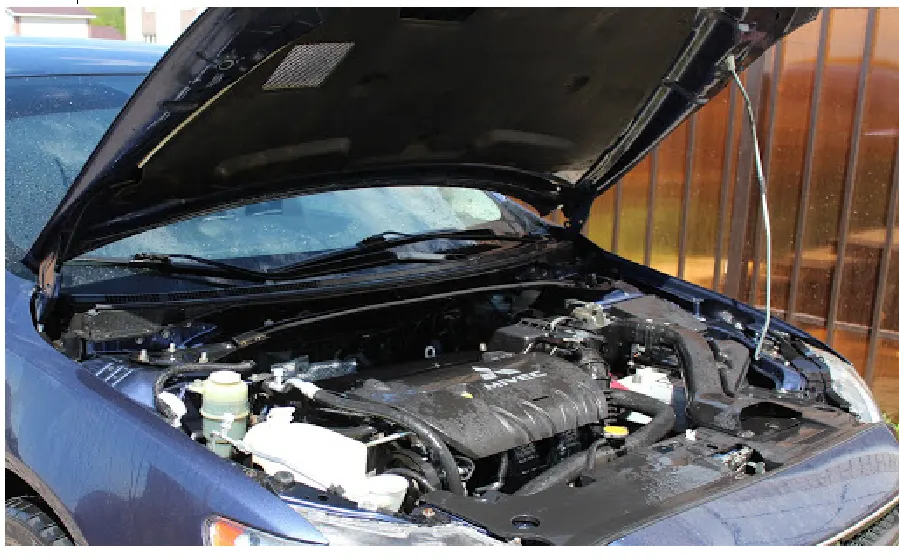
Hood Design consideration
The hood of a car is considered as the frontal BIW enclosure component. Bonnets are designed to reduce air resistance as the air flows around the car. A part from this bonnets are also designed to meet several other requirements. They serve a great deal of purpose in protecting the passengers inside the car and the pedestrians in the event of an accident. It also acts as the cover for the engine.
The hood or bonnet is the hinged cover over the engine of motor vehicles. Hoods can open to allow access to the engine compartment or trunk on rear engine and some mid-engine vehicles for maintenance and repair. Generally, the passenger car hood may be held down by cancelled latch. But in a race car or car in aftermarket, the hood may be held down hoods pin.
Hoods sometimes also contain a hood scoop, wiper jets, power bulge, o hood ornament. Car hoods are typically constructed from steel and sometimes from aluminium. Aftermarket car hood can be formed from other materials, including carbon fiber, fiberglass or dry carbon. The hood may vary from one make and model to another SUV. The hood is also designed for several requirements. A car hood is meant to protect the performance part of your vehicle, including the engine, while also providing easy access for repairs and maintenance.
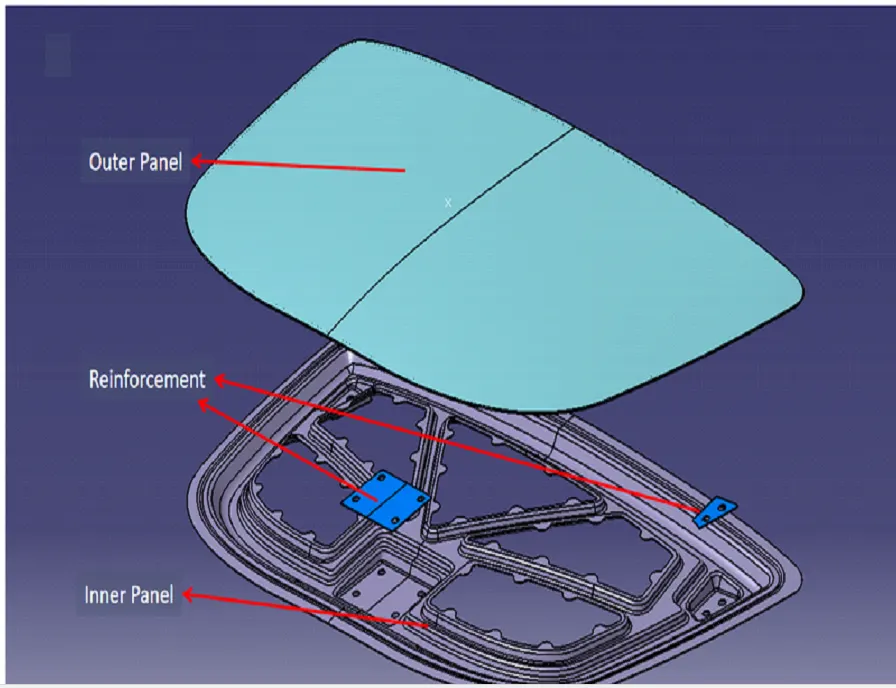
Following parts are using in hood assembly for this report
<!-- [if !supportLists]-->• <!--[endif]-->Hood outer panel
<!-- [if !supportLists]-->• <!--[endif]-->Hood inner panel
<!-- [if !supportLists]-->• <!--[endif]-->Hinge assembly
<!-- [if !supportLists]-->• <!--[endif]-->Striker assembly
Hood thickness
Outer panel thickness = 0.77mm
Inner panel thickness = 0.75mm
Reinforcement thickness = 1.5mm
Give a relief at the corners with a 3mm
<!-- [if gte mso 9]><xml>
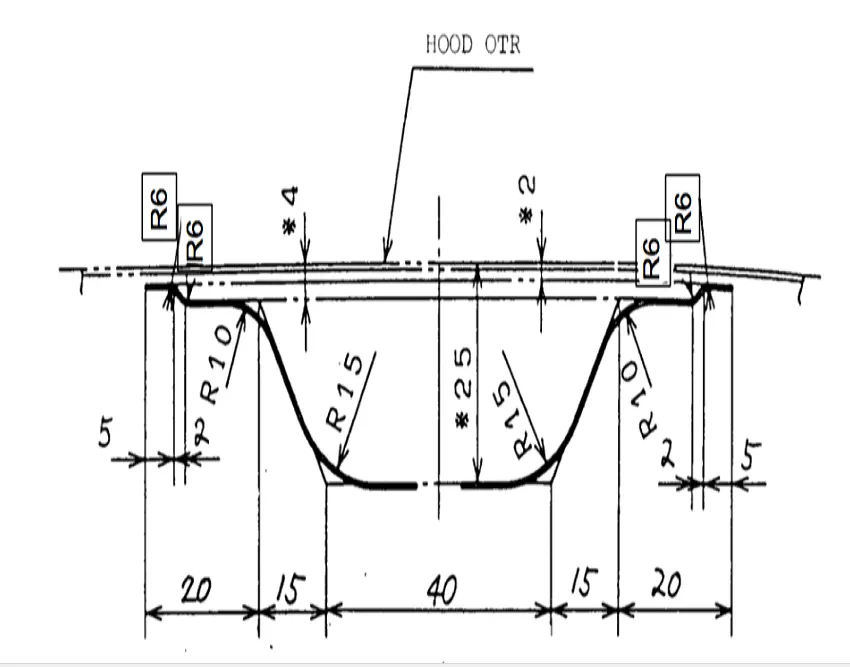
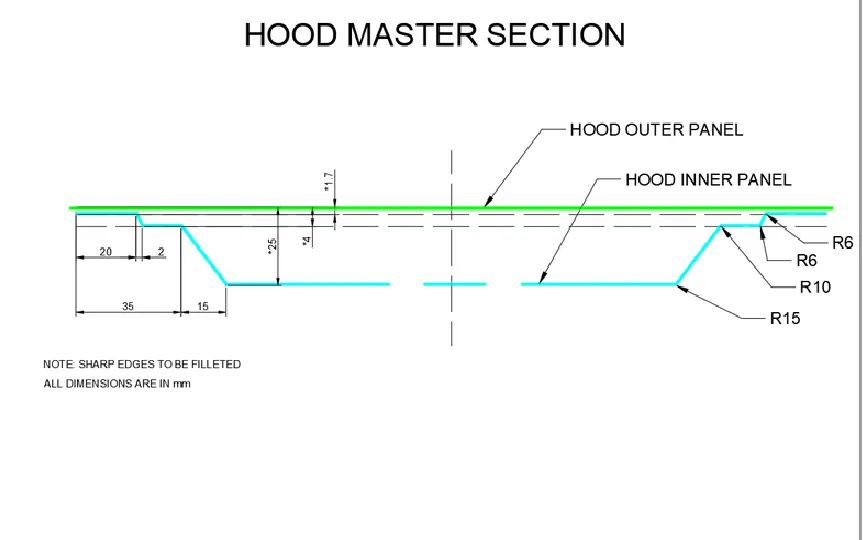
Hood master section
The master section is generally created is based on requirement from marketability team and this is done by taking all consideration that we saw before. The master section is predefined. The master section is little bit changes although same for all. The Hood master section is shown by image below here. Where all dimension is clear by this image.
<!-- [if gte mso 9]><xml>
<!-- [if gte mso 9]><xml>
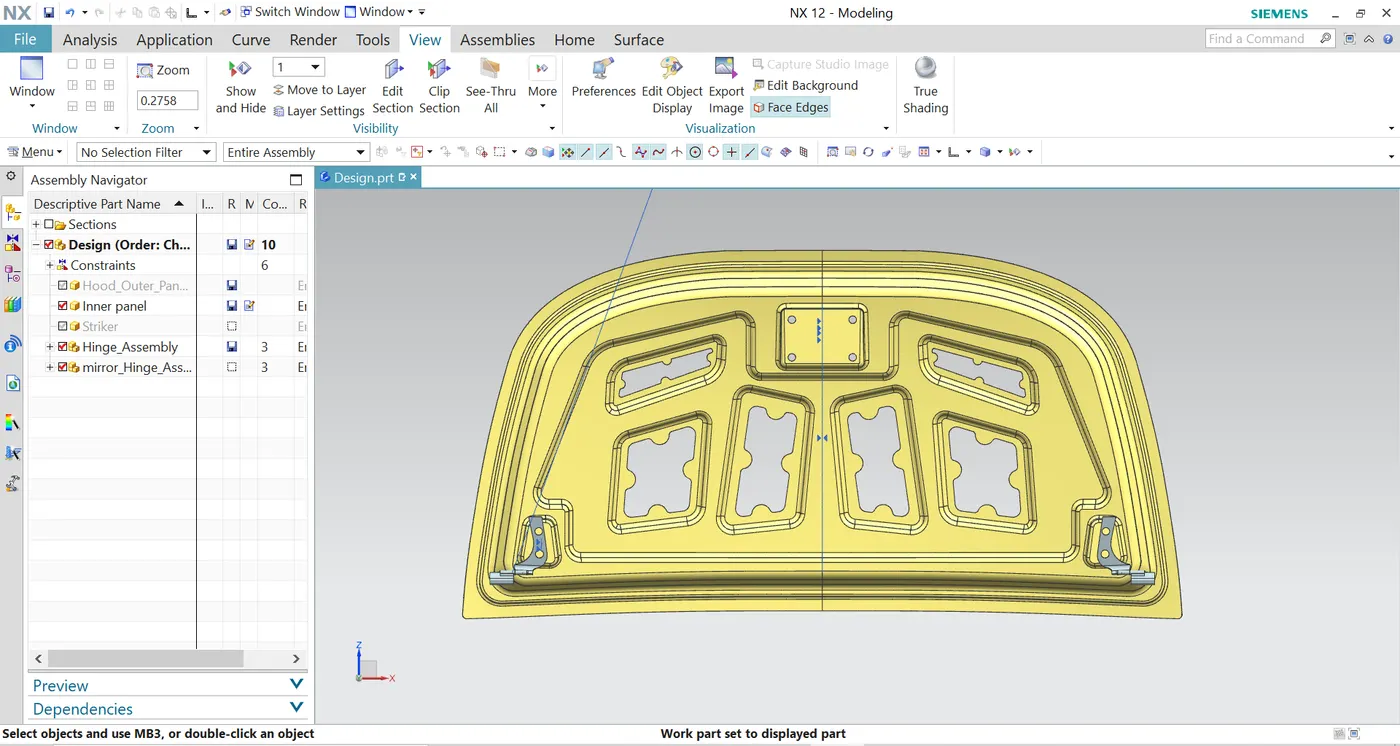
Inner panel
<!-- [if !supportLists]-->• <!--[endif]-->In the inner panel only we can research and implement the safety of pedestrians and as well as the driver. In this panel only we can attach the reinforcement, embossed, mastic points etc.
<!-- [if !supportLists]-->• It is an object of the present invention to provide a hood inner panel capable of reduction of a reaction of the hood inner panel even if a level of deformation of a good of a vehicle increases and ensuring a sufficient energy absorption capacity.
<!-- [if !supportLists]-->• Inner panel is the major part that ensures the rigidity of the hood and it is used to diverts the impact to outward of the hood however possible when the collision occurs. It can be achieved by the good inner panel design and the emboss direction in the inner panel.
<!-- [if !supportLists]-->• <!--[endif]-->Lot of design changes and researches are done and being carried out in the inner panel only to achieve the pedestrian safety and the passenger safety to make the standards.
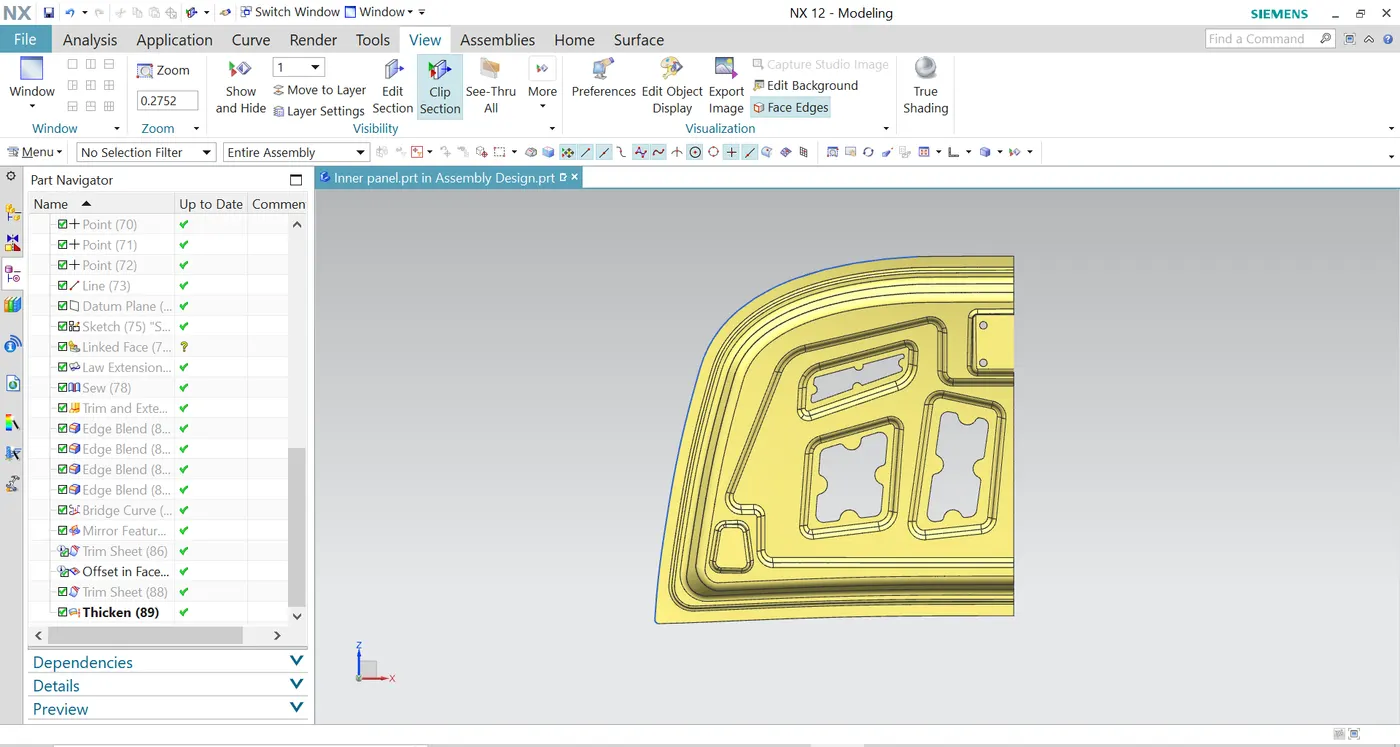
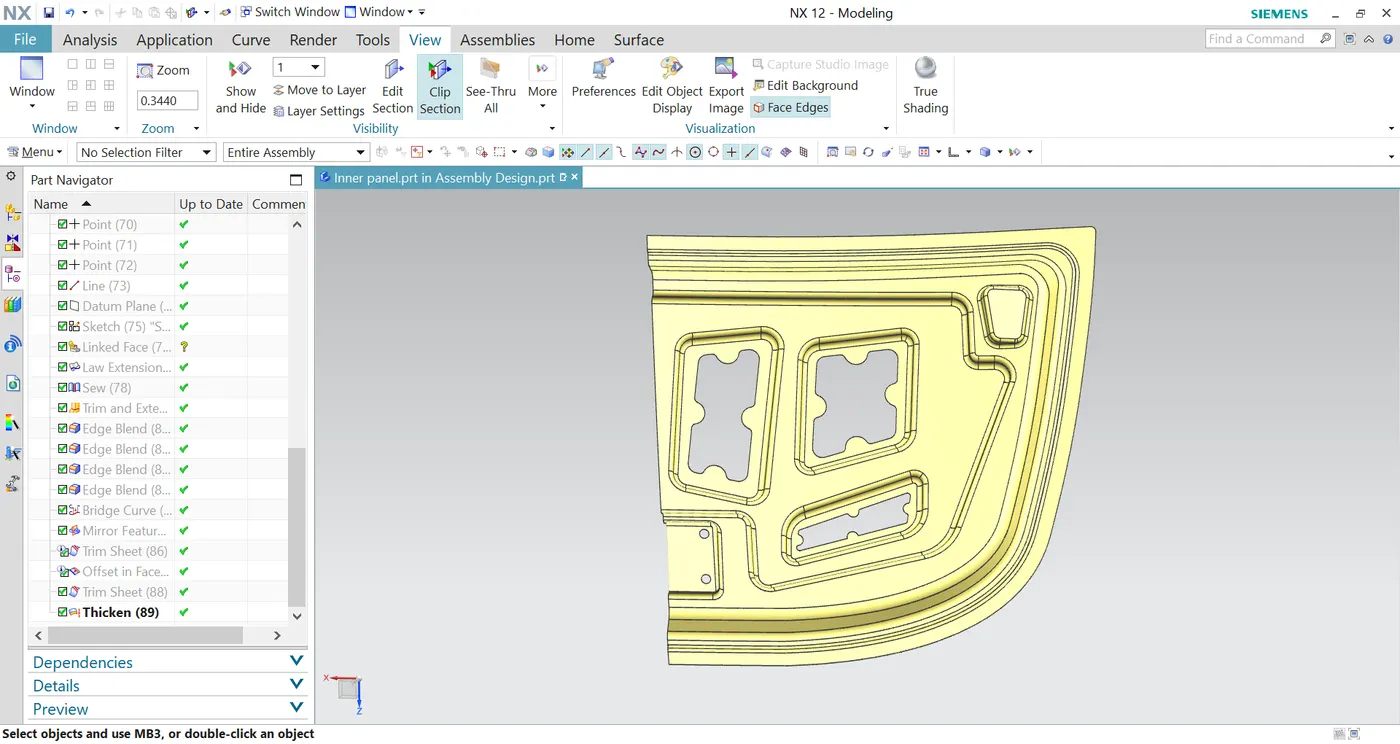
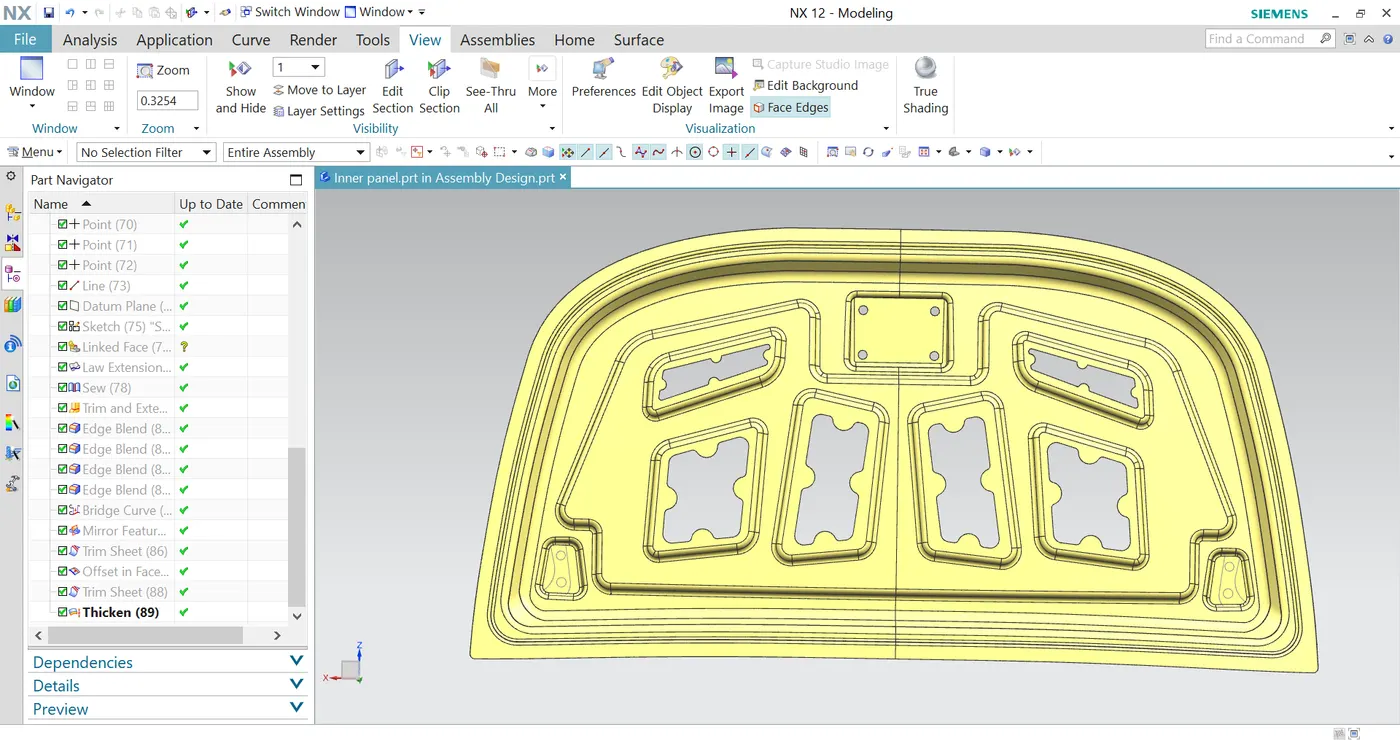
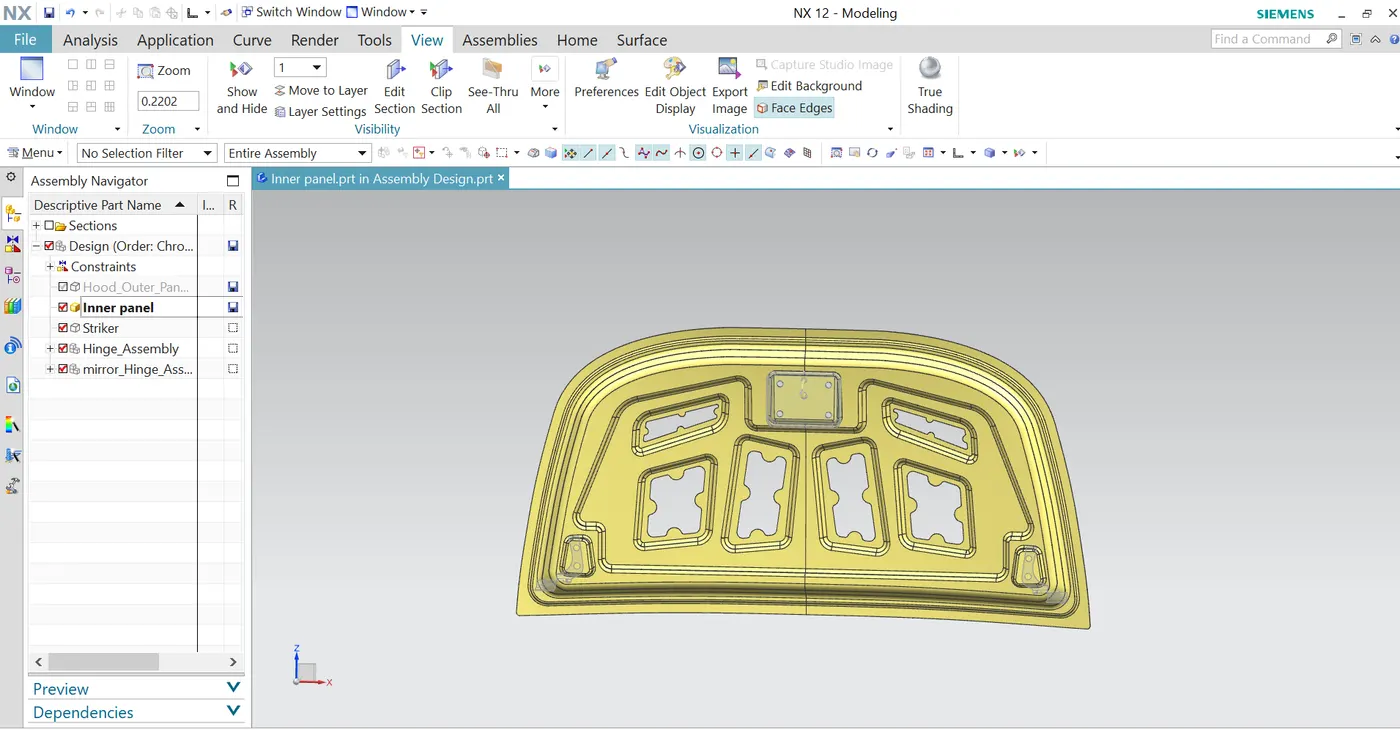
<!-- [if !supportLists]-->• By considering the given inner panel thickness(0.75) and offsetting the outer panel styling surface with the given offset data, the inner panel has been made with the embosses and mastic paints as below,
Outer panel
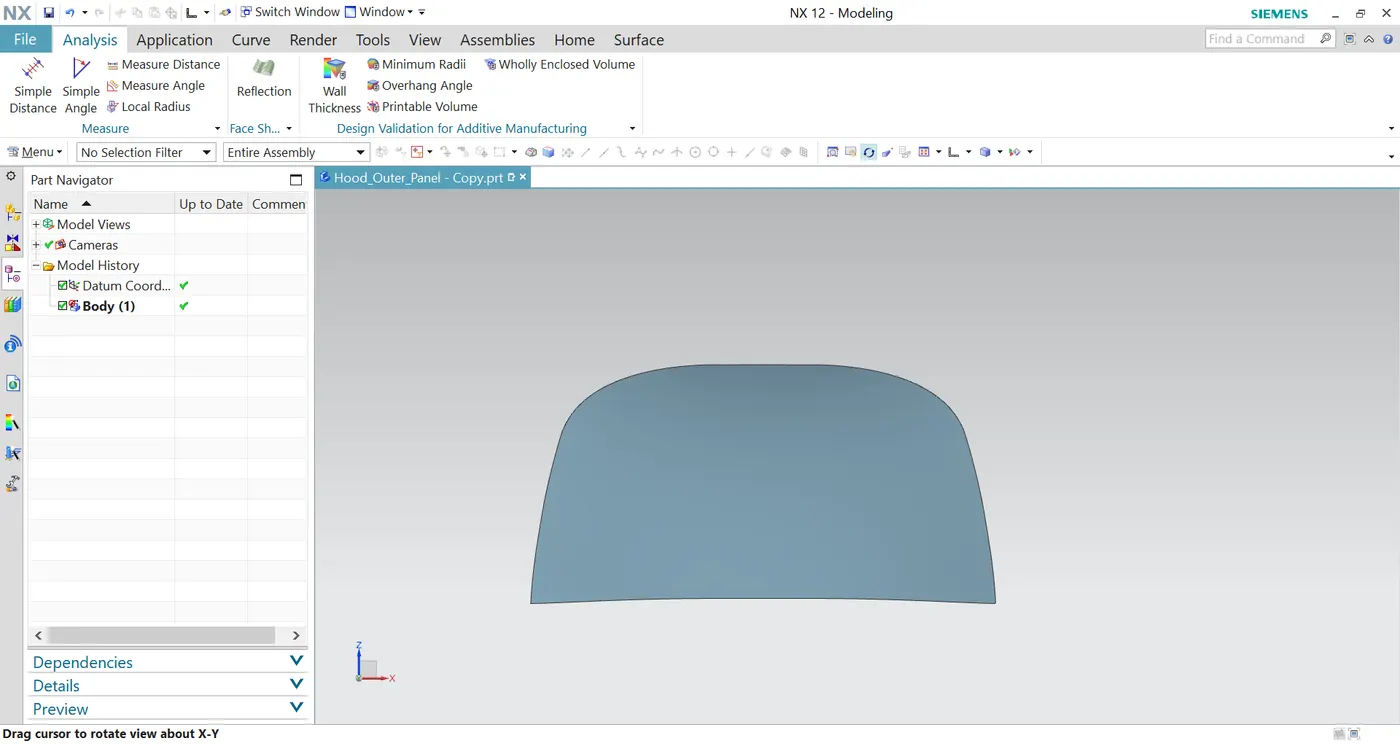
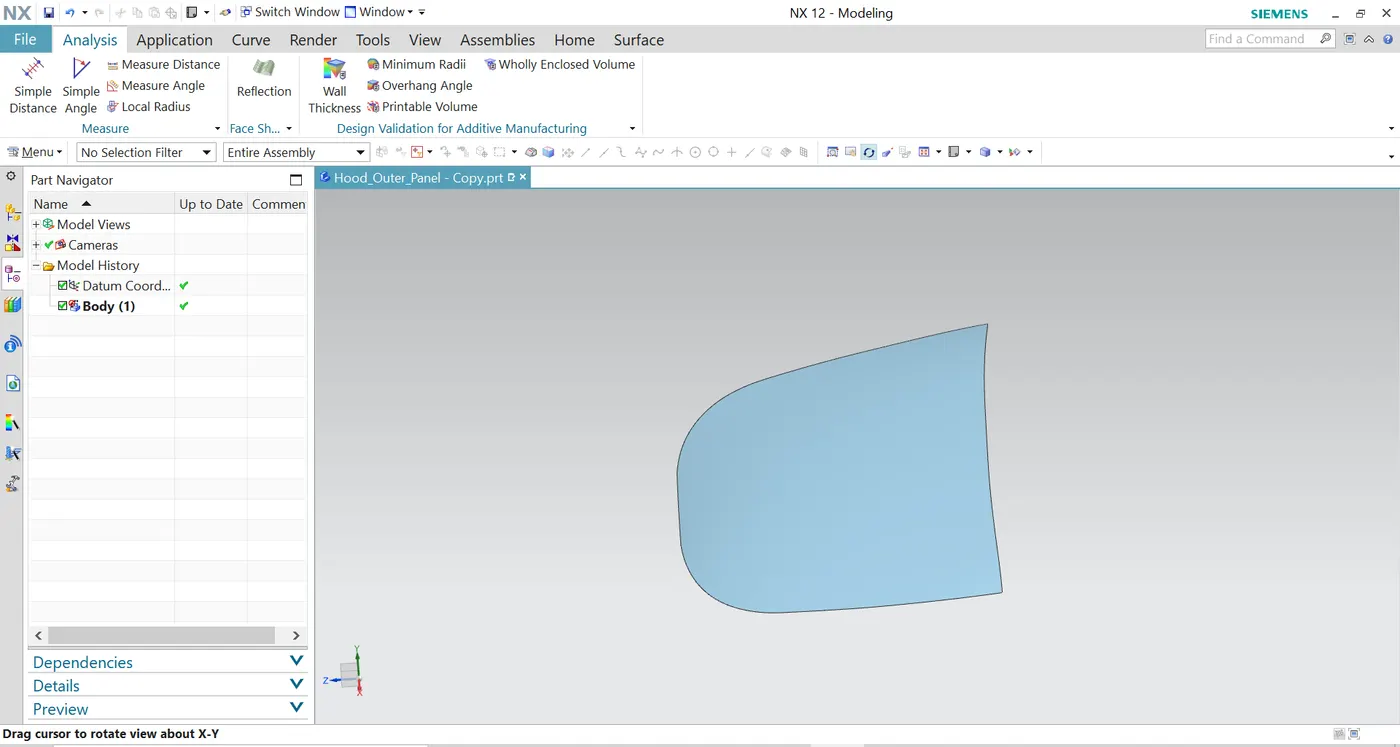
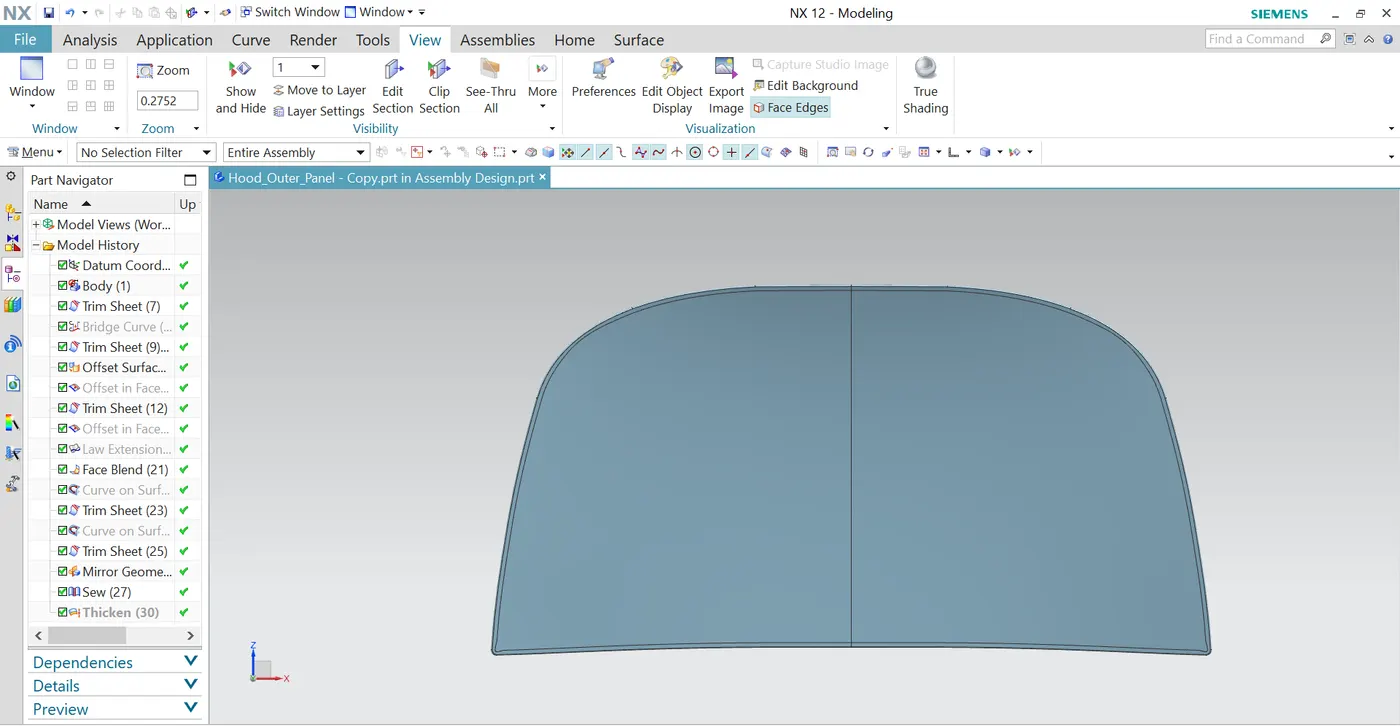
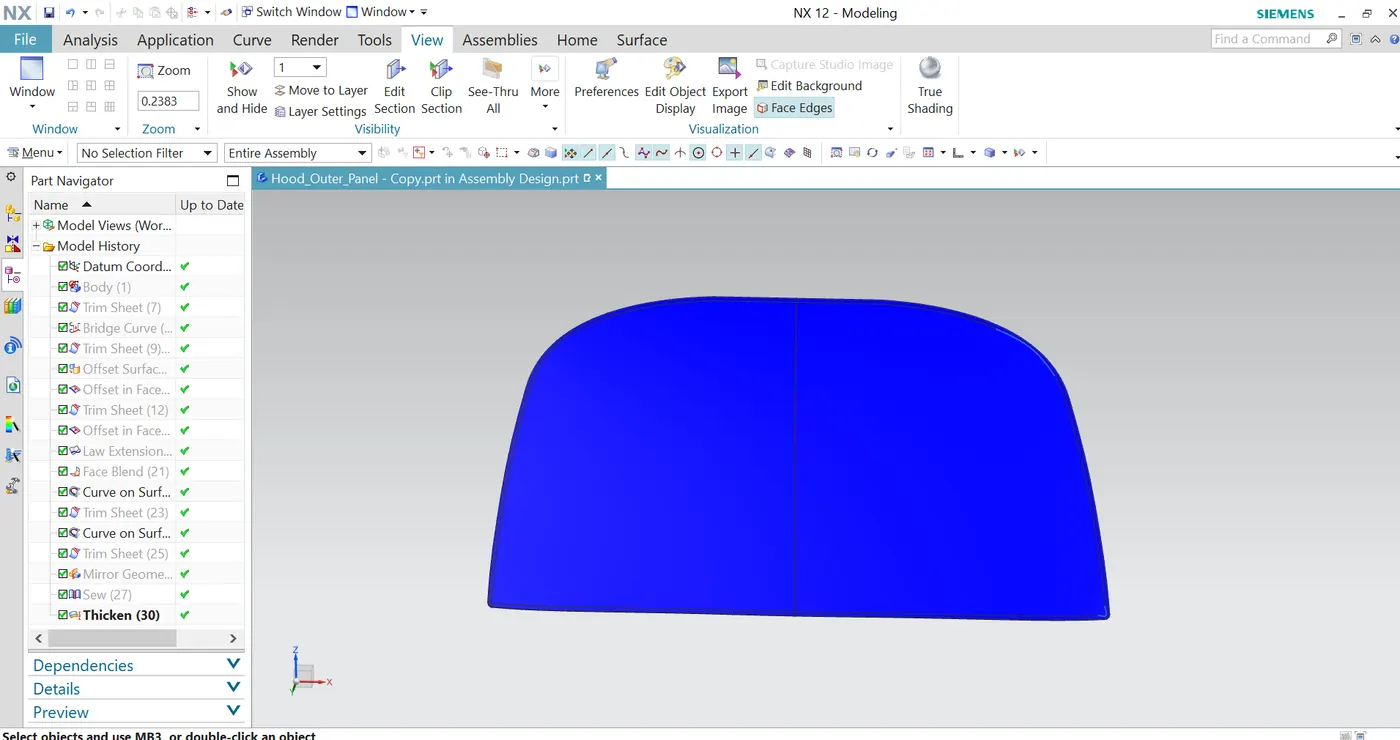
<!-- [if !supportLists]-->• A car hood panel is one of the most important components of the BIW. It is considered the closure sheet metal component. The outer panel has the esthetic look to it but it’s own is very weak and not capable of handling during force.
<!-- [if !supportLists]-->• We can also call it as cover of inner panel. It is the part, which gives luxurious look to the hood or bonnet. Outer and inner panel cannot join by any welding process like spot welding or rivet, which spoil the outer look of a car. The outer panel is generally extracted model from the prototype design.
<!-- [if !supportLists]-->• Outer panel is the most important part of the hood to make the car in avery good aesthetic proportion. So that the outer panel is perfectly made incense to achieve the aesthetic requirement. So that, the sheet metal operation result which is visible on the outer panel or it reduces the aesthetic value means, those operation are strictly not to be followed to make the outer panel, That’s why the hemming process is used to join the outer panel with the inner panel, instead of using welding methods.
<!-- [if !supportLists]-->• By considering the given outer panel thickness(0.75) and using the outer panel styling surface the outer panel has been made as below,
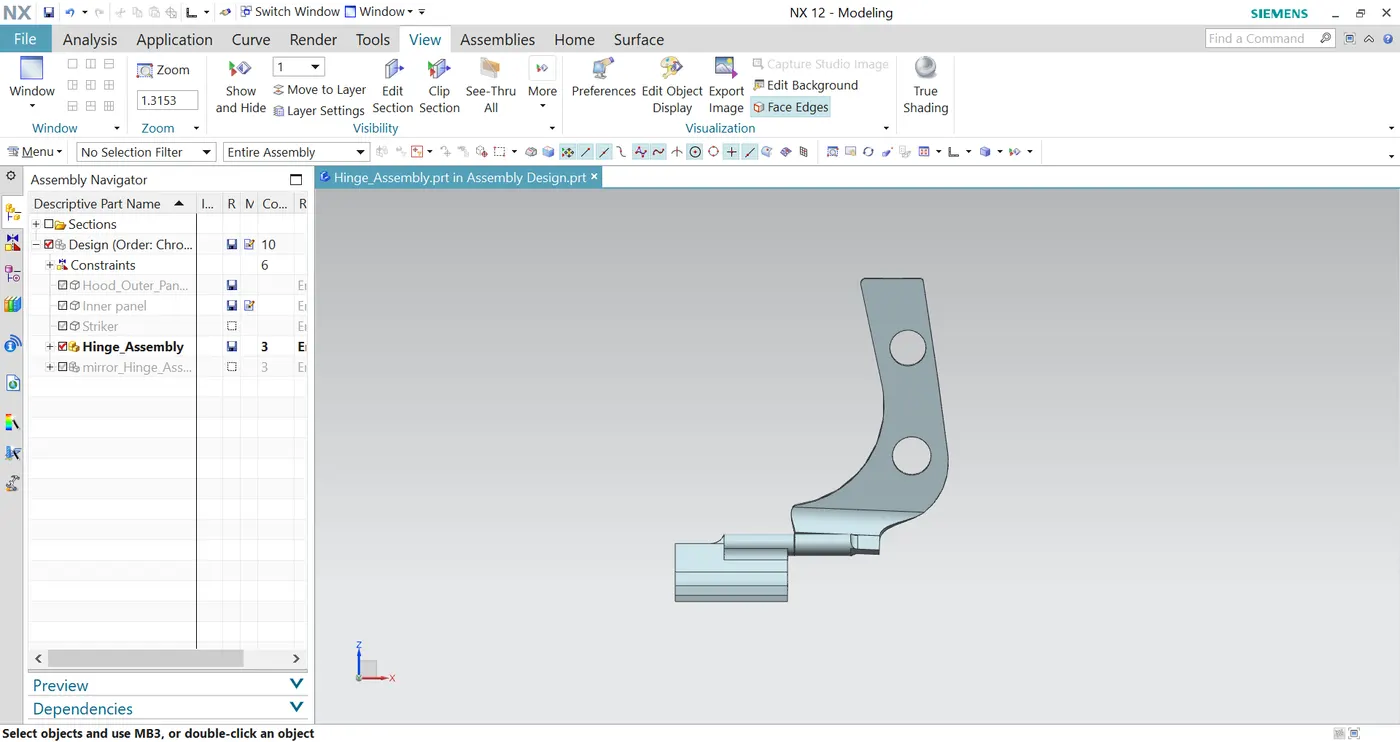
Hinge assembly
<!-- [if !supportLists]-->· The hinge was placed on the hood to give rollover action to tilt or tilt down the hood.
<!-- [if !supportLists]-->· It is used to fix the hood to the engine compartment.
<!-- [if !supportLists]-->· <!--[endif]-->For any component has to be open and close with an axis, then hinge plays a major role. It has two simple parts (one is hood side hinge, another one is engine compartment side hinge) and assembled with the single axis.
<!-- [if !supportLists]-->· Hinge assembly is attached at the each outwards end of the hood and the engine compartment.
Striker assembly
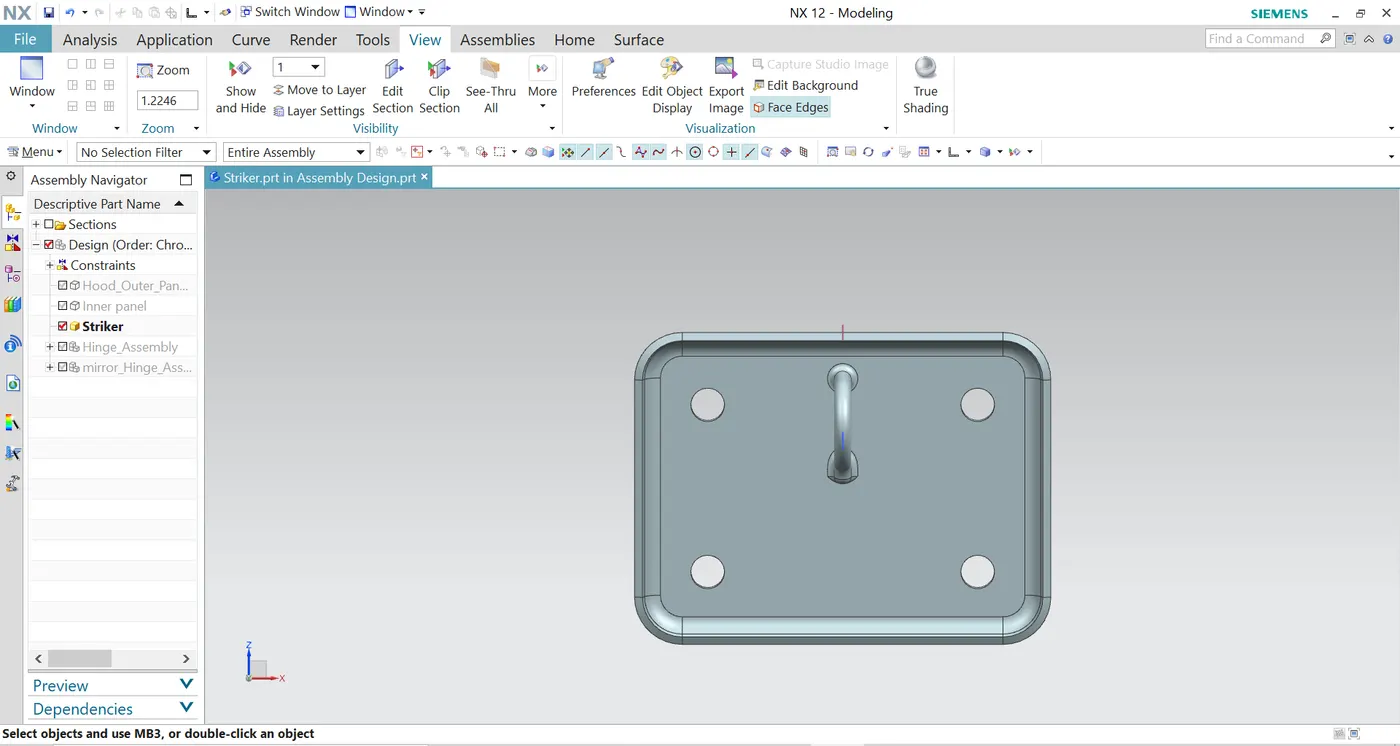
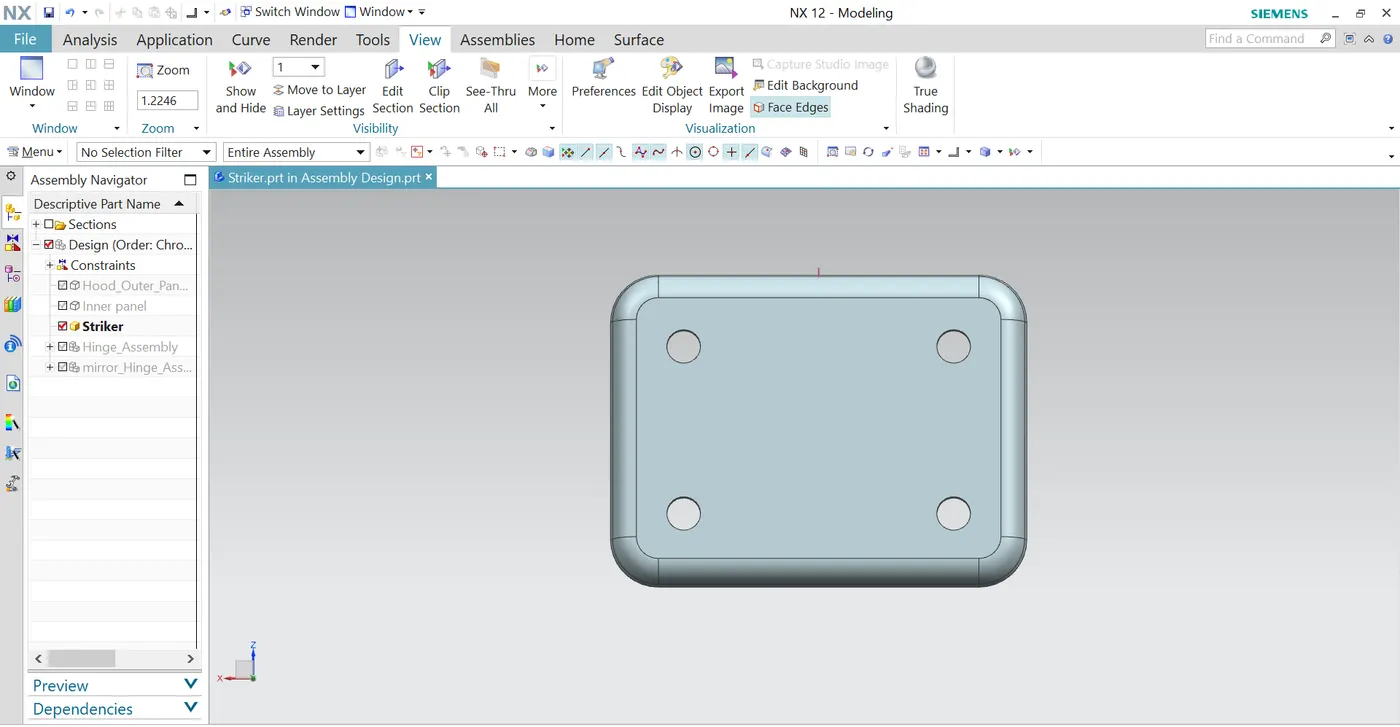
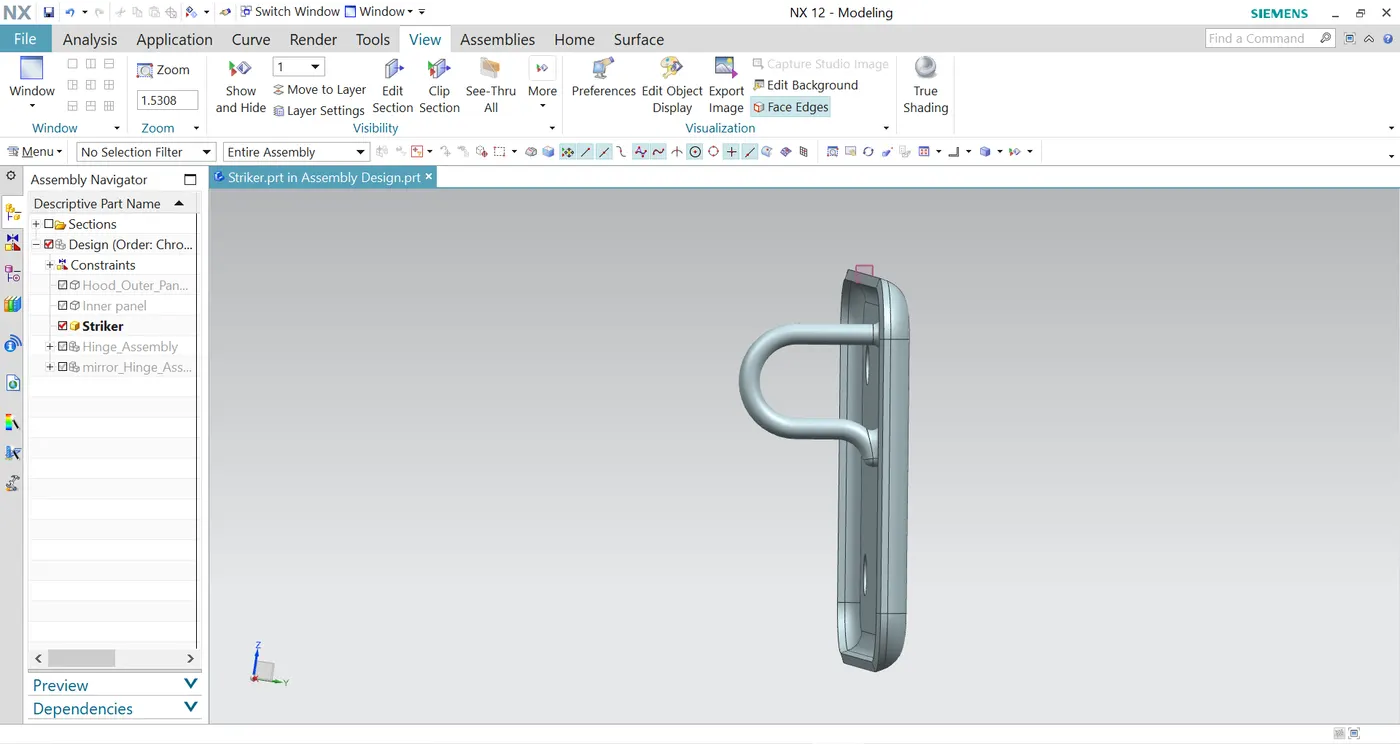
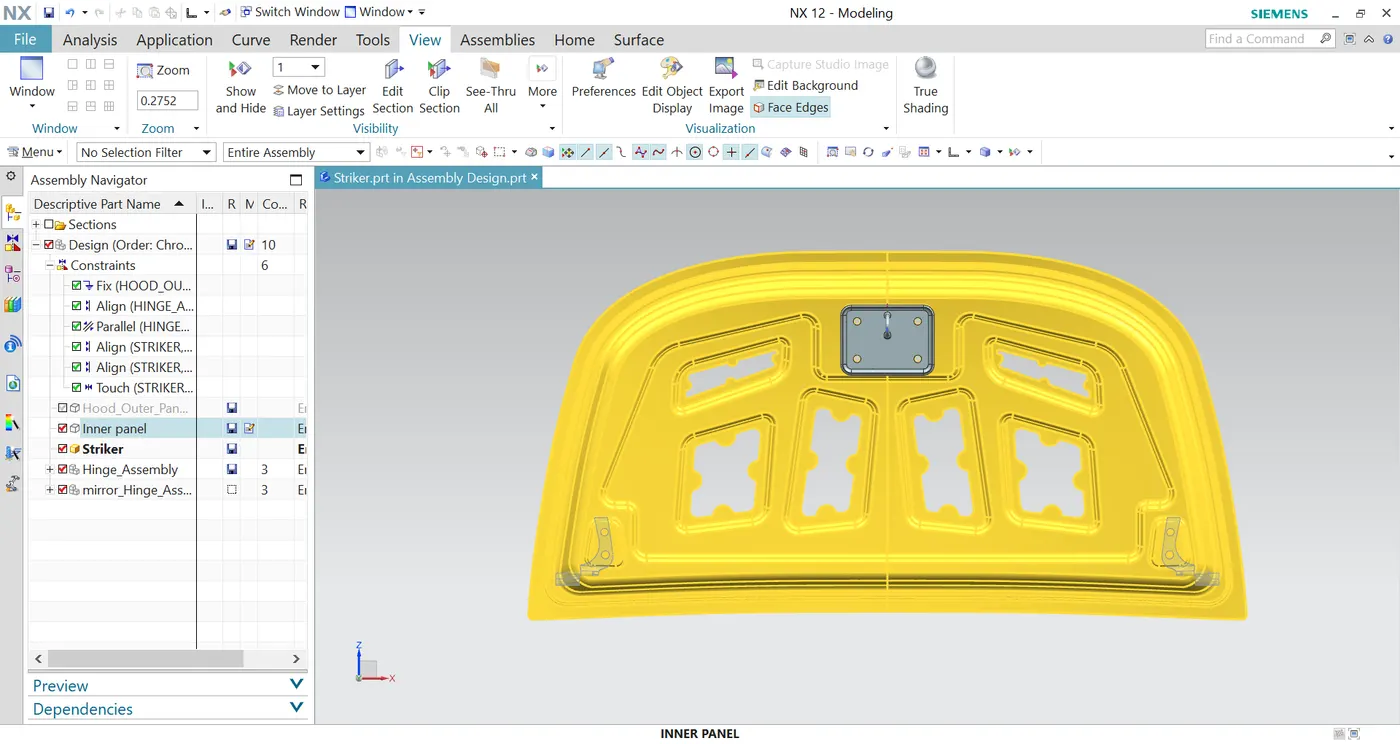
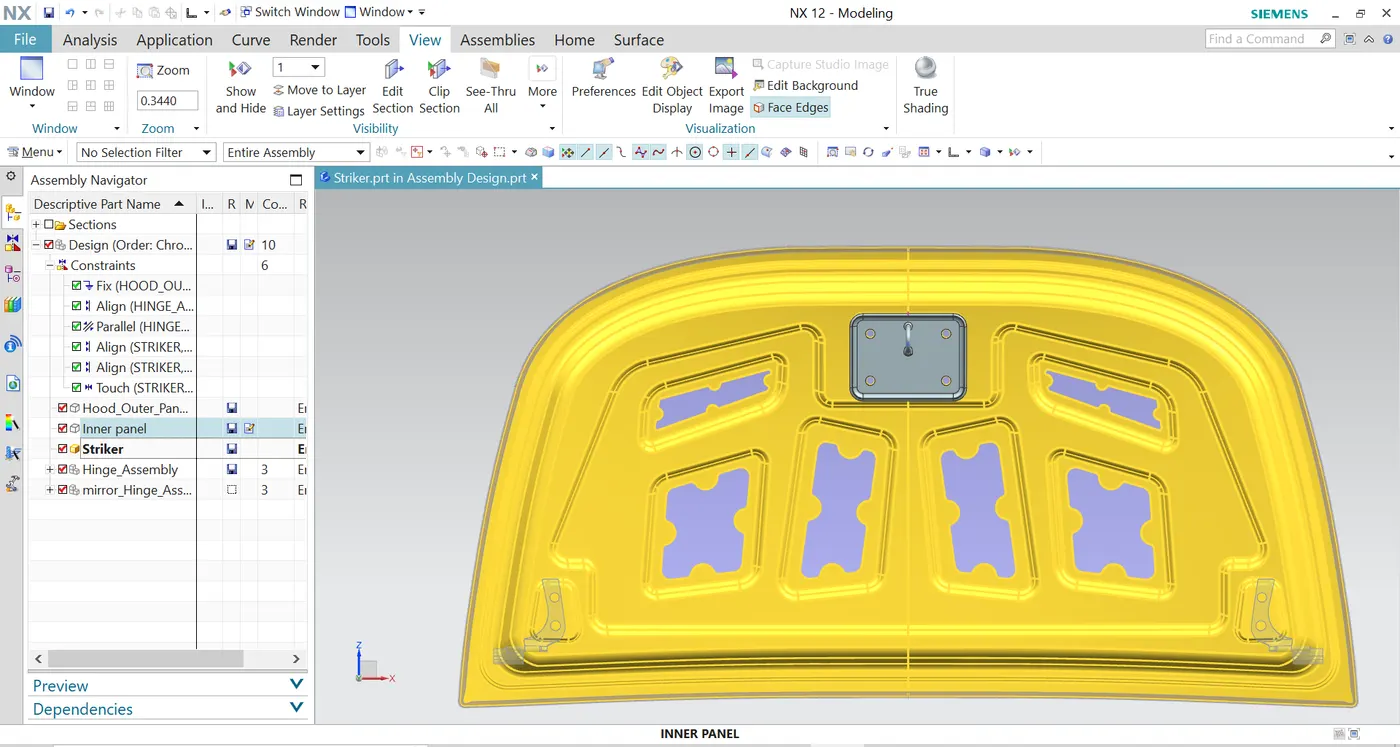
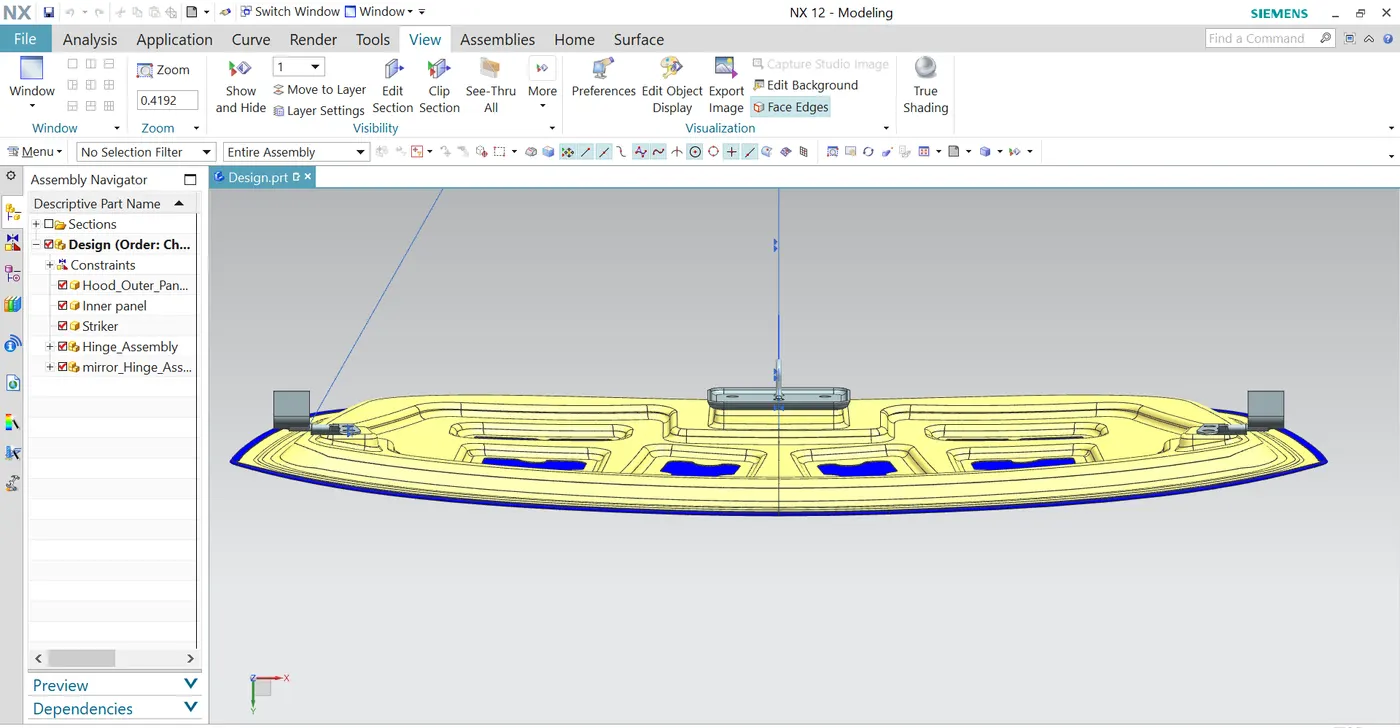
<!-- [if !supportLists]-->· Latch and striker is used for locking the hood with the car. It is usually placed on the space provided on the inner panel.
<!-- [if !supportLists]-->· The attachment of striker to the inner panel of the hood is done by following the certain steps.
<!-- [if !supportLists]-->· <!--[endif]-->For that initially the hinge is roughly attached/ assembled to the each outwards end of the inner panel through the hinge reinforcement. Then a line is created along the axis of the two hinges.
<!-- [if !supportLists]-->· A circle is created at the midpoint of that line and another line is created tangent to this circle and the reference line has created within the circle with particular angle. After that based on the required striker position the circle diameter and the line angle has been changed. Also an another line has been created parallel to the striker hook from the striking point of the striker.
<!-- [if !supportLists]-->· <!--[endif]-->Then the assemble the both lines and striker to the inner panel through striker reinforcement using the assembly constraints.
The process involved in designing hood as a sheet metal operation is
<!-- [if !supportLists]-->• <!--[endif]-->Blanking
<!-- [if !supportLists]-->• <!--[endif]-->Hemming
<!-- [if !supportLists]-->• <!--[endif]-->Punch cutting or piercing
<!-- [if !supportLists]-->• <!--[endif]-->Deep drawing
<!-- [if !supportLists]-->• <!--[endif]-->Embossing
Blanking
Blanking is a shearing process in which punch or die are used to produced parts from coil or sheet stock. Blanking produces the outside features of the component, while piercing produces internal holes or shapes. The web is created after multiple components have been produced and is considered scrap material. In blanking, the piece is cut off from the sheet, and it becomes a finished part.
Hemming
<!-- [if !supportLists]-->• <!--[endif]-->Hemming in automotive manufacturing is a cold process of joining an inner and outer panel by folding the flanges of the outer panel onto the inner panel, permanently clamping the inner panel in place. This process is used in the manufacture of doors, hoods, and deck lids and can be accomplished using a traditional press or with a robotically controlled roller.
<!-- [if !supportLists]-->• <!--[endif]-->Roll hemming is carried out incrementally with a hemming roller. An industrial robot guides the hemming roller & forms the flange. Roll hemming operation cal also be divided into several pre-hemming & final hemming process steps.
<!-- [if !supportLists]-->• Conventional die hemming is suitable for mass production. In die hemming, the flange is folded over the entire length with a hemming tool. Normally the actual hemming is a result of a forming operation in which the flange is formed with a hemming tool after the drawing & trimming operations have been completed.
<!-- [if !supportLists]-->• Hemming is used to fixed the parts together. It can be done by the edges of one part is to be folded over the other part to fix within it. This operation is done by using the roller.
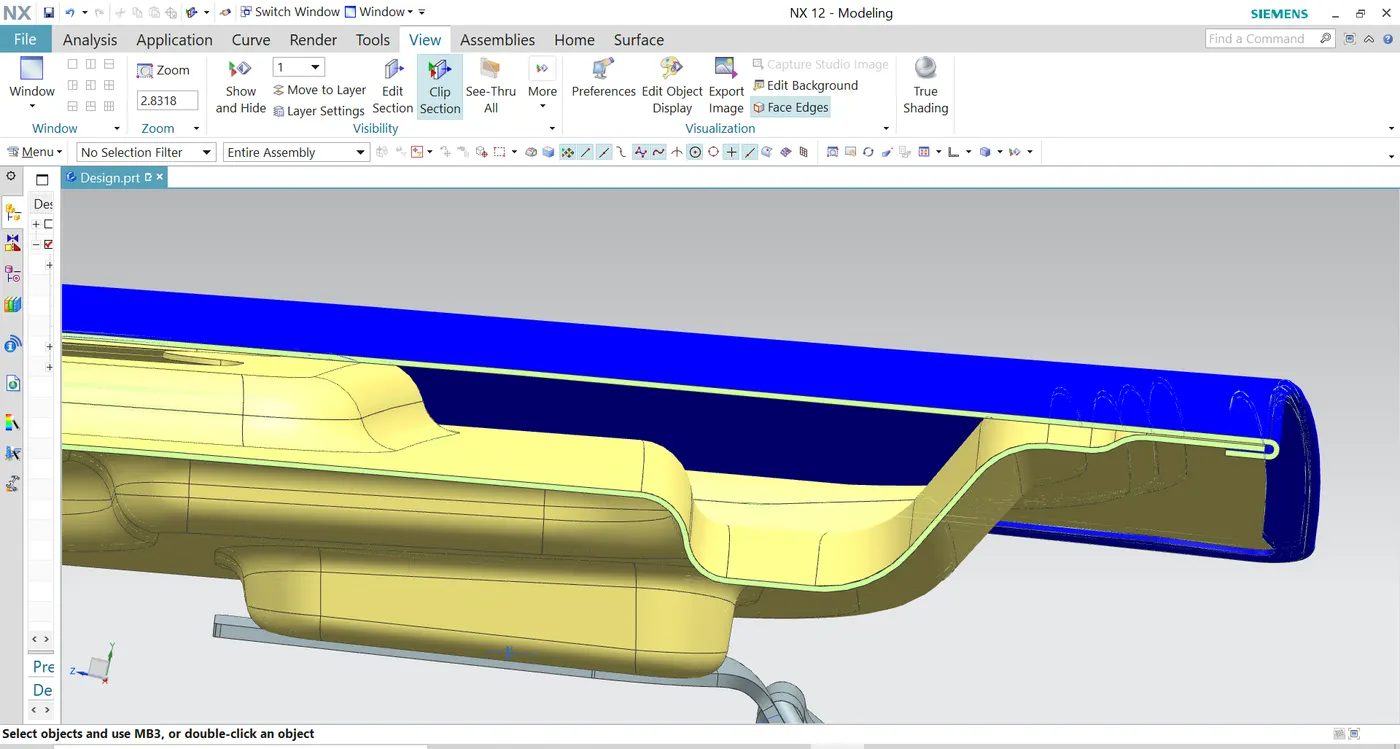
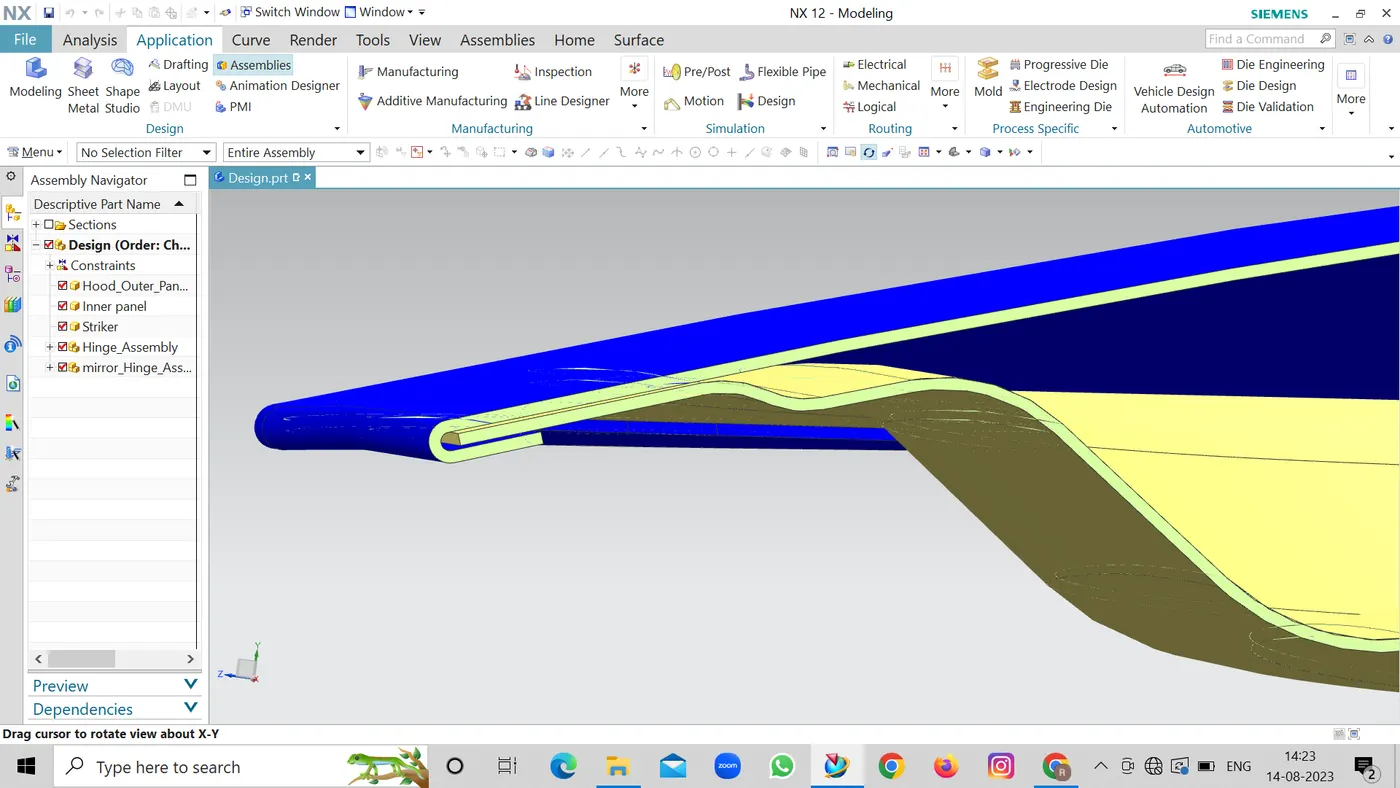
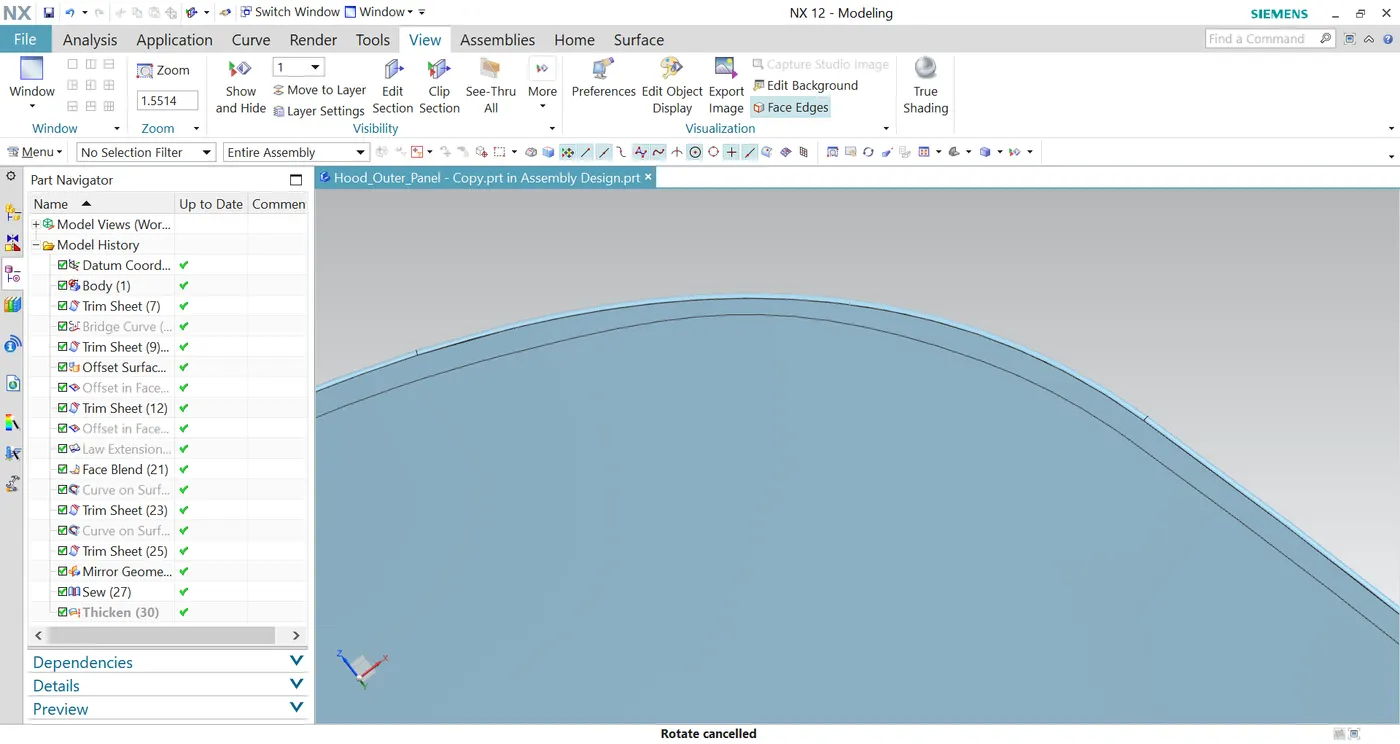
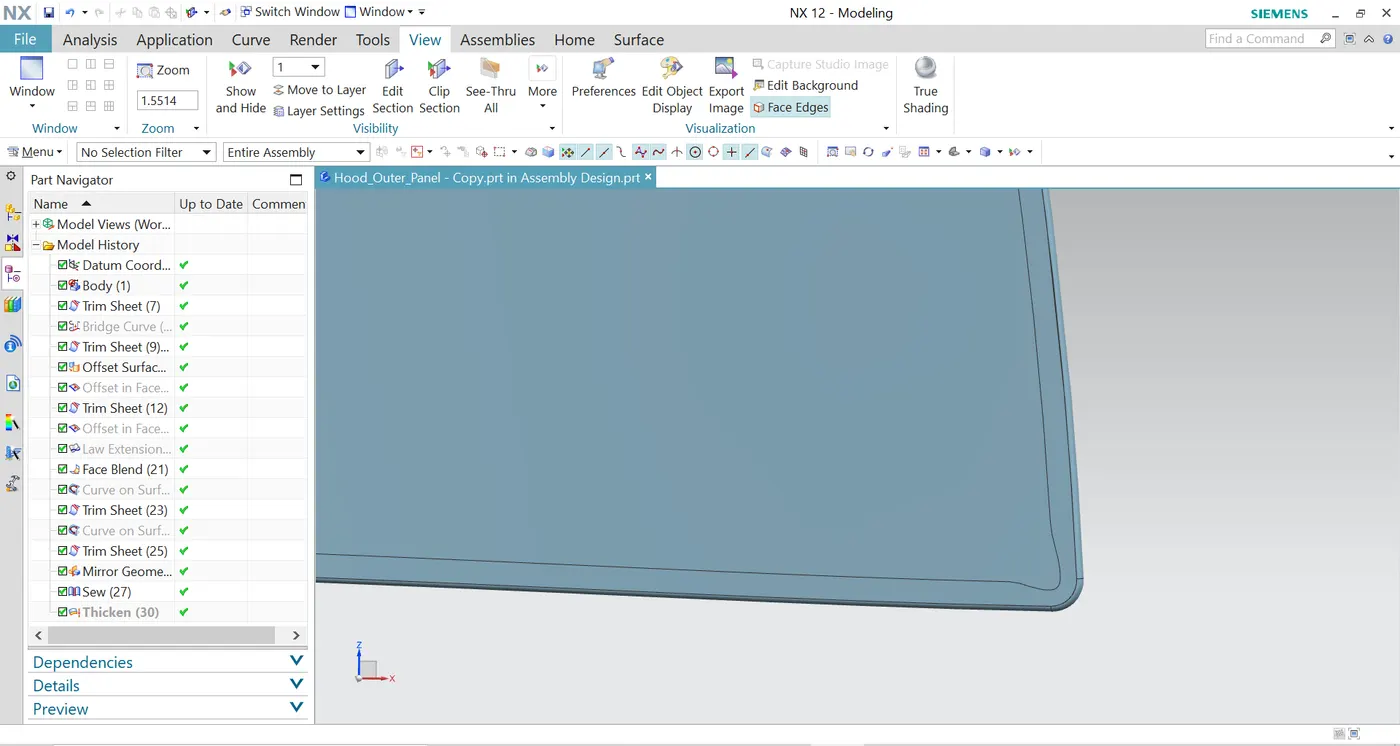
<!-- [if !supportLists]-->• <!--[endif]-->In hood our panel is subjected to the hemming operation which means that the outer panel edges is folded and roll it back to the underneath of the inner panel. The corner of the outer panel edge has to be trimmed, because while hemming process the roller transfer pressure to the outer panel edge to fold it and roll it back, so that it may cause the problem that the sheet metal may break.
Deep drawing
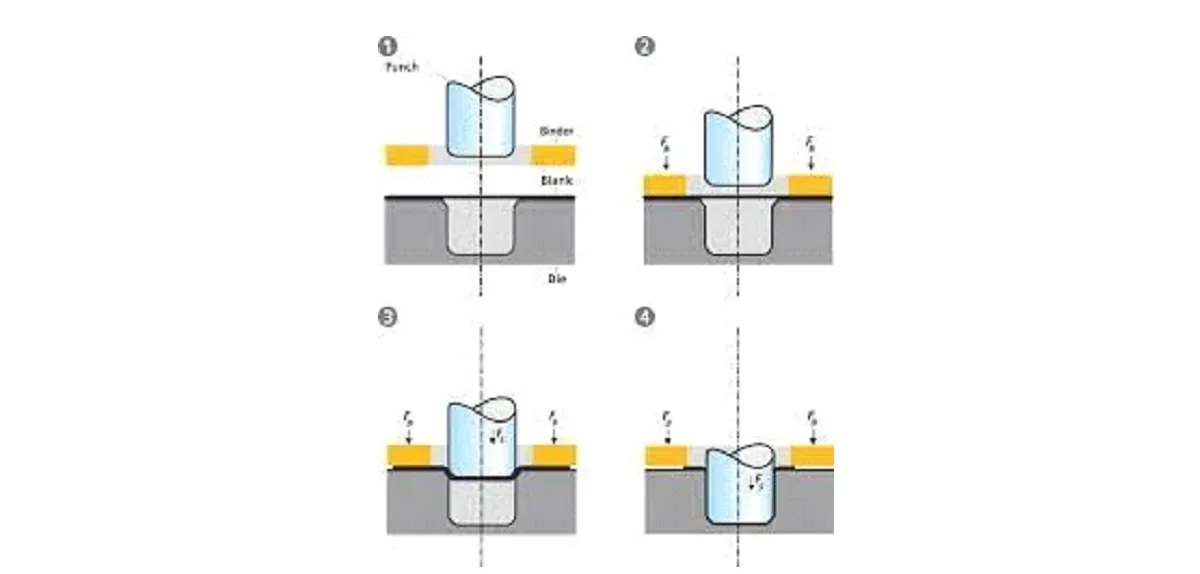
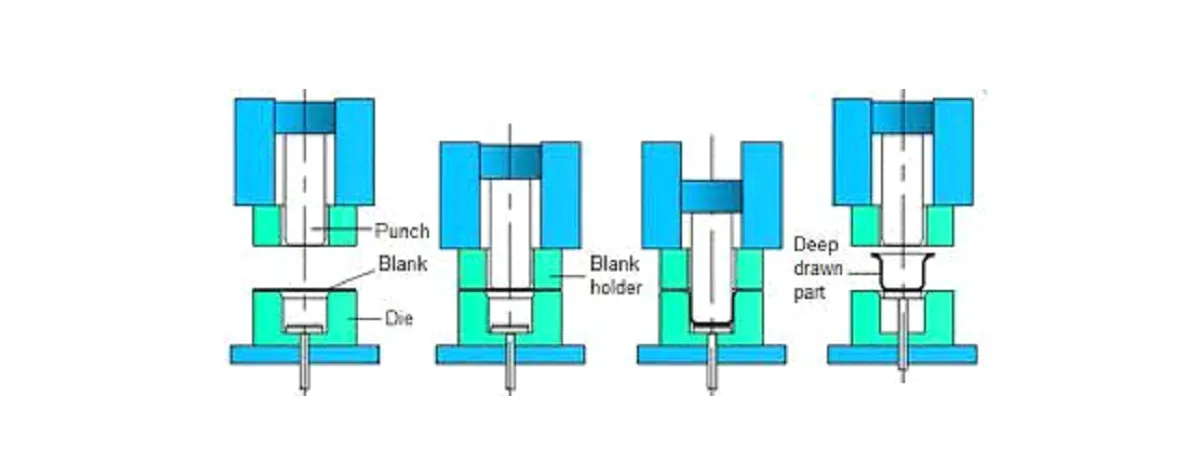
<!-- [if !supportLists]-->• Deep drawing is a manufacturing process that is used extensively in the forming of sheet metal into a cup or box-like structures. Pots & pans for cooking, container, sinks, automobile such as panel & gas tanks, are among a few of the item manufactured by sheet metal deep drawing.
<!-- [if !supportLists]-->• A deep drawing of sheet metal is performed with a punch and die. The punch is the desired shape of the part, once drawn. The die cavity matches the punch and is a little wider to allow for its passage, as well as clearance. For many calculation, the sheet metal thickness is assumed to remain constant. There are changes in thickness in certain areas due to force involved.
<!-- [if !supportLists]-->• Deep drawing is a sheet metal forming process in which sheet metal blank is radially drawn into a forming die by the mechanical action of a punch.
<!-- [if !supportLists]-->• It is thus a shape transformation process with material retention.
<!-- [if !supportLists]-->• The process is considered “deep” drawing when the depth of the drawn part exceeds its diameter.
Embossing
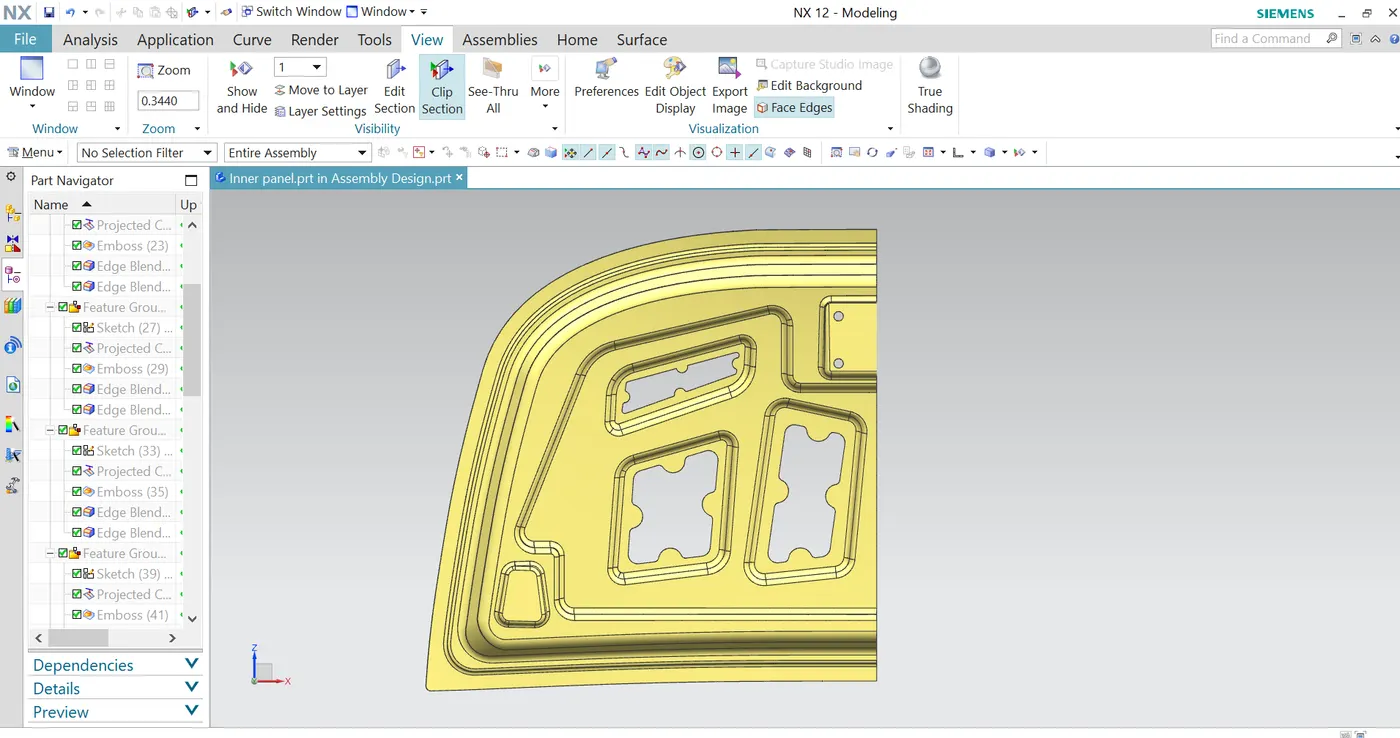
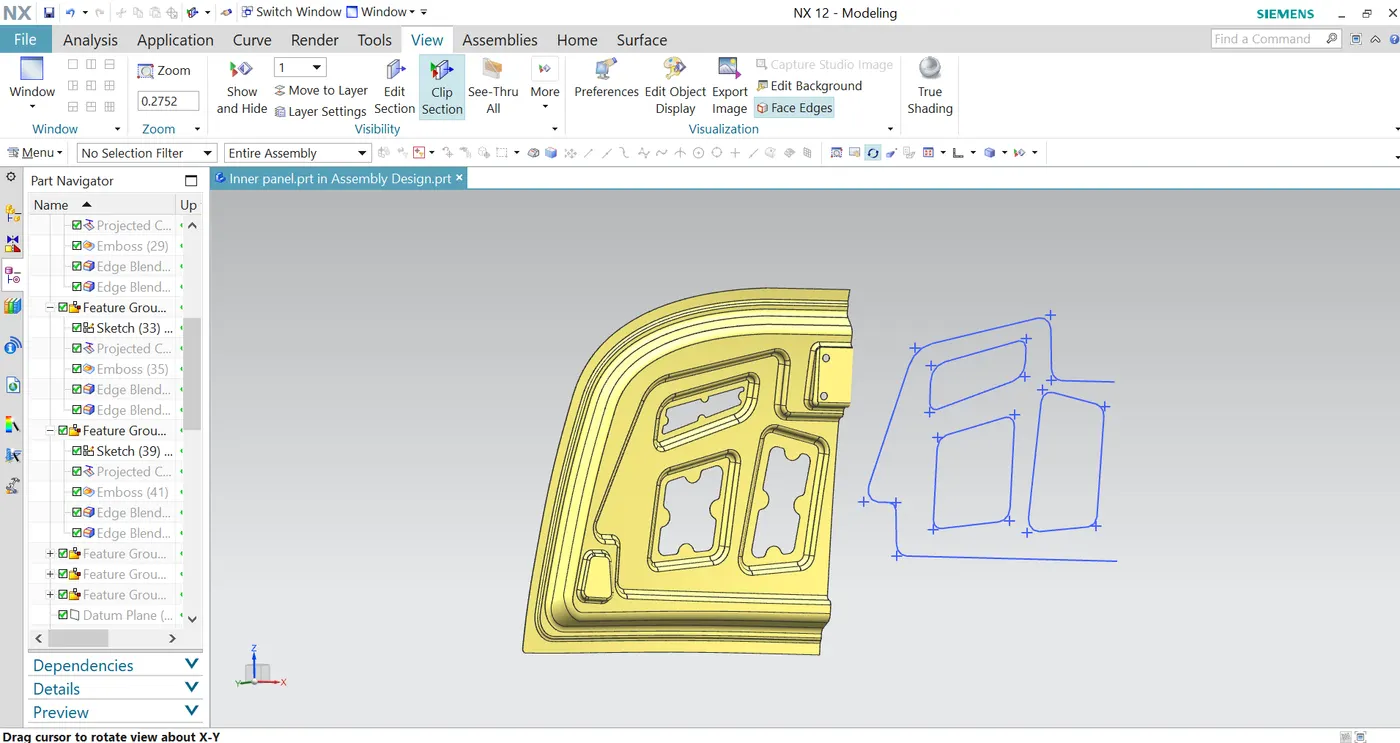
<!-- [if !supportLists]-->• <!--[endif]-->The sheet metal embossing operation is commonly accomplished with a combination of heat & pressure on the sheet metal, depending on the what type of embossing is required.
<!-- [if !supportLists]-->• <!--[endif]-->A sheet metal is drawn through the male & female roller dies, producing a pattern or design on the sheet metal. Depending on the roller dies used, different pattern can be produced on the sheet metal.
Latch trajectory
While opening or closing the hood, the latch must be perfectly aligned to the fixing or striker point. For that, the latches trajectory must be perpendicular to the hinge axis.
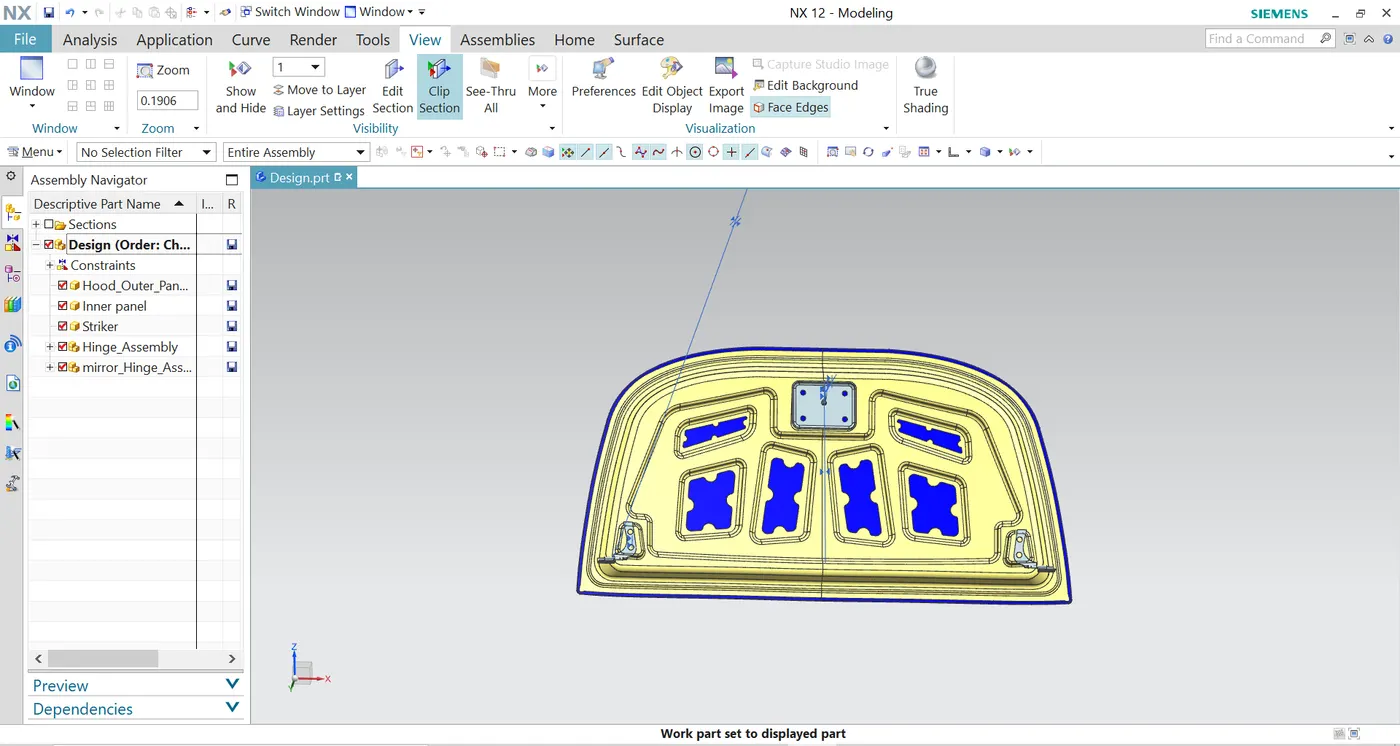
Final Hood Assembly views
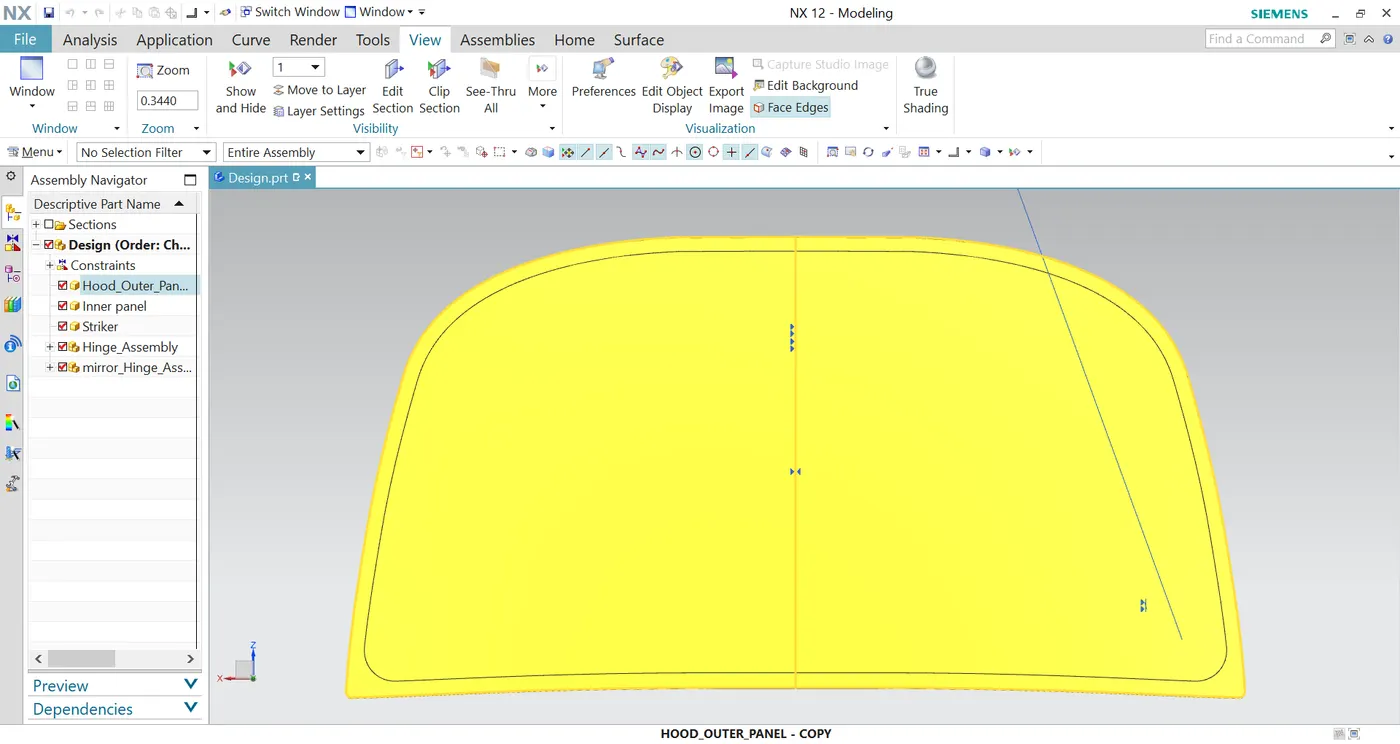
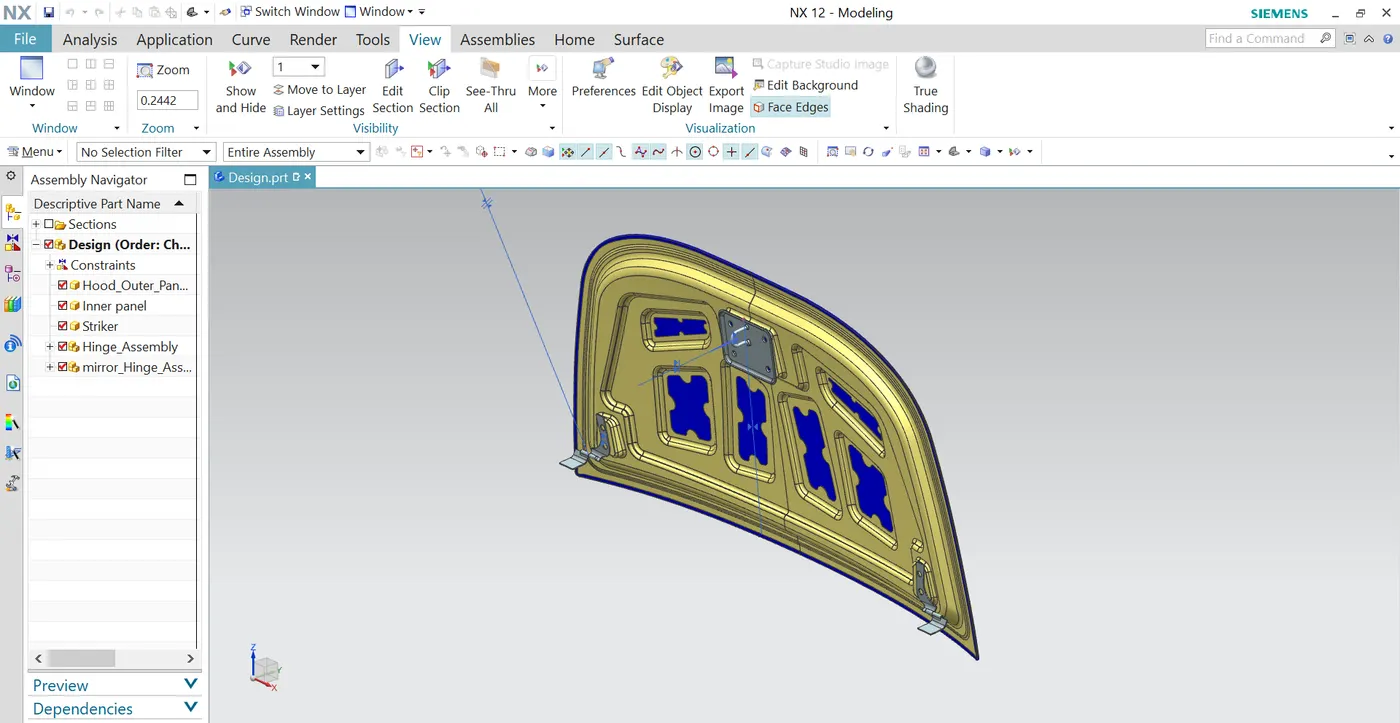
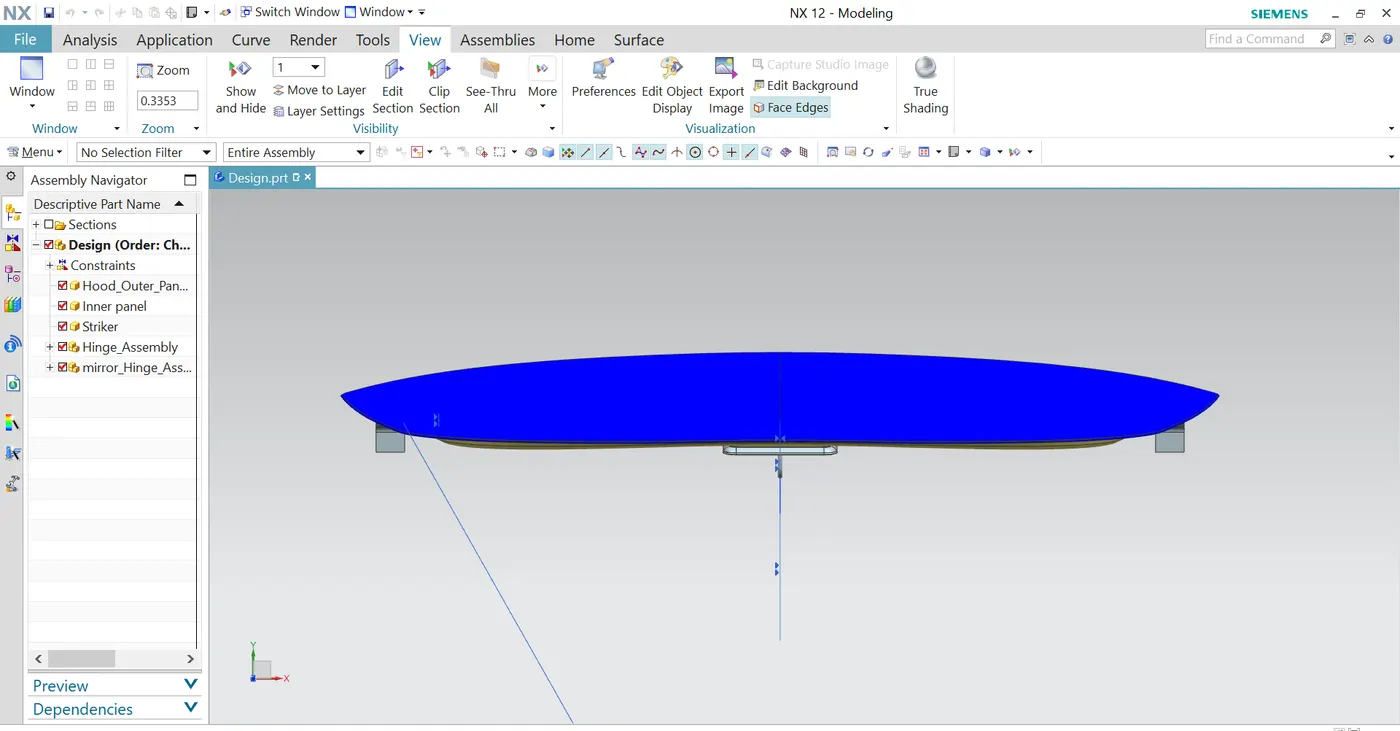
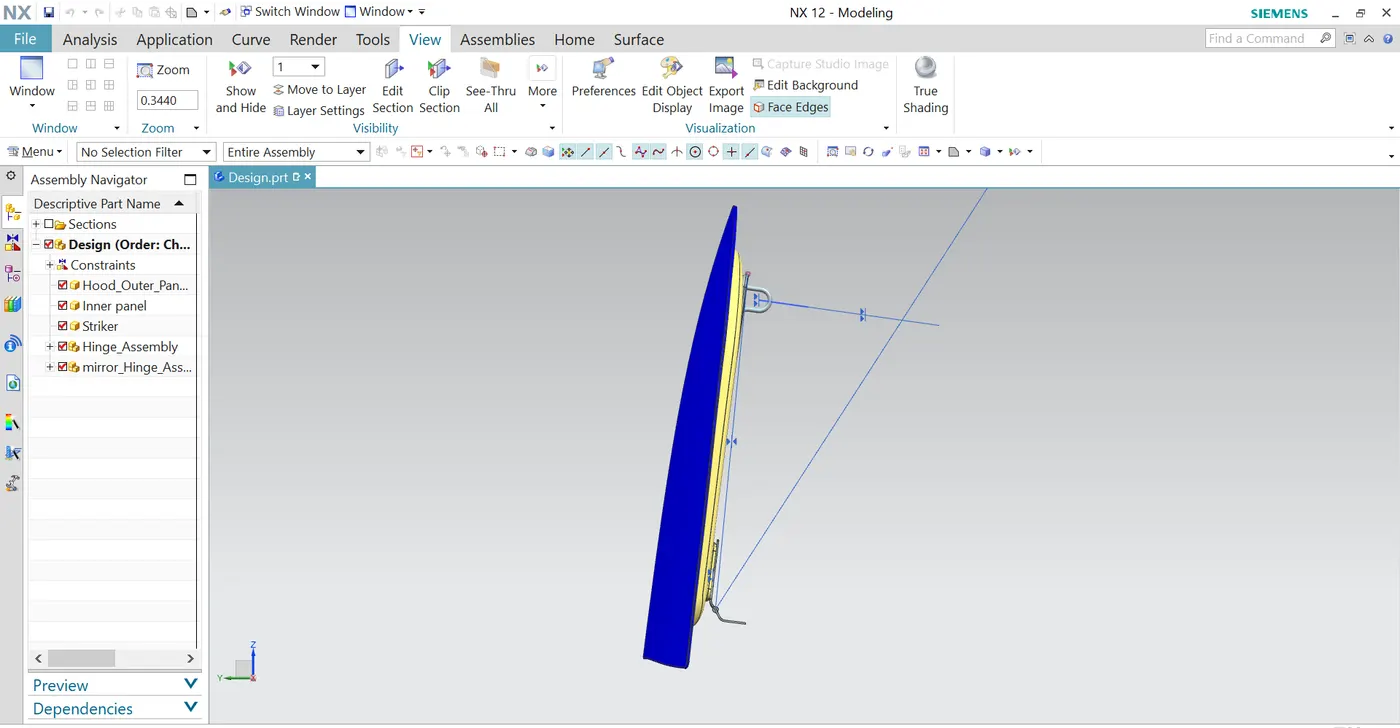
Tools used in hood design
<!-- [if !supportLists]-->· <!--[endif]-->Offset surface: The offset surface gadget copies the picked surface at a provided distance and guidance.
<!-- [if !supportLists]-->· Emboss: The embossing contraption makes a punched surface of the picked shut contour. The punch is produced during a chosen surface containing the contour surface. Sketch a draft can be obliged the punch from either the end cap or the base surface.
<!-- [if !supportLists]-->· <!--[endif]-->Trim Sheet: the trim sheets gadget parts the target surface along the intersection curve of the target surface and the gadget surface. The piece of the cover on the either side of the intersection can be either discarded or retained according to need.
<!-- [if !supportLists]-->· <!--[endif]-->Through curves: The contraption creates a surface between two various surface sections where the shape can be changed in section.
<!-- [if !supportLists]-->· Law extension: Creates an extended surface subject to an open chain contour or a shut contour on the picked target surface. A draft can be obliged by the extension.
<!-- [if !supportLists]-->· <!--[endif]-->Face blend: Creates a curve blend or fillet along two picked surfaces in given direction vector. The blend curve can be changed regarding reach, width and continuity.
<!-- [if !supportLists]-->· Extension sheet: Creates an extension of the picked sheet up to a given distance.
<!-- [if !supportLists]-->· Offset in the face: Creates an offset in the front or edge on the target face up to a provided distance.
<!-- [if !supportLists]-->· <!--[endif]-->Bridge curve: Creates a roundabout portion between two intersecting and non-intersecting curves. The beginning and endpoint of the roundabout changed by providing distance.
<!-- [if !supportLists]-->· Projected Curve: Creates a projection of a curved profile onto a goal surface. The surface can be linear and curved. The direction can be changed by a reasonable vector.
<!-- [if !supportLists]-->· <!--[endif]-->Sew: Combines sheet bodies by sewing common edge together or combines solid bodies using sewing faces. Any opening between the surface can be closed.
<!-- [if !supportLists]-->· <!--[endif]-->Mirror geometry: Mirror a geometry along a face.
<!-- [if !supportLists]-->· The surface on the curve: creates a surface splint feature directly on the face.
<!-- [if !supportLists]-->· Thicken: Creates a strong body using thicken.
<!-- [if !supportLists]-->· Extracted body: Creates a body of picked geometry that can be changed by editing the parent feature and rebuilding the extracted feature.
Conclusion: Thus, the automotive hood design has been designed using NX CAD