Hood design-Week 2
HOOD DESIGN- CHALLANGE
Introduction:-
The hood is the main component of a car at the front portion. It is used to decorate the vehicle & add a luxurious look. The bonnet's shape is made aerodynamic to minimize the air effect.

Hood design consideration:-
The hood of a car is considered the frontal BIW enclosure component. Bonnets are designed to reduce air resistance as the air flows around the car. Apart from this, bonnets are also designed to meet several other requirements. They serve a great deal of purpose in protecting the passengers inside the car & the pedestrians in the event of an accident. It also acts as the cover for the engine.
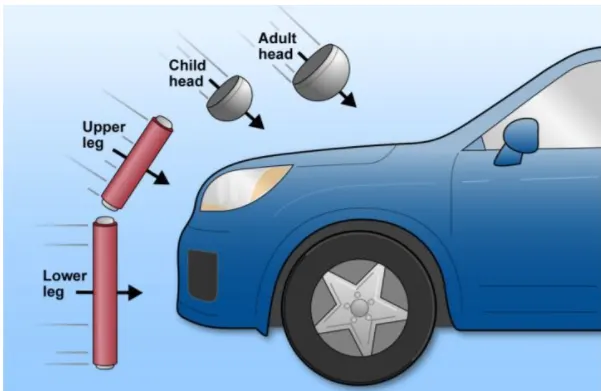
- The European New Car Assessment Programme (Euro NCAP) is a European car safety performance assessment program that has developed test specifications & rating systems for assessing pedestrian injuries during impacts with the front of vehicles such tests include a series of tests using effects designed to bio-mimic a collision at speed of 40 km/h.
- They describe a situation in which a pedestrian is situated laterally & a car first hits one of his legs. Tests are conducted on the leg, upper leg & most importantly the head, as head trauma is most commonly responsible for casualties.
- So to avoid severe injuries to the head, the high-impact area for adults & children is subjected to less thickness. Also, no reinforcement should be provided in that area as during head collision, the hood will absorb the head impact energy leading to the collapse of the hood & thus protecting the severe head injury.
- Another important criterion for the hood design is the protection of the occupants inside the car during a front collision. The design of the hood should be in such a way that during the collision, the force should travel in an upward direction through the embosses & directed toward the body of the car. Thus protecting the occupants inside.
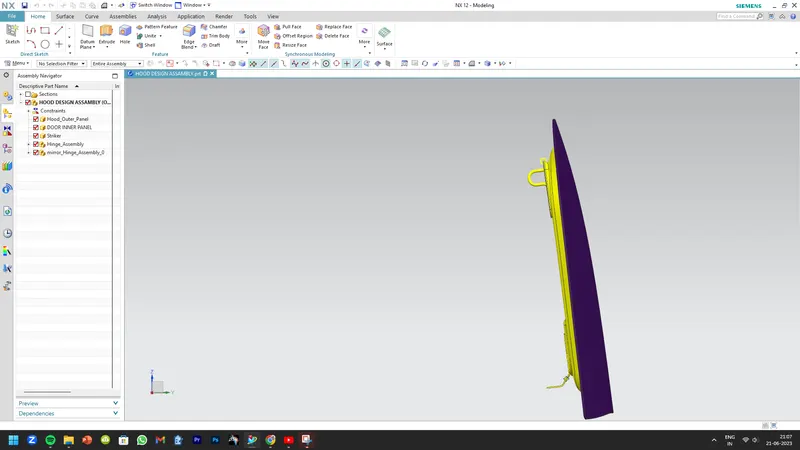
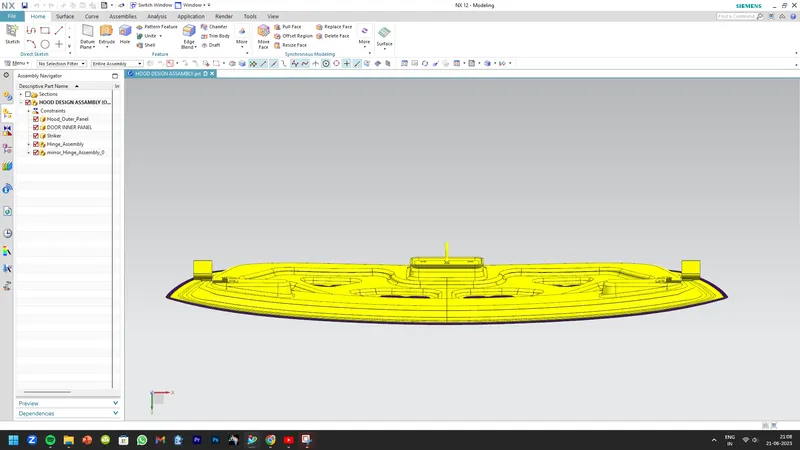
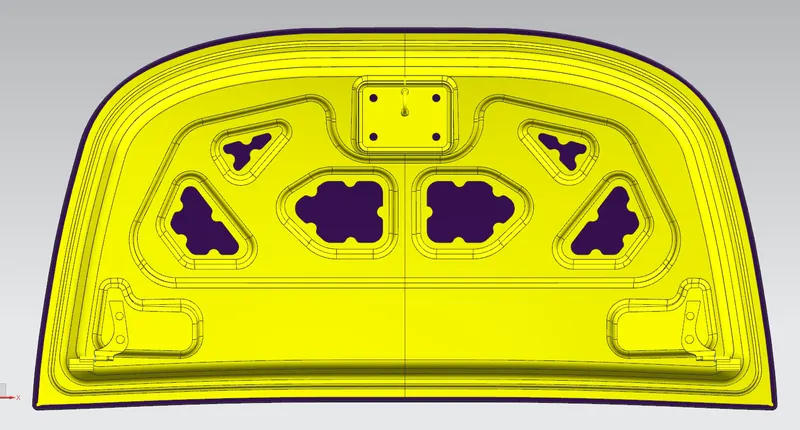
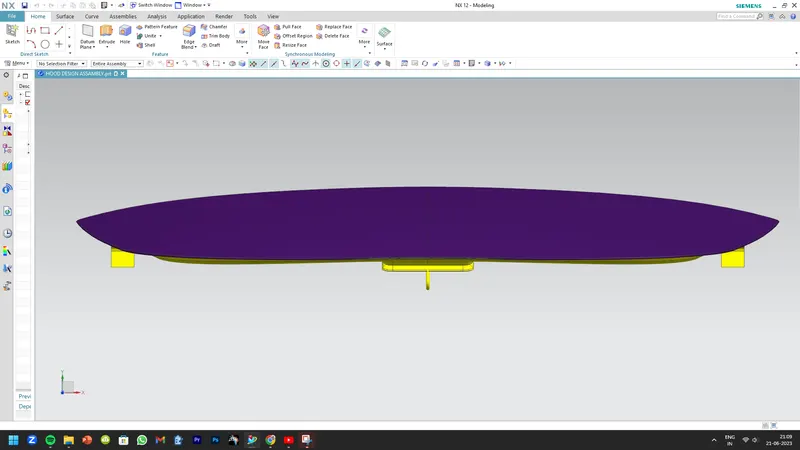
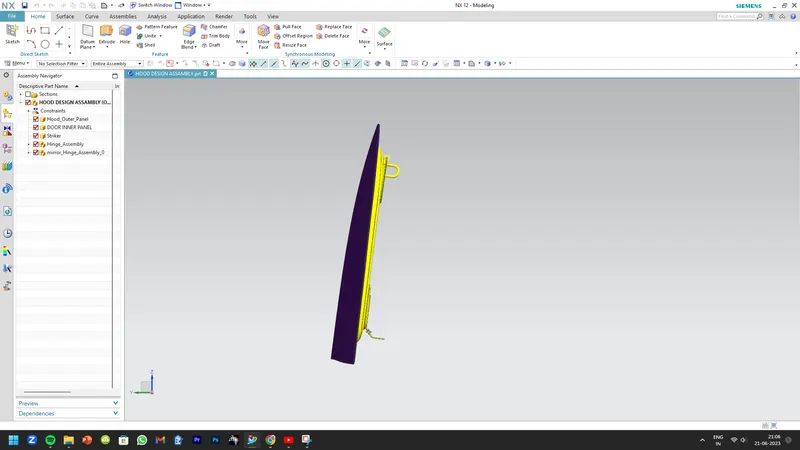
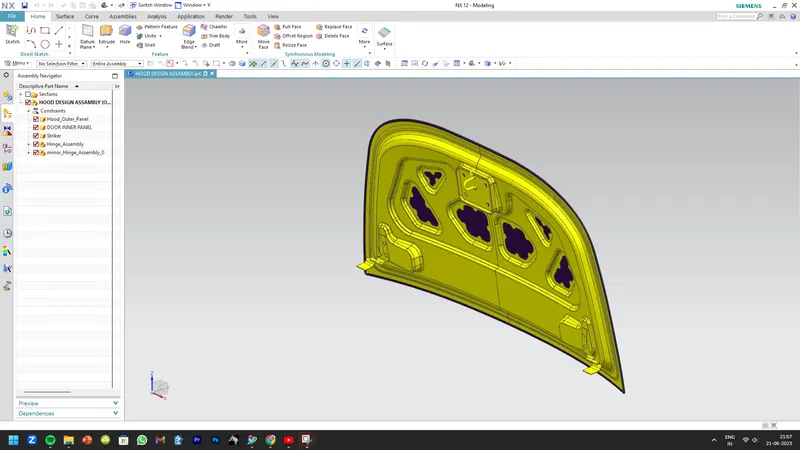
Following parts are used in hood assembly for this report,
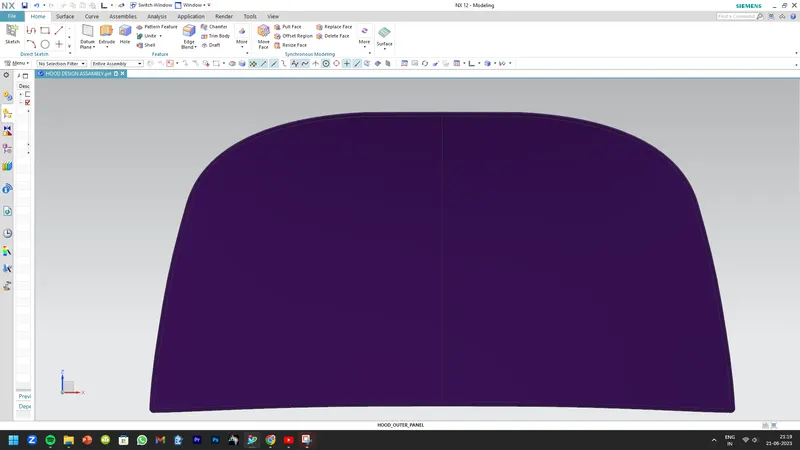
- Hood outer panel
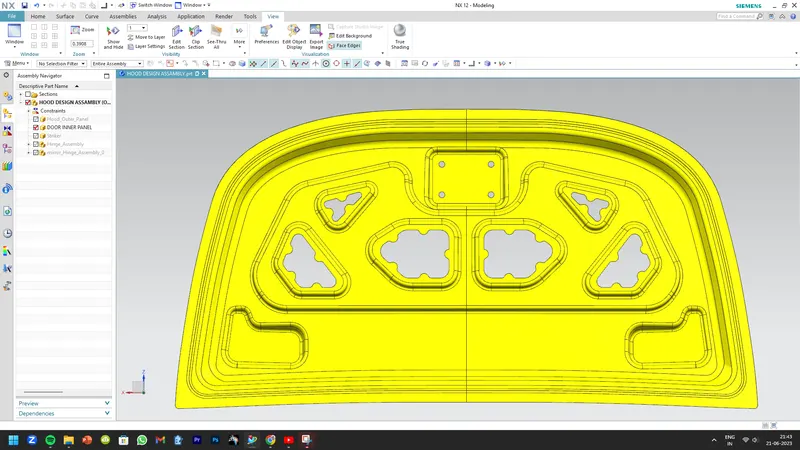
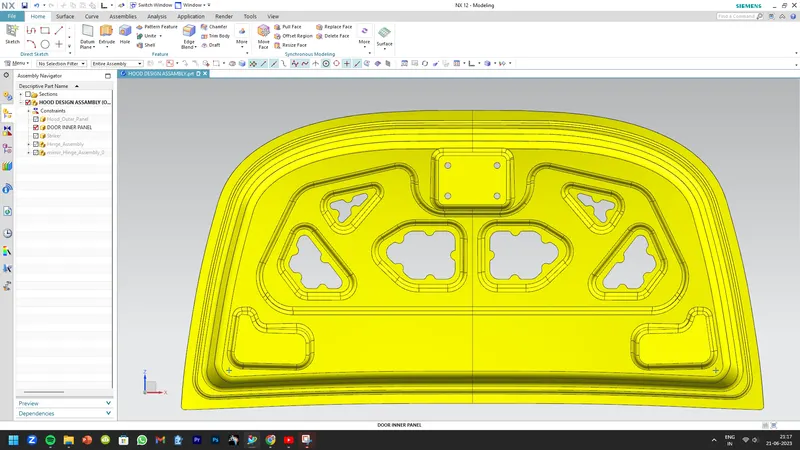
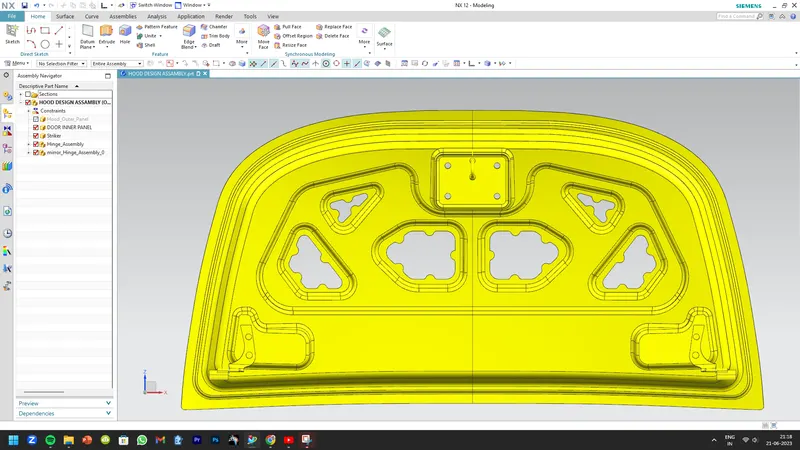
- Hood inner panel
- Hinge assembly
- Striker assembly
Hood thickness-
Outer panel thickness= 0.75 mm
Inner panel thickness= 0.75 mm
Reinforcement thickness= 1.5 mm
Inner Panel-
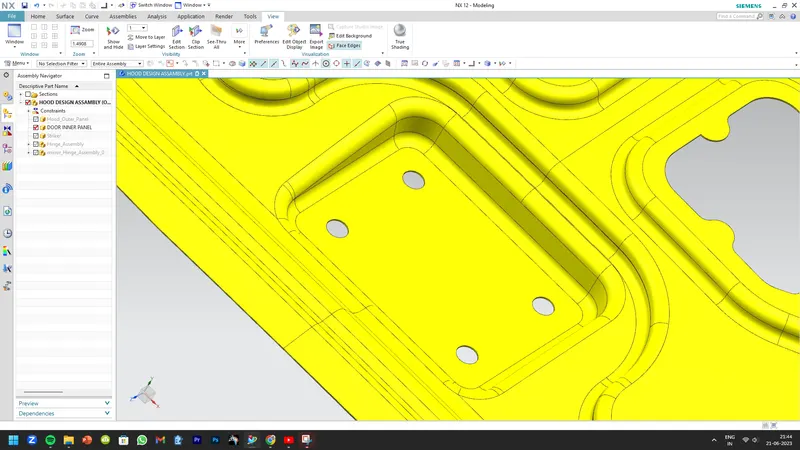
- In the inner panel only we can research & implement the safety of pedestrians & as well as the driver. In this panel only we can attach the reinforcement, embossed, mastic points, etc.
- It is an object of the present invention to provide a hood inner panel capable of reduction of a reaction force of the hood inner panel even if the level of deformation of a hood of a vehicle increases, & ensuring a sufficient energy absorption capacity.
Outer Panel-
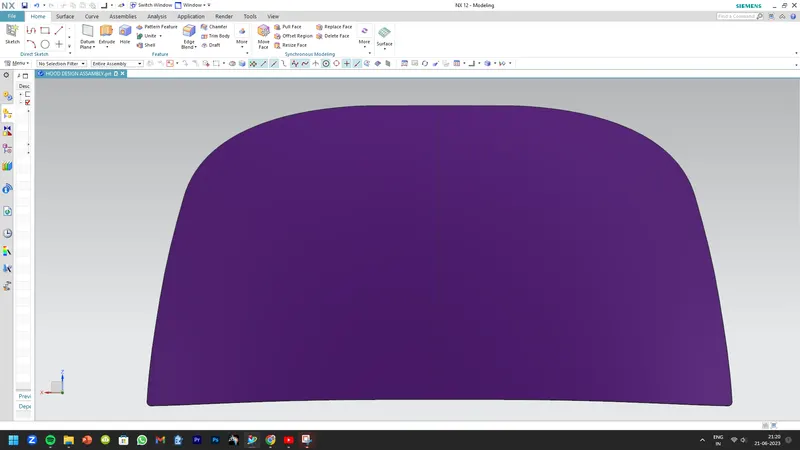
We can also call it a cover of the inner panel. It is the part, which gives a luxurious look to the hood or bonnet. Outer & inner panel can not join by any welding process like spot welding or rivet, which spoil the outer look of a car. The outer panel is generally extracted from the model from the prototype design.
Hinge Assembly-
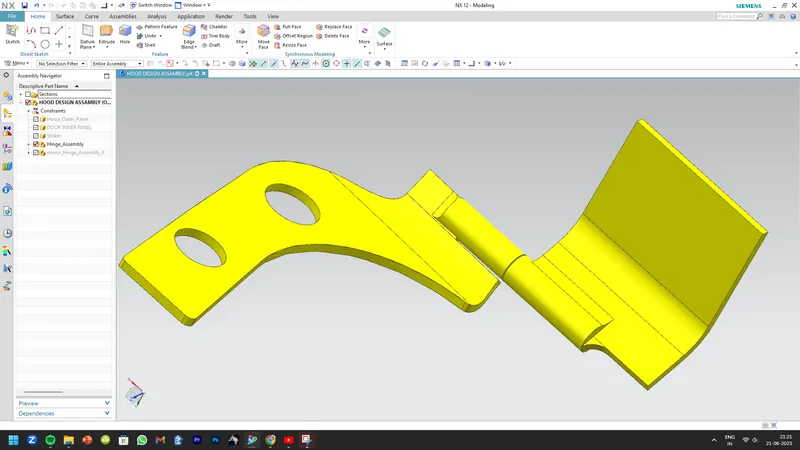
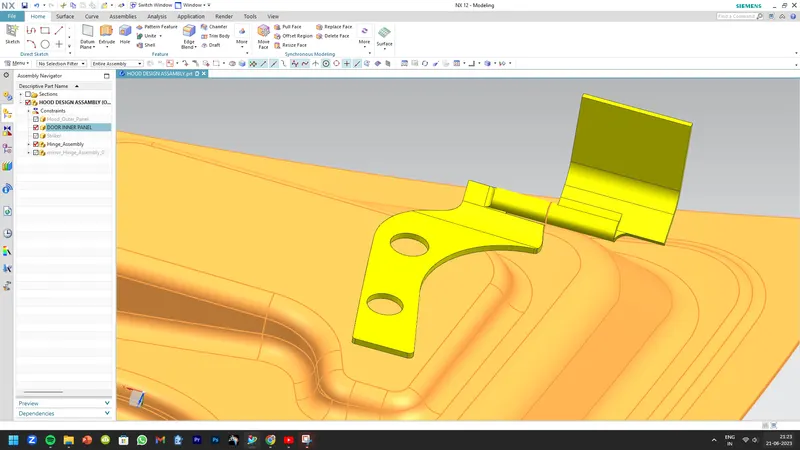
A hinge is a component that fixes the hood to the fenders of the car. The latch must be fixed perpendicular to the hinge axis so that the hood opens or closes properly.
Striker Assembly-
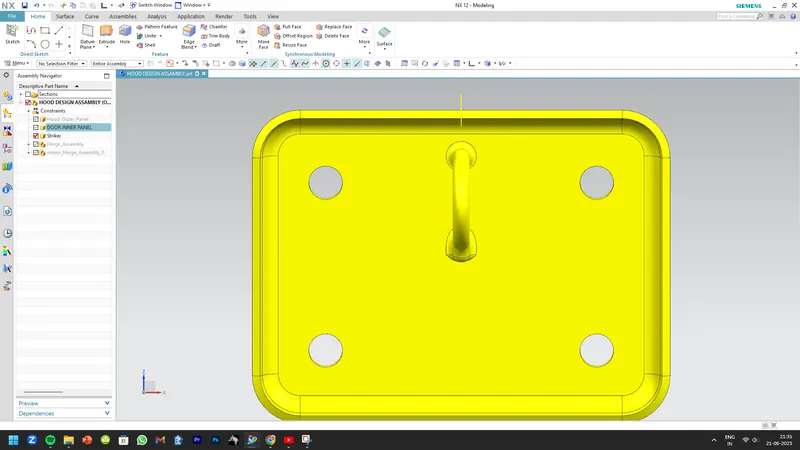
Latch & striker is used for locking the hood of the car. It is usually placed in the space provided on the inner panel.
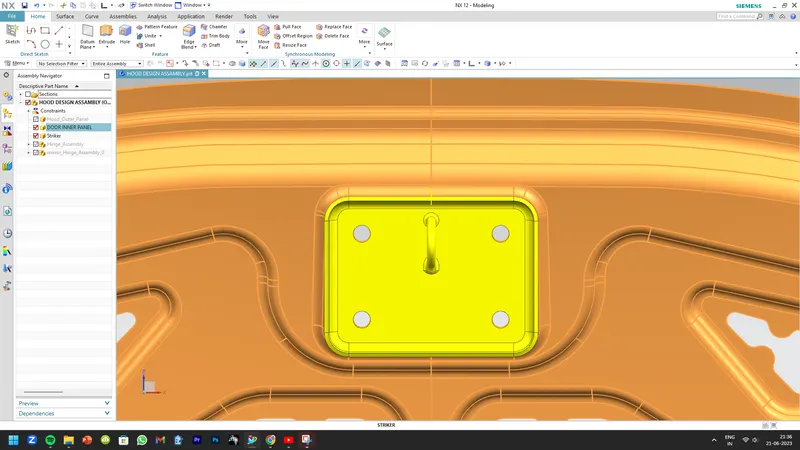
The process involved in designing a hood as a sheet metal operation is
- Blanking
- Hemming
- Punch cutting or piercing
- Deep drawing
- Embossing
Hemming-
- Hemming is a sheet metal forming process in which sheets are joined by bending it usually to 180 degree. Automotive body panels & parts such as deck-lids, trunk-lids, doors, hoods & tailgates are formed by hemming processes.
- Roll hemming is carried out incrementally with a hemming roller. An industrial robot guides the hemming roller & forms the flange. Roll hemming operation can also be divided into several pre-hemming & final hemming process steps.
- Conventional die hemming is suitable for mass production. In die hemming, the flange is folded over the entire length with a hemming tool. Normally the actual hemming is a result of a forming operation in which the flange is formed with a hemming tool after the drawing & trimming operations have been completed.
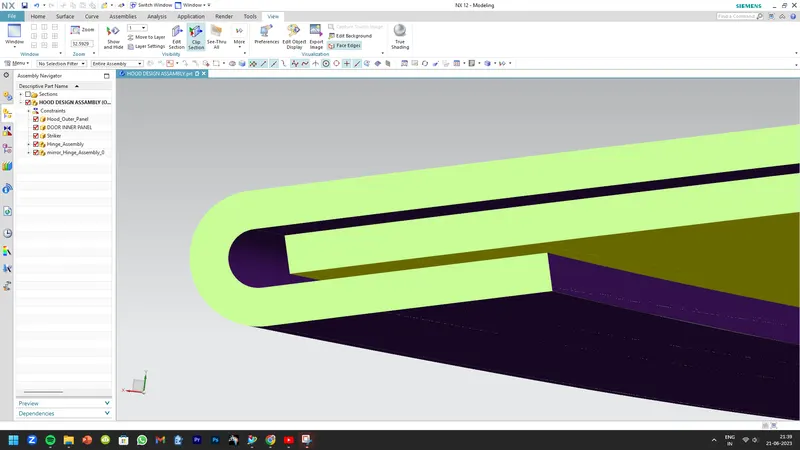
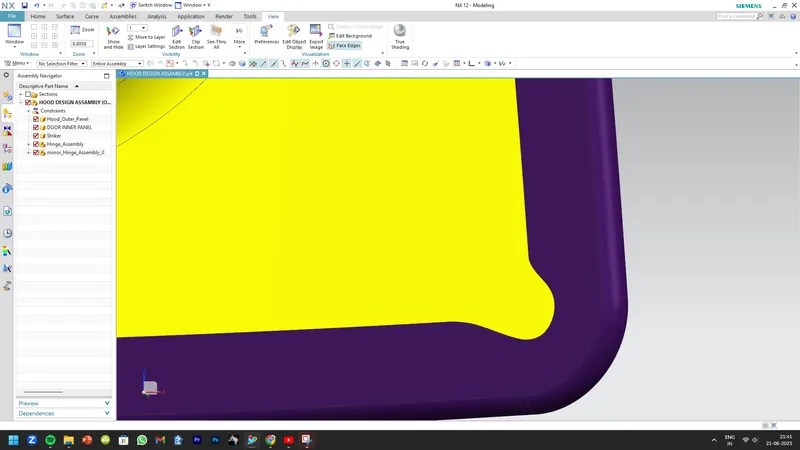
While doing the hemming process a relief angle is formed as a product of hemming when attaining at the corner of the sheet.
Deep Drawing-
- Deep drawing is a manufacturing process that is used extensively in the forming of sheet metal into a cup or box-like structure. Pots & pans for cooking, containers, sinks, and automobile parts, such as panel & gas tanks, are among a few of the items manufactured by sheet metal deep drawing.
- A deep drawing of sheet metal is performed with a punch and die. The punch is the desired shape of the base of the part, once drawn. The die cavity matches the punch and is a little wider to allow for its passage, as well as clearance. For many calculations, the sheet metal thickness is assumed to remain constant. There are changes in thickness in certain areas, due to the force involved.