Hood design-Week 2
AIM
Design Hood Outer Panel, Inner Panel and the necessary reinforcements by following the Master Section mentioned with the Design parameters explained in the videos.
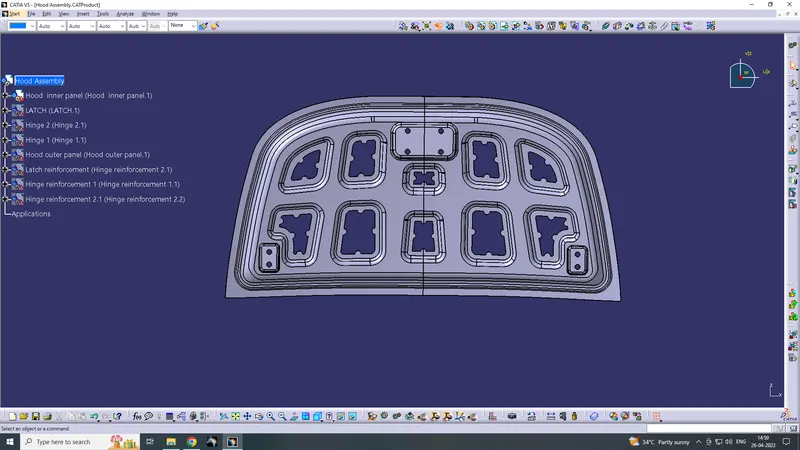
Submit an ASSEMBLY of Hood Inner Panel, Outer Panel, Latch, Hinge and the Reinforcements.
A detailed report about the Hood Design which includes a detailed explanation about hood and its components, Latch Trajectory, Mastic Data, Emboss Definitions, Manufacturing process like Deep-Drawing and Hemming, and all the parameters followed in the design.
HOOD
Hood is the engine cover hinged to the car's body (front-engine automobile). It gives you access to the vehicle's engine and is also vital for the safety against the frontal impact of the car.
Hood is a main component of front portion of a car. It is an opening body panel that covers the engine in front engine vehicle. It consist of an outer panel and inner panel. The inner panel provides the strength while the outer panel functions as the metal cover. It is an access panel to the engine compartment to enable maintenance of power train, drive belts, battery, fluid levels and lamp units.
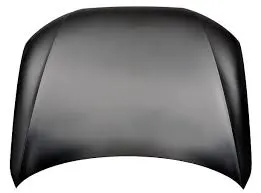
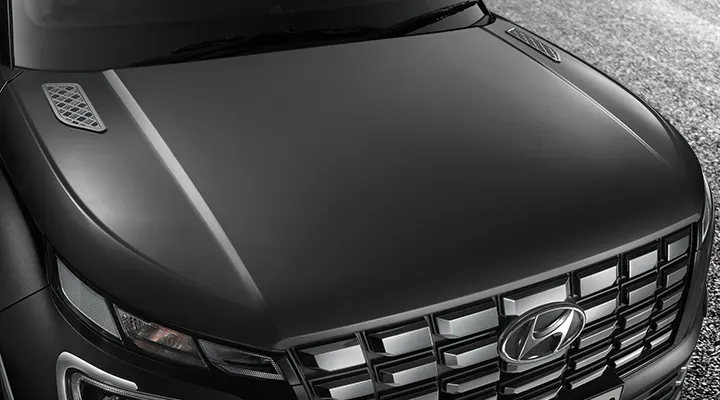
Types of hoods
There are two types of support available for the hood support
- Gas Stay
- Support Rod
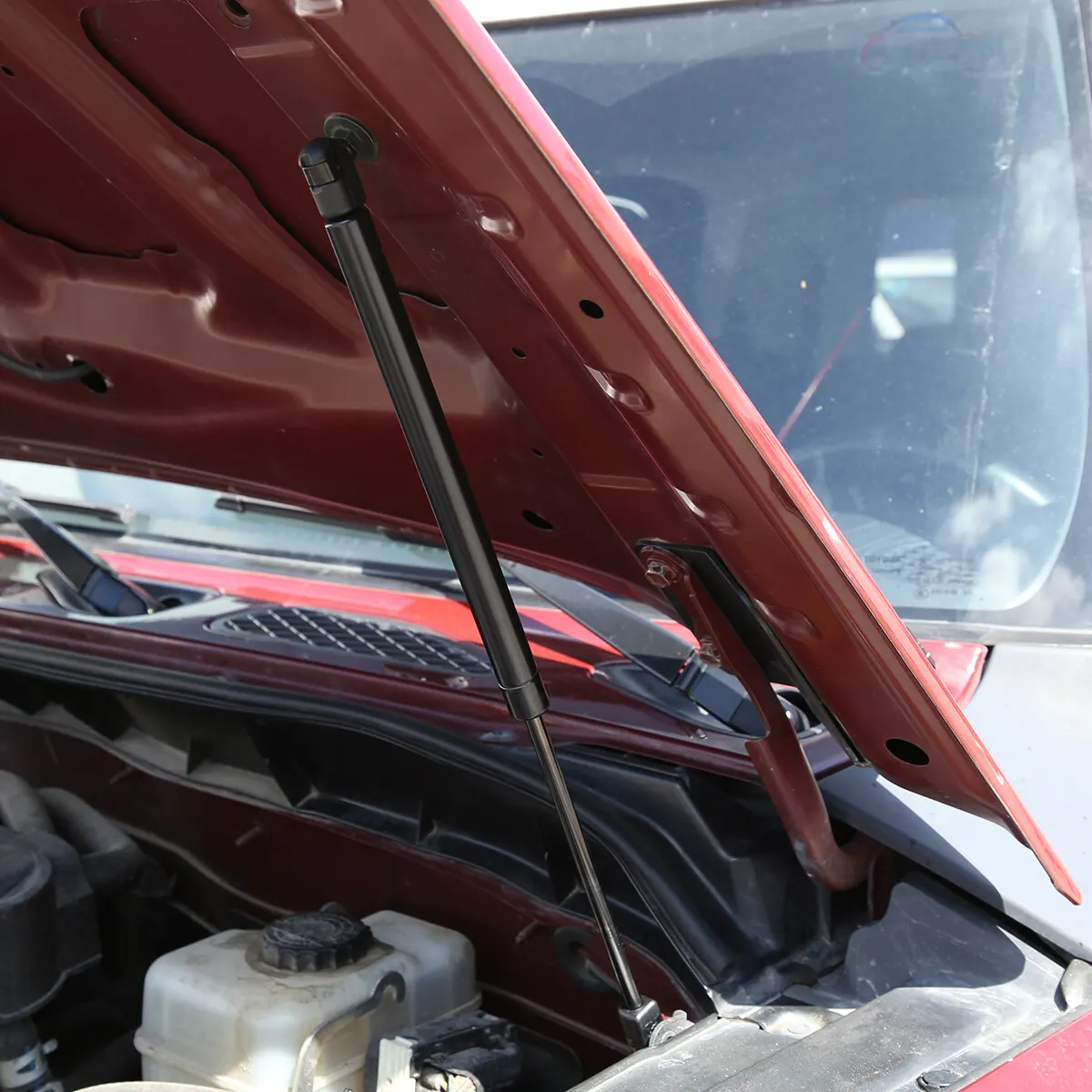
Gas Stay
It is a device used for supporting the engine hood of a vehicle in its open postion by means of an actuator which is activated by gas.
In case of gas stay only intial force is required to open the hood then it automatically opens at desired angle with the extension of pneumatic piston in cylinder of gas stay assembly.
Advantages of Gas stay are as follows
- No human effort is required
- Easy to operate
Disadvantages of Gas stay are as follows
- They are heavy in weight compared to support rod.
- Cost is more.
Support Rod
It is a simple metalic rod. It is not usually made linear to increase rigidity of rod but the length from line connecting support rod retaining point with retaing point on body side to maximum bending point should be less than 35mm to ensure the strength of support rod.
It should have sufficient clearance with other engine components to avoid rattling noise.
Gourmets are provided to keep the support rod in rest condition.
Advantages of support rod are as follows
- They are economical
- Light in weight.
Disadvantages of support rod are as follows
- When striking with the automotive body panel to leave scars which are very likely to cause rust.
- The metal rod is often too hot to be gripped by hands immidiately after the vehicle has been stopped.

Safety requirements
1. Passenger Safety
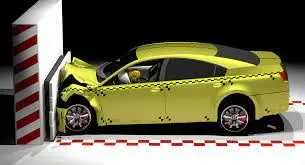
Whenever a frontal crash occurs in the car, the first part affected will be the hood. So must be designed in such a way that it should not come from the body of the vehicle and must absorb the energy as far as possible ad divert the force towards the side panel of the car so that the amount of force which is sent to the cabin is lesser since the force lesser the passenger will experience less amount of force so that passenger safety is ensured.
Pedestrian Safety
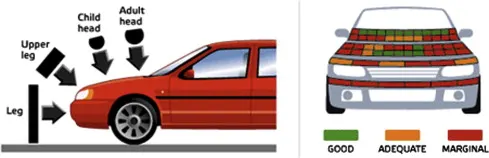
Design should be such way that it should reduce the injuries to the pedestrians in the event of a pedestrian vehicle collision. The objective of these measures is to reduce the number of road accident fatalities and the severity of injuries sustained by pedestrians involved in a collision with a vehicle in urban traffic.
The height, weight and age of the pedestrian all play a role in the kinematics of the event and in his ability to survive. Most fatalities for the younger population are related to brain damage caused by head impact on the bonnet. For older people additional risks include rupture of arteries in the lower limbs and pelvis from bumper and bonnet leading edges.Impact frequency and seriousness of injury has been studied for many years, resulting in rating systems and improved design.
Evaluation of pedestrian safety for a bonnet must be carried out in the context of its surrounding elements like Vehicle styling, size (wrap around distance “WAD”) and under bonnet clearance to other elements (considered as hard points). Local bonnet stiffness is influenced by mounting point stiffness such as hinges, bump stops and latches. This is better understood by superimposing the kinematics of a dummy onto the test conditions.
Wrap Around Distance (WAD) :- It is the geometrically traced distance from the contact point with the Ground Reference Plane, vertically below the front face of the bumper, to any point on the vehicle front structure.
Side Reference line :- The geometric trace of the highest points of contact between a straight edge, held parallel to the lateral vertical plane of the vehicle and inclined 45 deg. is traversed down the side of the front structure, and the side of the front structure.
Child Head Impact Zone :- 1000 WAD to 1500 WAD
Adult Head Impact Zone :- 1500 WAD to 2100 WAD
Besides functioning as an engine compartment cover, the hood of modern vehicles can also help manage the impact energy of a pedestrian’s head in a vehicle-pedestrian impact. However, a hood’s ability to absorb impact energy may be impeded by the proximity of the hood to components packaged inside the engine compartment, i.e., by its underhood clearance.
For example, for a given hood design, the hood’s ability to absorb impact energy through deformation can be significantly reduced when the hood and engine block are in close proximity.
Therefore, a large underhood clearance would be preferred for pedestrian protection.
The predicted level of protection offered by the vehicle is verifiedby EURO-NCAP.
Components of Hood
1. Outer Panel
2. Inner Panel
3. Hinge
4. Latch and striker
5. Reinforcement
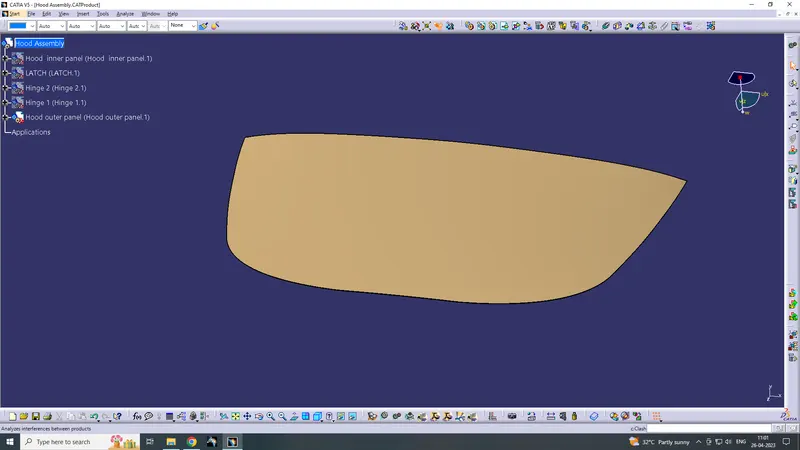
Outer Panel
We get the outer panel skin surface from style department with proper aesthetic look, gap etc. The shape of the Outer panel is made aerodynamic in order to minimize the air effect. Shape of Outer panel is reffered as a base to design a inner panel.
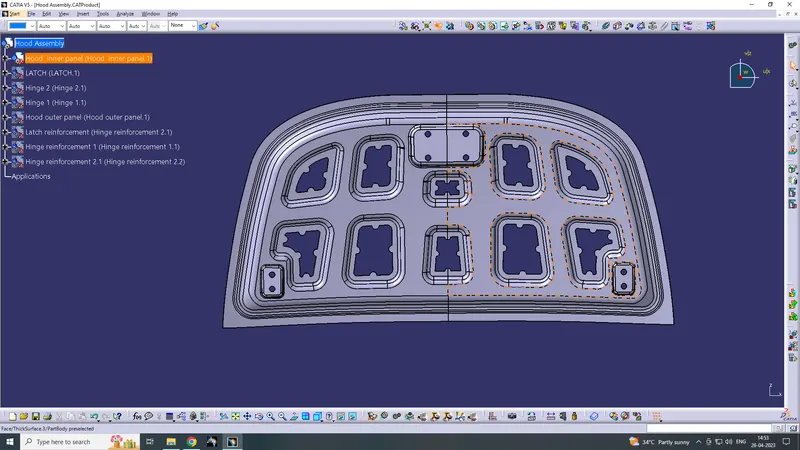
Inner Panel
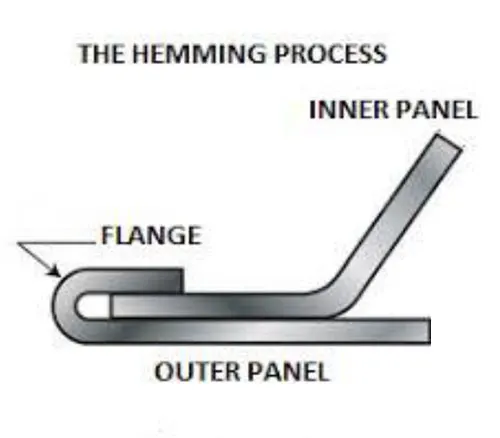
Hood Inner panel is main functional part in hood design. It gives structural support and strength to the outer panel of Hood. The outer and inner panels of the Hood are typically attached together using a hemming operation at the edges.
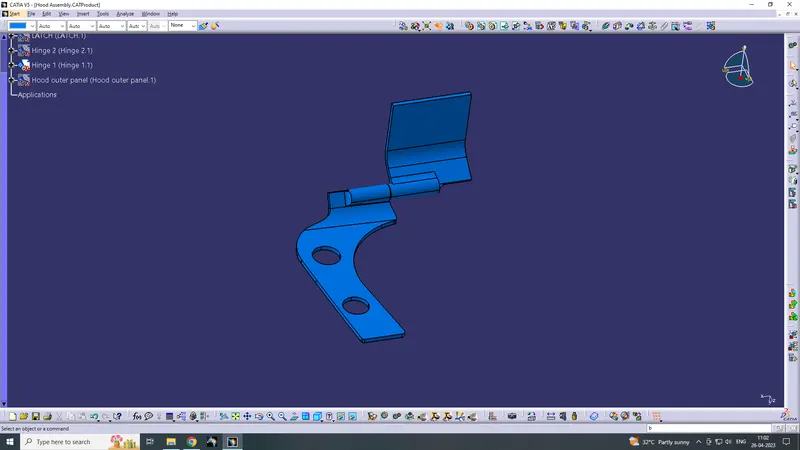
Hinge
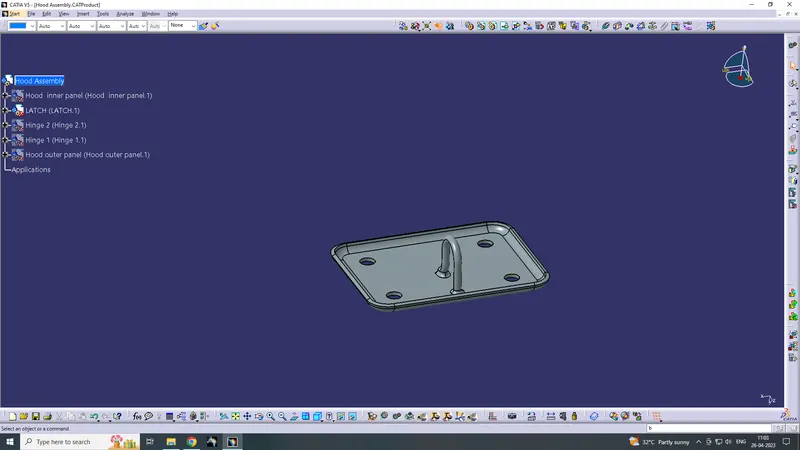
The hinges are used to guide and hold the hood when open & close. Hinge assembly consists of two parts one is connected to the hood inner panel and second is connected to the vehicle body.
Latch and striker
This system is the attachment of hood assembly and vehicle body. The hood latch system must be able to catch the striker of the hood upon closing and instantaneously, as well as automatically, lock. Once in the locked state, it must remain locked and only unlock upon the operator’s control.
Reinforcements
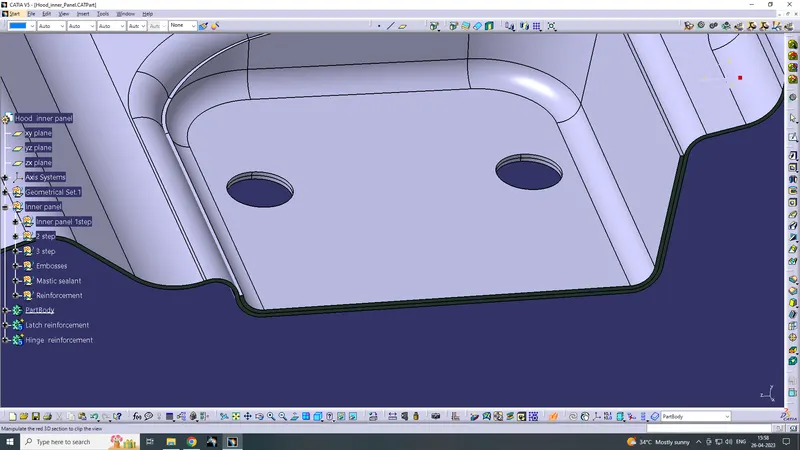
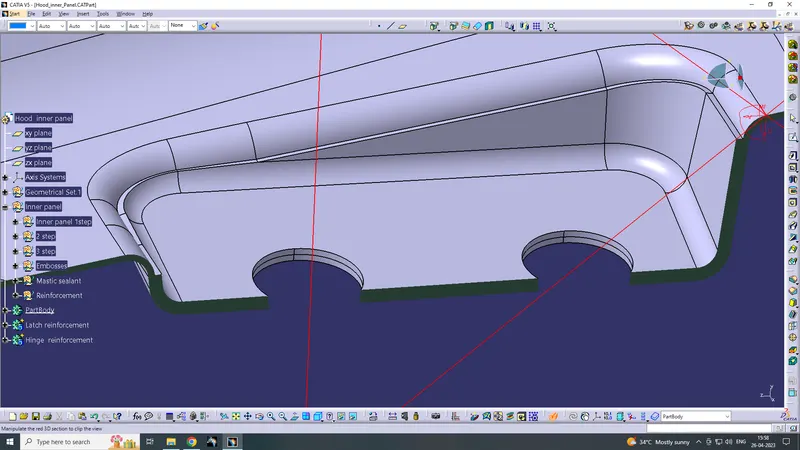
Reinforcement are provided mainly in hinge and latch region. When hinge and latch assemblies are attached to inner panel, strength of that area reduces locally so we add some additional material to increase the strength of the area locally. Thickness of reinforcement material is provided according to the design requirements. In this project, 1.5mm thickness has been given to both latch and hinge reinforcement.
Latch reinforcement
Hinge reinforcement
Latch Trajectory
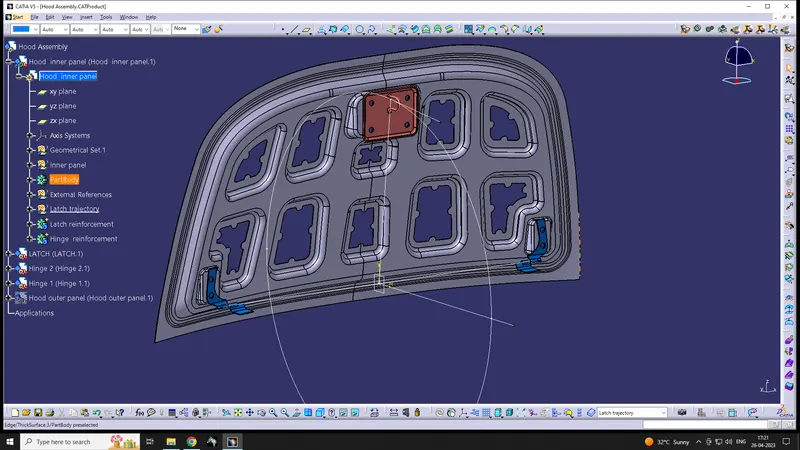
The latch trajectory shows the striker's way when the hood is opened and shut on a vehicle. The range of the round Trajectory is controlled by the set standard dependent on the typical stature of an individual. The range is estimated from the pivot hub up to the Latch. It is the Trajectory on which the movement of the hood (opening and closing are dependent). This circular Trajectory has a radius equal to the length from the centre point of the centre axis of the Hinge to the striker point on Latch. The striker point is also tangent to the Trajectory.
Mastic data
Mastic sealants used between the outer and inner panel. mastic sealants are the rubber like elasic compound which connects the outer and inner panels of car hood at specified points. Mastic sealants are used in the region between the inner and outer panel because other joining process like welding or riveting are not good for car asthetic design. It also helps in improving NVH (Noise, vibration, and harshness) characteristics.
Mastic salant points are effective around a circular region of 80mm diameter.
Emboss definitions
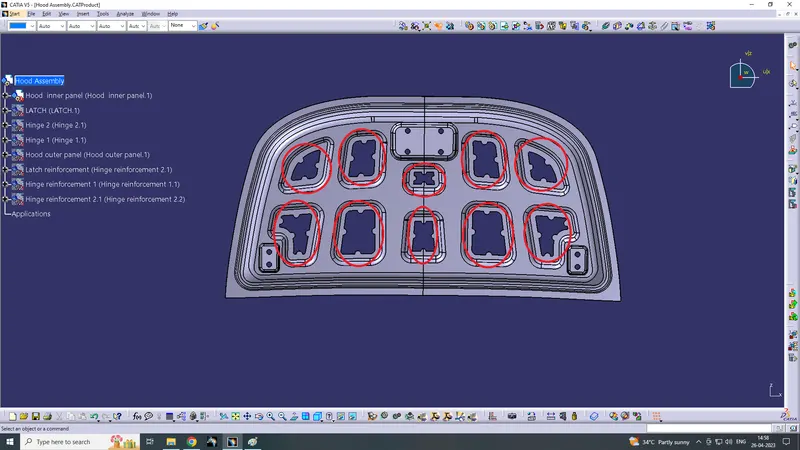
Embosses are provided to increase the strength of inner panel. Shape of embosses also determines the direction of collision force distribution. the shape of the embosses should be designed in such a way that, the collision forces should be directed towards outward side of the car (towards hinge side).
Manufacturing Aspects
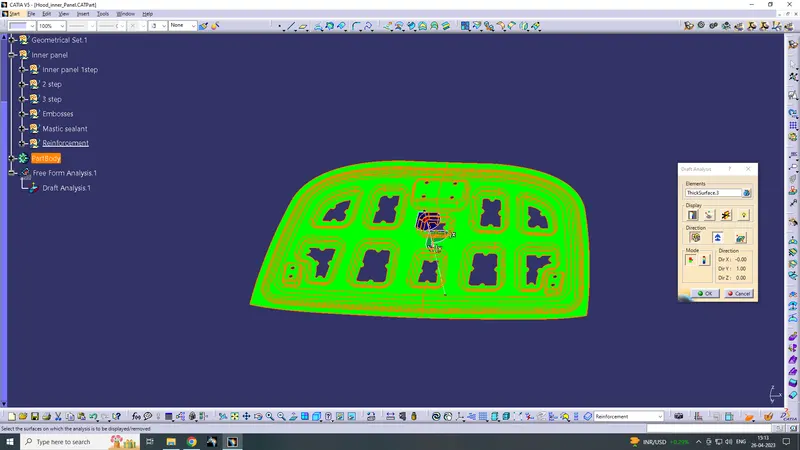
The most important design consideration of any component is manufacturing aspect. In sheet metal, the component is manufactured by press tool dies. The Press tool is stamping which includes cutting operations like shearing, piercing etc. and forming operations like bending, Deep drawing, hemming etc. The main focus of manufacturing aspect is to manufacture hood assembly with minimum operation sequence and process time.
Deep drawing
Deep drawing is a sheet metal forming process in which a sheet metal blank is radially drawn into a forming die by the mechanical action of a punch. It is thus a shape transformation process with material retention. The process is considered "deep" drawing when the depth of the drawn part exceeds its diameter.
The deep drawing process is a forming process which occurs under a combination of tensile and compressive conditions. A flat sheet metal blank is formed into a hollow body open on one side or a hollow body is formed into a hollow body with a smaller cross-section.
Deep drawing creates a seamless effect on metal, allowing for the creation of a smooth, curved edge. Deep drawn metal parts are created using a single metal blank, not a repeated course of metal blanks as is typically the case with traditional metal stamping.
Deep drawing is one of the most widely used processes in sheet metal forming. Apart from its use in many other sectors, it is applied in the automotive industry for the manufacturing of car body parts.
Hemming
Hemming is a sheet metal forming process in which sheets are joined by bending it to 180°. Automotive body panels and automotive parts such as deck-lids, trunk-lids, doors, hoods and tailgates are formed by hemming process. In this process, usually a sheet is bent with the help of inner sheet in three different stages.
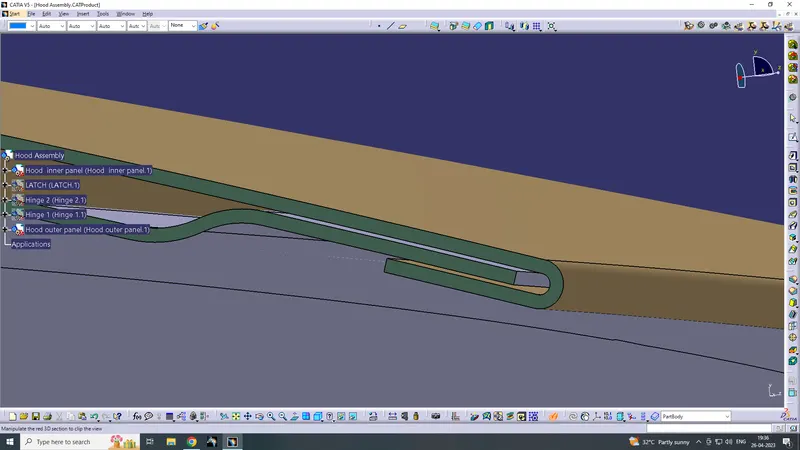
Reliefs
Reliefs are provided at the front and side portion of the panel for smooth rolling operation .so that no tearing of the sheet happens when the roller passes through a specific portion.
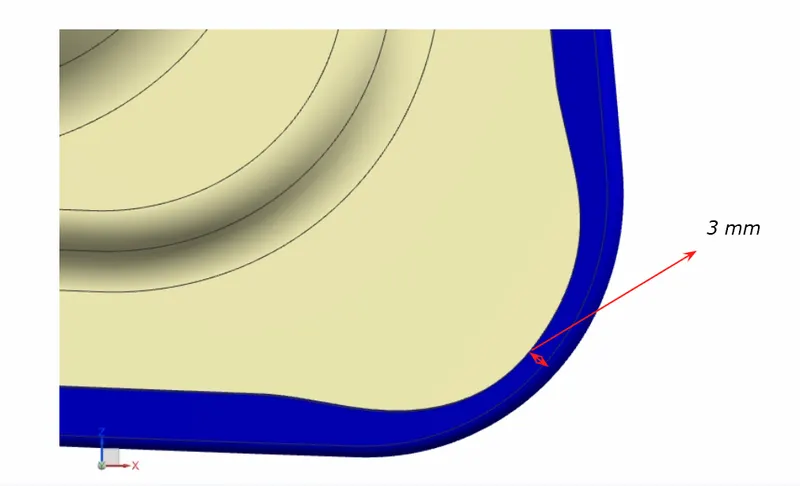
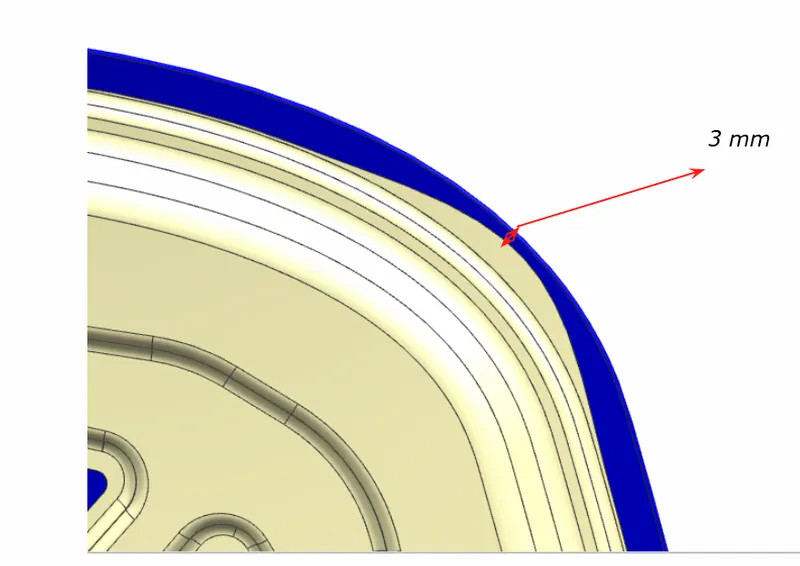
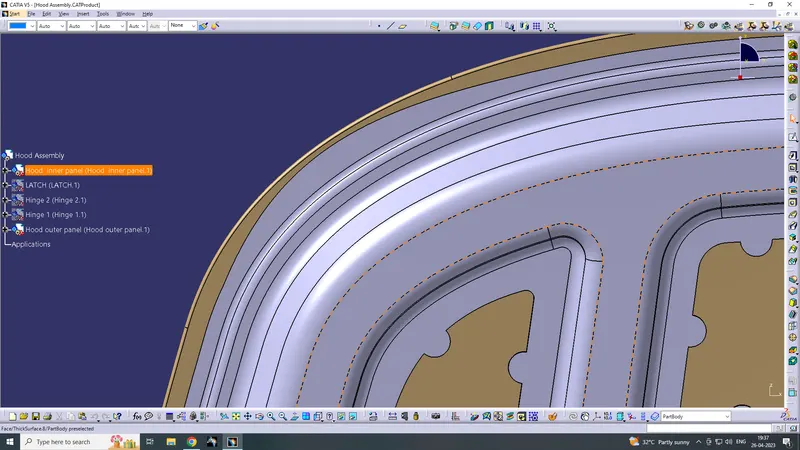
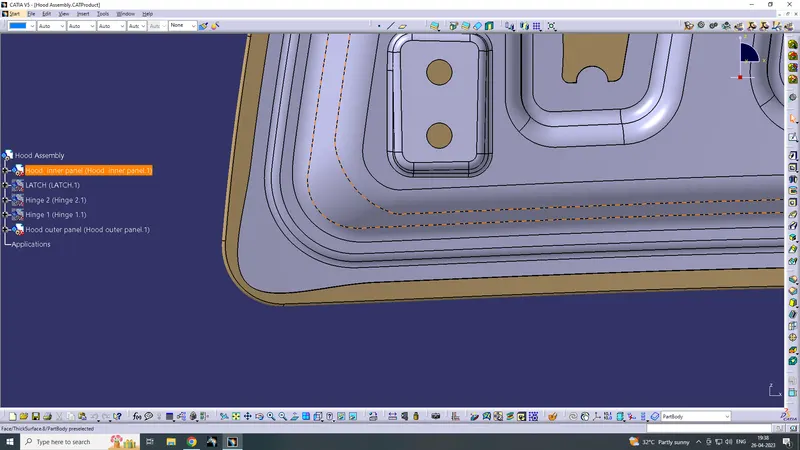
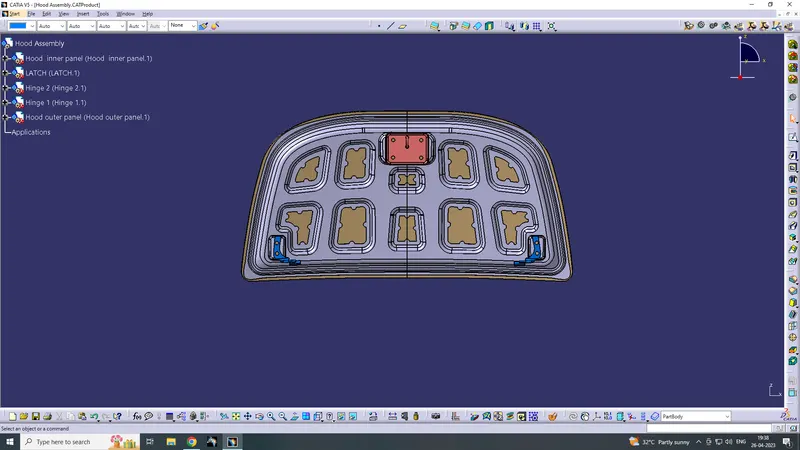
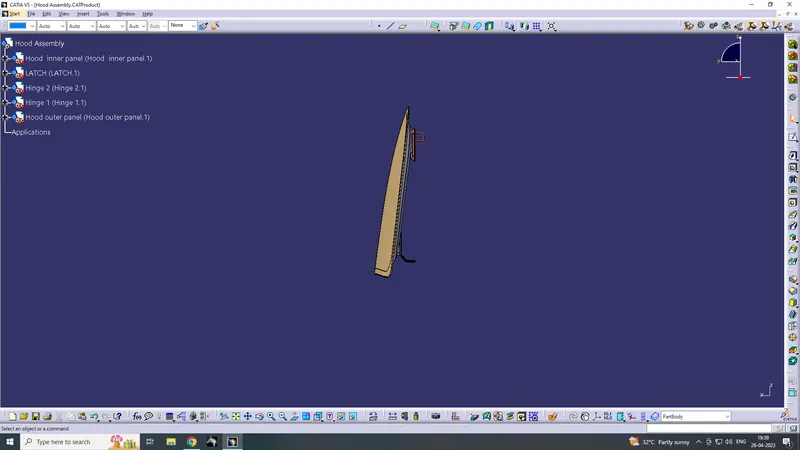
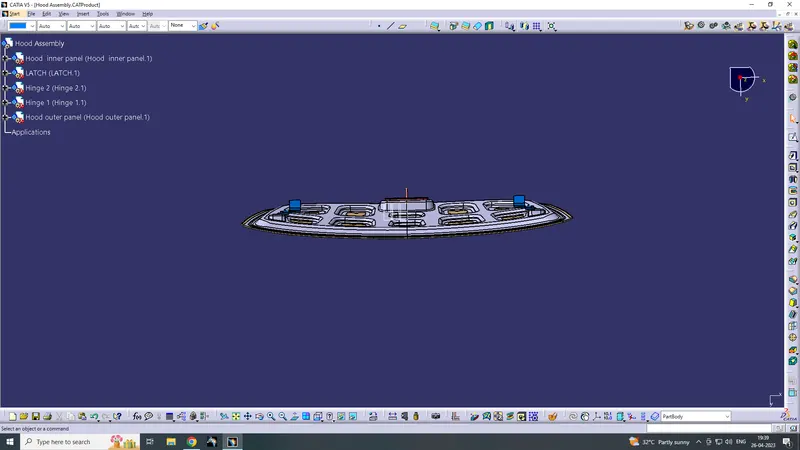
Final assembly
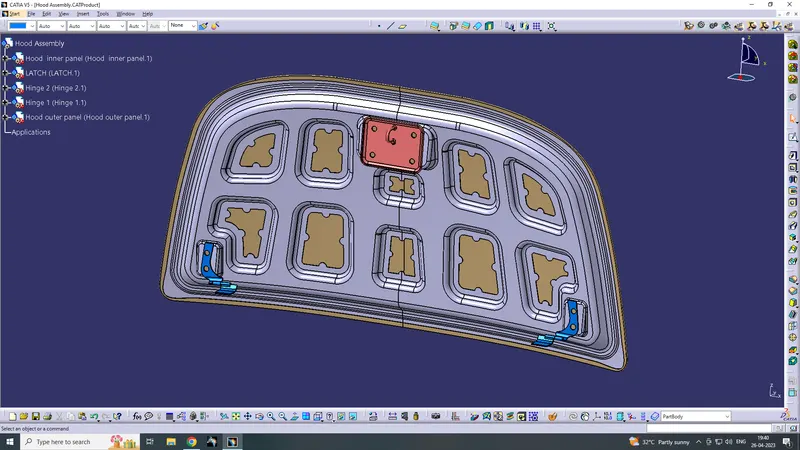
Conclusion
Thus, the hood is designed considering passenger and pedestrian safety as per the master section is successfully complete.