Hood design-Week 2
Detailed report on Hood Design
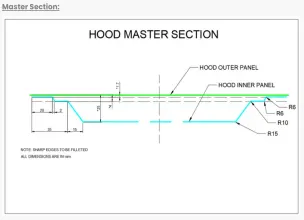
AIM- To Design Hood outer panel, inner panel and the necessary reinforcements by following the Master section mentioned with the design parameter, (Hinge,Striker) included.
Given data:
Design parameters to be considered.
- Outer Panel Thickness = 0.75mm
- Inner Panel Thickness = 0.75mm
- Reinforcement Thickness = 1.5mm
Master section:
INTRODUCTION:
A car hood (also known as a bonnet in some countries) is the metal cover that sits at the front of a car, protecting the engine and other internal components such as engine from external elements. It is typically hinged at the front and can be opened to allow access to the engine bay for maintenance or repairs. In addition to its functional purpose, the car hood can also contribute to the overall aesthetic design of a car.
A typical hood assembly consist of hood outer panel, inner panel, latch and striker, hinge, hood stay. Hood stay is an apparatus for supporting the engine hood of a motor vehicle in its open position. Hood are typically made of steel and aluminium. Deep drawing, hemming, blanking and piercing are the common sheet metal operations that are used in manufacturing hoods in automotive industries.
Hood design considerations:
- Opening Angle of Hood.
- Wrap Around Distance (WAD) for Pedestrian Safety.
- NVH (Noise, Vibration, Harshness).
- Latch and striker point
- Hinge axis
- Easy access intoengine compartment
- Frontal Crash impact forces absorption
- Good Aesthetic appearence
Opening angle:
And opening angle is most important factor while designing hood and it varies from person to person and country to country.In India, the average height of a person is 5.5 feet whereas in the European countries the average height is 6 feet, these points refers variation in opening angle of hood.Opening angle is considered as an important criteria, when the opening angle is less than required there are possibilities of human head injury.Common types of hood stays are Support Rod and Gas Stay.Support rods are manually operated and they are cost effective and simple to design whereas gas stays require no man power but they are costly.
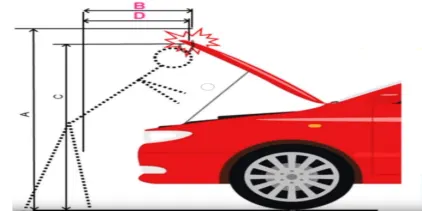
Common types of hood stays are Support Rod and Gas Stay.
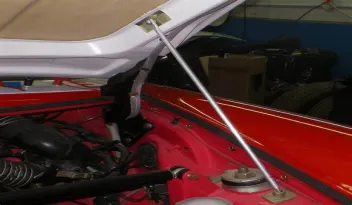
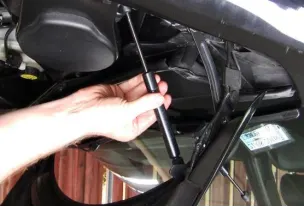
Hood stay Gas stay
Wrap Around Distance (WAD):
When a car crashes on the pedestrian, the whole human body wraps around the front shape of the car, and the head impacts on the bonnet or the windscreen. The distance at which the head impacts on the car from the ground is mentioned as wrap around distance (WAD).To be specific the Wrap Around Distance is a measurement of the distance from the ground to the head impact zone over the outer surface of the car. The wrap around distance is measured longitudinally in the centre of the vehicle from the ground.
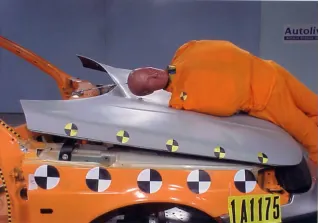
Noise, Vibration, Harshness (NVH)
Noise, Vibration and Harshness (NVH) is the study and modification of the noise and vibration characteristics of vehicle, particularly cars and trucks. To improve NVH, mastic sealants were provided on the inner panel to attach with outer panel. Here mastic points on the inner panel plays a major role to avoid Noise and Vibration into the cabin. NVH is measured by the instruments, namely microphones, accelerometers and force gauges, or load cells.
The hood or the Bonnet consists of the following parts:
- Hood outer panel
- Hood inner panel
- Re-enforcement
- Latch and Striker
- Hinges
Components
1.Hood outer panel
The car hood outer panel, also known as the car hood skin or car hood cover, is the visible outermost layer of the car hood that faces the outside of the vehicle. It is typically made of metal, such as steel or aluminum, and is designed to protect the engine and other components under the hood from debris, weather conditions, and collisions. It is the styling team who provides the skin for the outer panel. The shape, position and size of the hood should satisfy the safety norms. So while designing the hood we should give more importance to pedestrian safety. The outer panel is attached to the inner panel by hemming process because of outer panel panel aesthetics. We also provide mastic sealants between outer panel and inner panel to reduce vibration.
1a)Hemming
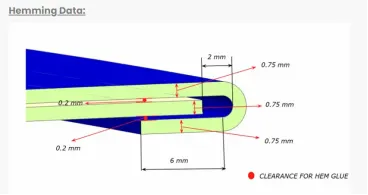
Hemming is a forming operation in which the edges of the sheet are folded or folded over another part in order to achieve a tight fit.The accuracy of the hemming operation is very important since it affects the appearance of the surface and surface quality. Material deformations, which occur during the hemming process, can lead to dimensional variations and other defects in parts. Typical hemming defects are splits or wrinkles in the flange, material overlaps in the corner areas or material roll-in. This is why it is important to provide required reliefs at the corners.
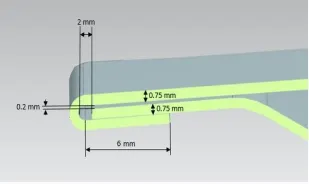
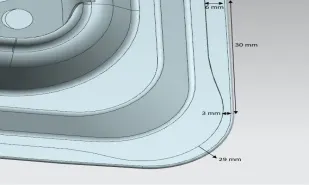
Hemming process Corner relief
There are two types of hemming operations,
- Conventional die hemming
In conventional die hemming, the flange is folded over the entire length with a hemming tool.
- Roll hemming
The roll hemming process involves two metal sheets that are joined together, with one sheet overlapping the other. A set of rollers is then used to gradually bend and compress the edge of the top sheet over the edge of the bottom sheet, creating a tight and uniform seam.This process can be performed manually or with the use of specialized machinery.
Roll hemming is often preferred over other hemming techniques, such as spot welding or adhesive bonding, because it provides a high-quality finish that is both strong and visually appealing. Additionally, it can be used to join dissimilar metals and is particularly useful for creating complex shapes and curves.
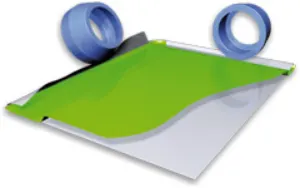 Roll hemming process
The roll hemming process requires skill and precision to achieve the desired result, and operators must be careful to avoid wrinkles or other defects in the finished product.
1b.Mastic Data
Hood commonly possess large surface area and hemming can only be provided through its boundary. We cannot use other joining techniques like welding, riveting etc because they leave marks on the outer panel which spoil its aesthetic appearance. So, mastic sealants are used to stick the inner surfaces of outer panel and inner panel. Mastic sealants are elastic compound that behave like rubber. It is applied between the inner and outer panels at specified spots. Each spot of mastic sealants has its effect around a circular region of 80mm diameter. Thus, the mastic points are arranged in such a way that it covers the areas away from the hemming which are more vulnerable to vibrate.
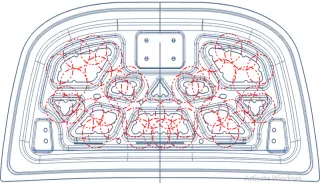
2.Hood inner panel
The car hood inner panel is the sheet metal panel that is located on the underside of the hood of a car. It is typically made of steel or aluminum and serves as a reinforcement for the hood, helping to distribute impact forces in the event of a collision. The inner panel also provides a surface for attaching insulation materials to reduce engine noise and heat transfer and also inner panel is the part that gives strength and rigidity to the outer panel.
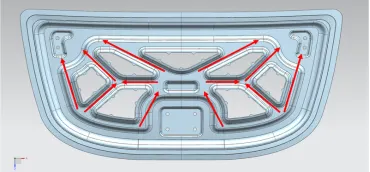
Embossing:
Throughout the inner panel we provide different embosses. We can increase the stiffness of the inner panel through these embosses. The shape and size of the embosses also determines the direction of the force distribution resulted from frontal collision. The force should be always distributed away from the passengers.
Deep drawing:
Deep drawing is a metalworking process in which a flat sheet of metal is formed into a three-dimensional shape using a punch and die. The process involves placing the sheet of metal onto the die, which has a cavity that matches the shape of the desired part, and then using the punch to push the metal into the die cavity. The metal is stretched and bent as it is forced into the die, and the resulting part takes on the shape of the die cavity.
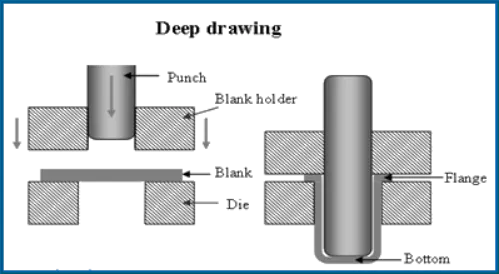
3.Reinforcement
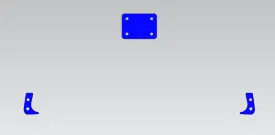
Reinforcements are provided according to the design requirements. Mainly it is provided at the hinge and latch regions to improve the strength locally. Usually thickness of reinforcements will be higher than that of the inner panels and the value varies according to cost and requirement.
4.Latch and Striker
In a car, the hood latch and striker are components of the hood locking mechanism that keep the hood securely closed while driving.The hood latch is typically located near the front of the car and is connected to the hood release lever inside the car. When the hood release lever is pulled, the latch releases the hood and allows it to be opened. When the hood is closed, the latch extends out and engages with the striker, which is a metal plate mounted on the car's body frame. The striker has a hole or groove that the latch fits into, securing the hood shut.
Position Of Striker And Hinge:
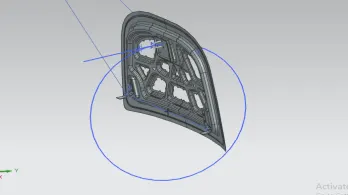
For the proper opening and closing of the hood, the striker should be perpendicular to the trajectory of the hood. For this, hinge is assembled at its position. Once it is placed, hinge axis is drawn.To check the hinge axis as the center we draw a big circle to the position the latch in such a way that it is perpendicular to the hood trajectory.
Latch Trajectory
The latch trajectory shows the path of the striker when the hood is opened and closed on a vehicle.The radius of the circular trajectory is determined by the set standard based on the average height of a person. The radius is measured from the hinge axis up-to the latch.
5.Hinges
The hinges of a car hood are the mechanisms that allow the hood to be opened and closed smoothly. They are typically located on the sides of the hood and are attached to both the hood and the car's body.
Final assembly of hood:
Conclusion:
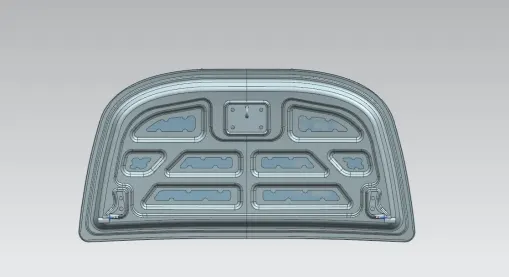
Final assembly of Hood outer panel, inner panel and the necessary reinforcements by following the Master section mentioned with the design parameter, (Hinge,Striker) is shown above.
Thank you
Syed Faizan