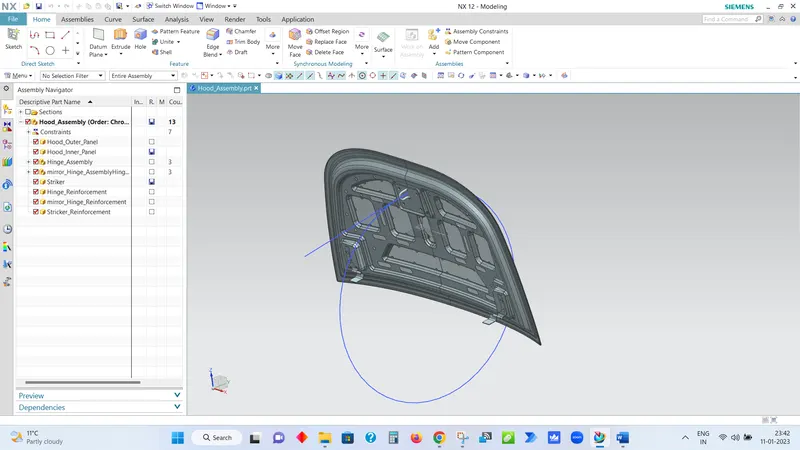
Hood design-Week 2
HOOD DESIGN
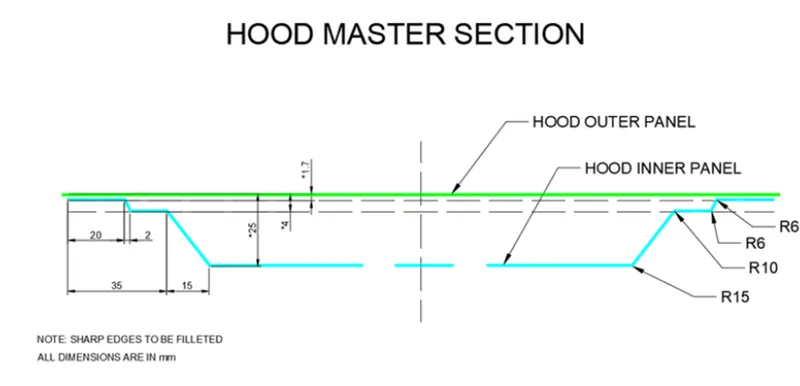
OBJECTIVE:- Design Hood Outer Panel, Inner Panel and the necessary reinforcements by following the Master Section mentioned with the Design parameters.
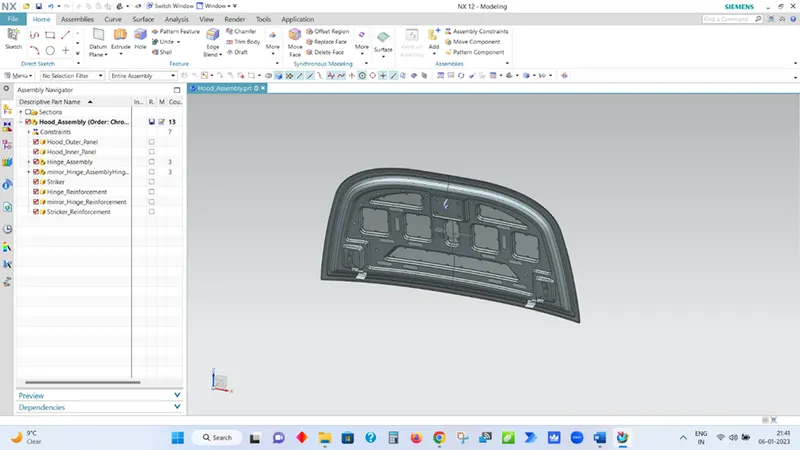
INPUTS
- Outer Panel Thickness = 0.75mm
- Inner Panel Thickness = 0.75mm
- Reinforcement Thickness = 1.5mm
Hemming Data
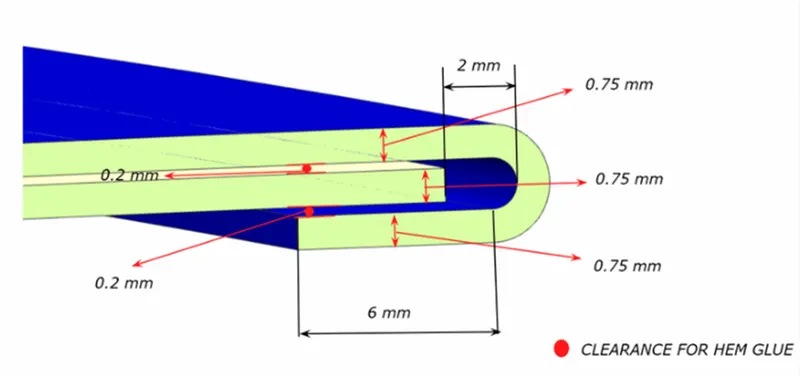
We have to follow the hemming data while creating hemming flange. 0.2mm clearance must be there on both side of inner panel for gluing or water proofing between inner & outer panel.
Hemming Relief
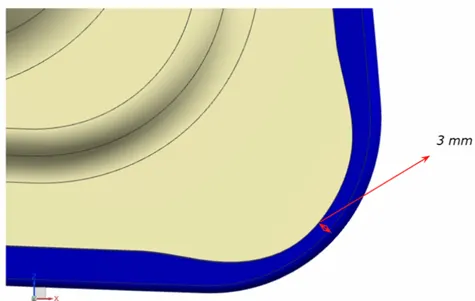
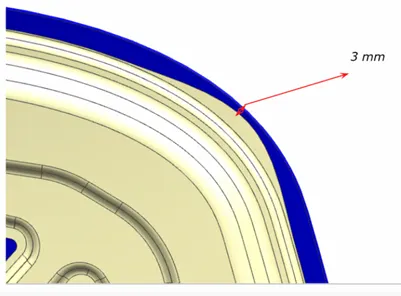
Hemming refief is provided at corners to pervent material deformation, Material overlap at corners while hemming operation.
Design Procedure
- Design of Inner Panel from outer panel surface data keeping in mind hood master section
- Design of Outer Panel
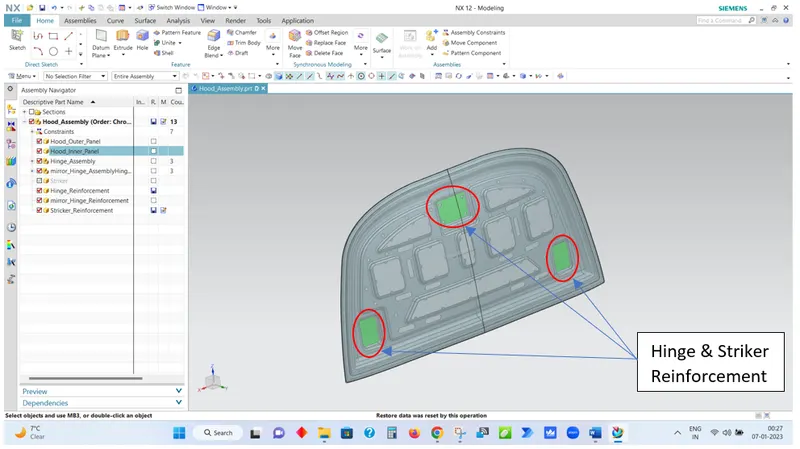
- Design of Hinge & Striker Reinforcement.
- Assembly of Inner, outer Panel & Hinge Assembly.
- Creation Of Hinge Axis
- Assembly of Striker with respect to Hinge Axis so that striker follows the hood Opening & closing trajectory.
Hood Design & its Main Component
Car hood, also referred to as a “bonnet” in some countries, is the hinged cover that rests over the engine bay of a front-engine vehicle. The car hood protects the engine and connected parts from the elements while providing easy access for repairs and maintenance.
Opening Angle of Hood
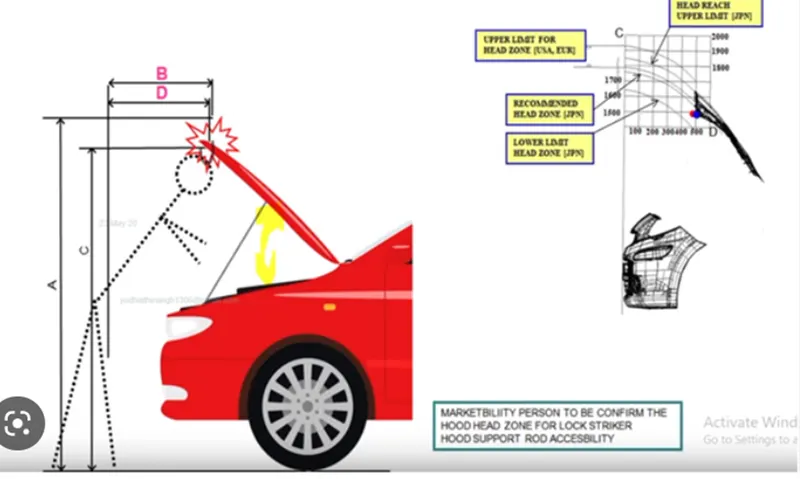
The first and formost requirement of Hood Design is to select the region for hood design for example Japan, USA, UAE.
The region will give you the idea of average hieght of people (Hood head Zone) living there which will help you to design lock stricker, Hood Support ( Support Rod or Gas Stay ) & Rod Accesibility.
The opening angle of hood should be enough so that it will not hit the head of occupant
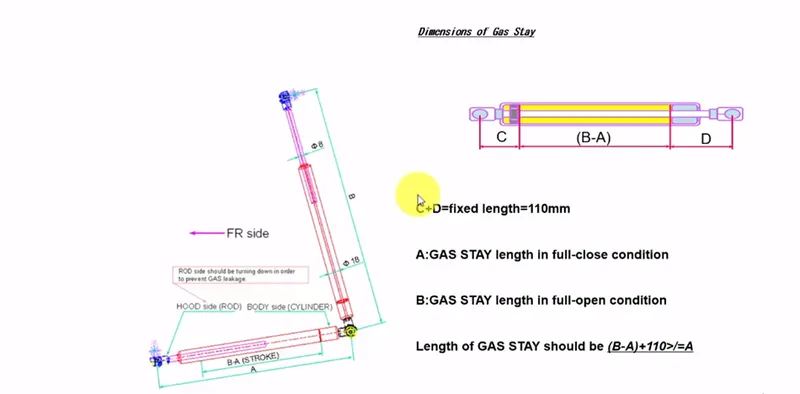
Hood opening angle can be controlled by the length of Support Rod or Gas Stay.
Design Consideration for Better Pedestrian Safety
Euro NCAP the European car assessment program is European car safety performance assessment program based in Leuven and founded in 1997.
They published safety reports on new cars and awards star ratings based on the performance of the vehicle in a variety of crash test including front side and pole impacts and impacts with pedestrian. The top rating is 5 star
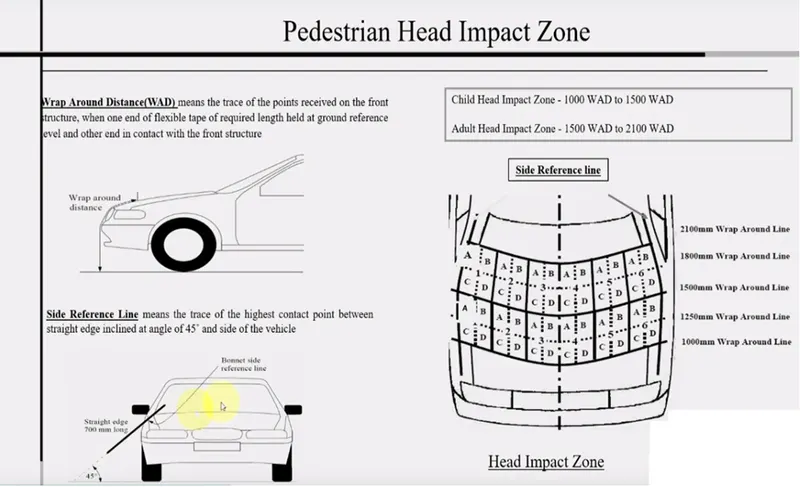
So here in Hood we separate the whole area of hood into several small part / region during frontal crash. Hood is the major portion a person is gonna come in contact with. So Euro NCAP specified some guidelines under which we distribute hood region into several parts and try to get more green region.
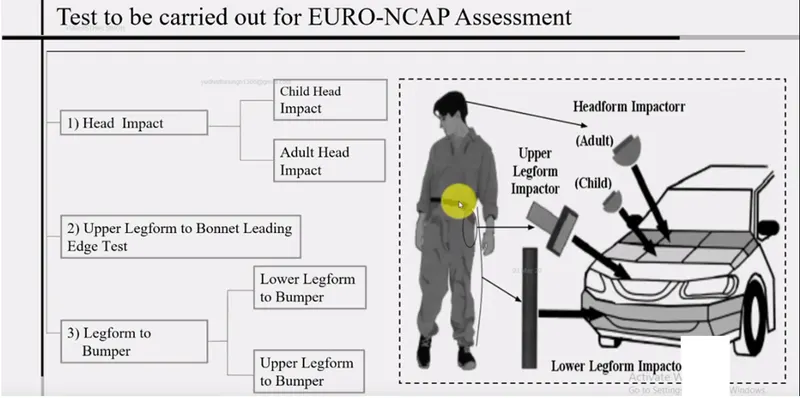
This region is basically distributed in relation to the height of children and adults who come in contact from front while accident. So, here the main motto is to achieve more green region and for that we provide splits in embosses so that during head impact the consequences of collision come less effective. So here I have given splits accordingly to improve head impact zone effectiveness in providing less damage to the person who hit it.
Under Hood Clearance
The distance of the hood outer from underlying hard points is 90 mm.
If the interference between outer panel and underlying components is more the impact on pedistrian hit by car is more. And head impact zone became red, as shown in figure.
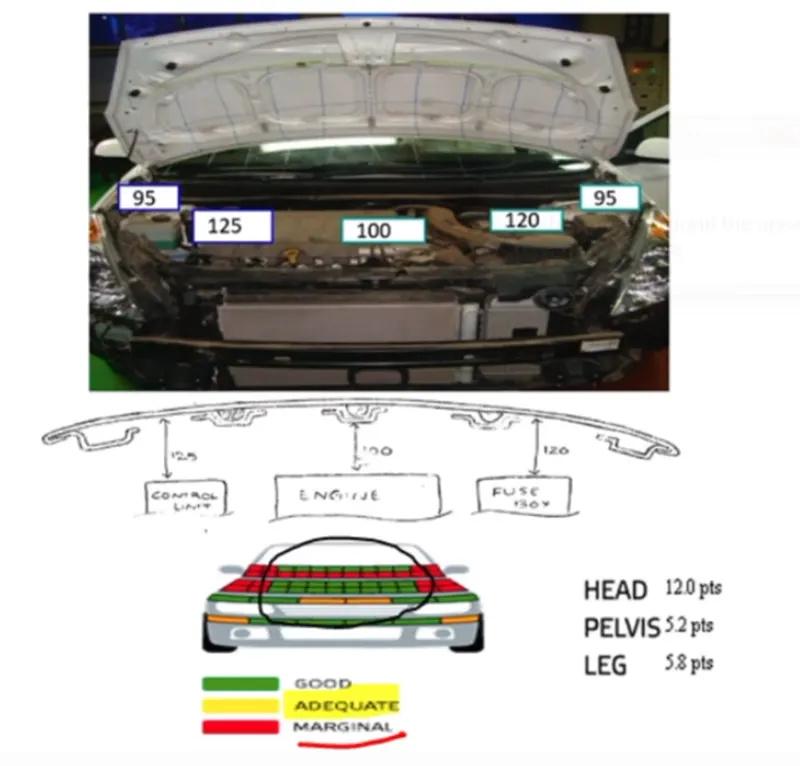
Impact deformation space should be generated below the styling surface.Package components that penetrate the generated deformation space are considered as critical and need to be relocated or turned to fullfill the HPC targets.
Deformable Mounting points.
Deformable mounting points act as passive safety feature.
Designing Deformable mounting points helps in dissipating the forces outside the vehicle while frontal crash to protect the occupant.
Hood Main Components
Inner Panel
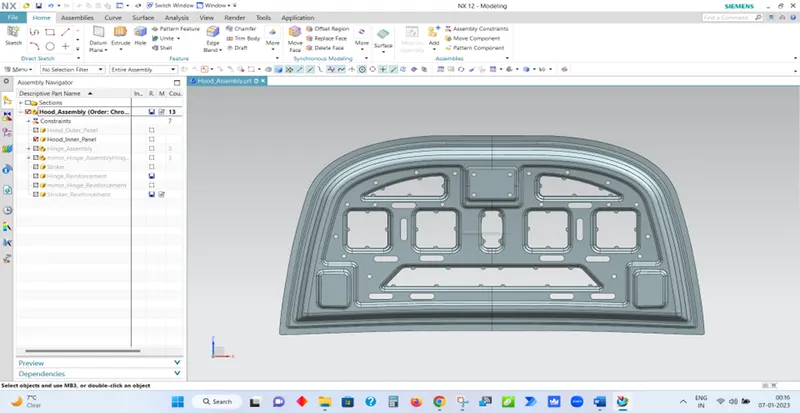
Inner panel is that part of hood which provides strength to Outer panel. Inner panel itself considered as biggest reinforcement in hood apart from hinge and latch reinforcement.
Outer Panel
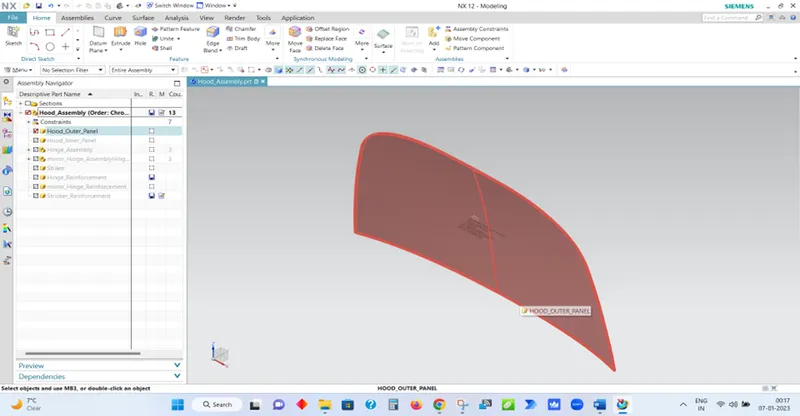
Design of outer panel is mainly inspired by aesthetic but there is some engineering also to it. Here main purpose of outer panel is to cover the inner panel to provide aesthetic look at the same time Panel must be curve & sleek so that it behave aerodynamically and air hitting from front reflect from it efficiently.
Gas stay / Support Rod (Hood stay):
Now after opening the Hood there need a support system to keep hood in elevated position. So that, one can access & work on the engine & other parts.
So, to fulfil this, Support Rod & Gas stay functions perfectly.
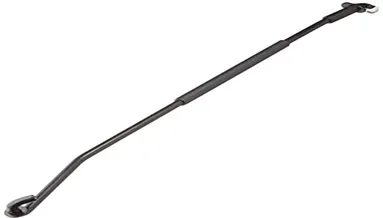
Support Rod - Support rod is basically long cylindrical rod. It safely keep an engine hood in an open state even if external forces are abruptly generated due to vibration & wind.
Advantages:
- It is Cost effective
- Simple
Disadvantages:
- When striking with the automotive body panel it leaves scars which are very likely to cause rust.
- The metal rod is often too hot to be gripped by hand when one attempts to keep the engine hood open for inspecting the engine room immediately after the vehicle has been stopped.
Design consideration of support rod:
- When hood is closed, during that the support rod will stay in place & positioned where it gets enough clearance to lay down & doesn't hit & create rattling noise while motion
- Support rod will always be placed opposite side of the battery’s position. So that it doesn't interfere with rod.
Ex- If battery is kept at left hand side then support rod will be placed at RHS.
- Now a straight support rod could wobble as the weight it is going to support would be around 8 to 9 kg. So a little deflection will be given in rod and design engineer has freedom to give it anywhere along the rod but the deflection shouldn't be more than 35 mm.
GAS STAY:
It is also a Hood stay but it is automated or need some slight amount of force then gas itself actuates it and make it work desirably.
Design of Gas Stay
Advantages:
- It is automatic in nature
Disadvantages:
- It is costlier
- Here below it is shown how gas stay looks like
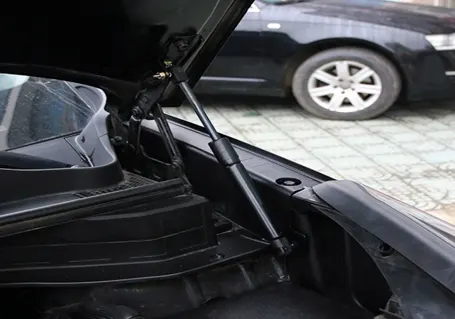
- So gas stay is a type of spring that unlike a typical mechanical spring that relies on elastic deformation, it uses compressed gas contained within an enclosed cylinder sealed by a sliding Piston to pneumatically store potential energy and withstand external force applied parallel to the direction of the Piston shaft.
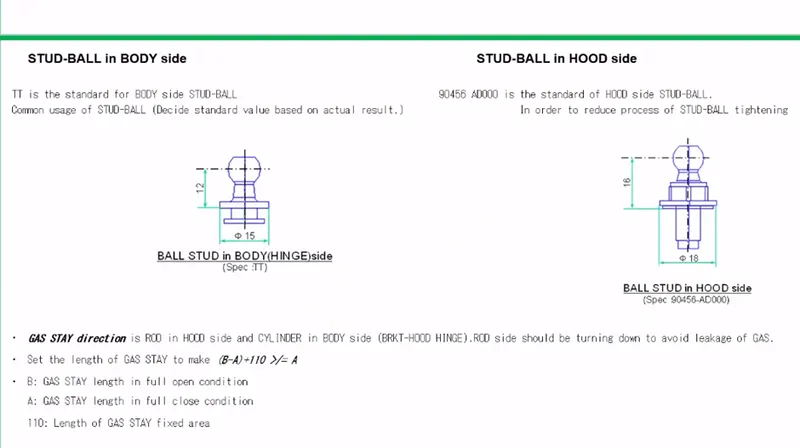
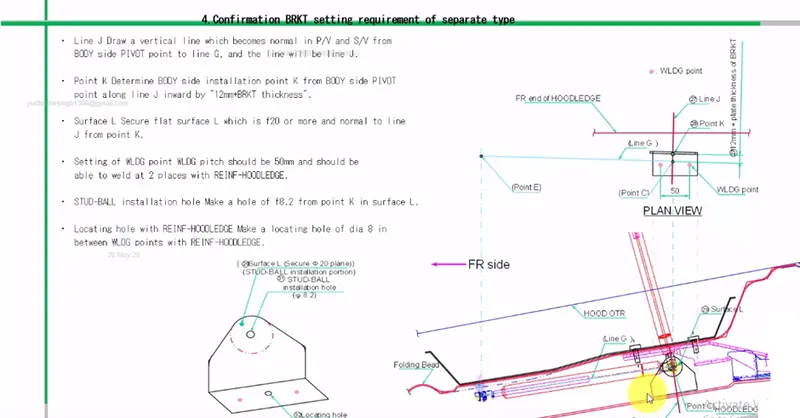
- In gas stay stud ball is used to connect it from the Hood and body from both ends.
- As gas stay is an additional component so we will use a bracket also for reinforcement to improve strength
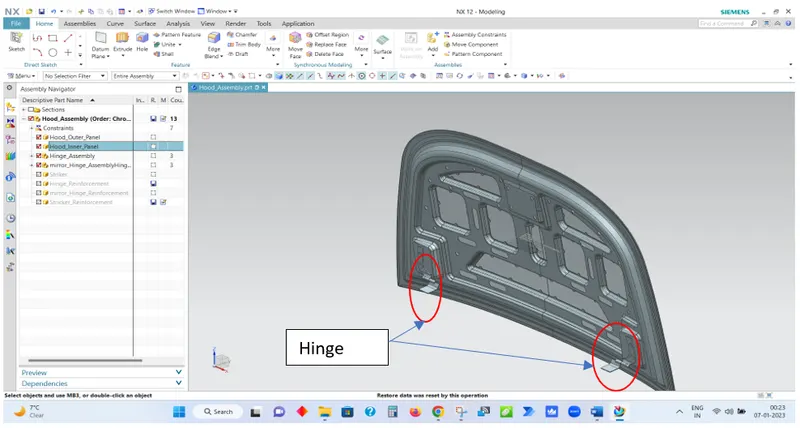
Hinge and hinge reinforcement
Hinge is a mechanical bearing that connects two solid objects typically allowing only a limited angle of rotation between them it has one degree of freedom. So here hinge is providing rotation to hood about it’s own axis and also keep it connected to the fender portion.
So while creating space for hinge we need to provide emboss there, because of emboss and hole its strength got affected so to compensate that we provide hinge reinforcement.
Hinge reinforcement has thickness around 1 to 1.5 mm to provide reinforcement to hinge embossed region.
Mastic Sealants
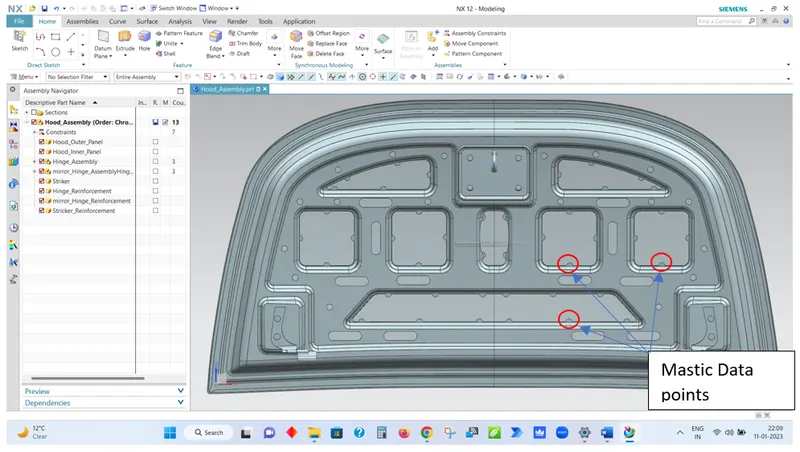
Mastci sealants/data are the type of rubber base adhesive used to join exterior automotive panels to the vehicle’s inner panel structure, such as on roofs, doors, and hoods. This one‐component synthetic rubber sealer remains elastic after curing to reduce panel flapping and to prevent panel distortion.
Advantages:
- Great application flexibility.
- Excellent adhesion to oily steel plates
- Ideal for aluminium panel bonding
- A formulation for virtually every need
Emboss
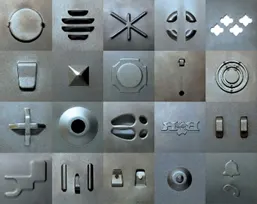
Sheet metal embossing is a stamping process for producing raised or sunken designs or relief in sheet metal. This process can be made by means of matched male and female roller dies, or by passing sheet or a strip of metal between rolls of the desired pattern.
the metal sheet embossing operation is commonly accomplished with a combination of heat and pressure on the sheet metal, depending on what type of embossing is required. Theoretically, with any of these procedures, the metal thickness is changed in its composition.
Deep drawing
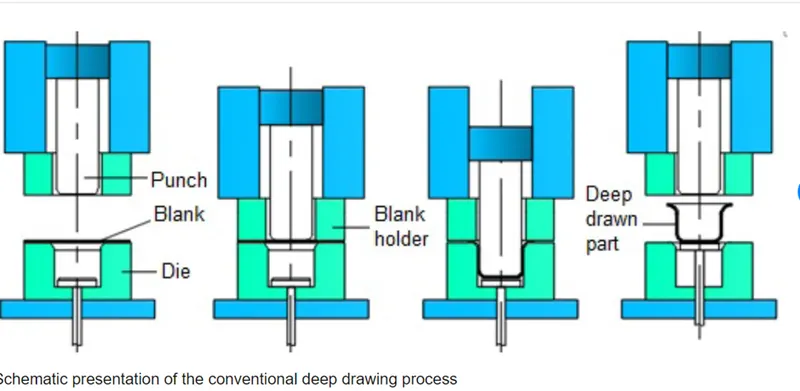
Deep drawing is a sheet metal forming process in which a sheet metal blank is radially drawn into a forming die by the mechanical action of a punch.[1] It is thus a shape transformation process with material retention. The process is considered "deep" drawing when the depth of the drawn part exceeds its diameter. This is achieved by redrawing the part through a series of dies.
Hemming
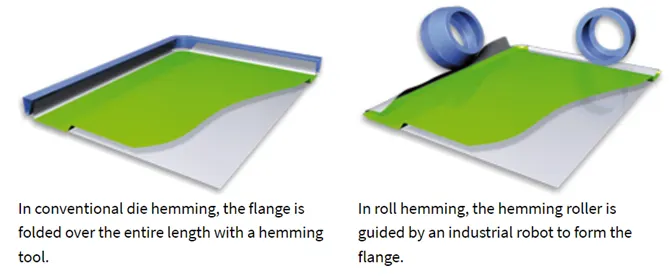
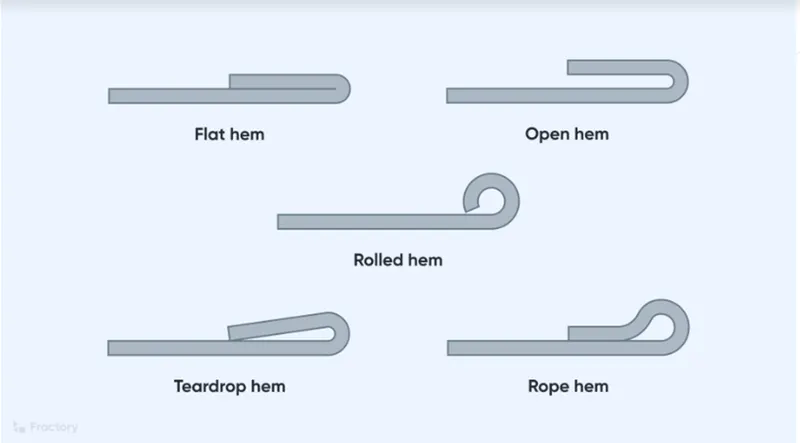
Hemming is a forming operation in which the edges of the sheet are folded or folded over another part in order to achieve a tight fit. Normally hemming operations are used to connect parts together, to improve the appearance of a part and to reinforce part edges.
In car part production, hemming is used in assembly as a secondary operation after deep drawing, trimming and flanging operations to join two sheet metal parts (outer and inner) together. Typical parts for this type of assembly are hoods, doors, trunk lids and fenders.
There are various types of hemming operations:
- Conventional die hemming
- Roll hemming
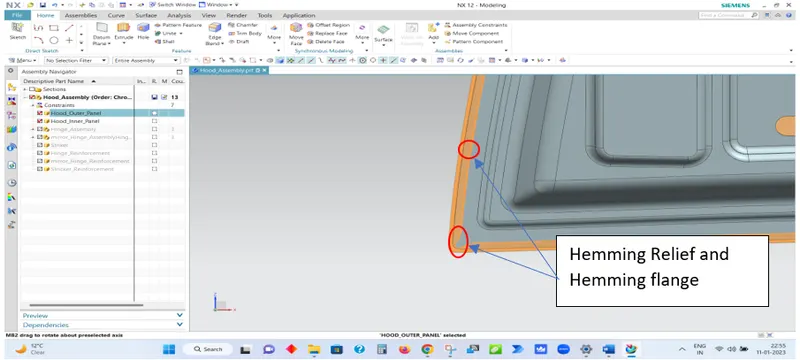
Hood Assembly