Hood design-Week 2
HOOD DESIGN:
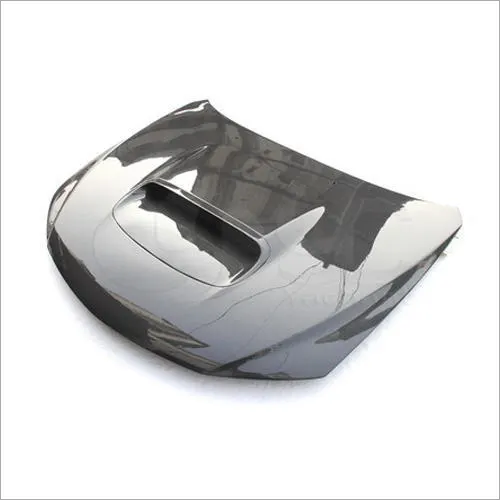
A Hood is a thin sheet that is hinged and covers the main body parts like engine and the battery.Its positioned at the outer most part of the car covering one of the majority portions in a car.Its main functions is to protect the major equipments from direct heat/sunlight and crash or hit by other vehice or pedestrian.It is also used to make the car look attractive and aerodynamically stable,it also gives an aesthetic look to car.Car hoods are typically constructed from steel and sometimes from aluminum. Aftermarket car hoods may be constructed from various other materials, including carbon fiber, dry glass etc.A hatch is placed in the inner pannel of hood to make it joined with the car so that it does not open every time.
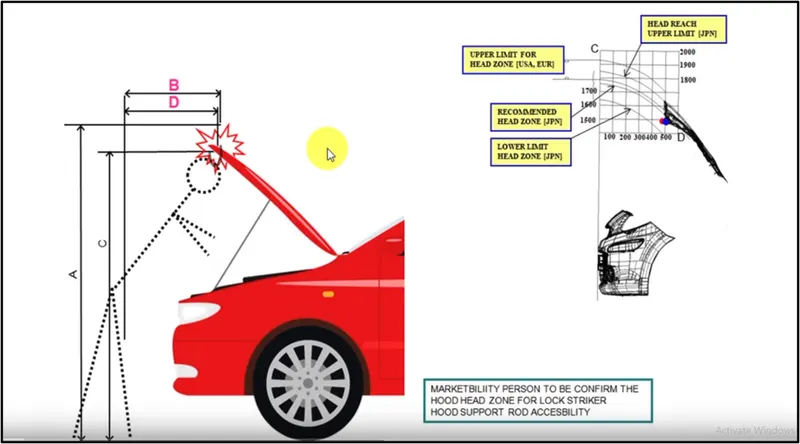
It should be noted that that there is a certain condition required for opening of the hood and it depends on the height of the person, meaning the height of the hood should be more than the average height of a person this is kept mandatory so that the person operating the engine should not collide or get hit with the hood.
 The
The
HOOD STAY:This is the support system of the hood it is used when then hood is opened and a support is provided,this is basically a rod which keeps the hood stable in open condition and does not bends or allow the hood to drop or fall.While designing this one should keep in mind that the support system should be self-sustainable to take the load of the hood even if any external force is applied it should facilate the opening and closing of hood easily.These are of two types:
a)Support Rod-
This is an image of Support Rod,this is a rod which that easily fitseasily inside the engine compartment and can be used whenever the hood is opened. This is present at an end opposite to that of the where the battery is installed.Initial bend have been provided in the rod to make it stiff thus capable of holding the weight of hood.
b)Gas Stay-
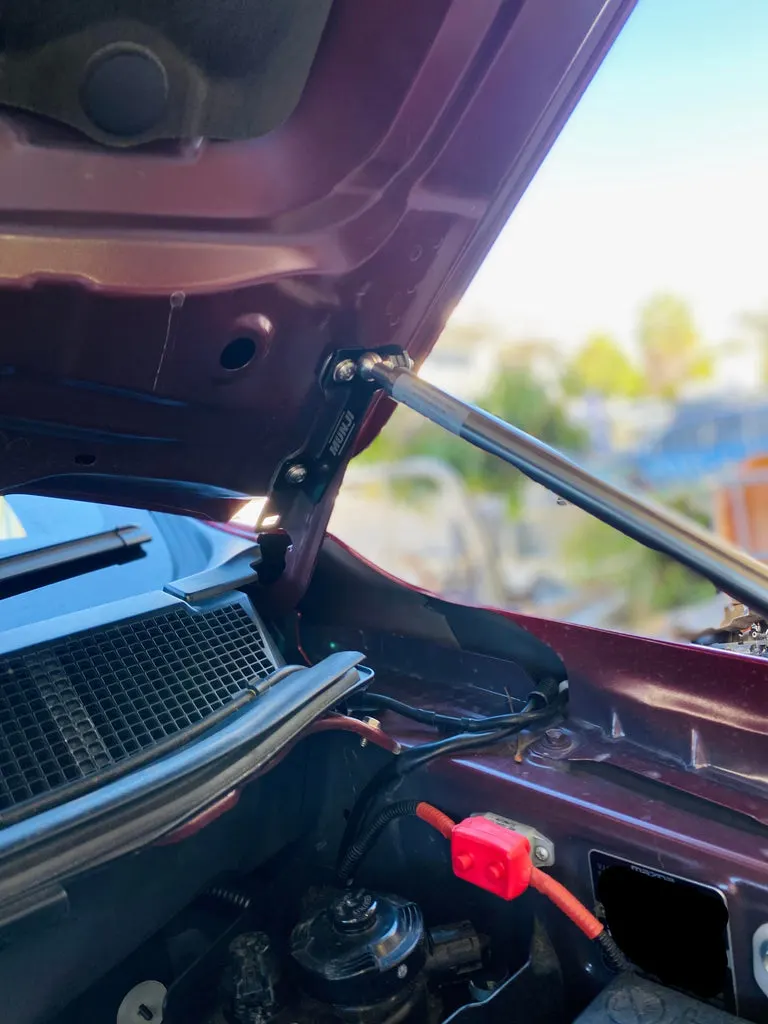
This type of apparatus is used in most heavy vehicles where the weight of the hood is more and it is difficult for a human being to open it conveniently. So, basically, a gas stay system uses gas-filled telescopic cylinders which only require an initial force to set it in motion.The rest of its operation is similar to that of a backdoor in a car.This is a more convinent method than support rod.
INNER HOOD PANNEL-
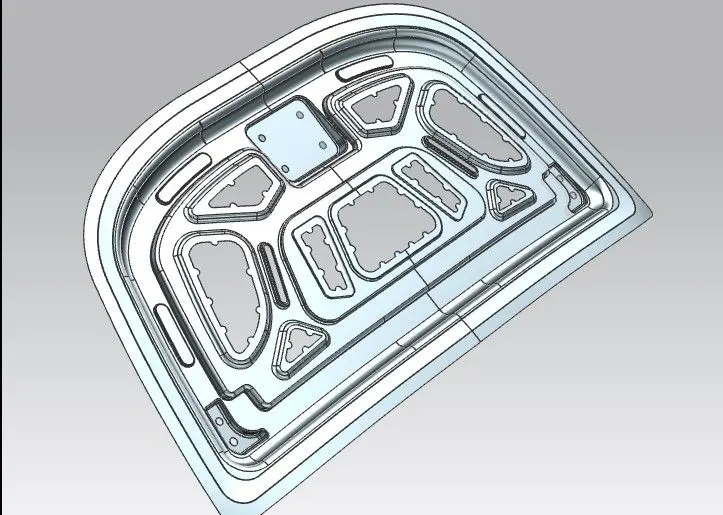
Hybrid hood inner panel for a vehicle is provided to improve rigidity, durability, and pedestrian protecting performance by comprising a composite structure in which a multi-cone structure and a frame structure are individually arranged on the front and the rear.It is one of the most important part of the hood which contains the latch,the striker and the embosses.The emboss section present in the inner panel of the hood is used to maintain proper force and heat flow in the car.Given below is an image describing the inner pannel of the hood
STRIKER:
This part is used for providing locking to the hood it consists of a latch-type mechanism and it is located on the inner panel of the hood to decide the position of our striker, the trajectory method is used with the help of this method we can easily locate our striker. This part holds our hood in closed condition unless it is being open by pulling the latch lever to open our hood.
OUTER HOOD PANNEL:
This is surface which covers the inner hood pannel and this is the surface on which the hemming process is done.It is that part of the hood which is visible from the outer side.Its depends on the size with respect to the cars that are made.
HINGE ASSEMBLY:
It is a very important part of the the hood assembly because of this we are able to open or close the hood easily.This should especially be strong so thst they can withstand the load of the hood hence its correct design and assembly is a very critical.
HEMMING:
They are a type of metal formin process in which the sheet metals are folded or made to fold.Normally hemming process are used to join two metal one beneath other and that too by using a special glue called hemming glue. In the car part production, hemming is used in assembly as a secondary operation after deep drawing, trimming and flanging operations to join two sheet metal parts (outer and inner) together. Typical parts for this type of assembly are hoods, doors, trunk lids and fendersThe apearance of the hon the outer paft .Material deformation that occur during hemming should be vey neat as its variation will case dimensional changes and maybe defect in some parts.Thre are two types of hemming process:Conventonal Die Hemming;Roll Hemming.
Conventional Die Hemming:This one is suitable for mass production .In this process the flanges folder over the entire length with the help of hemming tool.The process includes basically two types pre hemming and final hemming based on the opening of angles in the flange.
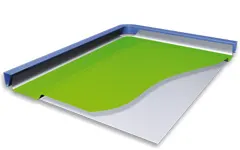
Roll Hemming:Roll hemming is carried out incrementally with a hemming roller. An industrial robot guides the hemming roller and forms the flange. Roll hemming operation can also be divided into several pre-hemming and final hemming process steps. Roll hemming is very flexible to use and tool costs are significantly lower as compared to those of conventional die hemming. However, the cycle times are much higher since the hemming is realized using a hemming roller which follows a defined path.

DEEP DRAWING:It is a sheet metal processin which a thick sheet of metal is drawn into forming die by the mechanical action of the punch.The process is considered "deep" drawing when the depth of the drawn part exceeds its diameter. This is achieved by redrawing the part through a series of dies. The flange region experiences a radial drawing stress and a tangential compressive stress due to the material retention property.Often components are partially deep drawn in order to create a series of diameters throughout the component. It common use to consider this process as a cost saving alternative to turned parts which require much more raw material.This process is divided into three types:1)Deep Drawing with tools(2)Deep drawing with active energy(3)Deep drawing with active means.
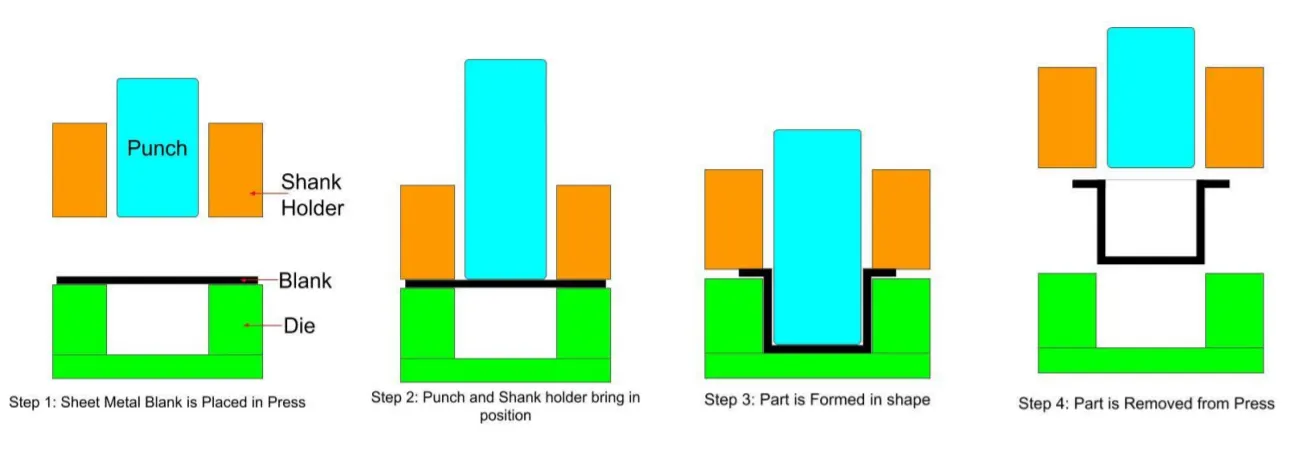
The above is an image that shows the Deep Drawing process.The rigid tools consist of a punch, die and binder. In deep drawing, the plate holder closes after the metal sheet blank has been inserted.Next, the sheet is clamped between the die and the binder. This process slows down the flow of the sheet while it is being drawn and thereby prevents wrinkles from forming under the binder. The punch stretches the sheet over the die radius and forms it in the die. The amount of punch force necessary for forming is thereby continually increased up to the lower dead center of the punch.When drawing complex car body parts in practice, there is usually a combination of stretch and deep drawing involved. It is necessary that the sheet metal is stretched as well as possible without reaching the material’s limits