Hood design-Week 2
Hood Introduction:-
The hood is a hinged cover of the engine of motor vehicles. Hoods can be opened to allow access to the engine compartment (or trunk on rear-engined and some mid-engined vehicles) for maintenance and repairs. In a prospective design, the hood should meet some specific conditions, such as pedestrian safety, hood head zone for the lock latch, frontal impact force distribution (occupant safety), manufacturability, etc. A typical hood assembly consists of an outer hood panel, an inner panel, a latch and striker, hinge, hood bracket. A hood support is a device for supporting the hood of a motor vehicle in its open position. It is the most critical part of the car, as it is constantly exposed to frontal impact, climatic conditions, heat generation in the engine compartment, etc. This allows access to the engine, battery and other components that must always be checked. at regular intervals. The inspection time may be for maintenance, repair or replacement of parts. The hood is a combination of an outer and an inner panel, and by design it also dissipates energy outside the car body.
Types of Support:-
They are two types support
i.Supprt rod.
ii.Gas Stay.
i.Support rod:-
A support bar is a device for supporting the hood of an automobile in its open position by means of a bar. It is mainly used where the weight of the hood is negligible. We have to lift the hood ourselves and place the support provided either in the hood or in the engine part.
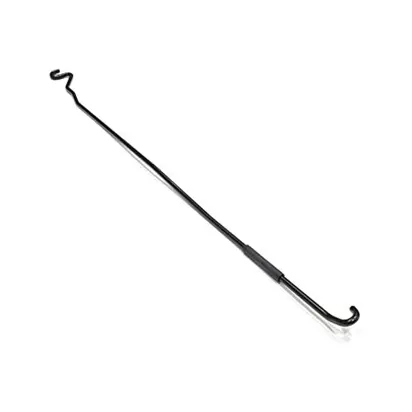
ii.Gas Stay:-
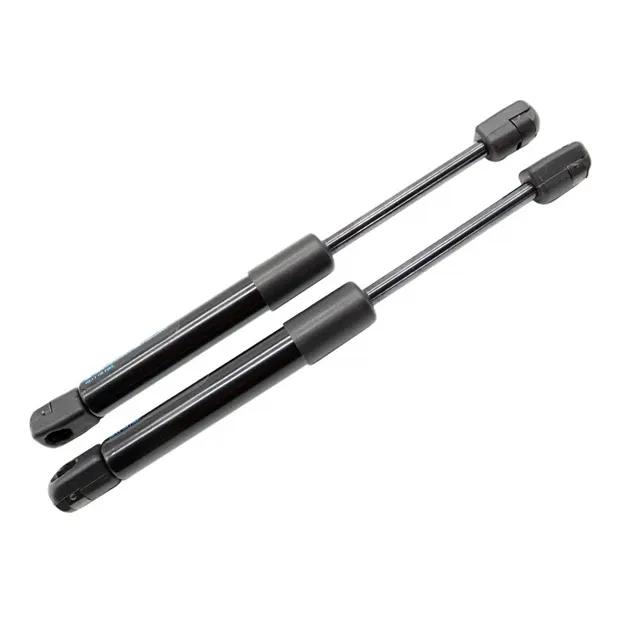
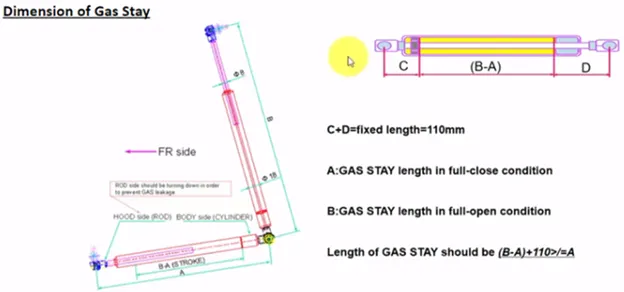
Gas Support A gas support is a device for supporting the engine hood of a motor vehicle in the open position using a gas-activated actuator. This is mainly used when the hood of the car is heavy. No man power is needed in this one. Spring struts are designed for use on lift-up doors; once the door is slightly open, the spring pushes the inlet to the fully open position. Euro fits a stock of different spring sizes depending on the door size requirement.
Desigen of Considiration:-
- Hood opening Angle:-
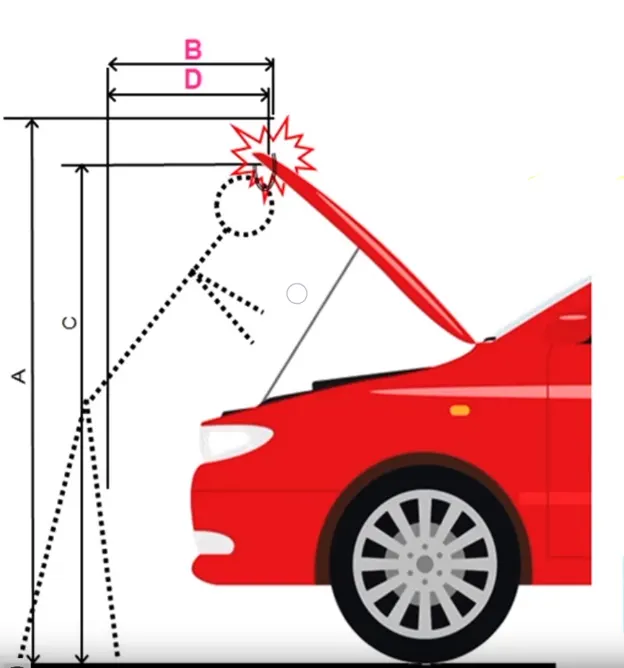
This criterion is the average height of people in the area under consideration. For example, the average height of a human being in India is 5.8 feet, while in European countries, the average height of a human being is 6 feet. The opening angle of the hood therefore greatly depends on the height of the person, which can be controlled using a support rod or a gas insert.
The opening angle is considered an important criterion because when the opening angle is smaller, there is a possibility of injury to the human head.By changing the length of the support rod, the opening angle can be changed.
Pedestrain Saftey:-
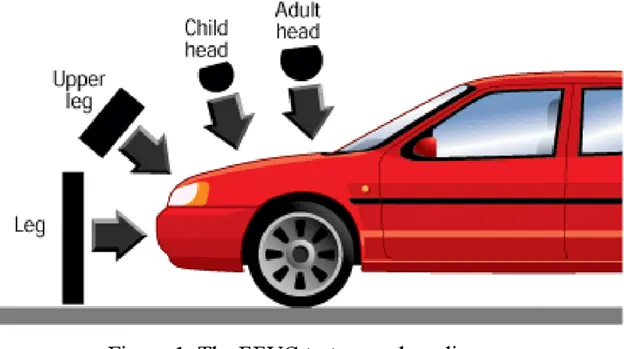
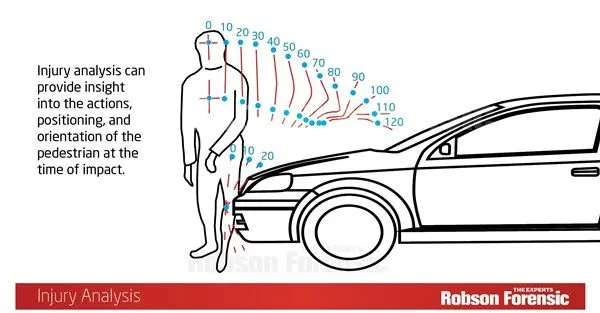
Pedestrian safety is an important consideration when designing a hood. A hood is designed according to the wrapping distance and the impact zone of the pedestrian's head. Safety is the most important criterion in the design of cars, which focus on the safety of pedestrians and passengers. Pedestrians are the most vulnerable road users and are exposed to a high risk of traffic accidents. The main cause of pedestrian death in a traffic accident is a head injury due to a hard impact of the head on a harder hood or the ground. This leads to the need for a new inner hood panel that is less stiff and more pedestrian-friendly. The area in the head impact area is softer to reduce the force of the impact in an accident.
Passenger Saftey:-
Whenever there is a frontal impact in a car, the hood will be the first part to be hit. It must be designed so that it does not come out of the body of the vehicle and should absorb as much energy as possible and dissipate the force towards the side panel of the car so that the magnitude of the force that is transmitted to the cabin is smaller, because the smaller the force, the less force will be applied to the passenger. passenger safety is ensured.

Manufactring Process:-
The following are the manufacturing steps to create the hood's outer and inner panels.
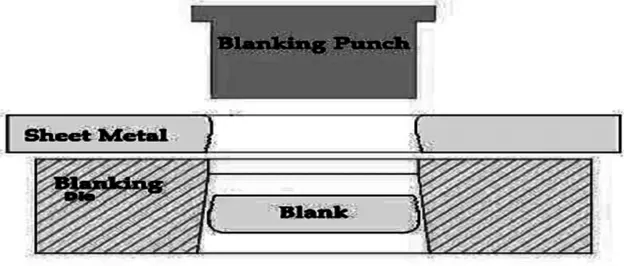
Punching: This is a process where the required sheet material for the production of the cover is punched out of a roll of sheet metal using a punching die. Pressing: The material obtained by punching is stretched using a punch. The die is designed according to the stamped design. This process is called deep drawing.
Component Of Hood Panel:-
i.Outer Panel:-
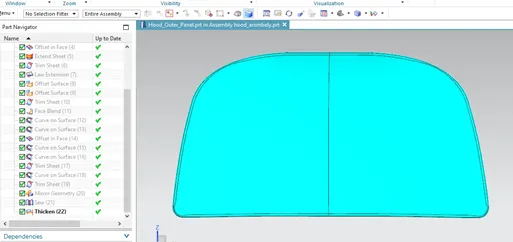
The hood panel of the car is one of the most important parts of the BIW (body in white), it is considered as the sheet metal cap of the cap. The outer panel has an aesthetic appearance, but itself is very weak and unable to handle the force of an impact. Most of the outer panels of the car hood are made of traditional steel plates, and their quality does not meet the needs of lightweight development. For this reason, it is necessary to achieve lightening effects by applying automotive aluminum sheets. The most widely used automotive aluminum alloys in the market are deformed aluminum alloys 6111, 6016 and 5182. The production process of the outer hood panel mainly includes punching, deep drawing, trimming, bending and side bending. Among them, deep drawing is a key process to ensure the quality of parts.
ii.Inner Panel:-
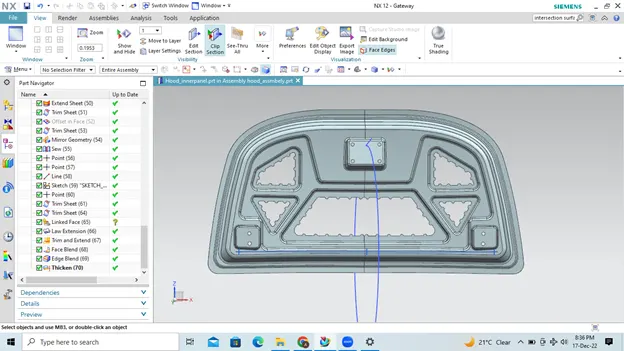
The inner panel of the hood is not visible to the customer, but it is a structural element of the outer panel. The hood panel is required to have a high initial reaction force against the impact exerted on the hood to increase the energy absorption capacity. The hood is also required to minimize the reduction in reaction force by deformations in a collision. The hood inner panel according to the invention includes a main body of the inner panel forming part of the hood of the vehicle, a front edge provided on the main body of the inner panel and extending in the width direction of the vehicle, and a rear edge provided on the main body of the inner panel, located on the rear side of the front foot and extending along in the direction of the width of the vehicle. The front foot includes a central portion in the vehicle width direction that is curved toward the front of the vehicle and is located in front of each end portion in the vehicle width direction, and the rear foot includes a central portion in the vehicle width direction that is curved toward the rear of the vehicle and located behind each end of the section in the direction of the width of the vehicle.
Embosses:-
We provide different reliefs all over the inner panel. With these moldings, we can increase the rigidity of the inner panel. The shape and size of the reliefs also determine the direction of distribution of the force caused by the frontal collision. The force should always be distributed away from the passengers. Here in the picture, the reliefs are designed so that the force goes to both sides of the car.
Manufacturing Considerations for Embossing:-
- The distance between the outer edges of the relief should be at least 5 mm.
- The draft angle should be provided with embossing using 7 to 9 easy removal of the part from the die.
- There should be no sharp corners in the embossing, which would lead to inefficient production.
- The height of the relief should not be more than 5 mm.
Mastic Point:-
The hood normally has a large area and the hemming can only be done across its border. We cannot use other joining techniques such as welding, riveting, etc., because they leave marks on the outer panel that spoil its aesthetic appearance. Thus, sealant sealants are used to bond the inner surfaces of the outer panel and the inner panel. Mastic sealants are elastic compounds that behave like rubber. It is applied between the inner and outer panels in the designated places. Each point of sealant has its effect around a circular area with a diameter of 80 mm. The sealant tips are thus arranged to cover areas away from the flashing that are more susceptible to vibration.
Renforcment:-
The zone near the bend and Latch has a higher chance of disenchantment in the hood panel. As a result, to prevent any failure during rotation and latching, the area is reinforced with special materials, the thickness of which is regularly controlled by the vehicle. The braces provide additional strength to the inner panel of the centers where various parts such as the lock and swivel will be placed. The bracing ensures that turns and bait have better support to prevent frustration.
Hinge:-
A hinge is a machine element that connects two bodies allowing angular movement around a fixed axis of rotation while preventing displacement and rotation in the other two axes. The hanger can be thought of as a radial bearing with only one degree of freedom where the shaft rotates in the hole. Hinges allow only one rotation, either swivel (most common), tilt or roll. Hinges are articulated and flexible devices that are attached to any swinging part. Hinges are mechanical bearings that are used to connect two swinging objects or points and give them freedom to move relative to each other. The hinges have limited movement, allowing the joint to move at only one angle and restricting other movements of the swing parts.
Striker:-
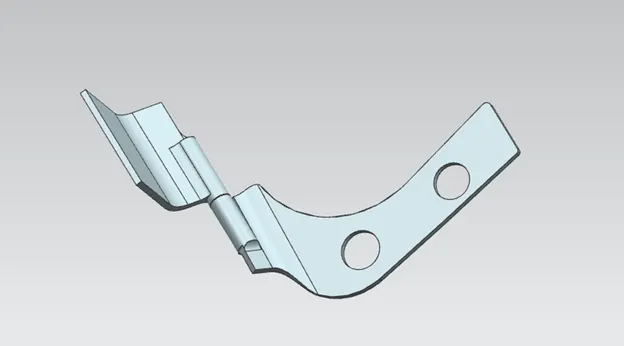
Latches are mechanical components that allow temporary connections between moving parts. They are operated to release the clutch and allow the two parts to separate. Latches are usually seen on cabinet doors and openings. They are also used in devices such as seat belts, clamps, straps and items with retractable parts. Different designs are characterized by different methods of operation, style of holding and mounting. The hood latch is very simple. When the hood is closed, the latch slides over what is called a latch and a spring covers the latch to keep it snug. When we pull the knob inside the car to open the hood, the hood latch cable opens the latch, allowing it to bypass the latch and open.
Latch Trajectroy:-
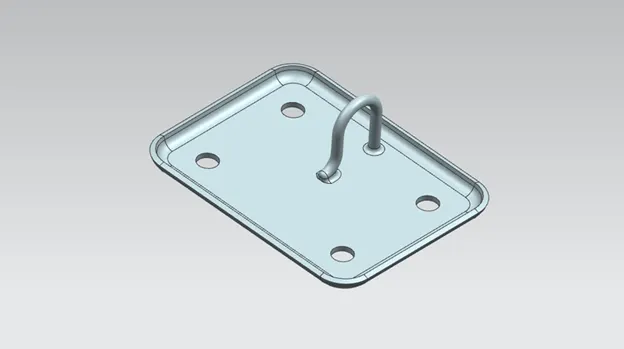
The latch trajectory shows the path of the firing pin when opening and closing the hood on the vehicle. The range of the circular trajectory is controlled by a set standard depending on the typical build of the individual. Range is estimated from the pivot hub to the latch. It is the trajectory on which the movement of the bonnet (opening and closing) depends. This circular trajectory has a radius equal to the length from the center of the hinge centerline to the latch point on the latch. The striker point is also tangent to the trajectory.
Hemming:-
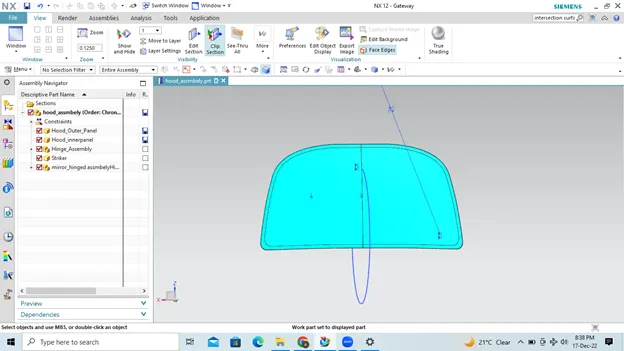
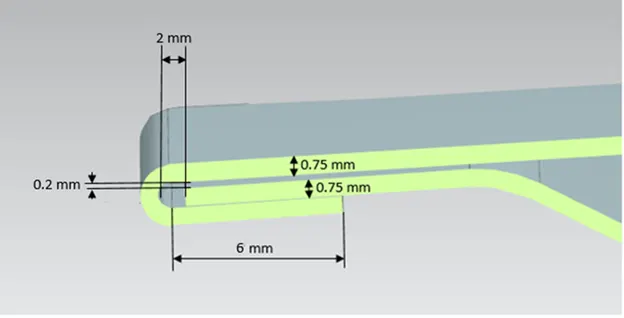
The hemming process involves joining the outer and inner panels of the hood by bending their corner curved areas 180 degrees. The sheet is also provided with a certain corner relief in order to be positioned so that the rollers that perform the hemming of the sheets can conveniently roll in the desired area. Flaring is a sheet metal operation widely used in the automotive sector, as the welding or joining process cannot be performed on styling parts as it may affect the aesthetics of the car.
Reliefs:-
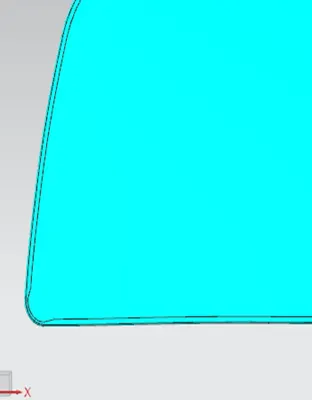
Reliefs are formed on the front and sides of the panel for smooth rolling, so that the sheet does not tear when the roller passes through a certain part.
Final Assmbely:-
Conculsion:-
The hood is designed with passenger and pedestrian safety in mind as the main section is successfully complet & i learned how to design the hood inner panel, outer panel using master sketch and styling surface. And he also learned how to assemble the hood inner panel, outer panel and stiffeners like latch and hinge assembly.