Hood design-Week 2
Objective
To design hood outer panel, inner panel, and reinforcements with the given outer hood skin, master section, and design parameters.
Hood Assembly
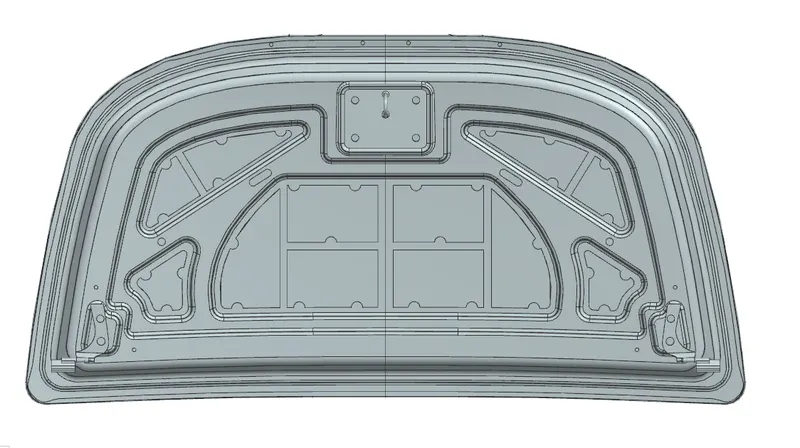
Figure 1: Assembly of Hood
Data to be used:
Hood Thickness Information
1. Outer Panel Thickness = 0.75mm
2. Inner Panel Thickness = 0.75mm
3. Reinforcement Thickness = 1.5mm
Introduction
A car hood is a hinged cover that provides access to the engine for repair and maintenance. A Latch is used to hold down the hood. The hood is made from steel and sometimes from aluminum. Other materials, including carbon fiber, fiberglass, or dry carbon can also be used to make the hood. The hood design varies from one model to another. Modern hood designs are made in accordance with pedestrian safety so that a minimum head injury during a collision with a motor vehicle should occur. Such designs may include a multi-cone inner hood panel design. The design of the hood is also important as it affects the aerodynamic flow of air around the car.
The hood consists of the following parts.
1. Hood Outer Panel - The outer panel is exposed to the environment. Aerodynamic airflow and pedestrian safety are given importance while designing the hood. The Hemming process is used to attach outer and inner panels together. So, Hemming flange and reliefs are provided on the hood for hemming operation. Mastic sealants are provided between the outer and inner panel to reduce vibration.
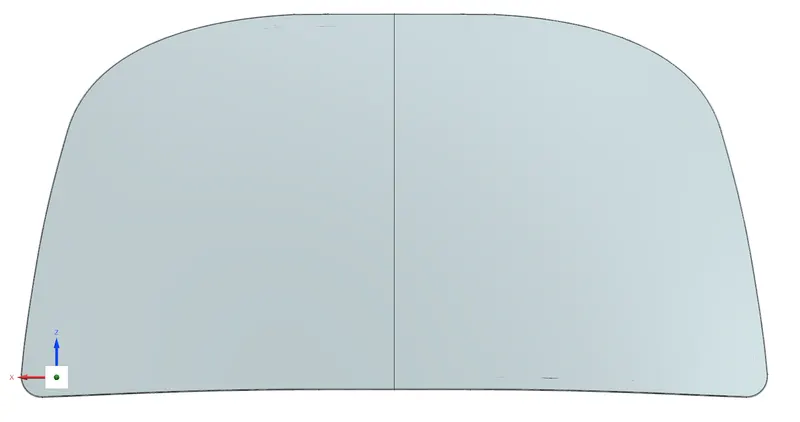
Figure 2: Hood outer panel
2. Hood Inner Panel - Inner panel gives strength and rigidity to the whole Hood assembly and decides how the forces will be transmitted to the car during a collision. The Latch and Hinge parts are fixed to this part. Embosses are provided to attach the Latch and Hinge to the inner panel. The inner panel is designed in such a way that it should be lightweight and at the same time provides enough strength to the car to withstand collision and provide passenger safety. As some materials are removed from one part, extra materials are provided to other parts to maintain strength.
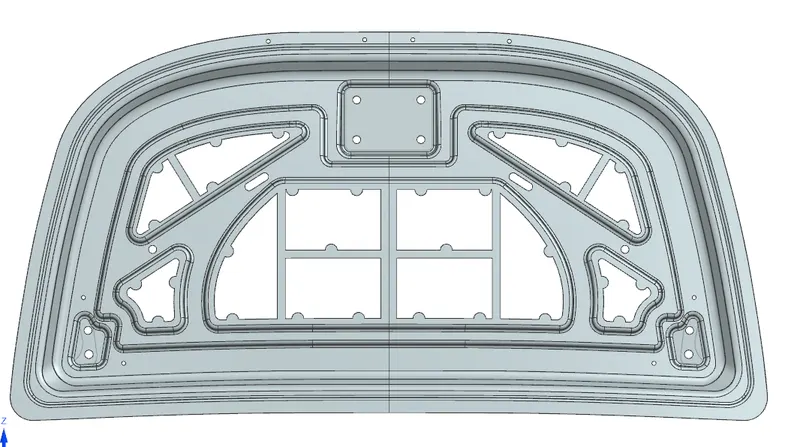
Figure 3: Hood inner panel
3. Latch-Striker and Hinge reinforcement - Reinforcements are provided according to the design needs. As some materials are removed from one part, it becomes necessary to provide reinforcements. It is mainly provided to regions where latch and hinge are attached to improve the strength. The thickness of reinforcements are usually given higher than the thickness of the inner panel
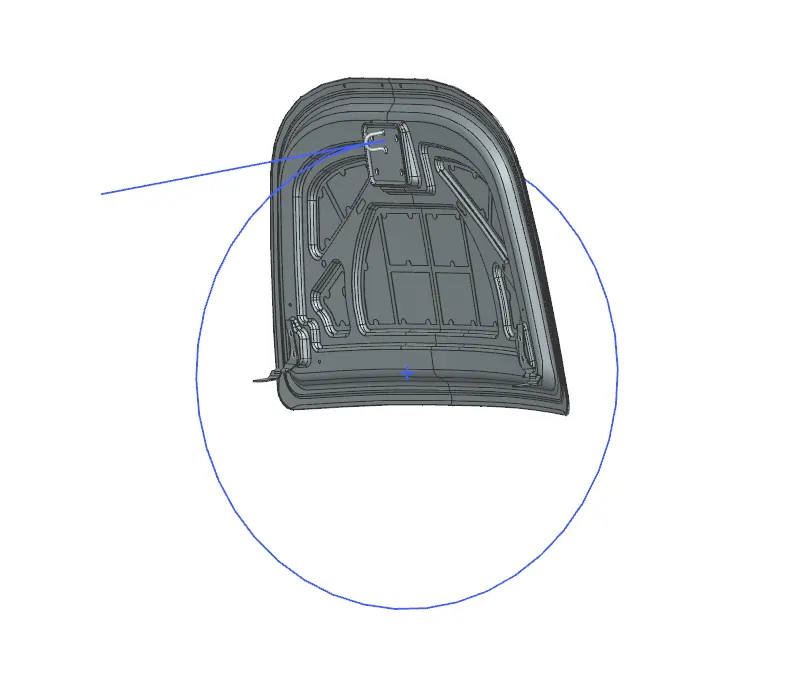
Figure 4: latch and Hinge reinforcement with trajectory
Latch Trajectory
Through the center point of the line joining the two Hinge Assembly a circle of approximate radius is drawn. Also from that point a straight line is drawn coinciding with the circle trajectory and to attach the Striker, the striker axis is made tangent to this meeting point.
Emboss
If we carefully see the Inner panel, we can observe a lot of Embosses. These emboss increase the stiffness of the Inner Panel and the way these embosses are made is very important as it determines the force distribution when the Car collides with other objects. The force direction should always go out from the Hood so that passenger safety is ensured.
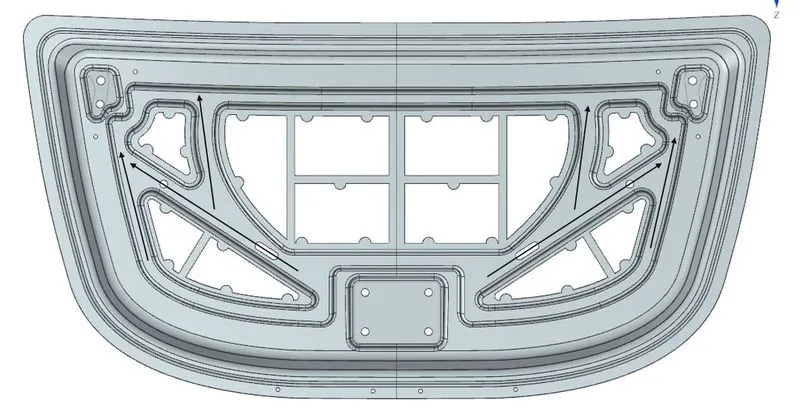
Figure 5: Emboss
Mastic Data
Mastic sealants are used to stick the inner and outer panels. Other joining techniques like Welding, rivering can't be used as these techniques don't provide a smooth surface finish and will leaves marks on the panel which will spoil the appearance of the car. These sealants are an elastic compound that behaves like rubber. These sealants are provided at certain spots in the hood and effects a region of 80mm diameter. The aim is to cover as much area as with these sealants so that Vibration will reduce and less noise will be produced during the journey.
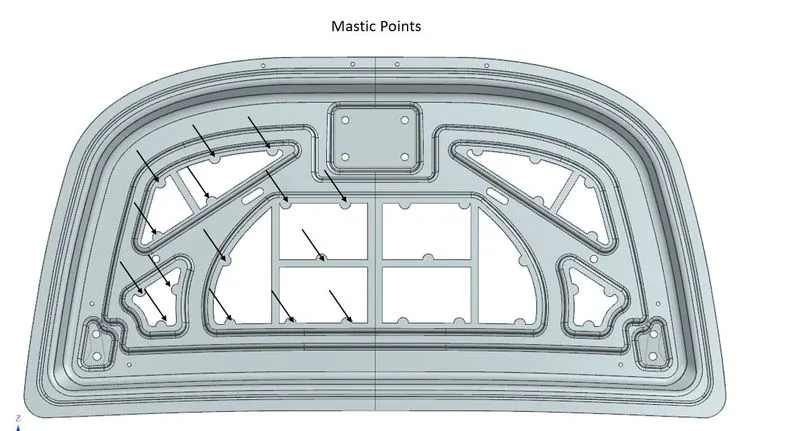
Figure 6: Mastic points
Hemmig
Hemming is a forming operation that allows the edges of the sheet to get folded over each other so that a tight fit is achieved. The hood outer panel sheet is folded over the hood inner panel. The car's outer appearance is significantly affected by this operation. So, it is a very critical factor in the final quality of the car hood.
Hemming is performed to:
1. Achieve a better final geometry in the vehicle´s part
2. Add resistance and rigidity to the part
3. Allow safe handling of the part
Types of Hemming process
1. Press Hemming
2. table top Hemming
3. Roller Hemming
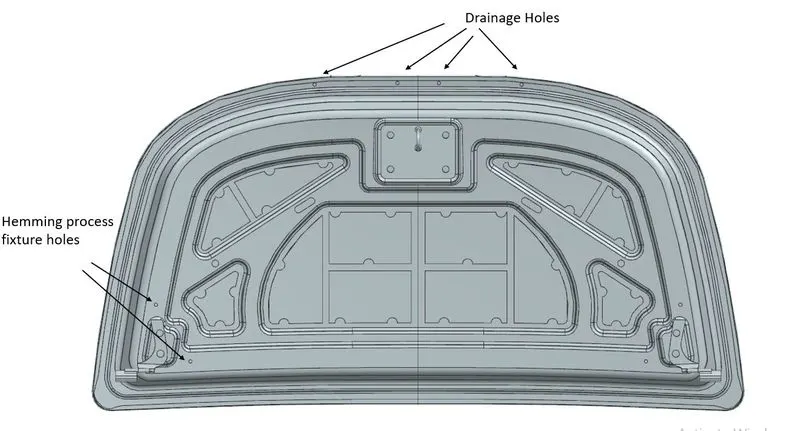
Figure 7: Hemming
Deep Drawing
Deep drawing is a widely used process in sheet metal forming. Here, a sheet metal blank is radially drawn into a forming die by the mechanical action of a punch. This is also known as the shape transformation process. The process is considered "deep" drawing when the depth of the drawn part exceeds its diameter. The part is redrawn with the help of series of dies. The flange region experiences a radial drawing stress and tangential compressive stress due to the material retention property. These compressive stresses result in flange wrinkles. Wrinkles can be prevented by using a blank holder, the function of which is to facilitate controlled material flow into the die radius.
Deep drawing processes are divided into three types:
1. Deep drawing with a tool
2. Deep drawing with active means
3. Deep drawing with active energy
Front and Rear Relief
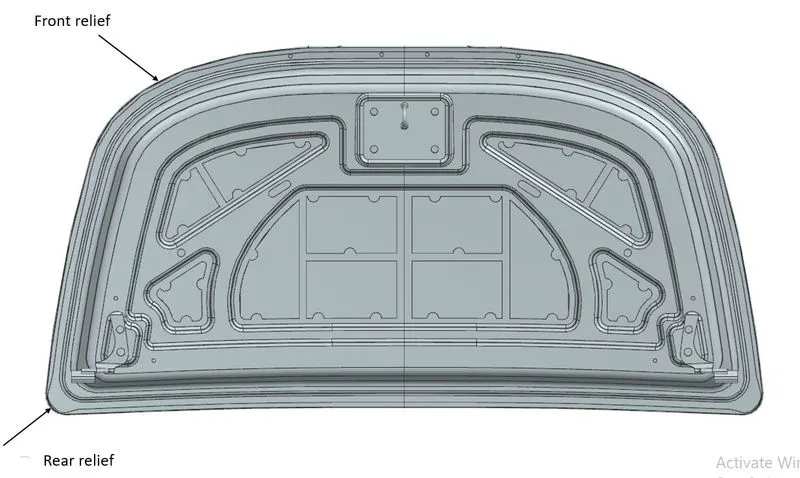
Figure 8: Front and rear relief