Benchmarking
Q.1. & Q.3. Parameters/Requirements:
a. Price - 8 Lakh to 10 Lakh
b. Seating Capacity - 5 People
c. Approximate Distance Travelled in a month - Assuming he works 22 Days and his daily traveling for work is 30Km. Also, he goes with his family out on weekends (taking it as 100 Km). So, the total approximate distance traveled is (22*20 + 500 + 100 = 1040 Km).
d. Mileage
e. Power
g. Engine
h. Fuel Type
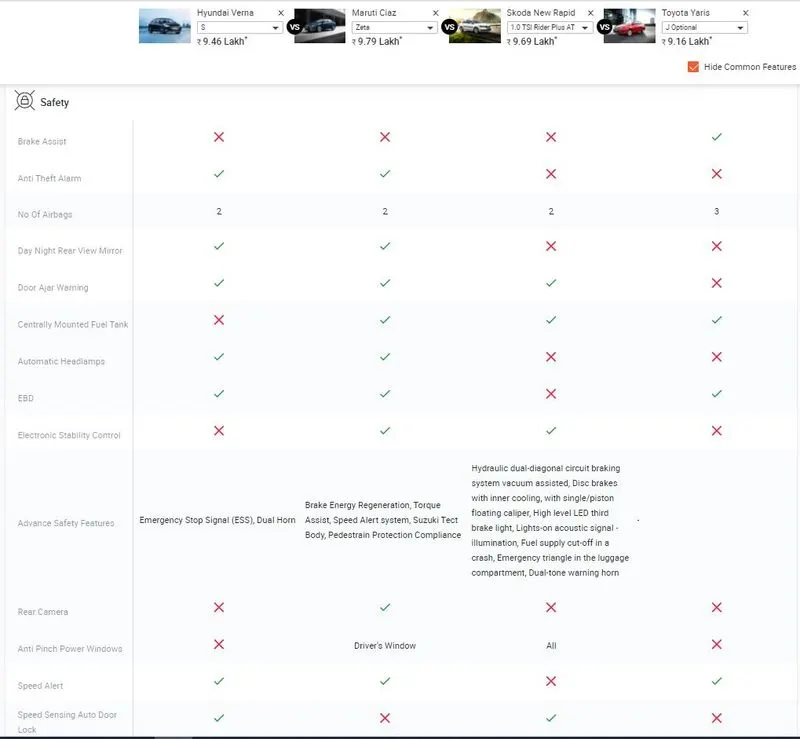
g. Safety Features
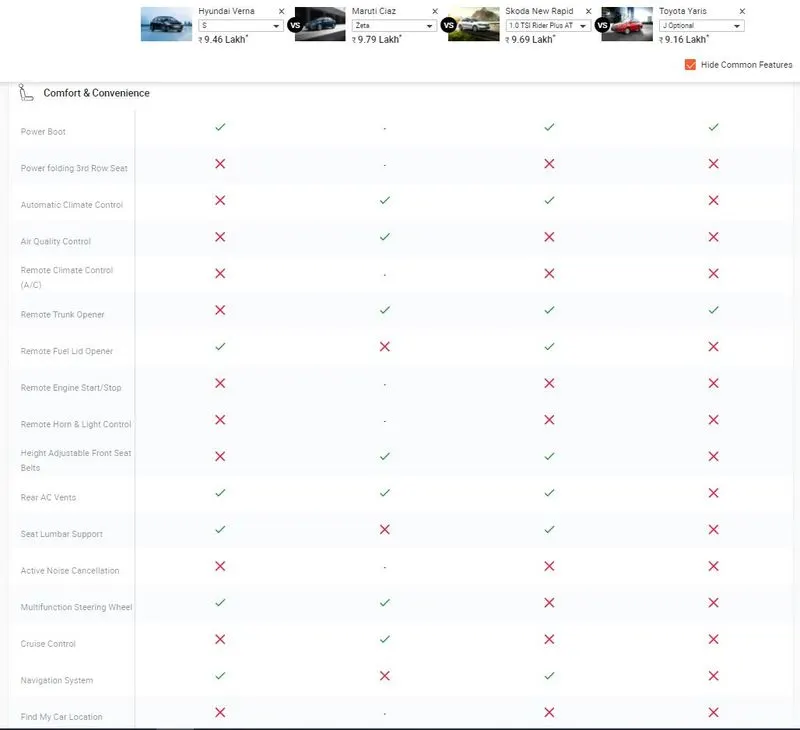
i. Comfort
Now, the question is SEDAN or SUVs?
Let's compare both types and decide:
1. Driving Performance - Sedan is better to go around the city with great mileage, small size, and easy maneuverability. SUVs is strong build vehicle which can also perform well in off-road conditions with high engine capabilities but has less fuel economy as compared to SEDAN.
2. Exterior - SEDAN offers a sporty, slim, stylish look while SUVs have a bit of a bulky, tank-like exterior.
3. Interior - Both of them are made to provide the best comfort experience to the passenger.
4. Visibility - Due to minimal blind spots in SEDAN as compared to SUVs, it makes it easier to see the obstacles that are out of sight.
Looking at the above comparison and keeping in mind that he wants the car for a daily commute and once in a month to go out of the station. I would like to discuss and suggest to him further about SEDAN.
Few Parameters for a quick comparison:-
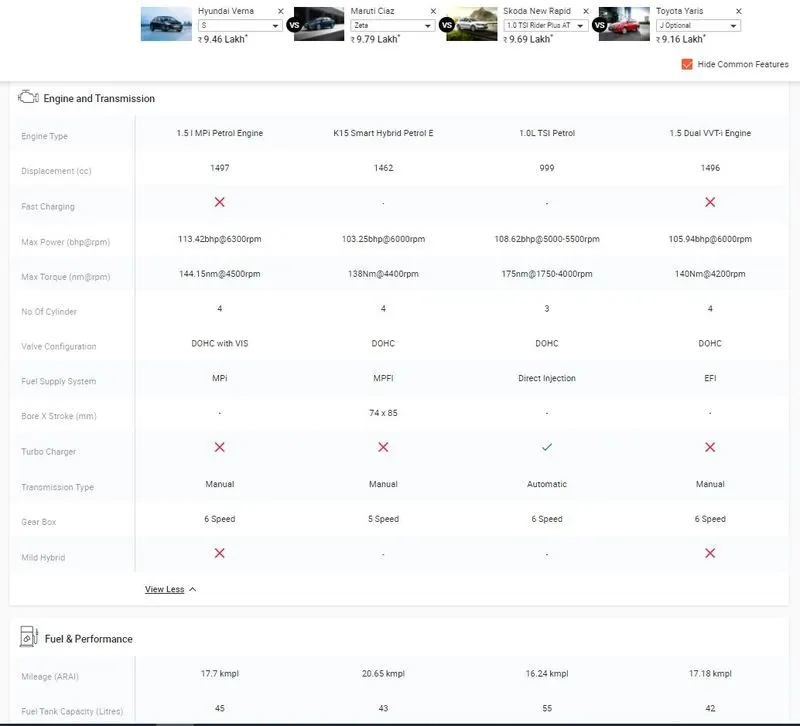
| Parameters | Hyundai Verna | Maruti Ciaz | Skoda Rapid | Toyota Yaris |
| Price starting | 9.5 Lakh | 9.8 Lakh | 9.7 Lakh | 9.16 Lakh |
| Fuel Type | Petrol | Petrol | Petrol | Petrol |
| Mileage | 17.7 Kmpl | 20.65 Kmpl | 16.24 Kmpl | 17.18 Kmpl |
| Engine | 1497 cc | 1462 cc | 999 cc | 1496 cc |
Q.2. Introduction - Benchmarking is a comparison between similar products on some specific parameters. A company can use Benchmarking as a tool to get a competitive advantage against another company in the market. It can help to identify the loopholes within the process/services, What better the rival company is doing in the market and how can healthy competition be established in the market and desired goal is achieved.
It is a powerful tool that helps to know "How the best performance is achieved" and provides necessary clues and information to change a company's own processes to meet the best results. But Benchmarking is not as simple as it appears. Many companies keep a limit on the information to be shared with other companies about their technology and innovation as it offers them a competitive advantage over the other companies. So, in this kind of Benchmarking the role of the Third Party becomes crucial, who can collect data on their behalf, make a detailed comparison, and provide feedback.
Phases in Benchmarking:
1. Current State Assessment - Experts within the company identifies the current performance of the product. They collect relevant data about the process which needs to be used in Benchmarking.
2. Benchmarking Participant Identification - There can be different benchmarks on which comparisons can be made. So, selecting a single Benchmarking is not simple. Choosing a single Benchmarking can lead to avoiding other parameters and thus, will be a waste effort. To avoid this, a careful identification is required to be made by the experts.
3. Comparative Analysis - Now, the comparison of the Benchmark parameter is made with that of other rival companies that have better or best processes/services. Efforts are made to make a detailed comparison in order to achieve the required results but the detailed comparison is many times not possible due to the limited availability of information.
4. Strategic Prognosis - Once the analysis is made, the strategy is made on how to achieve superior performance and it's time to implement the things practically and have an edge over the rivals.
Benefits of Benchmarking -
1. It gives an independent perspective, How well a company is performing in the market against its competitors.
2. Helps to identify the loopholes and identifies areas of improvement.
3. Establish healthy competitions between the competitors.
4. Forces the company to continuously improve.
4. Conclusion - My first impression, Ciaz is a better option as it is best in terms of Mileage. Even if in cities and traffic the mileage will reduce, still it will be decent enough. Skoda Rapid is clearly eliminated by me due to mileage and less displacement volume.
MPFI/MFI has advantages over EFI as it uses a separate injector for supplying the correct quantity of fuel to each cylinder according to the firing order. Also, it improves performance and efficiency by varying the fuel quantity and injection timing for each injector separately. As Totoya Yaris used EFI as a Fuel Supply system, I won't be considering that.
The advantage of Verna over Ciaz is that it generates more Torque and Power with more displacement volume and a 6-speed gearbox. Looking at safety features both are quipped with Air Bags, Anti Lock Braking System and Anti Theft alarm. The advantage of Ciaz over Verna is more Mileage, more Boot space, slightly bigger in height and length.
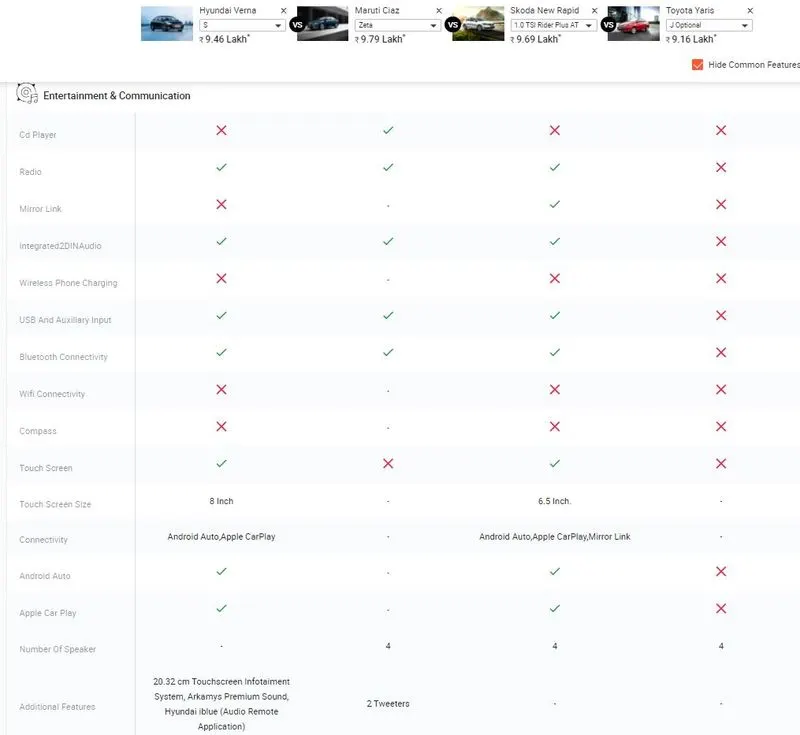
Ciaz has a centrally mounted fuel Tank and Electronic Stability control which are missing in Verna. Looking at all these features and Prices, I would suggest Maruti Ciaz has a slight edge over Hyundai Verna. My suggestion for Mr.Pughazhyendii is to take Hyundai Verna.