Hood design-Week 2
HOOD
Objective
To design car hood in NX using given master section and provided design parameters.
Hood
Car hood is a hinged cover that rests over the engine in a front-engine car. A latch is provided under the hood in order to prevent accidental opening during driving. Purpose of hood is to provide access to the engine and battery for repair and maintenance. It also protects these parts from direct sunlight and dust.
Safety Requirements
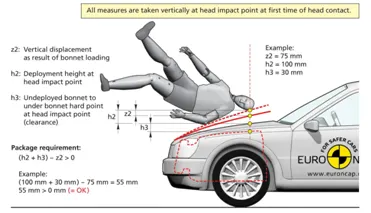
Safety is the most important criteria in automobile designs which concentrates on both pedestrian and occupant safety. The pedestrians are the most vulnerable road users and are at high risk of traffic accidents. The major reason for the fatality of the pedestrian in traffic accident is due to the head injury resulting from the hard impact of the head against the stiffer hood or the ground. This leads to the necessity of new inner hood panel which is less stiffer and pedestrian friendly. The head impact analysis on the present hood of the car was done to study the response of the adult head form at two different locations. Structural and modal analysis for the same present hood assembly was done to observe the local and global stiffness. In order to reduce the head injury of the pedestrian the local stiffness over the area of head impact has to be reduced thus the new design of hood inner panel was focused on that and the structural and modal analysis was done for the new design. The design with lesser local stiffness and similar global stiffness compared to the existing hood was finalized. The head impact analysis for the new design of hood inner panel was performed. The HIC values of the adult head form for two different locations are found to be 706 and 948 which meets the safety limitations of the adult head acceleration during impact as proposed by EEVC WG17 and Euro NCAP regulations. Thus the new design of the hood is pedestrian friendly, considerably maintaining the overall global stiffness of the hood.
Pedestrian Safety
- Crash mitigation tests that measure the potential for head and leg injuries resulting from pedestrian-motor vehicle crashes have been in place for many years in Europe and Japan.
- Euro NCAP began head and leg testing in 1997 and Japan began pedestrian head protection testing in 2003 and pedestrian leg protection testing in 2011.
- In general, these tests launch projectiles designed to simulate a person’s legs or head into various locations on a vehicle’s hood and bumper to assess the effectiveness in limiting pedestrian injury.
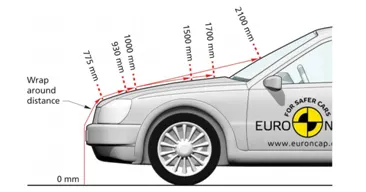
Wrap Around Distance
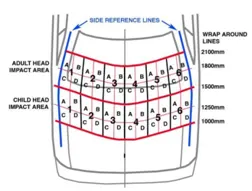
- The headform test area is defined as the outer structure that includes the upper surface of all outer structures.
- It includes, but is not limited to, the bonnet, wings, windscreen scuttle, wiper arms/spindles, windscreen frame, A-pillars and roof.
- It is bounded by the geometric trace of the 1000mm wrap around line in the front, the Bonnet Side Reference Lines and the 2100mm wrap around distance (WAD).
COMPONENTS USED IN HOOD
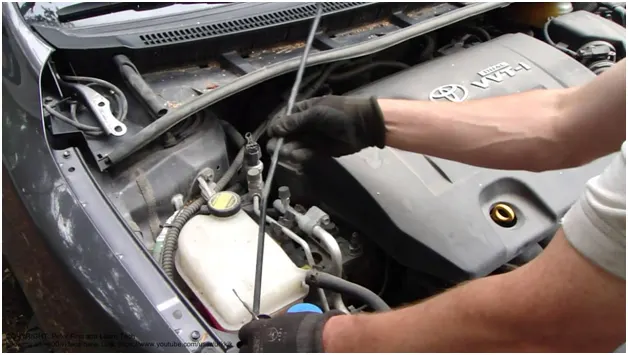
1)Support Rod
- The support rod is usually inside the engine compartment, when we open the hood and keep it in open condition, one end of the support rod attaches to the hood and supports it. this support rod has to be fixed manually onto the hood.
- The design of the support rod is not linear but it should have some bends to increase the rigidity and strength of the rod. the support rod should be mounted such that it does not collide with other parts, also the support rod should be mounted on the opposite side of the battery to avoid disturbance while removing the battery from car
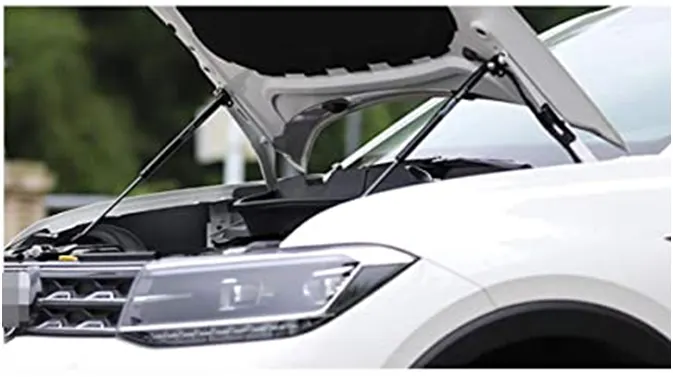
2)Gas Stay
A gas stay is used to open the hood. it uses compressed gas to open the bonnet automatically.gas stays for the front hood are mainly used in high end performance cars where the bonnet weight is high.
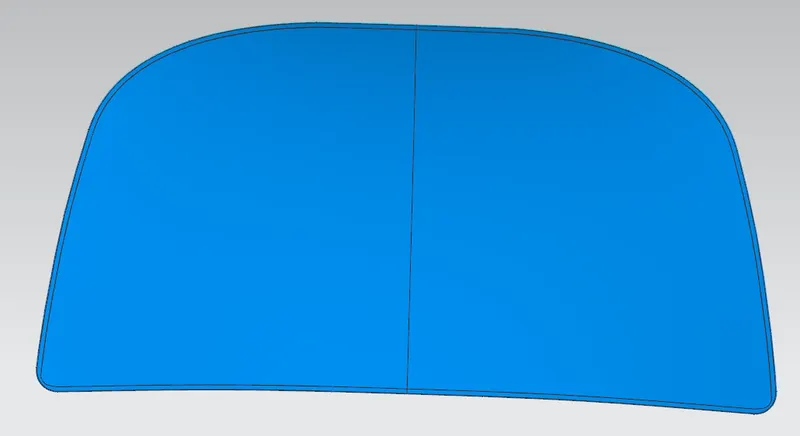
3) Hood Outer Panel
The outer panel works as a metal cover. It is responsible for aesthetics of the vehicle.
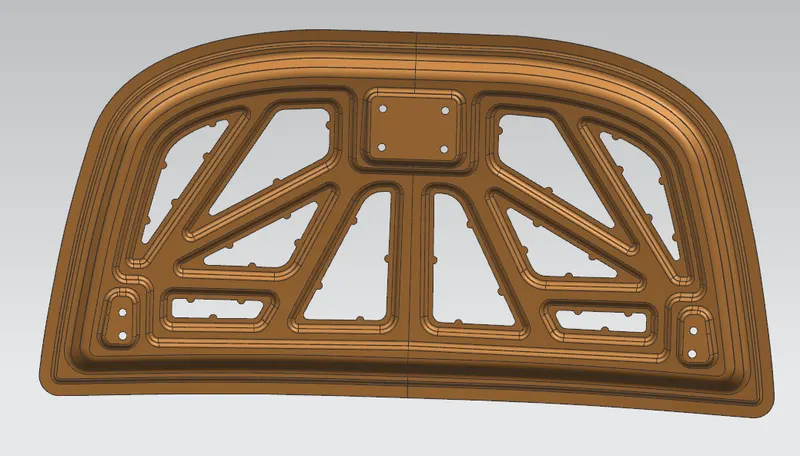
4) Hood Inner Panel
The inner panel provides strength and supports the outer panel.
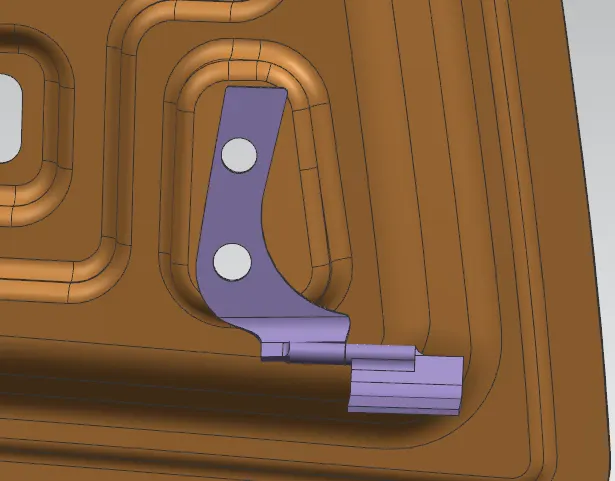
5) Hinges
Hinges are used to rotate around a fixed axis for opening and closing movement. One part of the hinge is fixed with the engine compartment and other part is connected to hood.
6)Striker
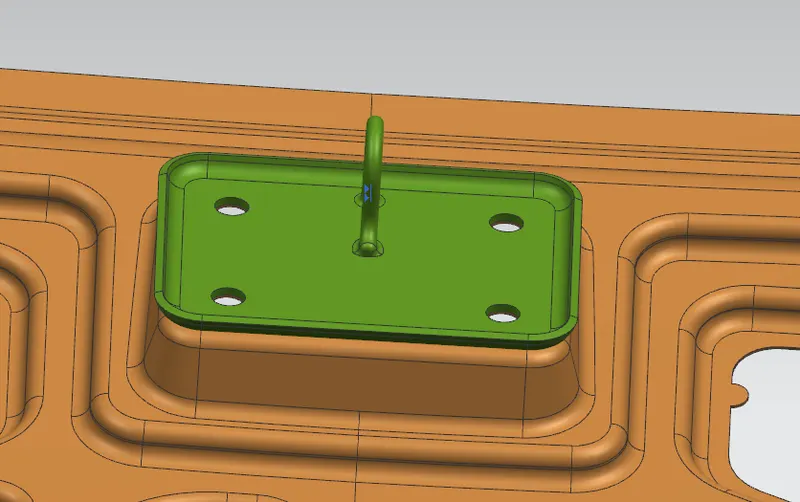
Striker is used to lock the hood, in order to prevent accidental opening of the hood during driving.
Latch Trajectory
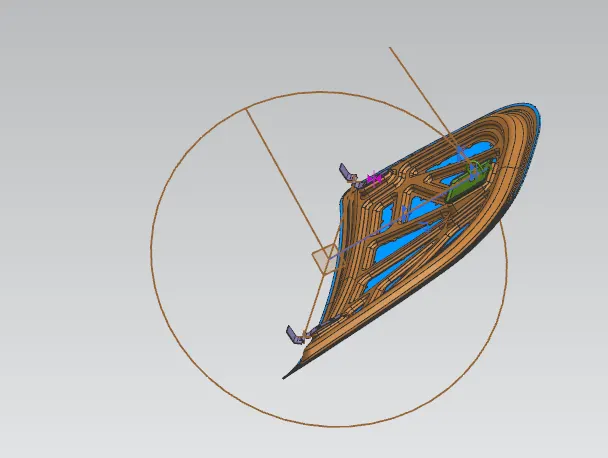
- It is the path along which the hood rotates during opening and closing movement.
- The striker on the hood follows a particular path while opening or closing the hood, which is along circumference of a circle with center at the hinge axis.
- This path is nothing but latch trajectory. It is a very important aspect in hood design, in order to decide hinge, latch and striker installation points.
Mastic Sealant
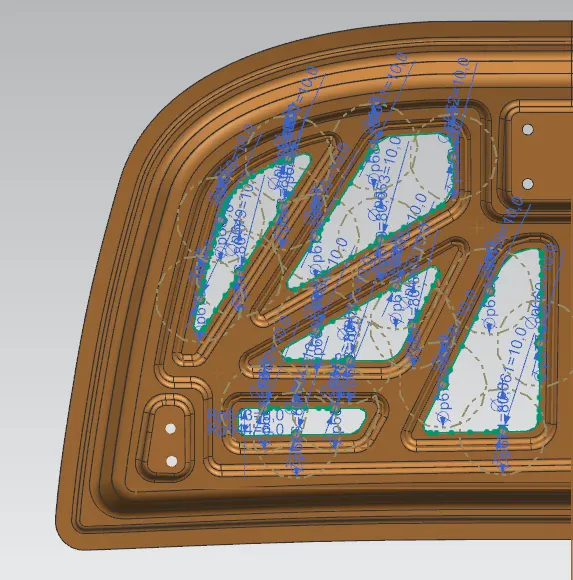
- Mastic sealant helps to locally improve strength of the hood. It is generally a hard rubber part, which is introduced as a paste in between inner and outer panel of the hood, which will get hardened inside the furnace.
- Every mastic sealant point will have a tendency to improve the local strength in around 80 mm diameter. Considering this, the mastic points are positioned such that most of the hood region is covered.
Design Methodology
- First the inner panel is designed from the given master section using the various commands and features. We create the embossing using the offset surface from the original master section. Similarly, we create the cuts on the emboss by sketching and using trim surface option.
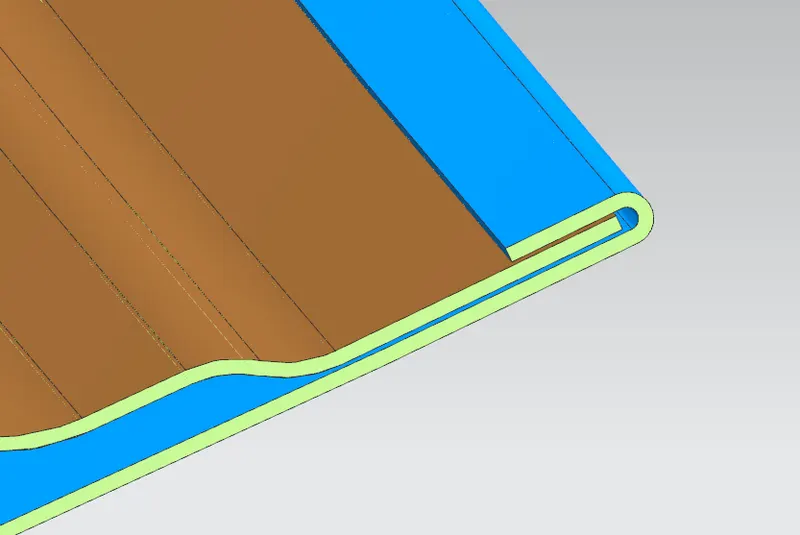
- Then the outer panel is designed from the same master section. Here we are supposed to provide the hemming to outer panel. The parameters of hemming are taken as per given values.
- Now, on the inner panel, the embossing for hinge and striker are produced by considering their respective dimensions and assembly positions. First the emboss for hinge is created and then by fixing the hinge into its position, we draw an axis passing through both side hinge axes to form a common axis. And then we position the striker such that it will move along circumference of a circle whose center is at midpoint of the common axis. Thus, position of striker is decided and we can create emboss for the same.
- Using the hinge emboss we created, we can create our hinge reinforcements by creating new parts in the assembly itself.
- Data Povided
Outer Panel Thickness – 0.75mm
Inner Panel Thickness – 0.75mm
Hood Manufacturing Process
1)Deep Drawing
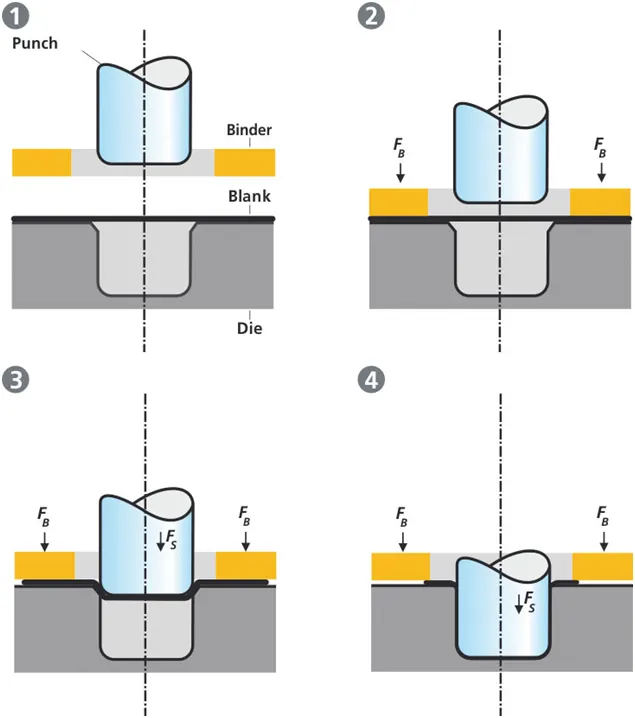
It is a sheet metal forming process in which a sheet metal blank is radially drawn into a forming die by the mechanical action of a punch. The process is considered deep drawing when the depth of the drawn part exceeds its diameter.
2)Hemming
Hemming is a forming operation in which the edges of the sheet are folded over other part or simply folded in order to achieve a tight fit. In car part production, hemming is used in assembly as a secondary operation after deep drawing, trimming and flanging operations to join two sheet metal parts together.
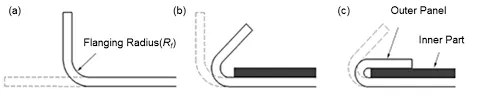
Hemming process
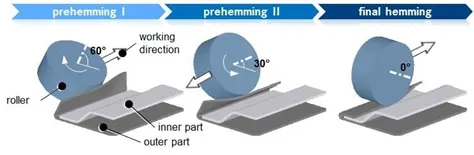
Roller Hemming process in 3 Stages
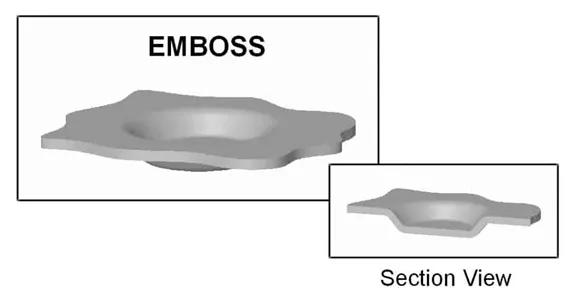
3)Embossing
Sheet metal embossing is a stamping process for producing raised or sunken designs or relief in sheet metal. This process is carried out by means of matched male and female roller dies, or by passing the sheet or rolls of metal between rolls of desired pattern.
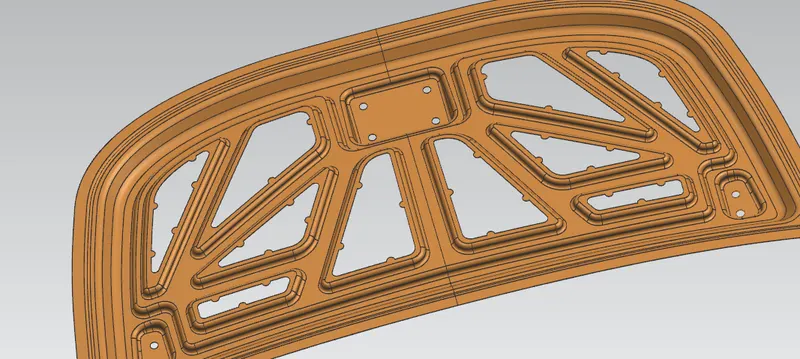
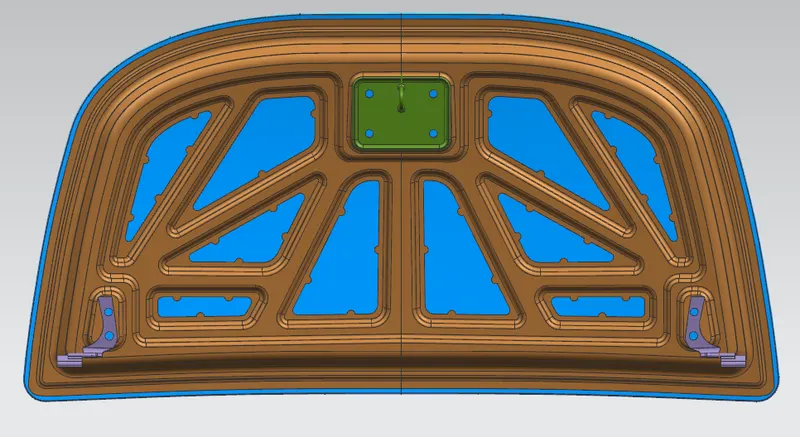
Final Hood Assembly
Conclusion
Designeing of hood along with its components and assembled the same, using NX CAD, by useing given parameters has been done.