Frequency Analysis of a rotating shaft
PROJECT REPORT
FREQUENCY ANALYSIS OF A ROTATING SHAFT
OBJECTIVE :
To find out the critical or resonant frequencies of a rotating shaft using Solidworks. Design the model using solidworks based on desired dimension.
THEORY :
RESONANCE
Resonance occurs when a material oscillates at a high amplitude at a specific frequency. We call this frequency resonant frequency. The dictionary defines resonance as,
“the state of a system in which an abnormally large vibration is produced in response to an external stimulus, occurring when the frequency of the stimulus is the same, or nearly the same, as the natural vibration frequency of the system.”
Physics defines Resonance as
A phenomenon in which an external force or a vibrating system forces another system around it to vibrate with greater amplitude at a specified frequency of operation.
Some Examples of Resonance
Below we have listed examples of resonance that we can witness in our daily lives:
- Musical Instruments
- Swing
- Bridge
How to Calculate Resonant Frequency?
A resonant frequency is the natural vibrating frequency of an object and is usually denoted as f with a subscript zero (f0). Resonance is witnessed in objects that is in equilibrium with acting forces and could keep vibrating for a long time under perfect conditions.
To find the resonant frequency of a single continuous wave, we use the formula,
|
v=λf |
Where,
- v is the wave velocity
- λ is the distance of the wavelength
Different Types of Resonance
There are many types of resonance, and they are:
Mechanical Resonance
Mechanical resonance can be defined as the tendency of a mechanical system to respond at greater amplitude when the frequency of its oscillations matches the system’s natural frequency of vibration (its resonance frequency or resonant frequency) than it does at other frequencies.The resonant frequency of a spring is calculated using the given formula:
|
f0=(12π×km−−√) |
Where,
- m is the mass of the spring
- k is the spring constant
Acoustic Resonance
Acoustic resonance is a phenomenon in which an acoustic system amplifies sound waves whose frequency matches one of its own natural frequencies of vibration. Acoustic resonance is an important consideration for instrument builders as most acoustic instruments such as the length of tube in a flute, the strings and body of a violin and the shape of a drum membrane use resonators. Acoustic resonance is also important for hearing.
Electrical Resonance
In a circuit when the inductive reactance and the capacitive reactance are equal in magnitude electrical resonance occurs. The resonant frequency in an LC circuit is given by the formula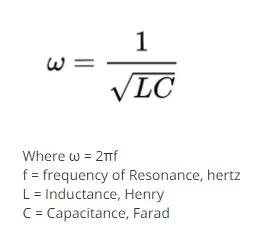
INPUT PARAMETERS :
1. DIMENSIONS
2. MATERIAL : Alloy Steel
E = 2.1E11 N/m^2 ; v = 0.28 ; Tensile strength = 723.825 MPa ; Ultimate strength = 620.422 MPa
PROCEDURE :
FIRST, Model the given shaft with two ends using the assumed geometry on solidworks.
SECOND, Open Simulation, Under New Study Import the models.
THIRD, In the frequency workbench, Apply material = Alloy Steel on the part.
FOURTH, From fix geometry option, Apply a fixed relation to the ends of the shaft.
FIFTH,Simulate the current problem for 5 modes.
SIXTH, Post-process the results in a tabular form.
CAD MODEL :
MATERIAL = ALLOY STEEL
MESH :
- Mesher used -- Standard mesh (7mm)
- Tolerence -- 0.3 mm
- Mesh type -- Solid mesh
BOUNDARY CONDITIONS
- All bodies are considered as Homogeneous and Isotropic.
- Material for the body is ALLOY STEEL
- The stepends of the shaft are fixed.
RESULTS :
The results are obtained for 5 different modes are as follows :
MODE 1 :
MODE 2 :
MODE 3 :
MODE 4 :
MODE 5 :
The different resonance frequencies obtained are as follows :
CONCLUSION :
It is clearly observed from the analysis that the frequency varies for different modes shapes and its amplitude is directly propotional to the frequency inducing the resonace.