Flow over an airfoil
Aim: To perform flow analysis on NACA0017 airfoil
Objective:
To model NACA0017 airfoil and perform flow simulation for am angle of attack of 0, 2, 4, 6, 8 and 10 degree and compare lift and drag forces.
Theory:
An airfoil or aerofoil is the cross-sectional shape of a wing, blade, or sail. An airfoil-shaped body, when moving through a fluid, produces an aerodynamic force. The component of this force perpendicular to the direction of motion is called lift. The component parallel to the direction of motion is called drag. The lift force is produced due presence of angle of attack which produces difference in pressure above and below the airfoil. Drag force is produced due to friction of flow on airfoil surface. It is proportional to frontal area of foil.
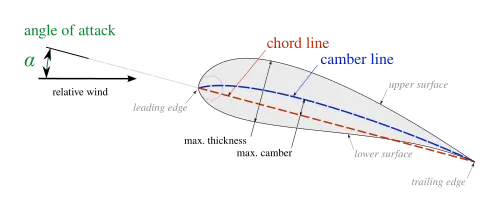
The angle of attack at which the lift force is maximum is known as critical angle of attack. When angle of attack is increased beyond critical value, lift force starts decreasing. This is known as stalling condition.
The airfoil is modelled using curve through point in solidworks. Data of NACA0017 is used from http://airfoiltools.com/ . The angle of attack is provided to airfoil by rotating the airfoil about its leading point.
Analysis Setup:
An external time dependent flow for 5sec is setuped in solidworks using flow simualtion wizard. Here, working fluid is air and inlet velocity of 200m/s is chosen for simulation. A local mesh is added for the surface of the airfoil to create a finer mesh for surface for accurate results. Sufficiently large 2D computation domain in XY plane is setuped. The flow in z direction is neglected as it does not contributes in lift and drag force. The computation domain limits choosen for this study are as follows,
x: -3m to 10m
y: -5m to 5m
The global goal is setuped for force and friction force in x and y direction. For calculation lift and drag froce, surface goal for force in x and y direction is setuped for the airfoil surface.
Results:
Case 1 : Angle of attack = `0^o`
Velocity:
Pressure:
Lift and Drag Force:
Case 2 : Angle of attack = `2^o`
Velocity:
Pressure:
Lift and Drag Force:
Case 3 : Angle of attack = `4^o`
Velocity:
Pressure:
Lift and Drag Force:
Case 4 : Angle of attack = `6^o`
Velocity:
Pressure:
Lift and Drag Force:
Case 5 : Angle of attack = `8^o`
Velocity:
Pressure:
Lift and Drag Force:
Case 6 : Angle of attack = `10^o`
Velocity:
Pressure:
Lift and Drag Force:
Results Comparision:
Conclusion:
From the chart it can be noticed that with increase in angle of attack, drag force increases. This is because with increases of angle of attack, the frontal area of airfoil iincreases abd that causes more resistance to flow. The lift force also increases with angle of attack and reaches to maximun value at 8 degree, beyond that the lift force starts decreases. This is called stalling condition and 8 degree is critical angle of attack. The decreases in lift force is due to yhe flow separation at the tail of the airfoil. As angle of attack is increased beyond critical value, the presuure at tail of airfoil drops significantly and that cause separation of flow from airfoil surface and reverse pressure currents are produced.