Flow over a cylinder
Aim of this Challenge:
To simulate the flow over a cylinder for the below conditions shown in tutorial video
- Calculate the baseline case (explained in video) Reynolds number and run baseline simulation. Then increase the Reynolds number by a factor of 20%, 40% and 100%, and then run the transient flow simulation.
- Calculate the simulation end time and create animations for pressure-velocity for all the three Reynolds number
Software Used:
Solid works
Factors Involved:
Cylinder Diameter = 0.04 m
Cylinder length = 0.05 m
Fluid type considered as Air
Explanation - Baseline:
Modelled a cylinder with the outer diameter of 0.04 m extruded to a length of 0.05 m.
Go to flow simulation then select wizard and follow the below steps:
- Provide the project name (Flow over a cylinder)
- Select the unit system (SI unit)
- Select the analysis type. In this case, going to do an External analysis. In physical features, select time dependent. In this case, we are going to see the behaviour of system as a function of time. This is called transient analysis. Total analysis time is set as 0.1 sec and output time step set as 0.01s.
- Select the fluid type for this simulation. In this case, selected Air as a fluid.
- Leave the wall thermal condition as default.
- Define the velocity parameters. Since this is external analysis, need to define the bounding box. Assign flow velocity and its direction. In our case the flow should go over the cylinder which is X-direction. Velocity values provide in the baseline analysis is 10 m/s. Velocity in Y & Z set to be Zero.
- Complete the wizard setup.
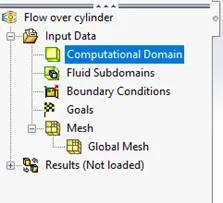
Once done with wizard setup, computational domain (Bounding box with the velocity direction) should be created in the input data.
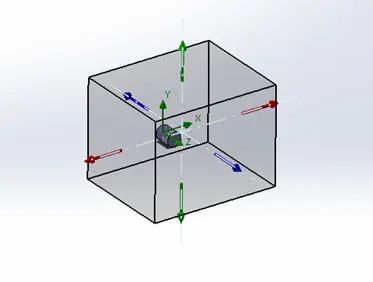
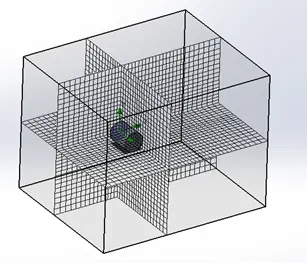
Mesh set as default and looks good. We can proceed for baseline simulation
Simulation:
Go to Flow simulation and Run the simulation.
Once done, go to results and create a cut section in the middle of cylinder. Here created 2 cut sections, one for velocity and another one for pressure.
Velocity plot: Pressure Plot:
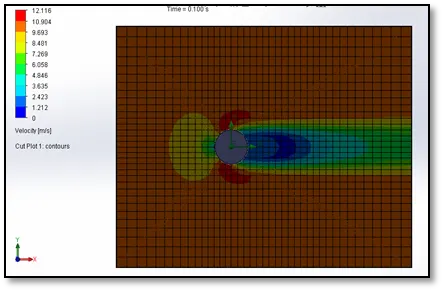
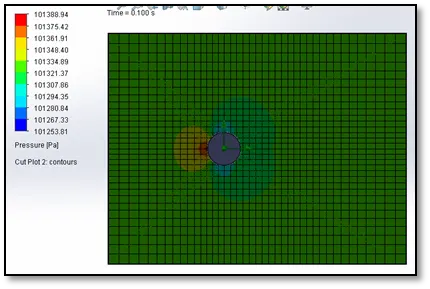
Created animation to understand the flow pattern with in the defined time frame.
Thus the Simulation for baseline has been completed.
Reynolds number calculation for the Baseline:
Re = ρVD/µ
Re = Reynolds number
V = flow velocity (m/s) – 10 m/s (baseline velocity as mentioned in video)
D = Diameter of cylinder (m) – 0.04 m
ρ = Density of fluid (kg/m3) – 1.292 kg/m3
µ = Dynamic viscosity of fluid (kg/m-s) – 1.729*10-5 kg/m-s
Here the fluid to be considered as Air.
Re = ρVD/µ
= (1.292 *10* 0.04) / 1.729*10-5
Re = 29890
Re = 29900 (Rounded to nearest value)
Reynolds number calculated for the baseline is Re = 29900
Increasing Reynolds number by 20% = 35880
Increasing Reynolds number by 40% = 41860
Increasing Reynolds number by 100% = 59800
Flow Criteria:
Baseline Re = 29900 V = 10 m/s
Case1 Re = 35880 V = 12 m/s
Case2 Re = 41860 V = 14 m/s
Case3 Re = 59800 V = 20 m/s
Calculating simulation end time:
We know, Time = Distance/ Velocity
Assume length of domain is 0.5 m
End time should be set to 2 times the flow through time.
For Case 1 – Time = 0.5/ 12
Time = 0.041 sec
End Time = 2*0.041 = 0.082 sec
For Case 2 – Time = 0.5/14
Time = 0.036 sec
End Time = 2*0.036 = 0.072 sec
For Case 3 – Time = 0.5/20
Time = 0.025 sec
End time = 2*0.025 = 0.05 sec
Results:
Case 1 to 3 results are captured below. Same steps to be followed for the flow simulation wizard mentioned above for baseline (Step 1 to 7). Need to update the simulation time and velocity respectively for each case in the simulation wizard.
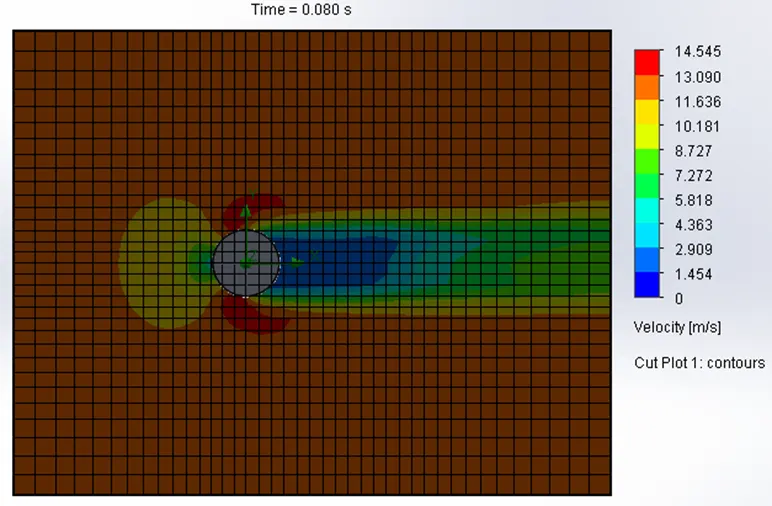
Case 1 :
Re = 35880, V = 12 m/s, End Time = 0.082 sec
Pressure Plot & Animation:
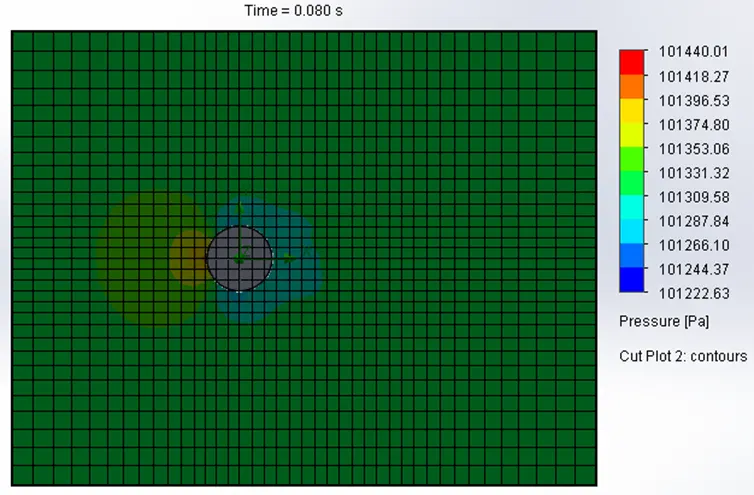
Velocity Plot & Animation:
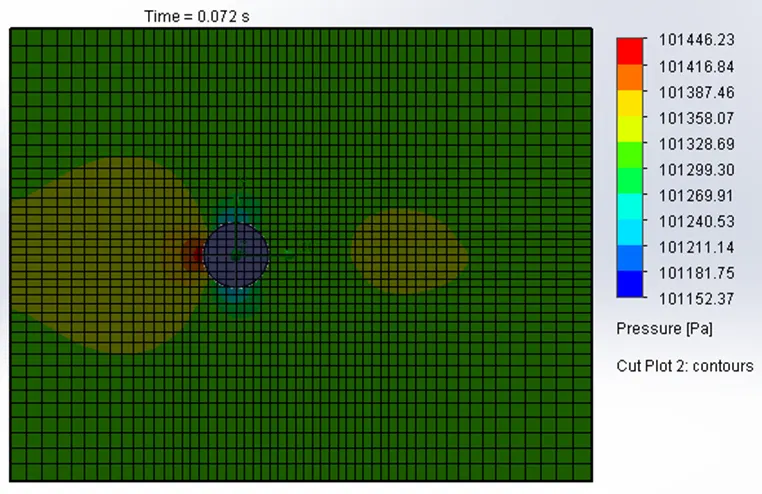
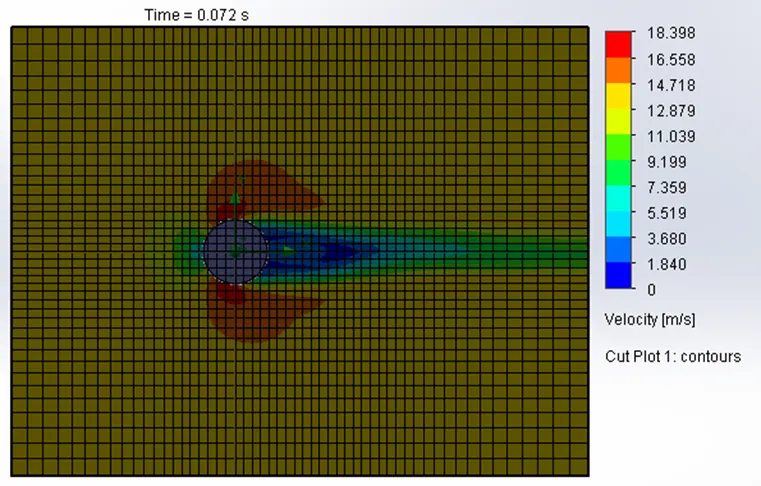
Case 2:
Re = 41860, V = 14 m/s, End Time = 0.072 sec
Pressure Plot & Animation:
Velocity Plot & Animation:
Case 3:
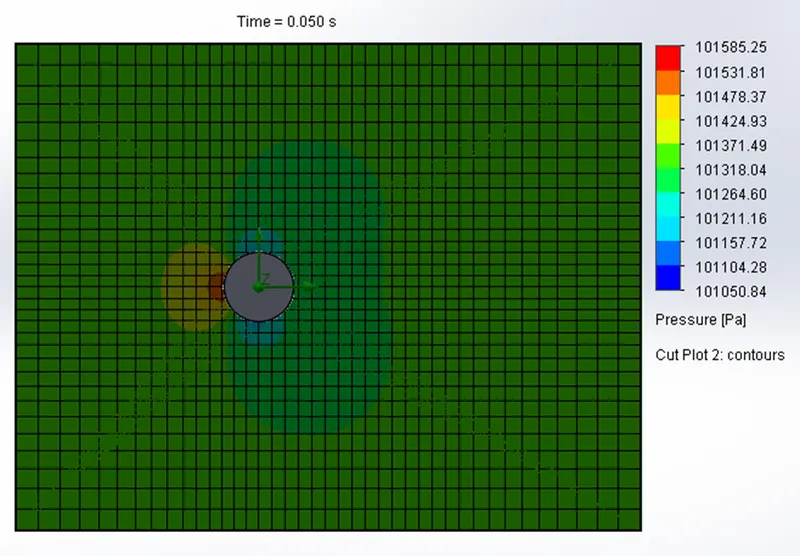
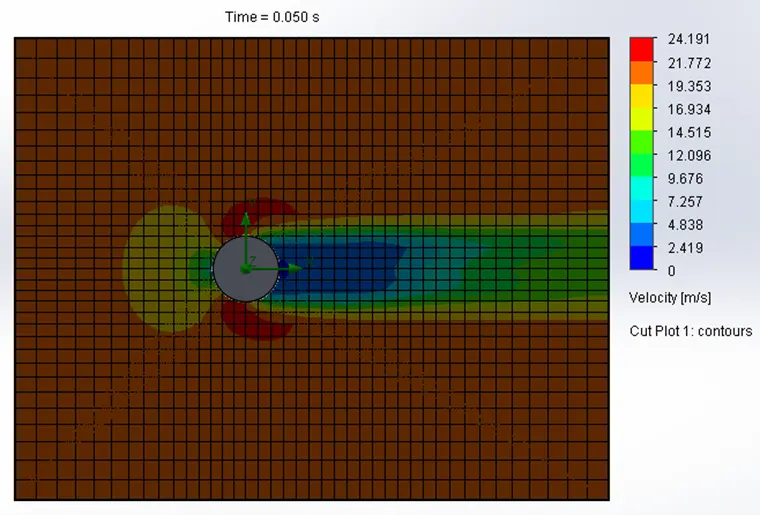
Re = 59800, V = 20 m/s, End Time = 0.05 sec
Pressure Plot & Animation:
Velocity Plot & Animation:
Conclusion summary:
Based on observation, we can see that increasing the Reynolds number increases the flow velocity and flow through time decreases accordingly. The pressure also increases slightly which is very less.