Final Project: Electric Rickshaw modelling
An electric rickshaw is a three-wheeled vehicle that is powered by an electric motor and battery. Electric rickshaws are becoming increasingly popular in many parts of the world as a more environmentally friendly and cost-effective alternative to traditional gasoline-powered rickshaws.
Electric rickshaws come in various sizes and designs, from small passenger vehicles that can accommodate a few people to larger cargo models that can carry heavy loads. They are commonly used for short-distance transportation in urban and suburban areas, particularly in developing countries where transportation infrastructure may be limited.
The electric motor in an electric rickshaw is typically a DC motor or a brushless DC motor, which is powered by a rechargeable battery. The battery is usually a lead-acid battery or a lithium-ion battery, depending on the size and design of the rickshaw. The motor is controlled by an electronic controller that regulates the speed and torque of the motor, allowing for smooth acceleration and braking.
One of the key advantages of electric rickshaws is their low operating cost. They require less maintenance than gasoline-powered rickshaws, and the cost of electricity is generally lower than the cost of gasoline. In addition, electric rickshaws produce zero emissions, making them a more environmentally friendly option than traditional rickshaws.
Overall, electric rickshaws offer a practical and sustainable mode of transportation for short-distance travel in urban and suburban areas. They provide a low-cost, low-emission alternative to traditional gasoline-powered vehicles and can help improve transportation accessibility in developing countries.
Evaluation of all components such as power source, electric motor, power converters etc., E-car charts depends on car parameters and driving patterns. The total amount of traction the vehicle needs to drive is calculated using Eq.1. System parameters such as vehicle weight, front position etc., are found in Table 1. Vehicle speed and acceleration are found in the driving cycle data. The required load capacity is calculated as a product of total gravity and speed.
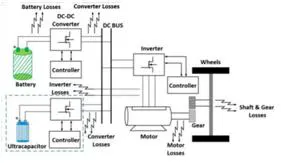
The power flow in the standard electric rickshaw is as shown in Figure 3. The dynamics of the automatic rickshaw are modeled in the Matlab-Simulink area.
The E-rickshaw is designed for the Indian Drive Cycle (IDC) measuring a total of 500 seconds. The car, which operates in cities, aims to travel at a speed of not more than 40 km / h due to the constant start and stopping of vehicles. The top speed is considered to be close to 38 km / h
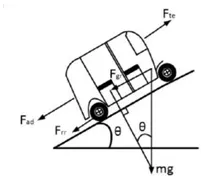
1)Total Tractive force The operating force of a car needs to be understood in order to have an effective model of car dynamics. The power of the auto-rickshaw rickshaw as you climb the hill is shown in Figure 2. The gravitational force produced by a car's electric motor must meet and overcome these forces namely (a) Rolling resistance (b) Aerodynamic gravity (c) Distance resistance and (d) acceleration capacity.
The maximum force applied to the E-rickshaw and its meanings are shown in Table 2. Here, M is the weight of the vehicle in kg, g is the gravitational constant, i.e., 9.81 m = s2, Cr is the coefficient of rolling resistance. E a road with a horizontal plain and aa speeding vehicle for m = s2. The sum of the force of gravity is the force required to propel the car forward by overcoming all the aforementioned forces operating on the vehicle. Ignoring all other power directly or indirectly in the vehicle, the full operating power can be found in Eq 1.
Fte= Frr+ Fad + Fgr+ Fa f (1)
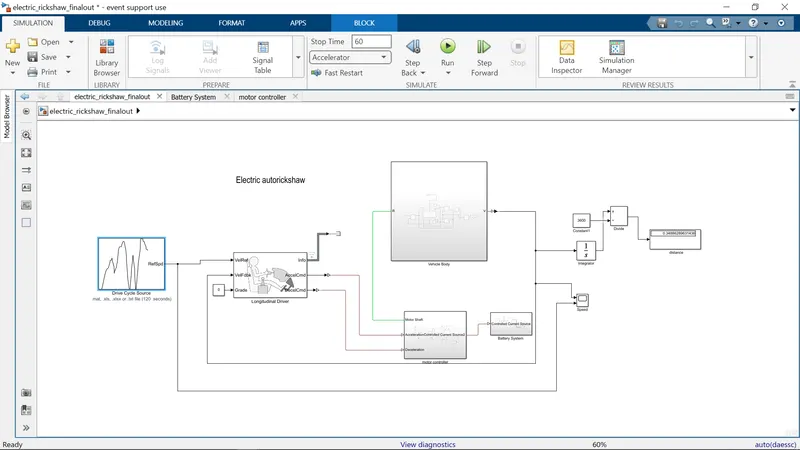
Simulink model
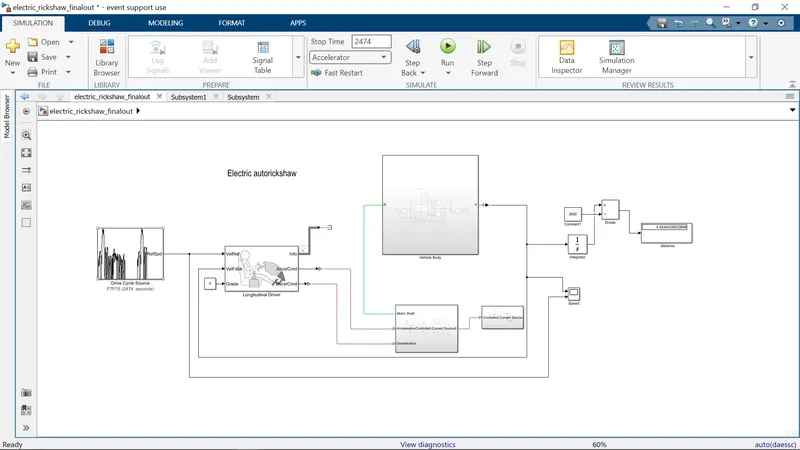
Drive cycle:
A driving cycle is a series of data points representing the speed of a vehicle versus time. they are used in propulsion system simulations to predict performance of internal combustion engines, transmissions, electric drive systems, batteries, fuel cell systems, and similar components. Here we are using two standard drive cycle:
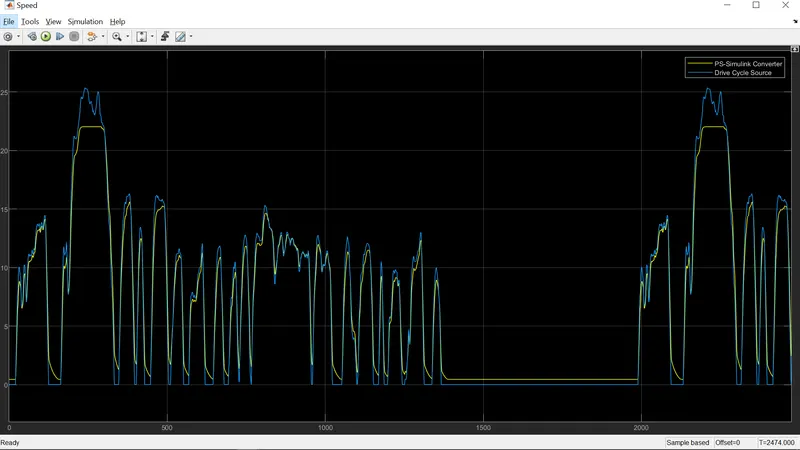
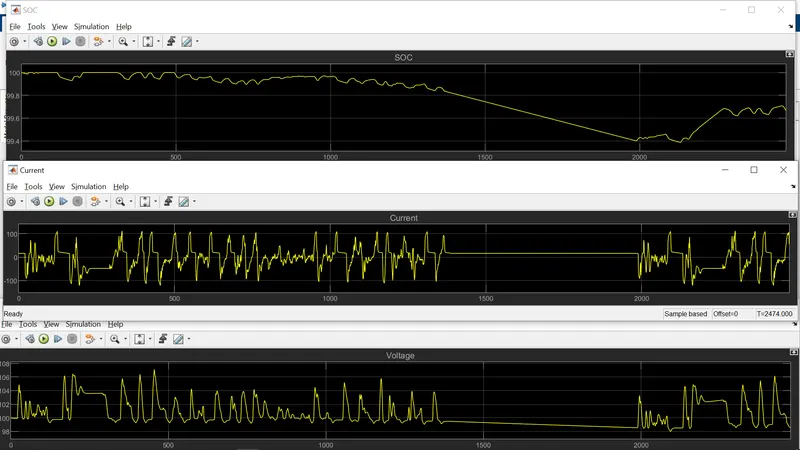
A.FTP75 (2474 cycle):
The Federal Test Procedure (FTP) is composed of the UDDS followed by the first 505 seconds of the UDDS. Though it was originally created as a reference point for fossil fuelled vehicles, the UDDS and thus the FTP-75, are also used to estimate the range in distance travelled by an electric vehicle in a single charge.
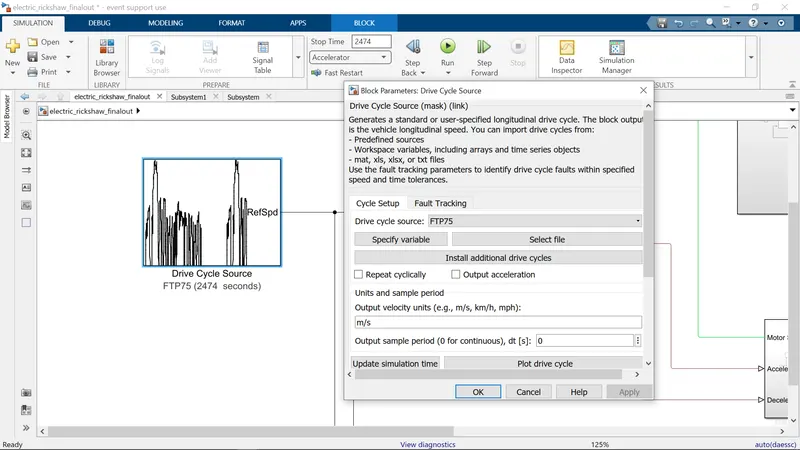
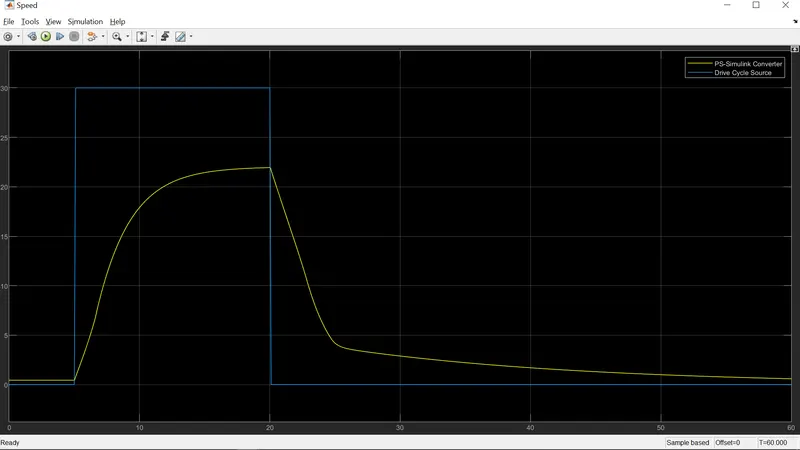
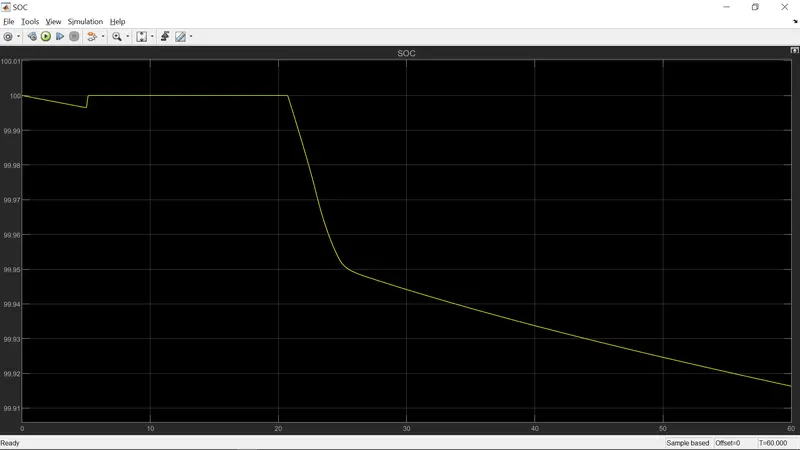
B.Wide Open Throttle (WOT) (60 Seconds):
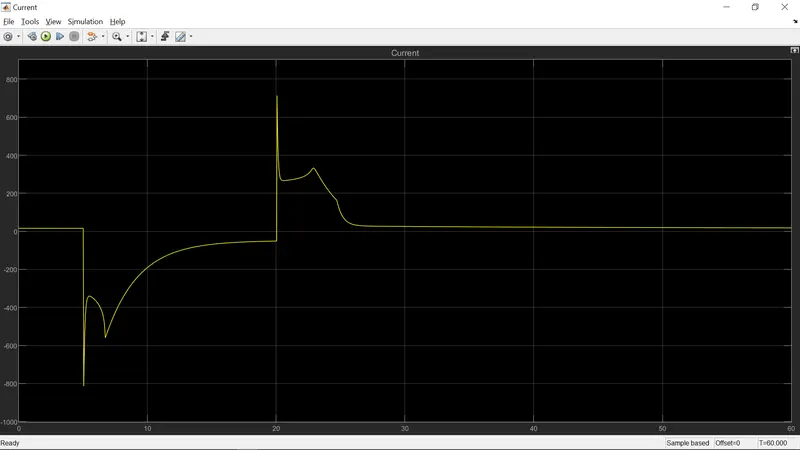
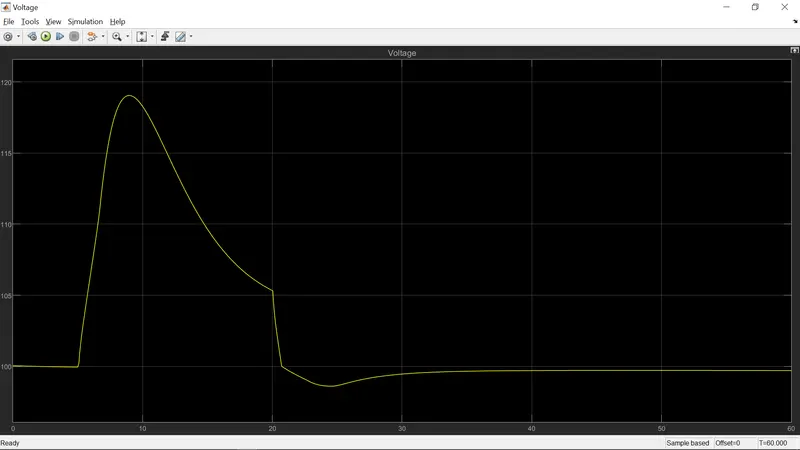
Generates a standard or user-specified longitudinal drive cycle. The block output is the vehicle longitudinal speed. Vehicle speed is 0 for first 5 second, 60kmph for 5 to 30 seconds and zero from 30 to 60 seconds.
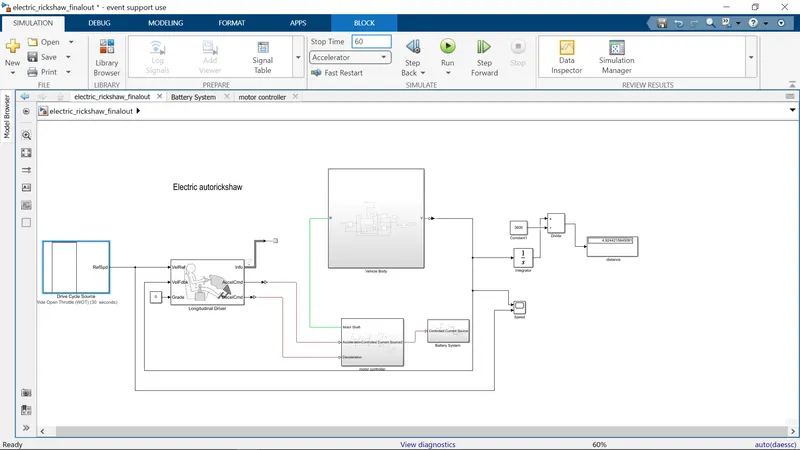
C. Make an excel sheet of all input and assumed data
Power Controller:
Power controller block has prime significance in the electric powertrains. It consists of controlled PWM voltage block, H-bridge block, two controlled voltage source, current sensor and temperature sensor.
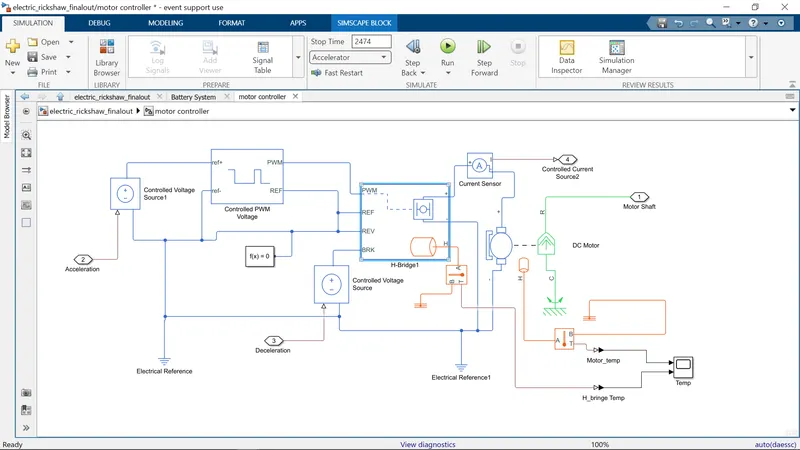
Controlled acceleration from driver subsystem is provided to controlled voltage source, the controlled voltage source converts the input of controlled acceleration signal to the equivalent voltage signal and output of controlled voltage source is provided to controlled PWM voltage block. Similarly, controlled braking signal is provided to another controlled voltage source and output of controlled voltage source is provided to H-bridge block.
Controlled PWM Voltage:
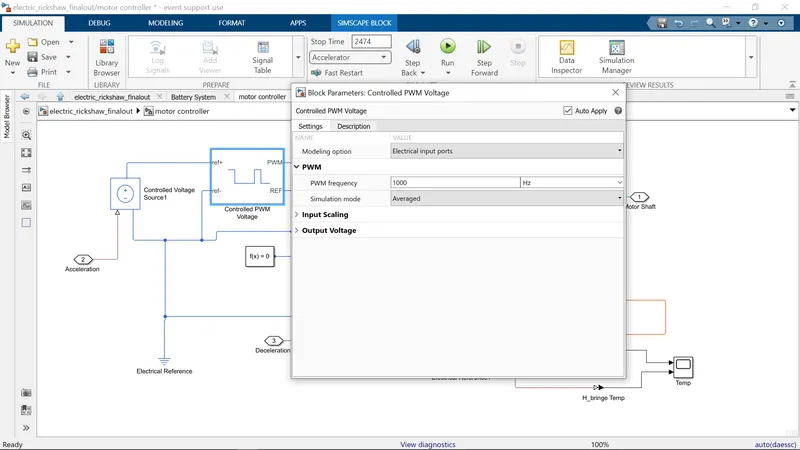
The Controlled PWM Voltage block represents a pulse-width modulated (PWM) voltage source. The block calculates the duty cycle based on the reference voltage across its ref+ and ref- ports.
H-bridge:
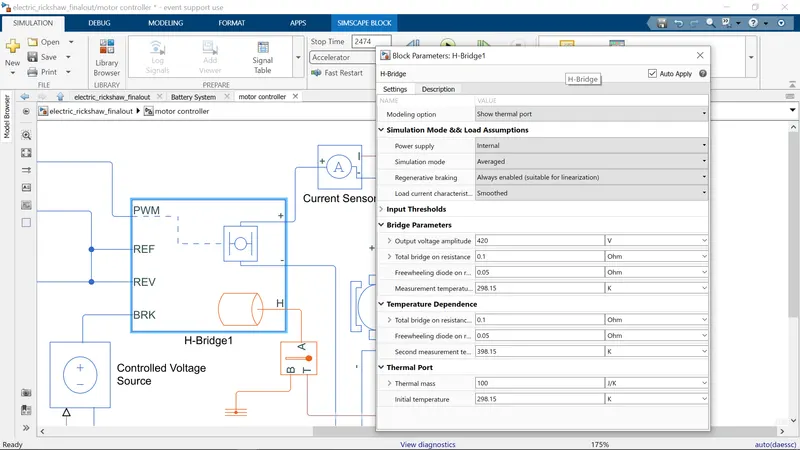
This block represents an H-bridge motor drive. The block can be driven by the Controlled PWM Voltage block in PWM or Averaged mode. In PWM mode, the motor is powered if the PWM portvoltage is above the Enable threshold voltage. In Averaged mode, the PWM port voltage divided by the PWM signal amplitude parameter defines the ratio of the on-time to the PWM period.Using this ratio and assumptions about the load, the block applies an average voltage to the load that achieves the correct average load current. The signal at the REV port determines the polarity of the output. If the value of the signal at the REV port is less than the value of the Reverse Threshold Voltage parameter, the output has positive polarity; otherwise, it has negative polarity.
Thermal Sensor:
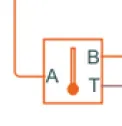
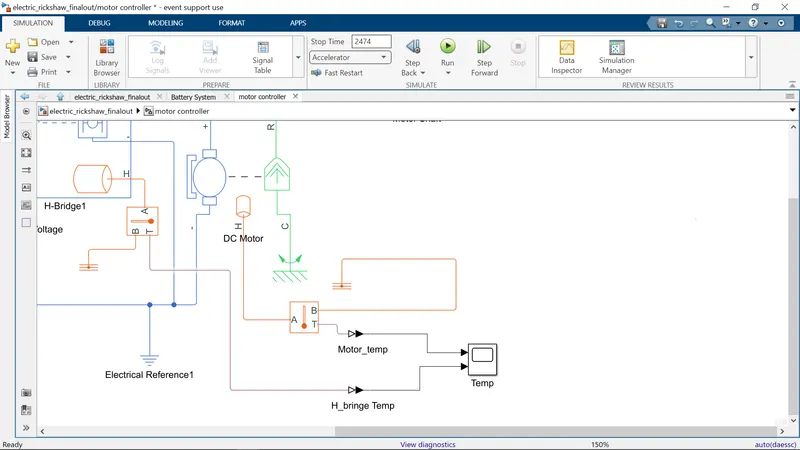
The Temperature Sensor, a device that determines the temperature differential measured between two points without drawing any heat. Connections A and B are thermal conserving ports that connect to the two points where temperature is being monitored. Port T is a physical signal port that outputs the temperature differential value. Output from H port from H-bridge block is given to port A.
The measured temperature is determined as T = TA – TB.
Motor:
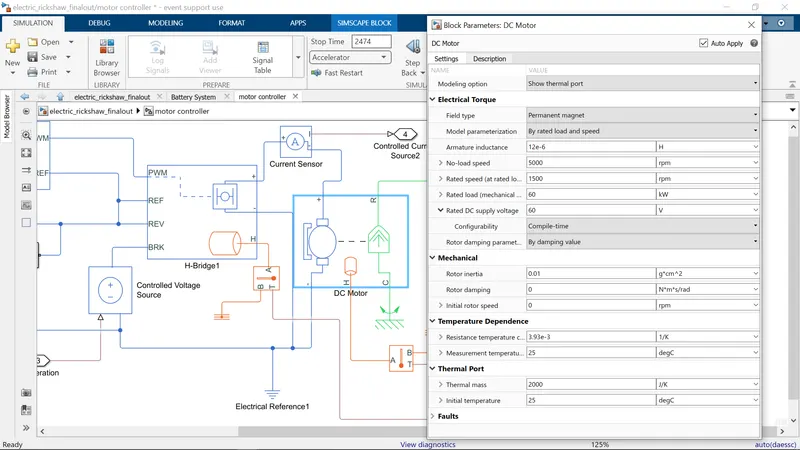
This block represents the electrical and torque characteristics of a DC motor includes Thermal port to sence the temperature of Motor.
The block assumes that no electromagnetic energy is lost, and hence the back-emf and torque constants have the same numerical value when in SI units. Motor parameters can either be specified directly, or derived from no-load speed and stall torque. If no information is available on armature inductance, this parameter can be set to some small non-zero value.
When a positive current flow from the electrical + to - ports, a positive torque acts from the mechanical C to R ports. Motor torque direction can be changed by altering the sign of the back-emf or torque constants.
Vehicle Dynamics:
Vehicle dynamics subsystem is simply the vehicle body working to the given task. It has wheels road conditions, surrounding conditions, load on the vehicle etc.
Vehicle body:
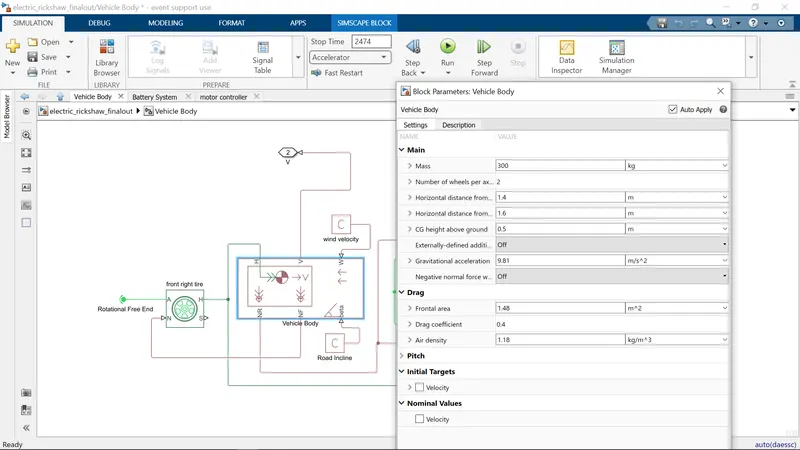
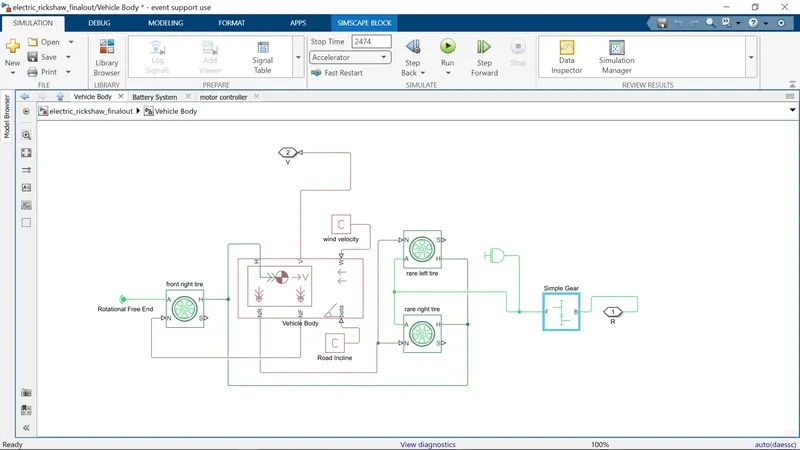
Represents a two-axle vehicle body in longitudinal motion. The block accounts for body mass, aerodynamic drag, road incline, and weight distribution between axles due to acceleration and road profile. Optionally include pitch and suspension dynamics or additional variable mass and inertia. The vehicle does not move vertically relative to the ground.
Connection H is the mechanical translational conserving port associated with the horizontal motion of the vehicle body. The resulting traction motion developed by tires should be connected to this port. Connections V, NF, and NR are physical signal output ports for vehicle velocity and front and rear normal wheel forces, respectively. Wheel forces are considered positive if acting downwards. Connections W and beta are physical signal input ports corresponding to headwind speed and road inclination angle, respectively. If variable mass is modelled, the physical signal input ports CG and M are exposed. CG accepts a two- element vector representing the x and y distance offsets from vehicle CG to additional load mass CG. M represents the additional mass. If both variable mass and pitch dynamics are included, the physical signal port J accepts the inertia of the additional mass about its own CG.
Tyres
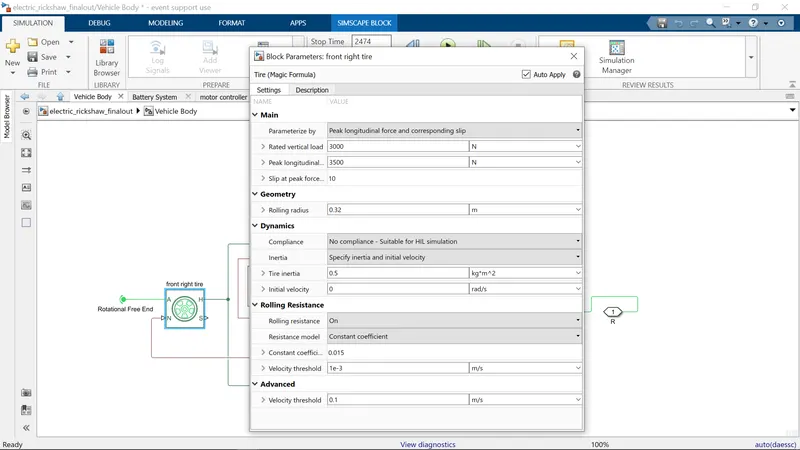
Tyre block Represents the longitudinal behaviour of a highway tire characterized by the tire Magic Formula. Connection A is the mechanical rotational conserving port for the wheel axle. Connection H is the mechanical translational conserving port for the wheel hub through which the thrust developed by the tire is applied to the vehicle. Connection N is a physical signal input port that applies the normal force acting on the tire. The force is considered positive if it acts downwards. Connection S is a physical signal output port that reports the tire slip. Optionally expose physical signal port M by right-clicking on the block and selecting Simscape block choices to switch between variants. Physical signal port M accepts a four-element vector corresponding to the B, C, D, and E Magic Formula coefficients.
tempature measuremnet for motor and controller
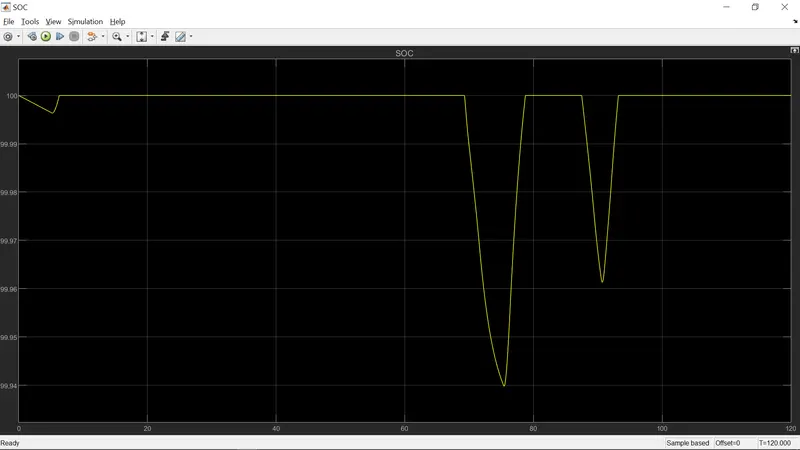
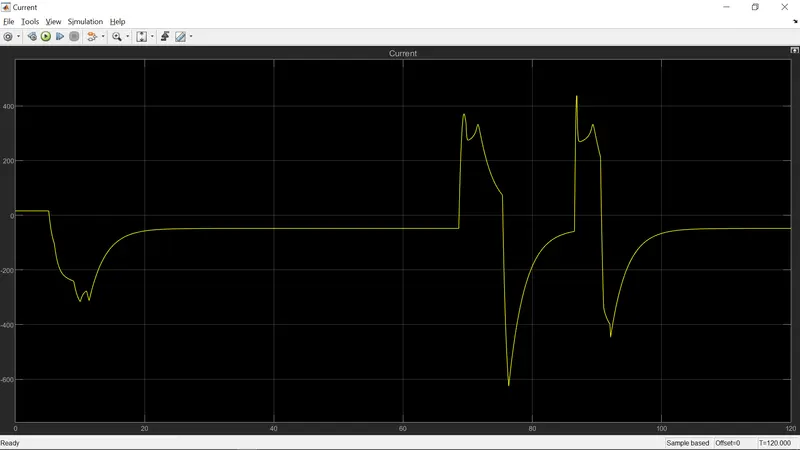
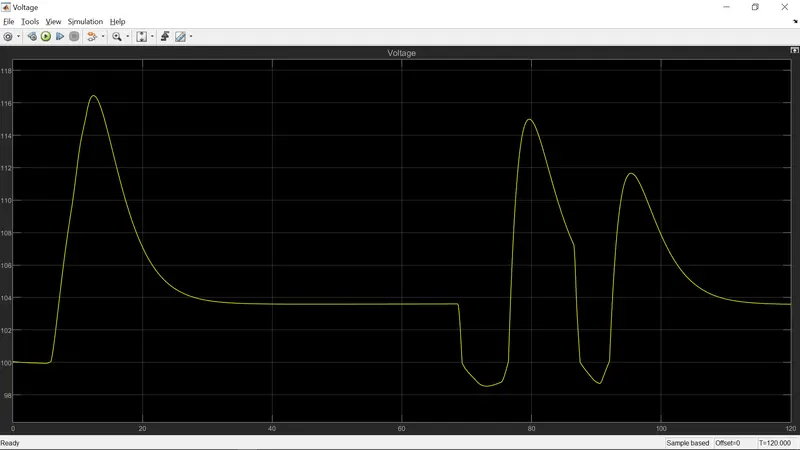
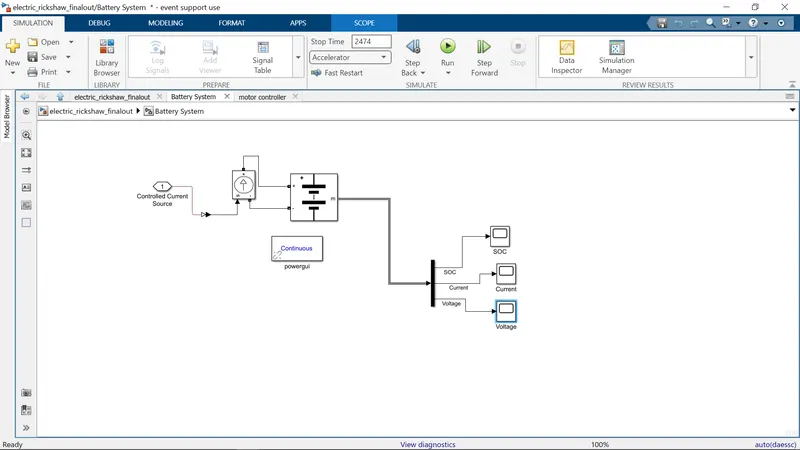
battery sub system
Result:
1.FTP75:
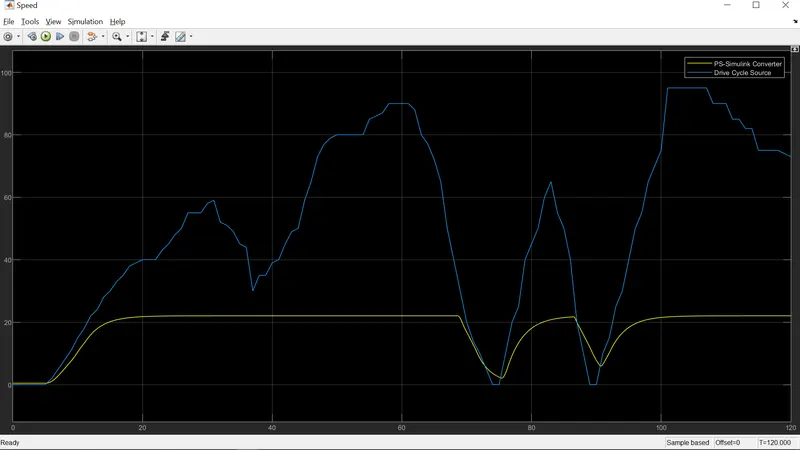
Input speed vs output speed:
The modelled rickshaw efficiently follows the input drive cycle.
B.Wide Open Throttle (WOT) (60 Seconds):
Make an excel sheet of all input and assumed data