Final Project: Design of an Electric Vehicle
Create a MATLAB model of electric car which uses a battery and a DC motor. Choose suitable blocks from Powertrain block set. Prepare a report about your model including following:
Objectives:
1. System level configurations
2. Model parameters
3. Results
4. Conclusion
Electric Vehicle (EV):
Electric vehicles are vehicles that are either partially or fully powered on electric power. Electric vehicles have low running costs as they have less moving parts for maintaining and also very environmentally friendly as they use little or no fossil fuels (petrol or diesel).There are two kinds of 'fuels' that can be used in electric cars. They're called alternating current (AC) and direct current (DC) power. The power that comes from the grid is always AC. However, batteries, like the one in your EV, can only store power as DC, hence they need converters to convert the AC power from grid and store them in battery as DC. They aslo need a converter to conver power from batter from DC to AC if powered by AC motor or DC to DC in oder to step Up or step down DC current for motor usage. An electric vehicle consist mainly of Motor and its controller, Large Battery pack to power the motor, Inverter to supply the appropriate current type and suitable voltage.
Block Diagram:
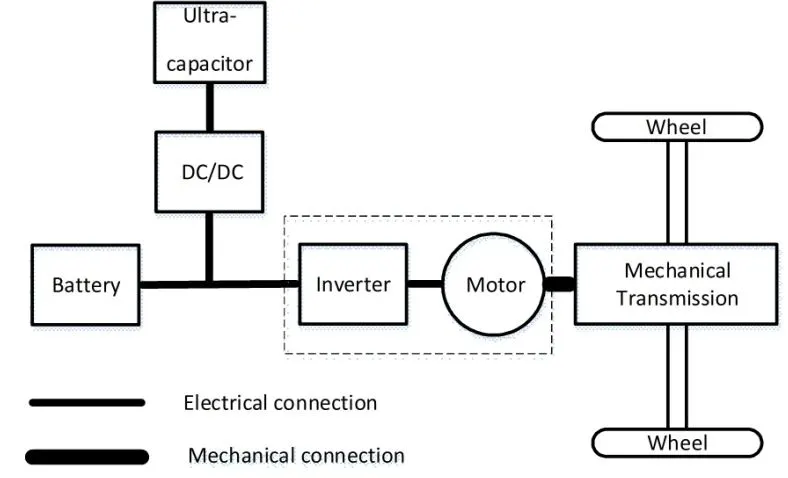
To model and electric vehicle all above component will be needed and subsystem will be made for each and every component. Our vehicle will be divide into 4 subsystem: Vehicle body, Motor and Controller, Driver Input and Battery
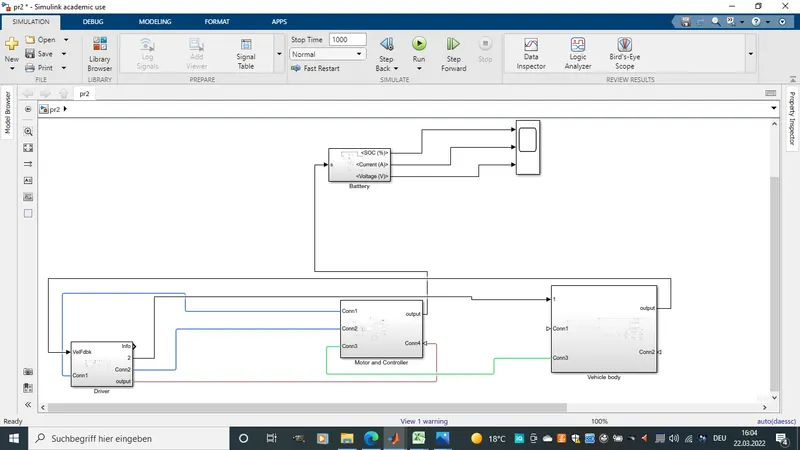
Vehicle body subsystem:
In this subsystem the framework of the vehicle is constructed and some important parameters like, air drag(wind), hill climbing etc. The wheels of the vehicle is mounted, in my model the vehicle is a rear drive. No value has been assigned for wind or hill. Then the rear whel is conected to a differential axel and a simple gear.
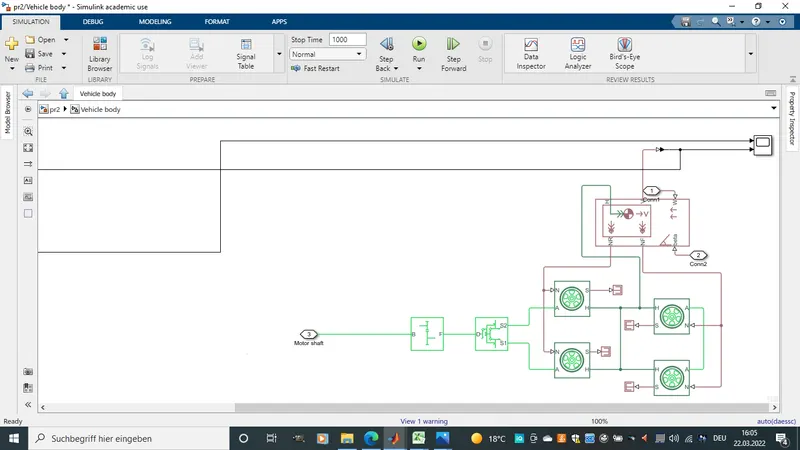
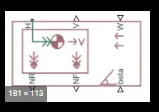
Vehicle body: The Vehicle Body block represents a two-axle vehicle body in longitudinal motion. The vehicle can have the same or a different number of wheels on each axle. NF and NR are connection to front and rear axel, The parameters for vehcle body are set as shown below.
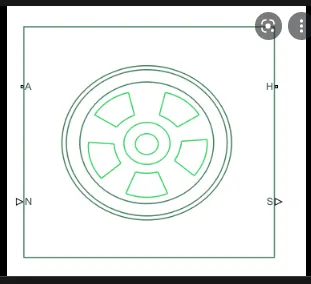
Tires: The Tire block models a tire with longitudinal behavior given by the Magic Formula, an empirical equation based on four fitting coefficients. The block can model tire dynamics under constant or variable pavement conditions. (N) is the Normal forcle acting on the tires hence connect to either NF or NR depending on if its real or front tire. (A) is the mechanical rotational hence connects to the axel or to the differential. (S) is the slip in this model the slip was ignored.(H) Mechanical translation, all for tires are connected to the mechanical translational of the vehicles body.
*Tires were set to default parameters
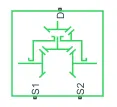
Differentials:
The Differential block represents a gear mechanism that allows the driven shafts to spin at different speeds. Differentials are common in automobiles, where they enable the various wheels to spin at different speeds while cornering. Ports D, S1, and S2 represent the longitudinal driveshaft and the sun gear shafts of the differential, respectively. Any one of the shafts can drive the other two. Together with the simple Gear block below the differentials gear of the motors rotation is passed on to the wheels.
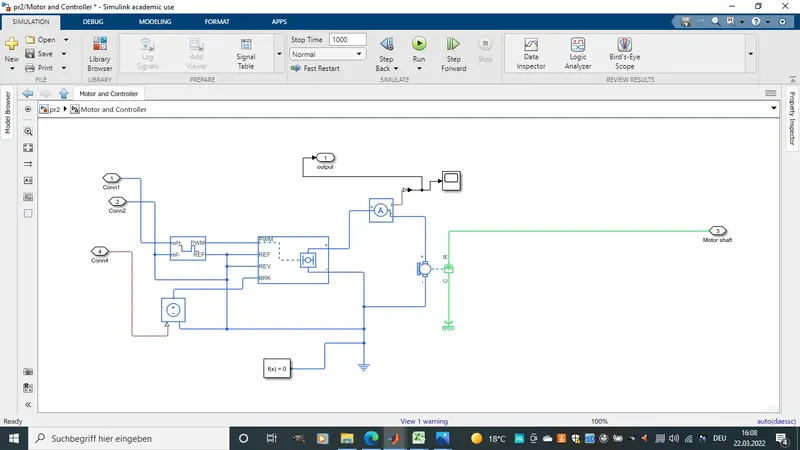
Motor and Controller Subsystem: In this subsystem the motor and its controller are modeled. A DC motor is used and H-bidge is used to control the motor by varrying voltage input and enable regenerative energy from braking or slowing down to be send back to the battery, a current sensor is connected to measure current given to the motor then they are all connected as shown in the picture. A PWM voltage control is connected to control the bidge. Motor negative terminal is connected to a mechanical reference and bidge and PWM negative terminals are connected to earth. Parameters are set as shown in thier respective blocks
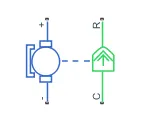
Motor: In this model this DC motor is used to used to give rotation to the wheel
- (+ and -) are the positive and negative terminals of the motor
-(R) is connected to the gear differential while C is connected to mechanical refference.
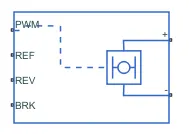
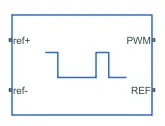
H-bridge and PWM controller: This block represents the H-bridge motor drive and the PWM controller. They could be opperated either in PWM or average.
-IN PWM mode, the motor is powered if the PWM port voltage is above the enable threshold voltage.
-In Average mode, the PWM port voltage divided by the PWM signal amplitude parameter defines the ratio of the on time to the PWM period.
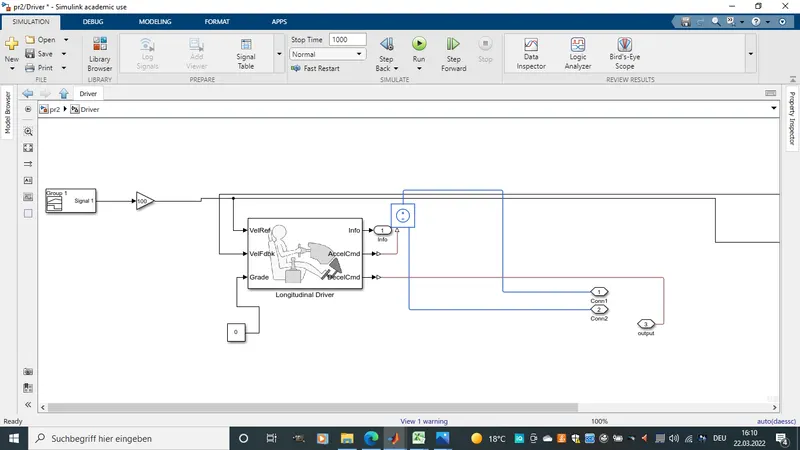
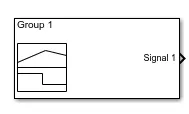
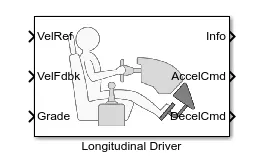
Driver Input Subsystem: This Subsystem is mainly for velocity input. A simple signal is generated with the signal builder a simple drive cycle is generated with acceleration up to 1 (100 cause its multiplied by 100). So our driver accelerates to 100km/hr and maintains the speed for few seconds then decelerates to 0. Since our drive cycle gives just the speed at which we want to drive the vehicle, a longitudinal drive which is mainly a PI block controls and compares the desired speed with the vehicle speed.
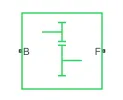
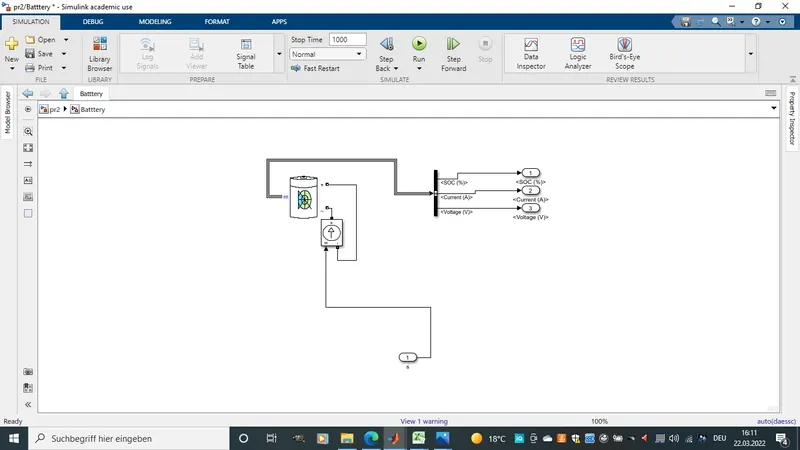
Battery Subsystem: A big battery is used to used to power the EV. It gives us the state of charge of the battery with current and voltage.
Observations:
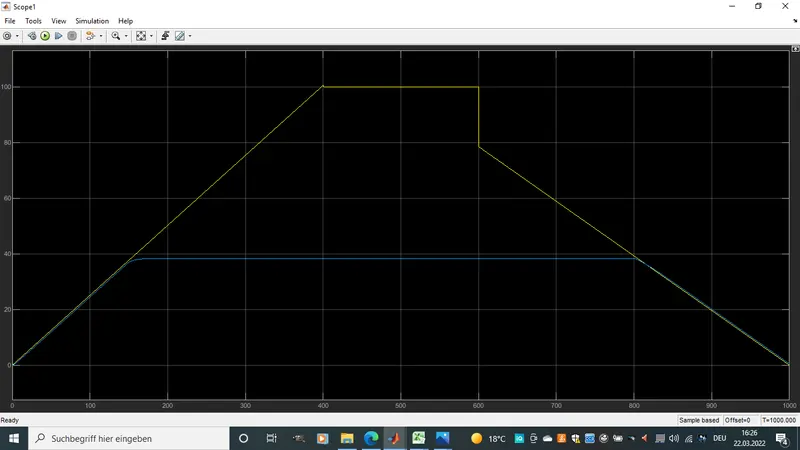
Here is a picture of desired drive cycle against vehicles drive(in blue) we observe that as from 800 sec the vehicle starts decelerating.
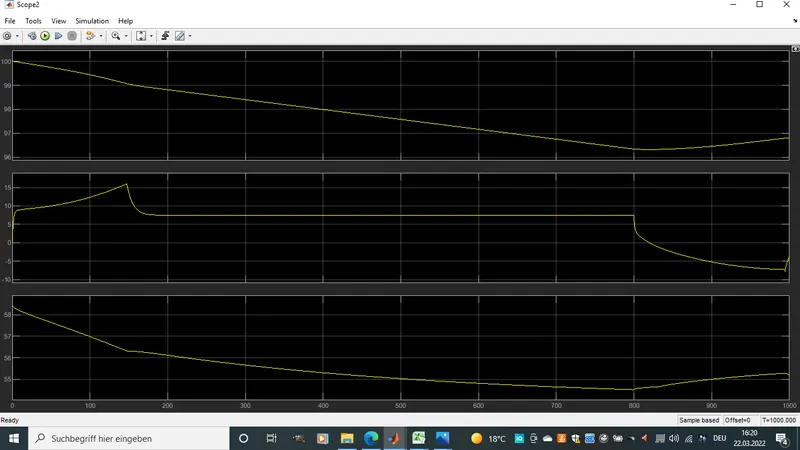
*Here is a picture of battery state, current and vltage. We see battery drops nonlinear first 200 sec the later battery starts dropping lenearly, as from 800 sec when vehicle starts decelerating, Battery starts charging up.
-We also observe that the vehicle takes much enery to accelerate in first 200sec then starts consuming modrate when vehicle atains a stady velocity.